supervisory final
0.0(0)
Studied by 5 people Call Kai
 Learn
Learn Practice Test
 Spaced Repetition
 Match
Match Flashcards
 Knowt Play
Card Sorting
1/42

Earn XP
Description and Tags
Last updated 9:56 PM on 5/7/23
Name | Mastery | Learn | Test | Matching | Spaced | Call with Kai | Chat |
|---|
No analytics yet
Send a link to your students to track their progress
43 Terms
1
New cards
Strategic planning
\
1. Planning
2. Organization
3. Coordination
4. Leading
5. Controlling
1. Planning
2. Organization
3. Coordination
4. Leading
5. Controlling
2
New cards
Smart goals
S- specific—-- MVV (Mission, vision, value)
M- measurable—-- surveys ##, data analysis {qualitative (narrative) and quantitative (numbers)}
A- achievable/ assessment based—-- the goal is an achievable goal for the HCO
R- realistic—--Developing a new product line that is within the company's budget and resources & Setting realistic sales targets based on market trends and the company's current performance
T- timeline—-- Gnatt charts, pert charts{calandars}
\
M- measurable—-- surveys ##, data analysis {qualitative (narrative) and quantitative (numbers)}
A- achievable/ assessment based—-- the goal is an achievable goal for the HCO
R- realistic—--Developing a new product line that is within the company's budget and resources & Setting realistic sales targets based on market trends and the company's current performance
T- timeline—-- Gnatt charts, pert charts{calandars}
\
3
New cards
Scientific Management Theory
TAYLOR- focuses on breaking down tasks into smaller components and optimizing each component to its fullest potential
\
\
4
New cards
Bureaucratic theory
emphasizes the importance of rules, procedures, and hierarchy in organizations.
5
New cards
EX:
Scientific Management Theory:
\
Scientific Management Theory:
\
assembly line production in manufacturing industries, where each worker performs a specific task repeatedly to maximize efficiency, and time-motion studies are used in healthcare to analyze and improve patient care processes.
\
\
6
New cards
Bureaucratic Theory EX:
government agencies, where strict rules and procedures are in place to ensure consistent decision-making and impartiality, and large corporations, where hierarchical structures and clear lines of authority are established to maintain order and control.
\
\
7
New cards
Leading-Herzberg’s two-factor theory
\
* Job satisfaction and dissatisfaction are caused by different factors.
* Job satisfaction is caused by intrinsic factors.
* Job dissatisfaction is caused by extrinsic factors.
* Job satisfaction and dissatisfaction are caused by different factors.
* Job satisfaction is caused by intrinsic factors.
* Job dissatisfaction is caused by extrinsic factors.
8
New cards
intrinsic factors
(e.g. achievement, recognition, and meaningful work), and job dissatisfaction is caused by extrinsic factors (e.g. salary, job security, and working conditions).
9
New cards
Maslow’s theory-
\
\
\
* Human needs are arranged in a hierarchy.
* Lower-level needs must be met before higher-level needs become relevant.
* Human needs are arranged in a hierarchy.
* Lower-level needs must be met before higher-level needs become relevant.
10
New cards
All Motivation theories-
\
* Motivation is a key driver of human behavior.
* Understanding what motivates individuals is critical for organizations to improve productivity and employee satisfaction.
* Motivation is a key driver of human behavior.
* Understanding what motivates individuals is critical for organizations to improve productivity and employee satisfaction.
11
New cards
Situational theory-
\
* Effective leadership depends on the situation.
* Different situations require different leadership styles.
* Effective leadership depends on the situation.
* Different situations require different leadership styles.
12
New cards
Theory X-
assumes employees are lazy and need to be coerced or threatened to work.
13
New cards
Theory Y-
assumes employees are motivated and enjoy their work.
14
New cards
Behavior theory-
\
* Behavior is shaped by reinforcement and punishment.
* Positive reinforcement of desired behaviors is more effective than punishment.
* INTRINSIC AND EXTRINSIC MOTIVATION
* Behavior is shaped by reinforcement and punishment.
* Positive reinforcement of desired behaviors is more effective than punishment.
* INTRINSIC AND EXTRINSIC MOTIVATION
15
New cards
Reinforcement theory-
\
* Behavior is shaped by __**consequences.**__
* Positive reinforcement of desired behaviors is more effective than punishment.
* Behavior is shaped by __**consequences.**__
* Positive reinforcement of desired behaviors is more effective than punishment.
16
New cards
mechanistic -
\
* a hierarchical and rigid structure that emphasizes control and efficiency, with clear chains of command and decision-making authority.
* a hierarchical and rigid structure that emphasizes control and efficiency, with clear chains of command and decision-making authority.
17
New cards
Functional -
\
a hierarchical structure where employees are grouped based on their functions, such as marketing, finance, and human resources.
a hierarchical structure where employees are grouped based on their functions, such as marketing, finance, and human resources.
18
New cards
Matrix
\
* ______ organizational structure is a hybrid structure where employees are grouped by both function and product, allowing for flexibility and collaboration.
* ______ organizational structure is a hybrid structure where employees are grouped by both function and product, allowing for flexibility and collaboration.
19
New cards
Organic
\
* \*best fit for post covid world bc its most flexible\*
* open too change
* \*best fit for post covid world bc its most flexible\*
* open too change
20
New cards
Top-down control
\
* a management style where decision-making authority is held by a small group of executives who dictate the actions of the lower levels of the organization.
* a management style where decision-making authority is held by a small group of executives who dictate the actions of the lower levels of the organization.
21
New cards
centralized decision-making
\
* a structure where decision-making authority is held by a central group or individual, with little input from lower levels of the organization
* a structure where decision-making authority is held by a central group or individual, with little input from lower levels of the organization
22
New cards
\
Emotional intelligence: 4 skills { SA-SM-SA-RM}
Emotional intelligence: 4 skills { SA-SM-SA-RM}
1. **Self-awareness**: Ability to perceive your emotions accurately as they happen
\
2\. **Self-management:** Ability to use emotional awareness for self-control
\
3\. **Social awareness:** Ability to understand people’s emotions and how people react to
you
\
4\. **Relationship management:** Ability to use social skills to relate to others to influence
them
\
23
New cards
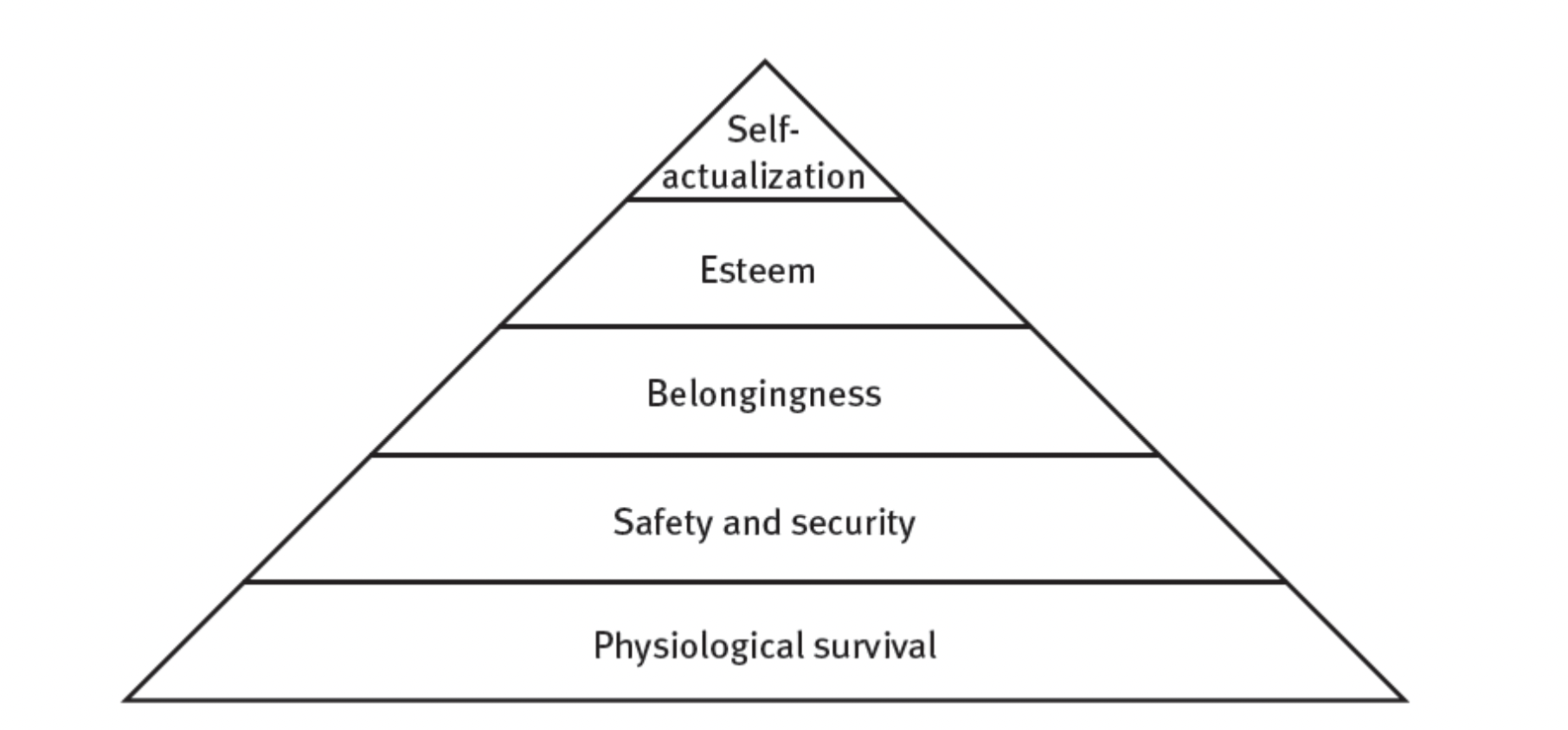
Maslows hierarchy of needs
Self- actualization, esteem, belongingness, safety & security, physiological survivas \**SAEBSSPS*\*
24
New cards
Three-step control method
\
1. Setting performance standards.
2. Monitoring performance.
3. Taking corrective action.
1. Setting performance standards.
2. Monitoring performance.
3. Taking corrective action.
25
New cards
Six Sigma
a quality management approach that aims to eliminate defects and reduce variability in processes. It was developed by Motorola and is now widely used to improve efficiency and customer satisfaction.
The process involves **defining, measuring, analyzing, improving, and controlling to achieve high-quality results**. It can be applied to any industry, including manufacturing, service, and healthcare.
The process involves **defining, measuring, analyzing, improving, and controlling to achieve high-quality results**. It can be applied to any industry, including manufacturing, service, and healthcare.
26
New cards
Lean methods
Control charts - quality control method
QUANTITATIVE
○ WASTE
○ VARIANCE {DEFECTS}
○ Control charts are a tool used in lean methods to monitor and control process performance. They are used to identify and address common cause variation in a process, which is the variation that is inherent in the process and can be managed through process improvement efforts.
\*REMOVAL OF WASTE\*
\
QUANTITATIVE
○ WASTE
○ VARIANCE {DEFECTS}
○ Control charts are a tool used in lean methods to monitor and control process performance. They are used to identify and address common cause variation in a process, which is the variation that is inherent in the process and can be managed through process improvement efforts.
\*REMOVAL OF WASTE\*
\
27
New cards
Fishbone diagrams
(cause/effect chart) improvement
○ Sometimes called ishikawa diagram
○ Graphic depiction of POSSIBLE causes of a problem
○ NOT root cause diagram, only systems.
\
○ Sometimes called ishikawa diagram
○ Graphic depiction of POSSIBLE causes of a problem
○ NOT root cause diagram, only systems.
\
28
New cards
Root-cause analysis- improvement
\
\
○ Statistical method for determining root cause of a problem
○ EX: The vital few, **80/20 rule**. Helps determine priorities for
solving a problem.
\
○ EX: The vital few, **80/20 rule**. Helps determine priorities for
solving a problem.
\
29
New cards
Decision-making and solving problems-approaches and methods, outcome measure in decision-making
\
\
\
\*OUTCOME MEASURE-REDUCING CLINICAL OUTCOMES {getting rid of the problem for better measure}
\
\*OUTCOME MEASURE-REDUCING CLINICAL OUTCOMES {getting rid of the problem for better measure}
\
30
New cards
Two Types of Decisions: __**PROGRAMMED**__
\
\
Non-ambiguous, routine, procedural
Example: how to provide care to patients without insurance?
Example: how to provide care to patients without insurance?
31
New cards
Two Types of Decisions: __**NONPROGRAMMED**__
Ambiguous situations, new problems, nonroutine
Example: how to provide care in a novel pandemic?
As managers in HCOs you are more likely to encounter nonprogrammed decisions.
\
Example: how to provide care in a novel pandemic?
As managers in HCOs you are more likely to encounter nonprogrammed decisions.
\
32
New cards
methods for making nonprogrammed decisions are:
\
\
\
1\. Rational…follows a stepwise progression
2\. Satisficing…not the best alternative but one “will do.” May be used in a crisis, chaotic situations, when time is critical, etc.
3\. Intuition…experience does matter!
4\. Incremental…putting the puzzle together piece by piece.
5\. Evidence-based…what does experiential data tell us?
1\. Rational…follows a stepwise progression
2\. Satisficing…not the best alternative but one “will do.” May be used in a crisis, chaotic situations, when time is critical, etc.
3\. Intuition…experience does matter!
4\. Incremental…putting the puzzle together piece by piece.
5\. Evidence-based…what does experiential data tell us?
33
New cards
Some barriers to effective decision-making are:
\
\
\
1. **Not separating the problem from the symptom**. Don’t solve the symptom.
2. **Letting your ego drive the decision**…don’t think you know more than you do.
3. **Not taking the time.**
4. **Having an inappropriate leadership style**…situational does work!
5\. **Groupthink**…conformity at the expense of new ideas.
6\. **Biases and personal agendas**…self -awareness & suspension.
\
1. **Not separating the problem from the symptom**. Don’t solve the symptom.
2. **Letting your ego drive the decision**…don’t think you know more than you do.
3. **Not taking the time.**
4. **Having an inappropriate leadership style**…situational does work!
5\. **Groupthink**…conformity at the expense of new ideas.
6\. **Biases and personal agendas**…self -awareness & suspension.
\
34
New cards
Lewin's 3-Step Process:
\
\
1. **Unfreeze:** The first step is to recognize the need for change and create a sense of urgency.
2. **Change:** The second step is to implement the change.
3. **Refreeze:** The final step is to reinforce the change and make it permanent.
35
New cards
Force Field Analysis:
\
* Change is the result of the interaction between driving forces (factors that promote change) and restraining forces (factors that oppose change).
* To implement change successfully, it is necessary to strengthen the driving forces and weaken the restraining forces.
* Change is the result of the interaction between driving forces (factors that promote change) and restraining forces (factors that oppose change).
* To implement change successfully, it is necessary to strengthen the driving forces and weaken the restraining forces.
36
New cards
In managing change in healthcare, a combination of Lewin's 3-Step Process and Force Field Analysis may be most effective, including:
\
\
\
* Using Lewin's 3-Step Process to create a sense of urgency, implement the change, and reinforce the change to make it permanent.
* Using Force Field Analysis to identify driving and restraining forces, and to develop strategies to strengthen driving forces and weaken restraining forces.
* A tailored approach that takes into account the unique needs and circumstances of the organization may be most effective in managing change in healthcare.
* Using Lewin's 3-Step Process to create a sense of urgency, implement the change, and reinforce the change to make it permanent.
* Using Force Field Analysis to identify driving and restraining forces, and to develop strategies to strengthen driving forces and weaken restraining forces.
* A tailored approach that takes into account the unique needs and circumstances of the organization may be most effective in managing change in healthcare.
37
New cards
Kinds of budget: “MOCC”
\
\
**Operating budget:** A budget that covers day-to-day expenses and revenues for a specific period, typically one year.
**Capital budget:** A budget that covers long-term investments in fixed assets such as property, plant, and equipment.
**Cash budget:** A budget that projects cash inflows and outflows for a specific period, typically one year.
**Master budget:** A comprehensive budget that includes all types of budgets for the organization.
**Capital budget:** A budget that covers long-term investments in fixed assets such as property, plant, and equipment.
**Cash budget:** A budget that projects cash inflows and outflows for a specific period, typically one year.
**Master budget:** A comprehensive budget that includes all types of budgets for the organization.
38
New cards
Conventional approach to budgeting:
\
* involves incremental adjustments to the previous year's budget.
* It typically relies on historical data and does not take into account changes in the external environment or new initiatives.
* involves incremental adjustments to the previous year's budget.
* It typically relies on historical data and does not take into account changes in the external environment or new initiatives.
39
New cards
Operating budget:
\
* An operating budget is a detailed plan of expected income and expenses for a specific period, typically one year.
* It includes revenue and expenses related to day-to-day operations such as salaries, supplies, and utilities.
* An operating budget is a detailed plan of expected income and expenses for a specific period, typically one year.
* It includes revenue and expenses related to day-to-day operations such as salaries, supplies, and utilities.
40
New cards
Budget variance:
\
* the difference between actual and budgeted amounts.
* A favorable budget variance occurs when actual results exceed budgeted results.
* An unfavorable budget variance occurs when actual results fall short of budgeted results.
* the difference between actual and budgeted amounts.
* A favorable budget variance occurs when actual results exceed budgeted results.
* An unfavorable budget variance occurs when actual results fall short of budgeted results.
41
New cards
In healthcare, a combination of budgeting approaches may be most effective, including:
\
\
\
* Developing a comprehensive master budget that includes operating and capital budgets, as well as a cash budget to project cash flow.
\
* Incorporating a flexible budget that can adjust for changes in the external environment or new initiatives.
\
* Monitoring budget variance regularly to identify areas of concern and to make necessary adjustments.
* Developing a comprehensive master budget that includes operating and capital budgets, as well as a cash budget to project cash flow.
\
* Incorporating a flexible budget that can adjust for changes in the external environment or new initiatives.
\
* Monitoring budget variance regularly to identify areas of concern and to make necessary adjustments.
42
New cards
Extrinsic motivators
**external factors that drive behavior.**
EX:
In a management setting, rewards such as **bonuses or promotions can be used to encourage employees to work harder and achieve better results.**
For instance, providing a bonus to the sales team for meeting or exceeding their targets can motivate them to work harder and increase their performance.
EX:
In a management setting, rewards such as **bonuses or promotions can be used to encourage employees to work harder and achieve better results.**
For instance, providing a bonus to the sales team for meeting or exceeding their targets can motivate them to work harder and increase their performance.
43
New cards
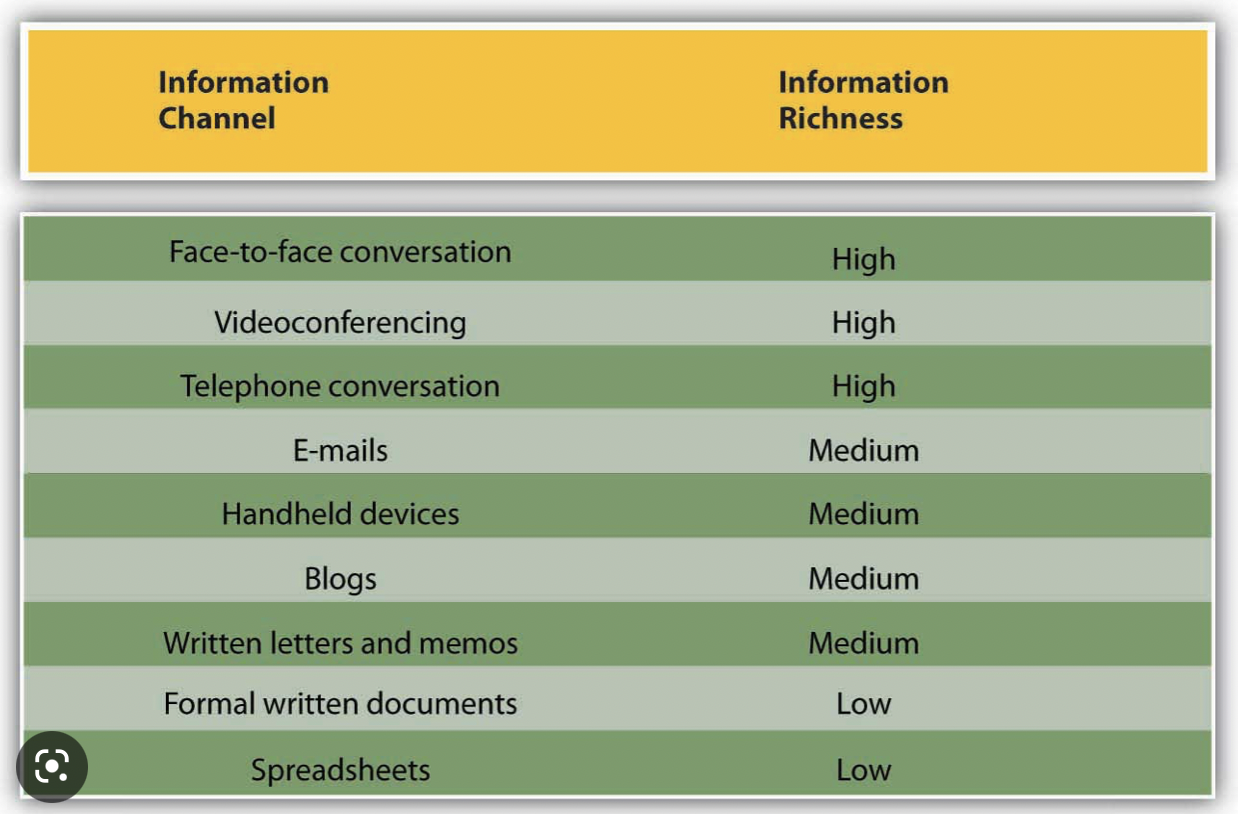
TYPES OF COMMUNICATION CHANNELS & RICHNESS