Lecture 3.3: Regulation of Metabolism
 Call Kai
 Learn
Learn Practice Test
 Spaced Repetition
 Match
Match Flashcards
 Knowt Play
1/114

There's no tags or description
Looks like no tags are added yet.
Name | Mastery | Learn | Test | Matching | Spaced | Call with Kai | Chat |
|---|
No analytics yet
Send a link to your students to track their progress
115 Terms
Which of the following are true of gluconeogenesis? Select all that apply.
a) It is a pathway with 10 reactions.
b) It occurs mainly in the liver & to a lesser extent in the kidneys.
c) It takes place in brain & muscles where glycogen is stored.
d) It is the reverse of glycolysis.
e) It is used to make glucose when dietary glucose and glycogen reserves are low.
b) It occurs mainly in the liver & to a lesser extent in the kidneys.
e) It is used to make glucose when dietary glucose and glycogen reserves are low.
How many steps in gluconeogenesis
11 steps
(T/F) Gluconeogenesis is a revserse reaciton of glycolysis
False — gluconeogenesis shared similar reactions but is not a direct reversal of glycolysis
What enzymes are shared between both glycolysis and gluconeoenesis
Enolase, Phosphoglycerate mutase, Phosphoglycerate kinase, G3P dehydrogenase, Triose phosphate isomerase, Aldolase
How do you convert Pyruvate to Phosphoenolpyruvate
Break the reaction into 2 separate exergonic steps
1) Pyruvate is converted into Oxaloacetate by pyruvate carboxylase coupled with ATP hydrolysis and the cofactor Biotin
2) Oxaloacetate is converted to Phosphoenolpyruvate (PEP) by Phosphoenolpyruvate carboxykinase and GTP
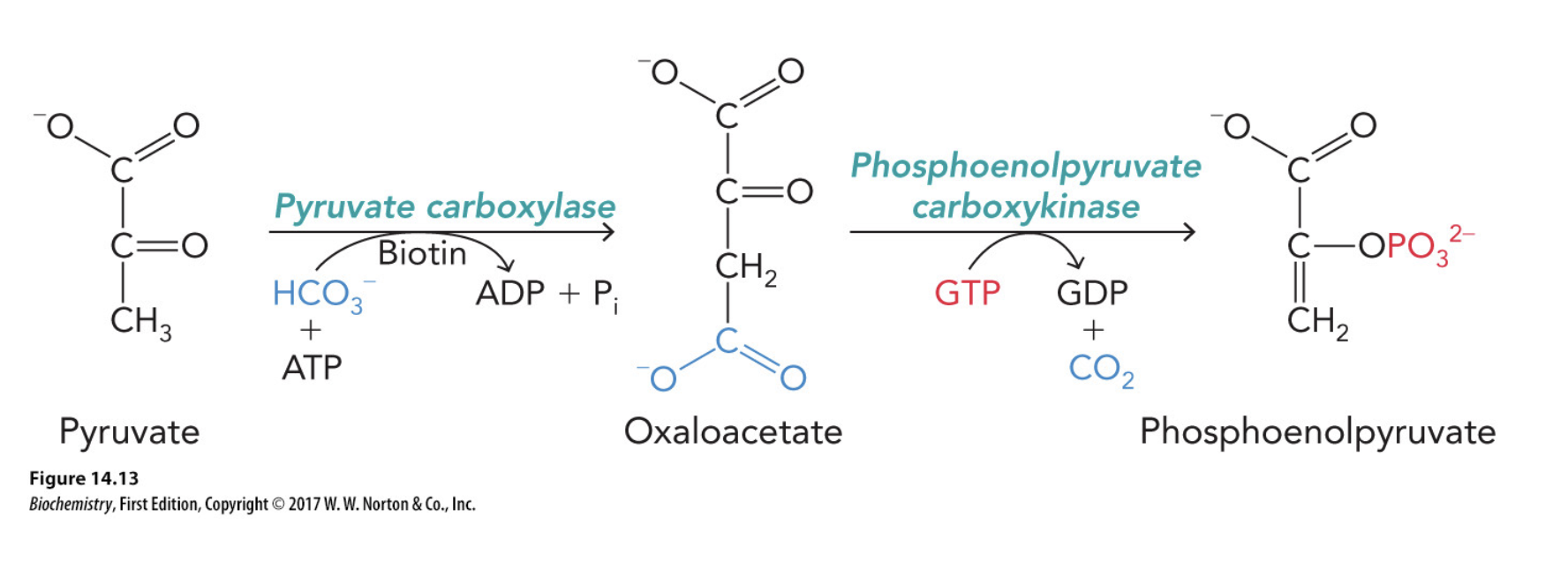
Once PEP is created what are the following steps of gluconeogenesis
Once PEP is created the 6 shared reversal steps begin to eventually create G3P
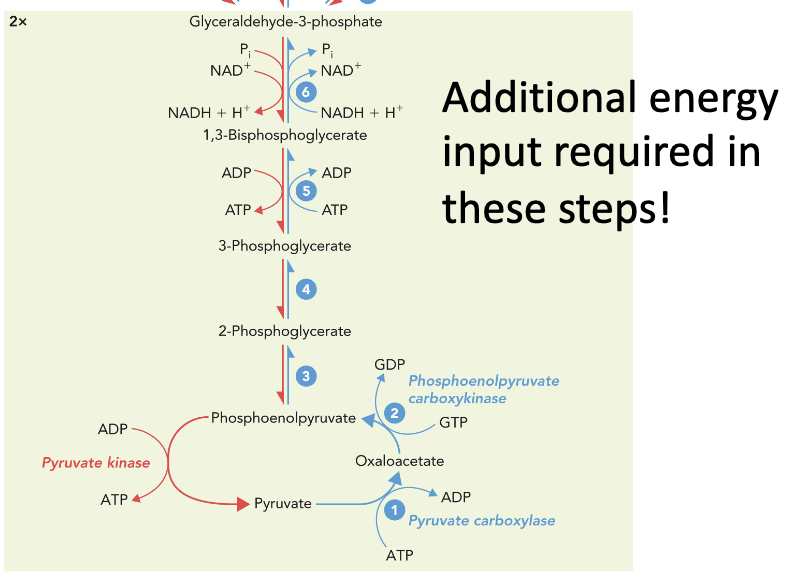
How many Phosphoenolpyruvate are created in the 2 steps of gluconeogenesis
2 — one from each pyruvate
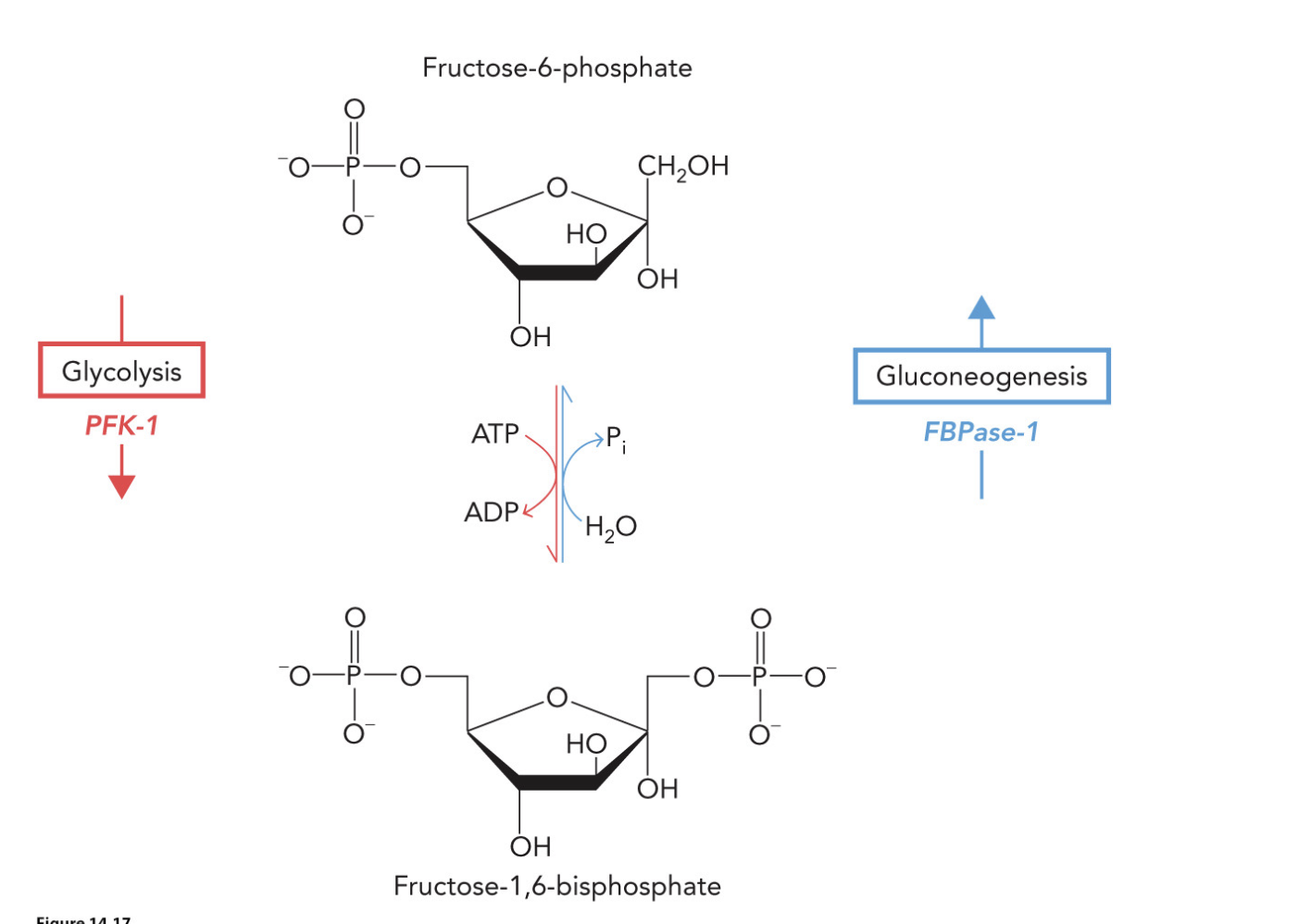
What enzymes reverses the 3rd step of glycolysis
FBPase-1
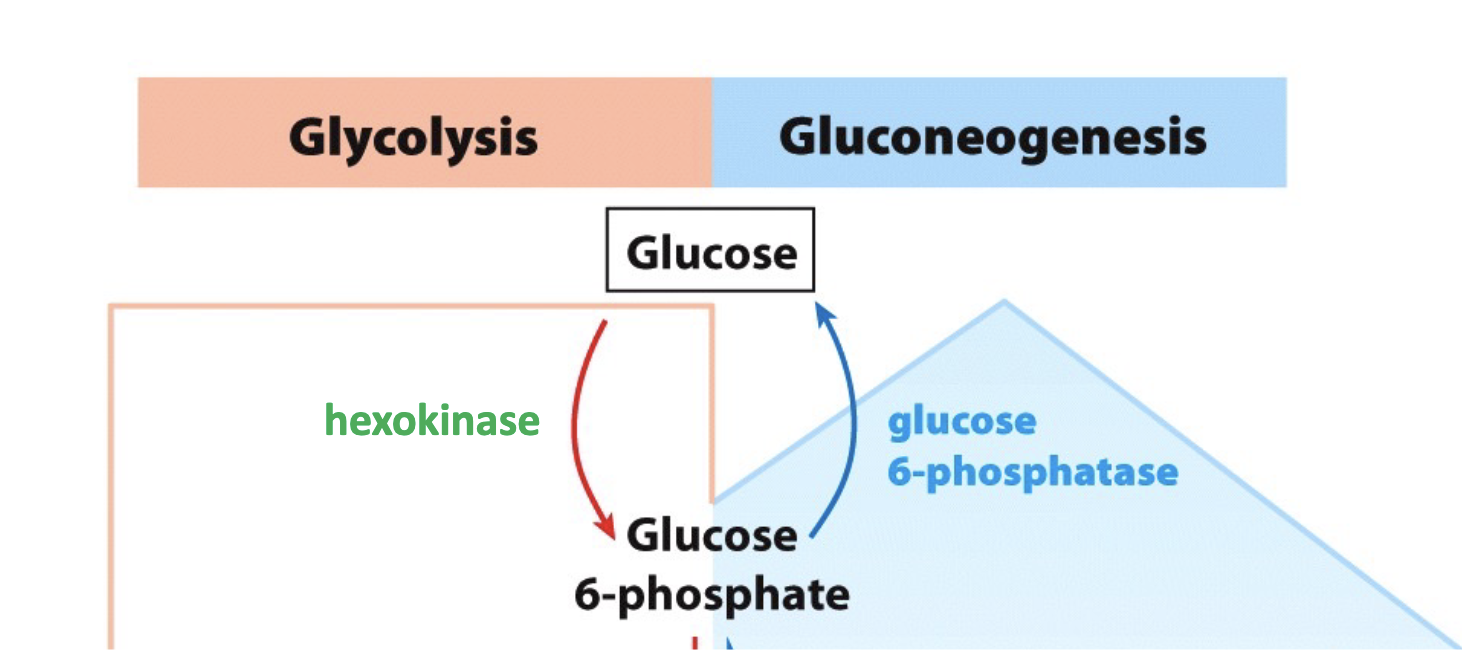
What enzyme reverses step 1 of glycolysis
Glucose-6-phosphatase
What is the full reaction for gluconeogenesis
2 pyruvate + 4 ATP + 2 GTP + 2 NADH + 2 H+ + 4 H2O —> Glucose + 4 ADP + 2 GDP + 6 P + 2 NAD+
When is gluconeogenesis triggered
During starvation or vigorous exercise
What is the only source of ATP for the brain, nervous system, and RBC
Glucose
Which of the following enzymes are used in both glycolysis and gluconeogenesis? Select all that apply.
a) Hexokinase
b) Enolase
c) Phosphoglycerate kinase
d) Triose phosphate isomerase
e) Pyruvate kinase
b) Enolase
c) Phosphoglycerate kinase
d) Triose phosphate isomerase
In the gluconeogenesis pathway, the enzyme glucose-6-phosphatase reverses which step in glycolysis?
Select an answer and submit. For keyboard navigation, use the up/down arrow keys to select an answer.
a) the formation of glucose
b) the reaction catalyzed by pyruvate dehydrogenase
c) the reaction catalyzed by hexokinase
d) the formation of fructose-1,6-bisphosphate
c) the reaction catalyzed by hexokinase
Which enzyme in the glycolysis pathway catalyzes a reaction that requires two enzymes to reverse in the gluconeogenesis pathway?
a) pyruvate kinase
b) phosphofructokinase I
c) pyruvate dehydrogenase
d) glycogen phosphorylase
a) pyruvate kinase
Which of the following are true of liver tissue compared to other tissues? Select all that apply.
a) mostly a catabolic tissue that burns glucose and fats for energy
b) releases stored glucose to the rest of the body when needed.
c) maintains stable blood glucose levels
d) stores glucose as glycogen
e) uses gluconeogenesis to make glucose if glycogen stores are depleted.
f) has limited glycogen storage capacity
b) releases stored glucose to the rest of the body when needed.
c) maintains stable blood glucose levels
d) stores glucose as glycogen
e) uses gluconeogenesis to make glucose if glycogen stores are depleted.
The enzyme Glucose 6-phosphatase is mainly found in:
a) Skin
b) Liver
c) Muscle
d) Brain
e) Red Blood Cells
b) Liver — Glucose-6-phosphatase is the enzyme that catalyzes the final step of gluconeogenesis. converting glucose-6-phosphate into free glucose, which can then be released into the bloodstream. Which is exactly why these are the only organs capable of releasing free glucose into the blood to help maintain blood glucose levels.
Which steps of glycolysis are regulated in muscle cells?
Step 1, 3 & 10
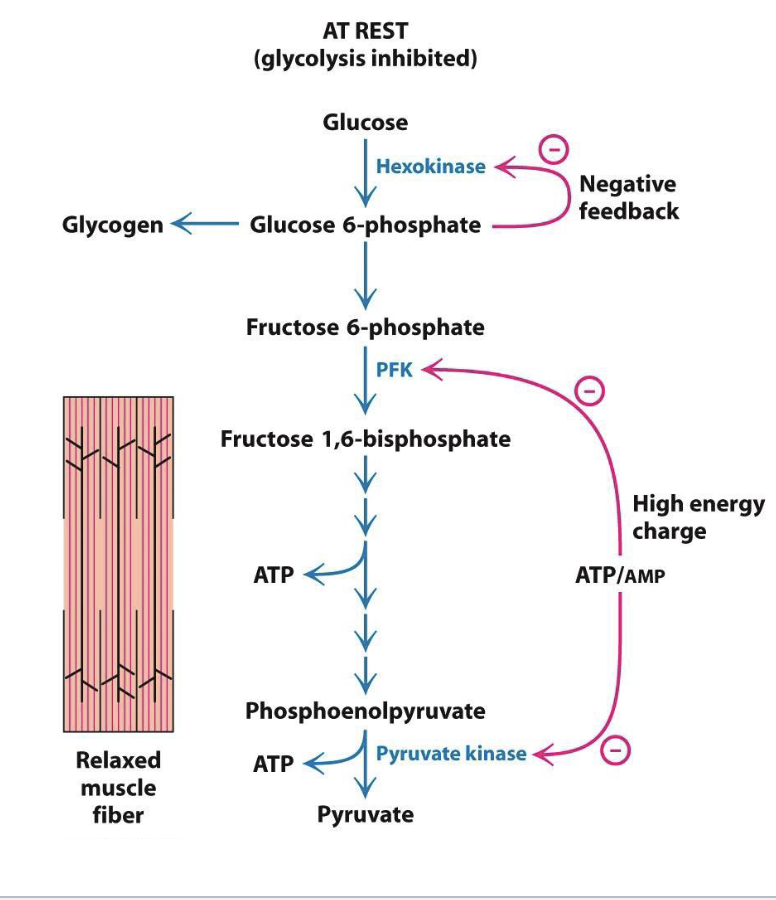
Hexokinase is regulated by:
a) negative allosteric regulation by ATP
b) negative allosteric regulation by glucose-6-phosphate
c) negative allosteric regulation by fructose-6-phosphate
d) positive allosteric regulation by ATP
e) positive allosteric regulation by glucose-6-phosphate
b) negative allosteric regulation by glucose-6-phosphate
Which glycolytic intermediate serves at the starting material for glycogen synthesis?
Select an answer and submit. For keyboard navigation, use the up/down arrow keys to select an answer.
a) glucose
b) glucose 6-phosphate
c) fructose 6-phosphate
d) fructose 1,6-bisphosphate
e) dihydroxyacetone phosphate
b) glucose 6-phosphate
What molecule acts as an allosteric activator of Phosphofructokinase 1?
a) ATP
b) G6P
c) F6P
d) ADP
e) NADH
d) ADP
Which binding site on PFK has a higher affinity for ATP?
Select an answer and submit. For keyboard navigation, use the up/down arrow keys to select an answer.
a) Active Site
b) Allosteric Site
a) Active Site — PFK-1 has two distinct binding sites for ATP:
Active (catalytic) site — This is where ATP functions as a substrate. This site has a higher affinity for ATP, meaning it's saturated even at relatively low ATP concentrations.
Allosteric (regulatory) site — This is a separate, lower-affinity site. ATP only binds here in significant amounts when its concentration is high. When ATP binds here, it induces a conformational change that inhibits enzyme activity by lowering PFK-1's affinity for its substrate
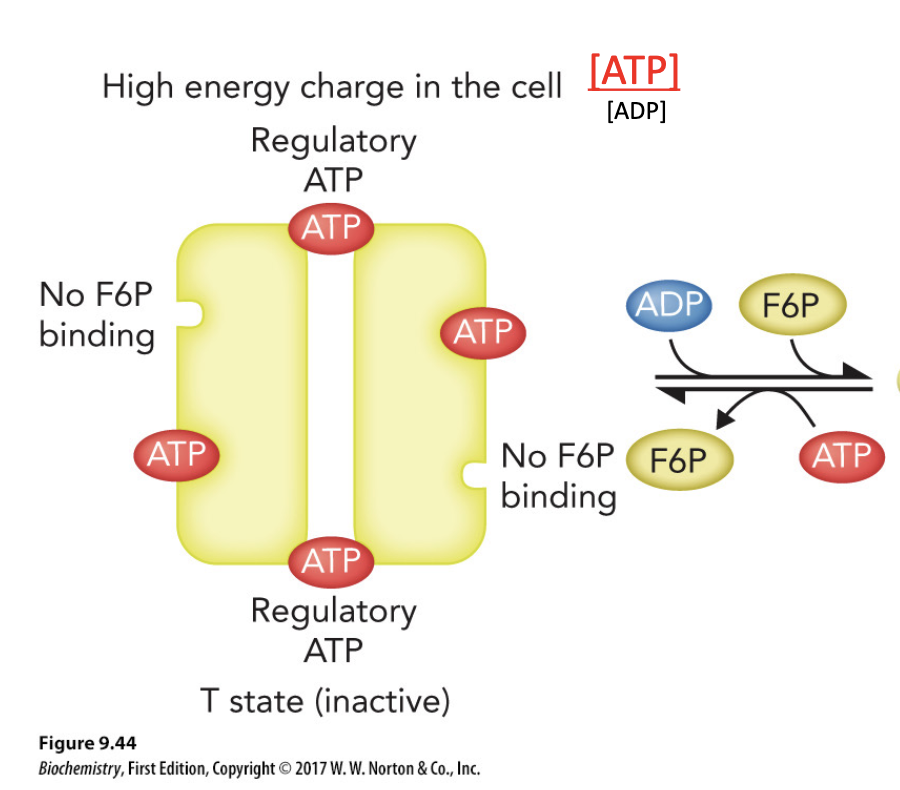
High concentrations of ATP cause the PFK enzyme activity curve to shift ________.
a) Left
b) Right
b) Right
Which of the following molecules activates pyruvate kinase?
Select an answer and submit. For keyboard navigation, use the up/down arrow keys to select an answer.
a) F-1,6-BP
b) ATP
c) Acetyl-CoA
d) long-chain fatty acids
e) NADH
a) F-1,6-BP
What does skeletal muscle burn for energy
Glucose and Fat
Skeletal muscle is mainly a _____ (catabolic/anabolic) tissue
Catabolic
(T/F) Skeletal muscle can perform gluconeogenesis
False
What does the liver do when glycogen storages are too high
liver performs glycolysis to create pyruvate which eventuall can become a fatty acid (fat)
When blood glucose levels run low the liver performs _______
gluconeogenesis
In muscle, regulation of glycolysis depends on _____ _______
energy charge
In muscle, at rest glycolysis is ______
inhibited
In muscle, during exercise glycolysis is ______
Active
What is the negative feedback inhibitor for hexokinase
Glucose-6-P
What is the negative inhibitor for PFK and Pyruvate kinase
ATP / AMP
What is the activator for PFK
ATP / AMP
What is the activator for Pyruvate kinase
Fructose 1,6-BP
Hexokinase is _______ inhibited by ________
allosterically; glucose-6-phosphate
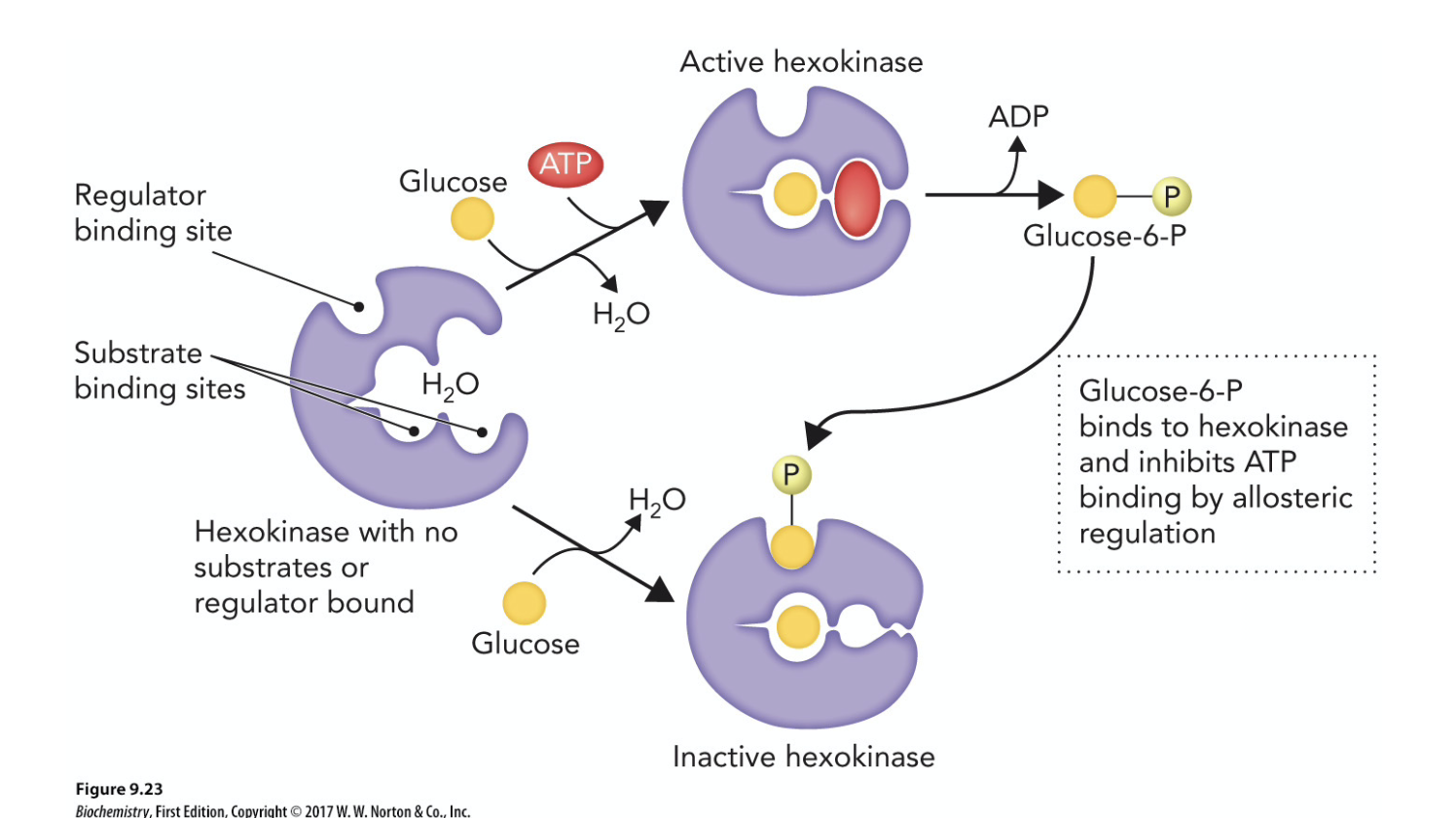
What happens when glycogen stores in the muscle become fully saturated
Once muscle storages are full excess glucose is sent to the liver
When G6P levels are too high _____ is inhibited
Hexokinase
PFK is shut off when _____ are too high
Fructose 6-phosphate
When G6P is elevated but glycogen stores are not full what occurs
G6P is shunted to another pathway to create glycogen to me stored for later use
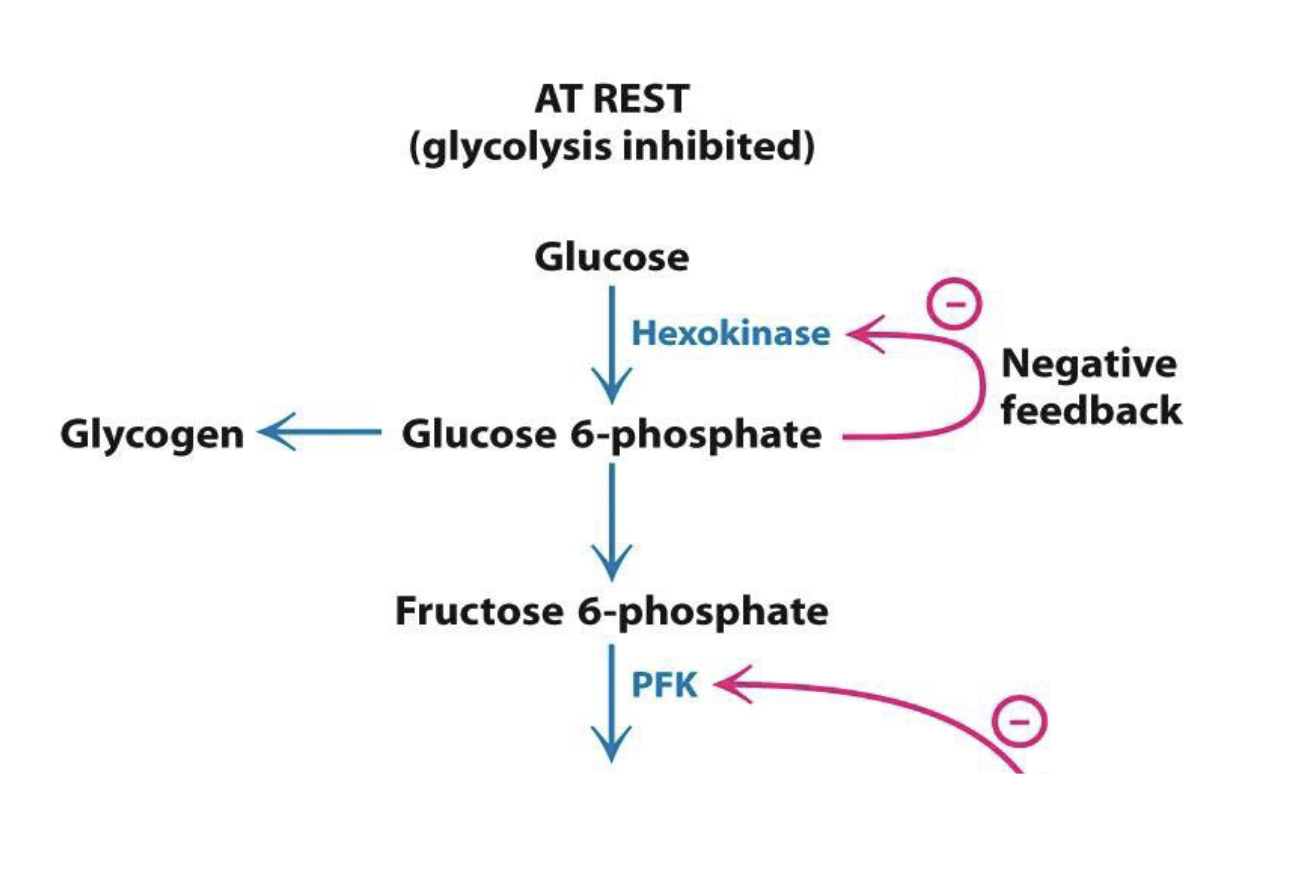
What is the true “committed step” of glycolysis
Step 3 — F6P —> F16BP catalyzed by PFK
PFK is a _____ with _____ binding sites that bind ____ or _____
PFK is a tetramer with allosteric binding site thats bind ATP or ADP
At high energy _____ is an _____ for PFK
At high energy ATP is an inhibitor for PFK
At low energy _____ is an _____ for PFK
At low energy ADP is an activator for PFK
If ATP > ADP then ____ PFK activity
Decreased
If ATP < ADP then ____ PFK activity
Increased
When [ATP] is low then PFK-1 vs F6P graph shifts _____ favoring ____ state
Left; R-state
When [ATP] is high then PFK-1 vs F6P graph shifts _____ favoring ____ state
Right; T-state
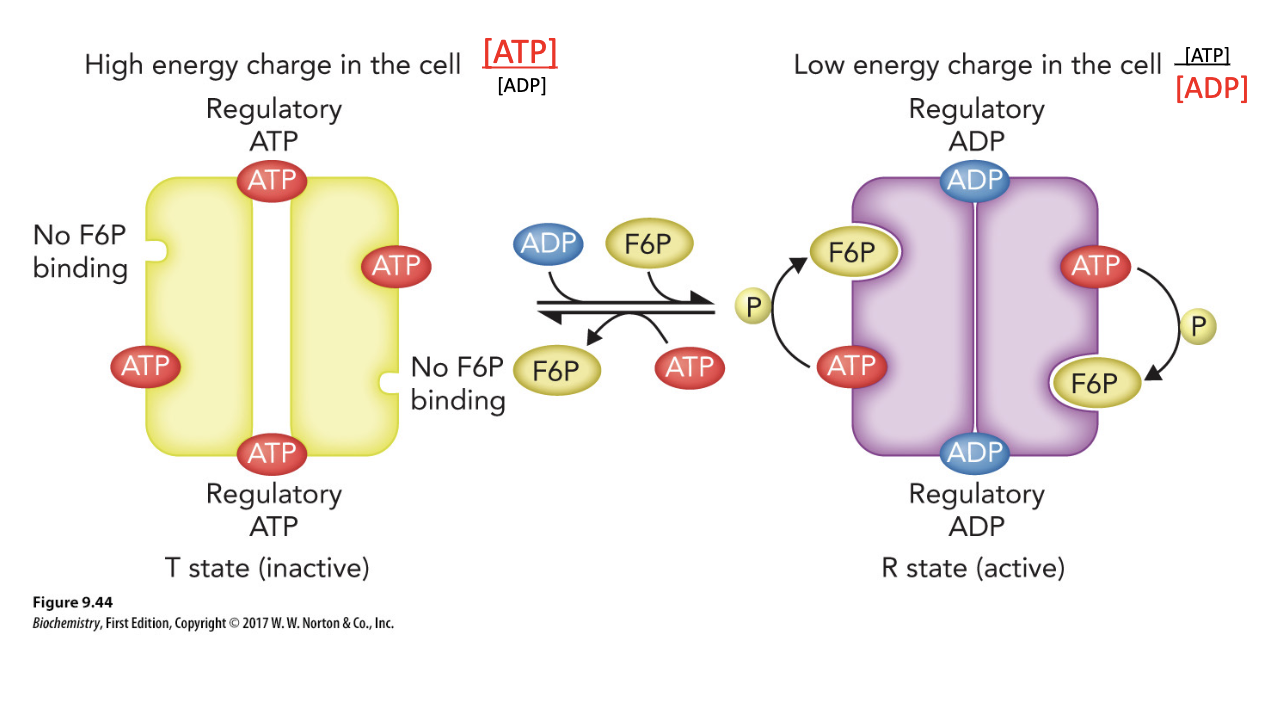
Explain the mechanism for ATP inhibition of PFK
When ATP binds the allosteric site, it triggers a conformational change in the enzyme — shifting it from the high-affinity R-state to the low-affinity T-state. In the T state, the enzyme's active site has much lower affinity for F6P, so the reaction slows down dramatically even though substrate is present.
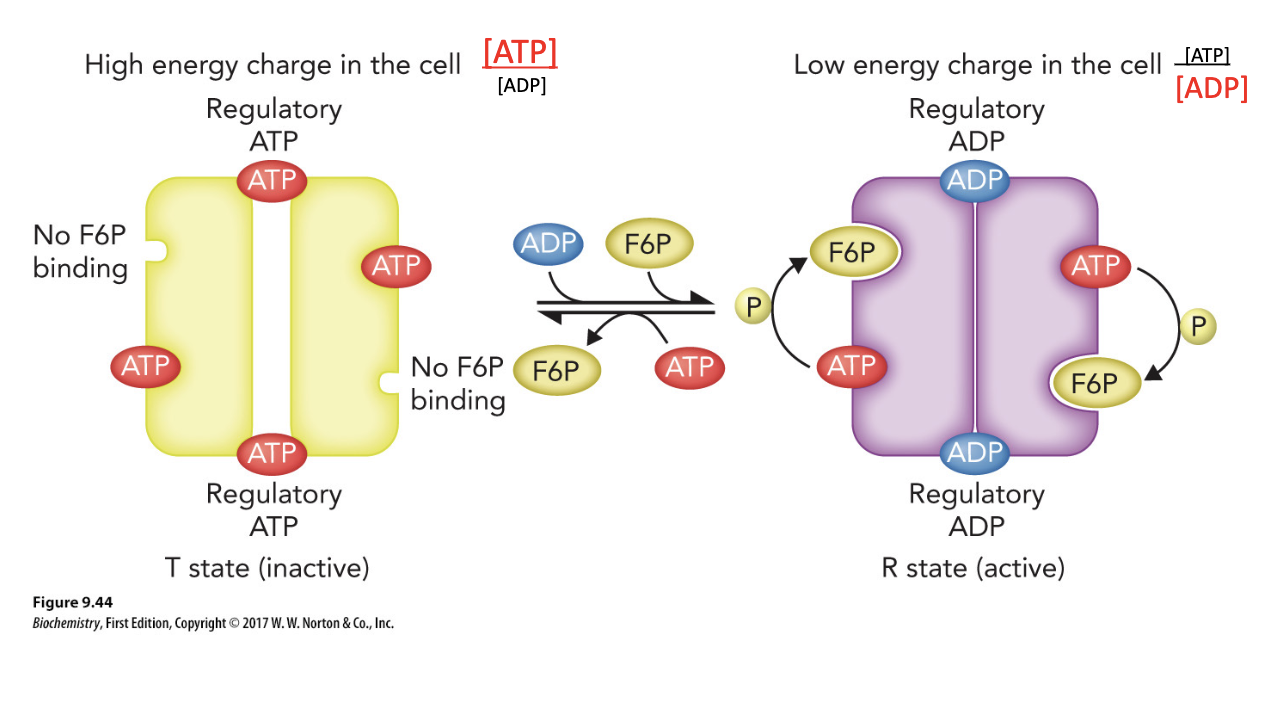
Explain the mechanism for ADP inhibition of PFK
When AMP binds instead of ATP, it stabilizes the enzyme in the high-affinity R state. This opens up the catalytic sites, which are now able to bind F6P
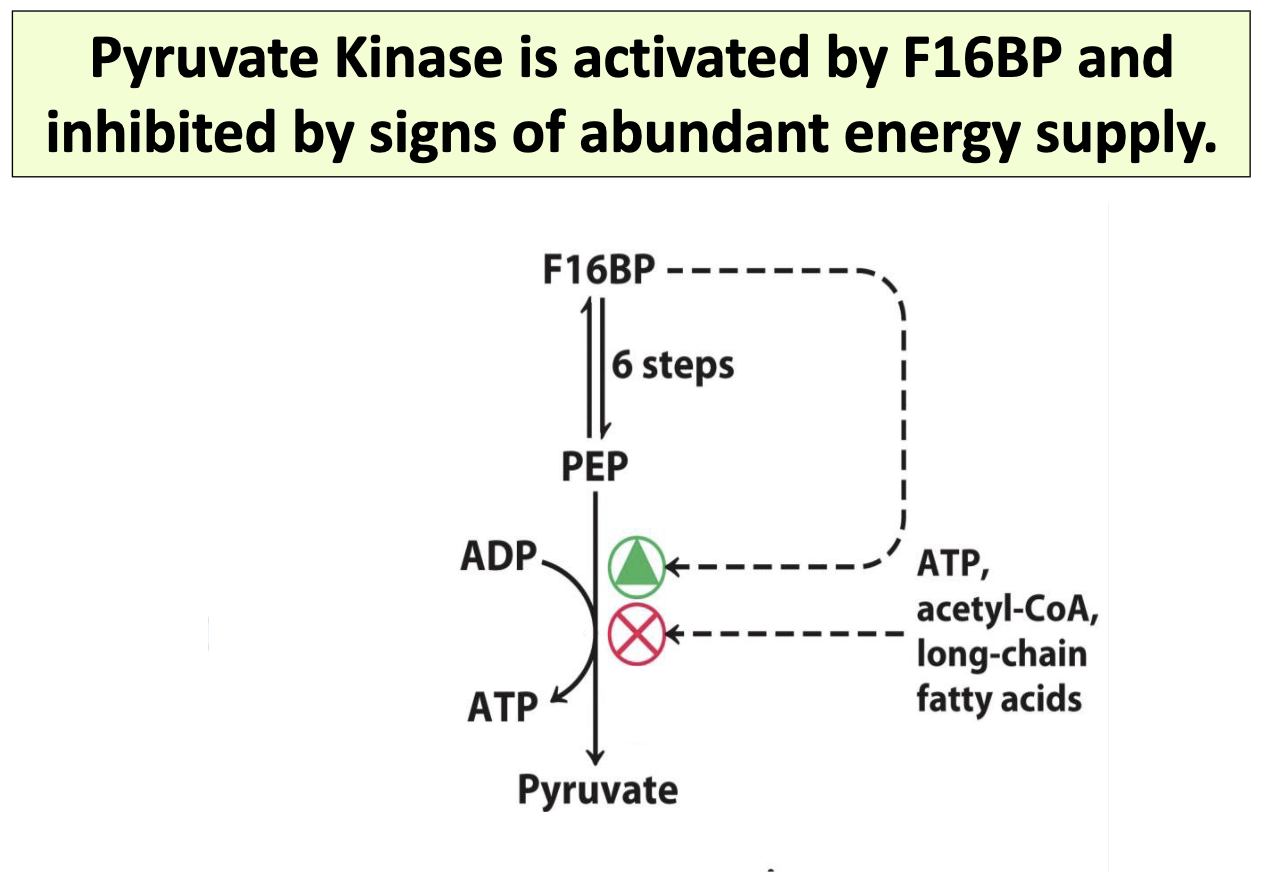
Pyruvate Kinase is inhibited and activated by _____
F16BP
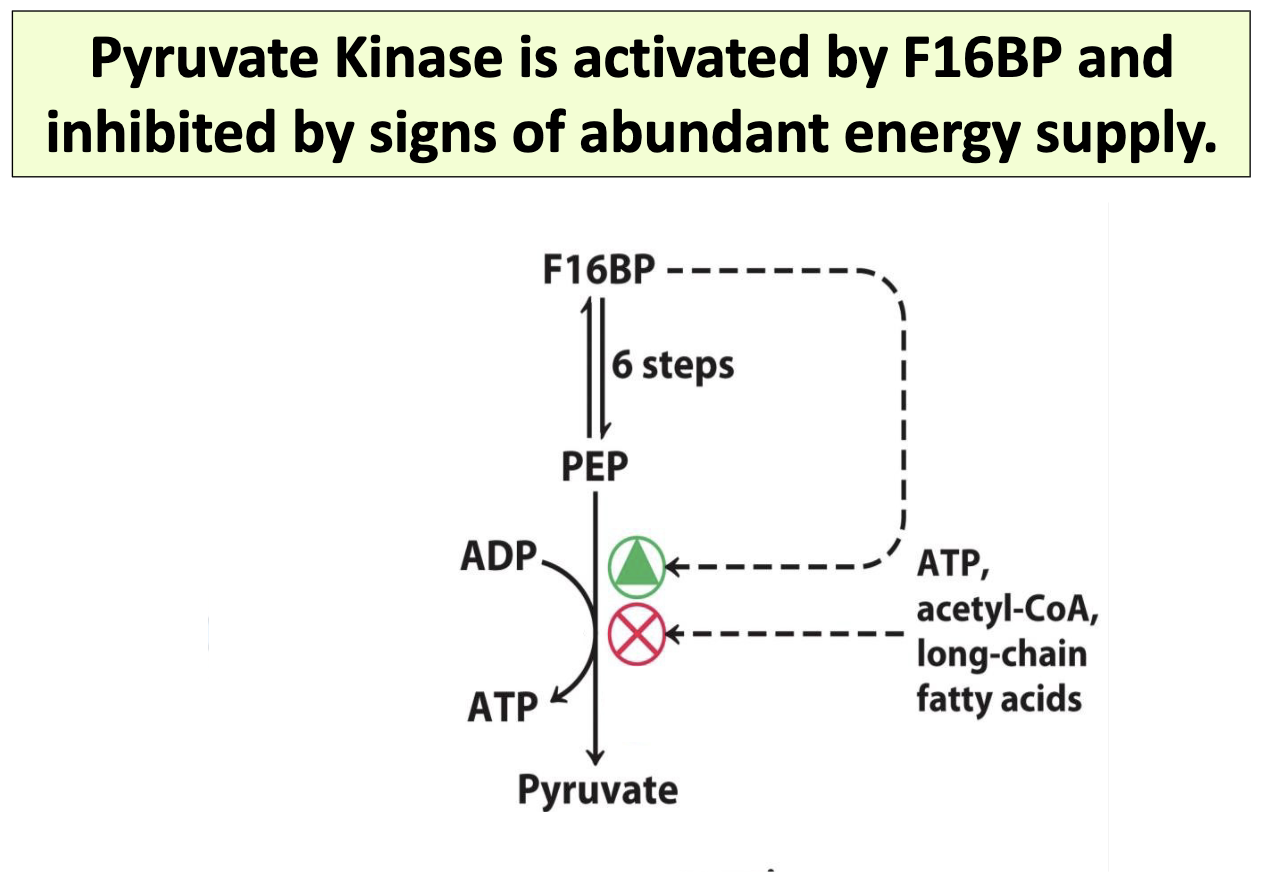
When energy levels are high F16BP acts as an ______ for pyruvate kinase
inhibitor
How many ATP equivalents are required for the first two reactions of gluconeogenesis to reverse the last reaction of glycolysis? Assume that one molecule of glucose is synthesized by the gluconeogenic pathway. Enter a numeric value only.
4
Which tissue expresses a glucose transporter with the highest affinity for glucose?
Select an answer and submit. For keyboard navigation, use the up/down arrow keys to select an answer.
a) liver
b) brain
c) muscle
b) brain
Which of the following is TRUE about hexokinase and glucokinase?
a) Glucokinase catalyzes dephosphorylation, whereas hexokinase catalyzes phosphorylation.
b) Glucokinase is found in the liver, while hexokinase is found in muscle.
c) Glucokinase is inhibited by glucose 6-phosphate, whereas hexokinase is not inhibited by glucose 6-phosphate.
d) Glucokinase's substrate is glucose, whereas hexokinase's substrate is fructose.
e) Glucokinase operates at high glucose concentrations, whereas hexokinase does at low glucose concentrations.
e) Glucokinase operates at high glucose concentrations, whereas hexokinase does at low glucose concentrations.
What is the glucose carrier protein in the brain and its Kd
Glut-3; Kd = 1-5 mM
What is the glucose carrier protein in the liver and its Kd
Glut-2; Kd = 20-40mM
What is the glucose carrier protein in muscle and its Kd
Glut-4; Kd = 5-10mM
Glut-2 in the _____ only brings glucose in at ___ concentrations. Explain
liver; high; the liver’s function to to control blood glucose levels, therefore the Kd is high to allow for glucose to only create/release glucose when the blood levels are too high and need to be lowered
_______ is the primary enyme for formation for G6P in liver
Glucokinase
Why does increasing the [Glucose] not affect hexokinase
The Km for hexokinase is so low that it functions at Vmax at normal blood glucose levels. This means that the enzyme is typically fully saturated and by increasing the concentration of glucose this will not affect the rate
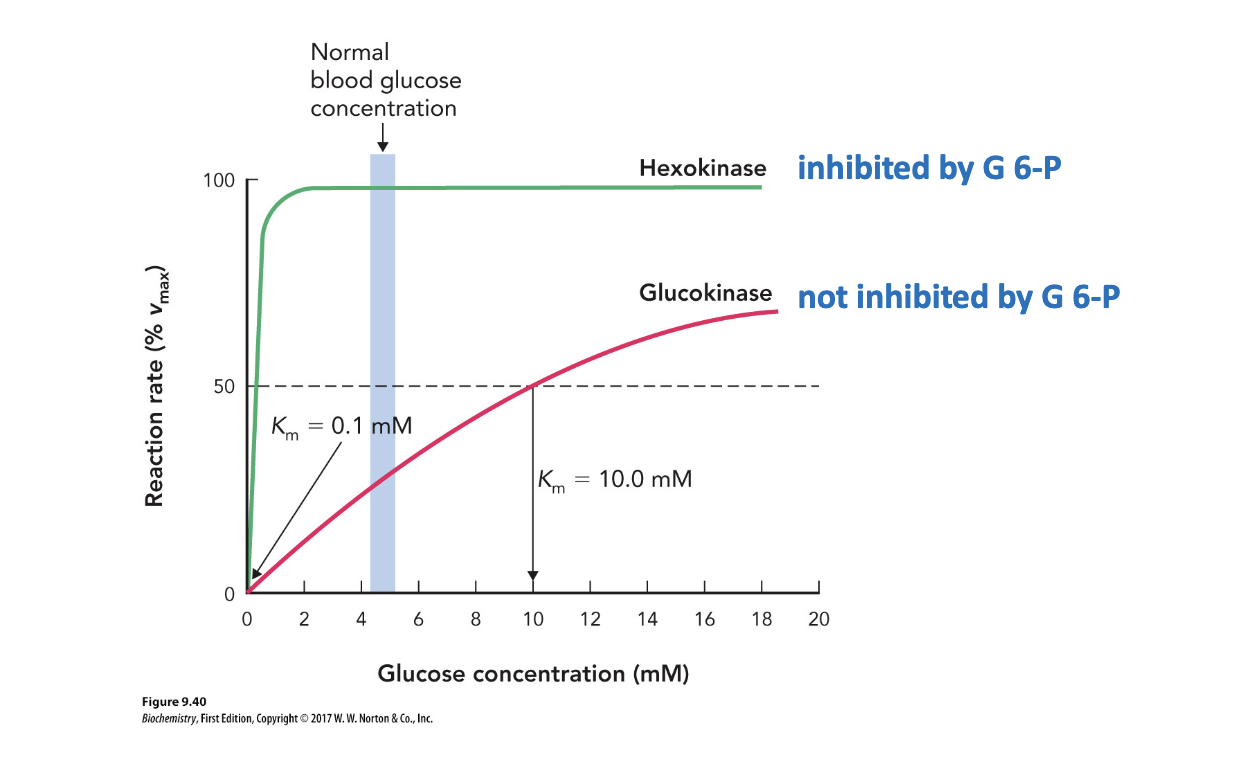
What is the Kd of hexokinase
Km = 0.1 mM
What is the Kd of glucokinase
Km = 10 mM
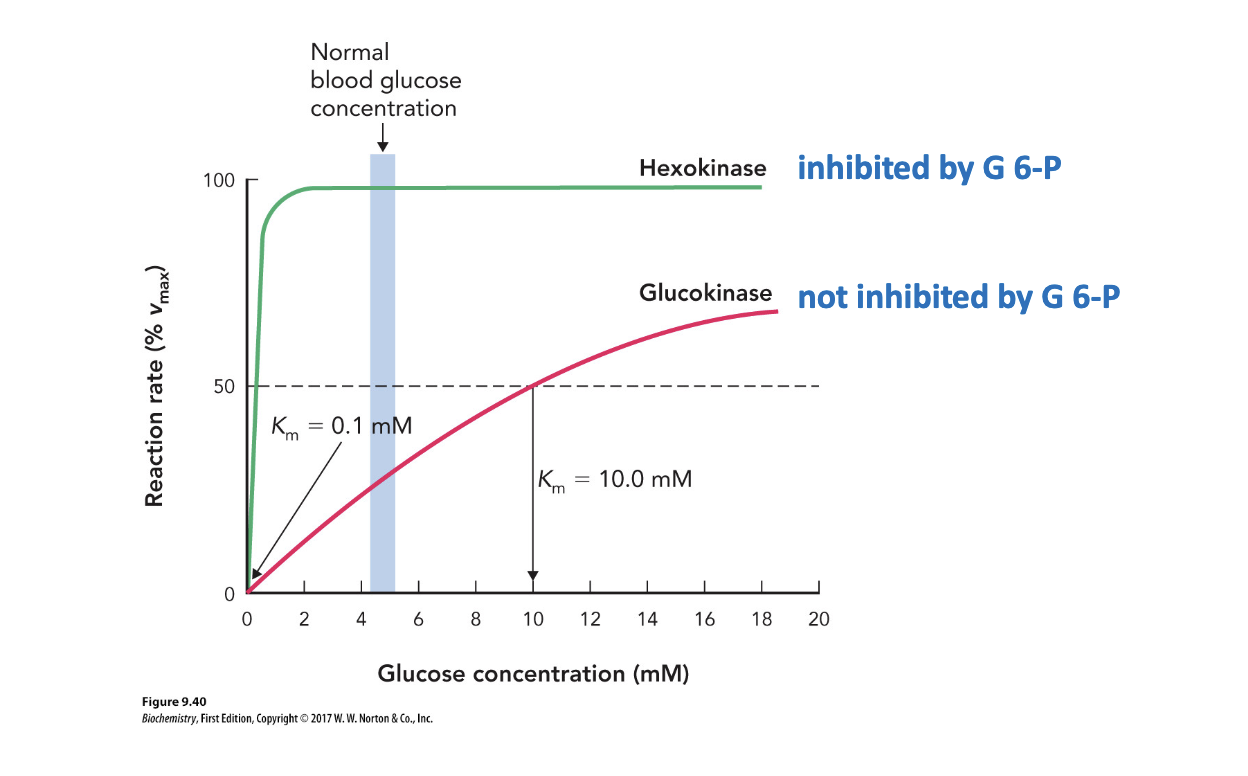
Explain this significance of these enzyme curves
The low Km of hexokinase ensures that muscle cells always have glucose stored, even at low glucose concentrations, to allow for contraction. The less steep curve of glucokinase ensures that the liver only releases glucose when concentrations of G6P are low and will store glucose when G6P concentrations are high. The higher Km for glucokinase means that the liver will only store glucose when concentrations are high — the primary function of the liver
(T/F) Glucoskinase is inhibited by G6P
False — hexokinase is inhibited by G6P not glucokinase
Why is it important that Hexokinase (muscle & other tissues) is inhibited by G6P and not glucokinase (liver)
G6P is the product of the first step of glycolysis (glucose + ATP → glucose-6-phosphate). In muscle and other tissues when glucose levels are high there is no need to phosphorylate more glucose when the supply is already high. This negative feedback makes sure that when G6P is high the creation of more G6P is stopped. However, in the liver glucokinase is responsible for the uptake of glucose from the blood. Therefore, if high G6P levels inhibited glucokianse this would prevent the liver from performing its primary function.
Fructose-1,6-bisphosphate is synthesized by ______ from the molecule ______.
Blank 1: phosphofructokinase-1
Blank 2: fructose-6-phosphate
F2,6-BP is an: (select all that apply)
a) allosteric activator of PFK-1
b) allosteric activator of PFK-2
c) allosteric activator of FBPase-1
d) allosteric inhibitor of PFK-1
e) allosteric inhibitor of PFK-2
f) allosteric inhibitor of FBPase-1
a and f
F2,6-BP activates PFK-1 → promotes glycolysis
F2,6-BP inhibits FBPase-1 → blocks gluconeogenesis
FBPase-2 is an enzyme that:
a) dephosphorylates F1,6-BP
b) phosphorylates F1,6-BP
c) dephosphorylates F2,6-BP
d) phosphorylates F2,6-BP
c) dephosphorylates F2,6-BP
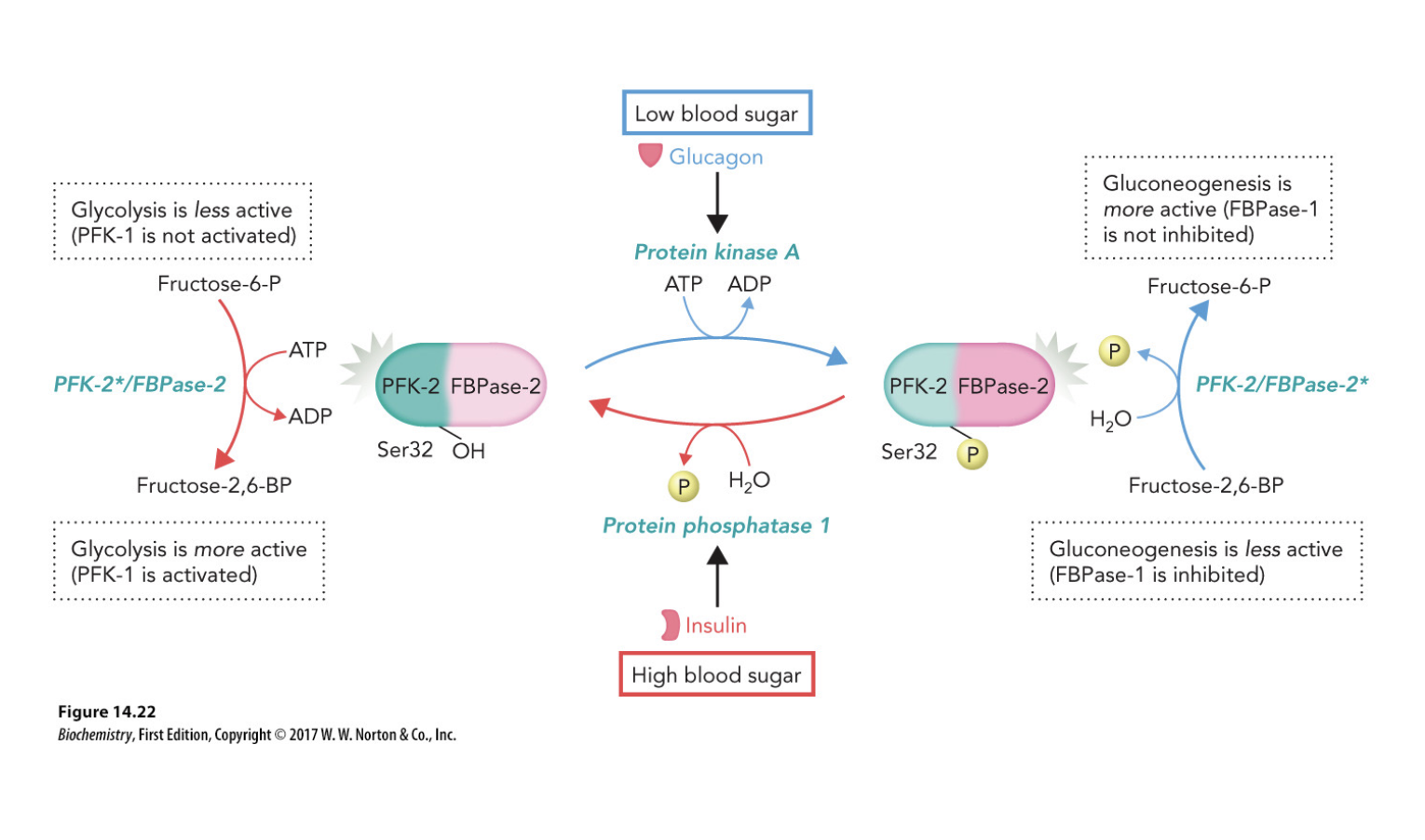
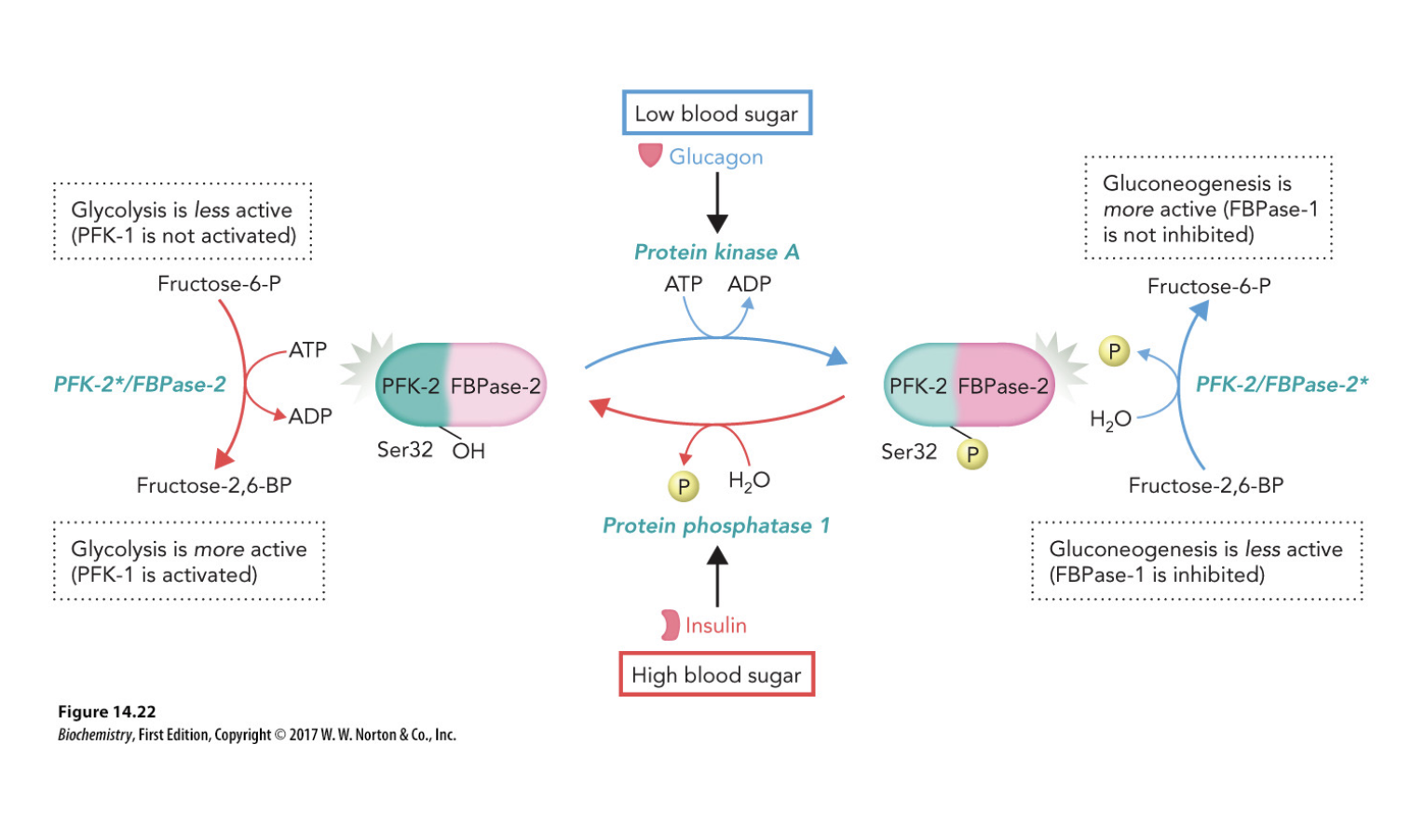
When the PFK-2/FBPase-2 enzyme is phosphorylated, _______ is active, which favors _______.
a) FBPase-2; glycolysis
b) PFK-2; gluconeogenesis
c) FBPase-2; gluconeogenesis
d) PFK-2; glycolysis
c) FBPase-2; gluconeogenesis
When Glucagon levels rise, ________ is activated, whereas when Insulin levels rise, ________ is activated. (Select all that apply)
a) FBPase-2 ; PFK-2
b) PFK-2 ; FBPase-2
c) Protein phosphatase 1 ; Protein kinase A
d) Protein kinase A ; Protein phosphatase 1
e) Gluconeogenesis ; Glycolysis
f) Glycolysis ; Gluconeogenesis
A, D, E
Glucagon → Protein Kinase A → phosphorylates PFK-2/FBPase-2 → FBPase-2 active → ↓F2,6-BP → Gluconeogenesis favored
Insulin → Protein Phosphatase 1 → dephosphorylates PFK-2/FBPase-2 → PFK-2 active → ↑F2,6-BP → Glycolysis favored
What inhibitors PFK-1
High [ATP]
What activates PFK-1
High [ADP] and & [AMP]
What inhibits FBPase-1
High [AMP]
What is enzyme catalyzes fructose 1,6-BP to F6P in the liver
FBpase-1
What is enzyme catalyzes F6P to fructose 1,6-BP in the liver
PFK-1
_____ through glycolysis is regulated in response to ______ ______
Flux through glycolysis is regulated in response to energy charge
_______ is the most important regulator of glucose metabolism in the liver
F2,6-BP
Explain the synthesis of F2,6-BP
F6P + ATP is catalyzed by PFK-2 to create F2,6-BP. F2,6-BP then serves as an activator of PFK-1 to create F1,6-BP
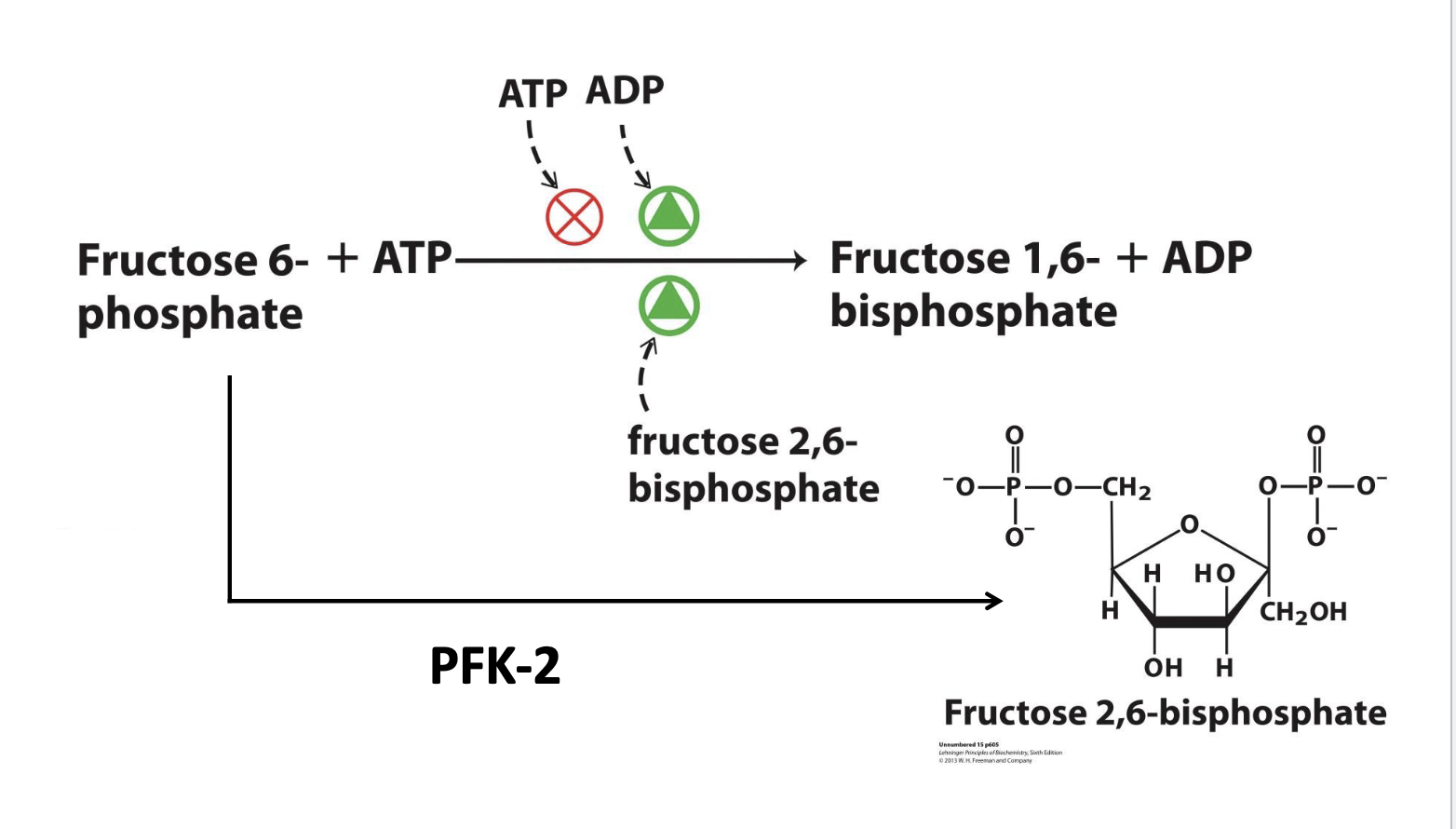
Fructose 2,6-bisphosphate is an _____ for PFK-1 and an _____ for FBPase-1
activator; inhibitor
Explain why the reciprocal regulation characteristics of F2,6-BP is important for a liver cell
When F26BP is present glycolysis is favored/activated and gluconeogenesis is inhibited. This allows the liver to have a crucial on/off switch to buffer the amount of blood glucose
More F2,6-BP = more glycolysis, less gluconeogenesis.
Less F2,6-BP = less glycolysis, more gluconeogenesis.
The [F26BP] is determined by the rate of its synthesis by ______ and its breakdown by ______
PFK-2; FBPase-2
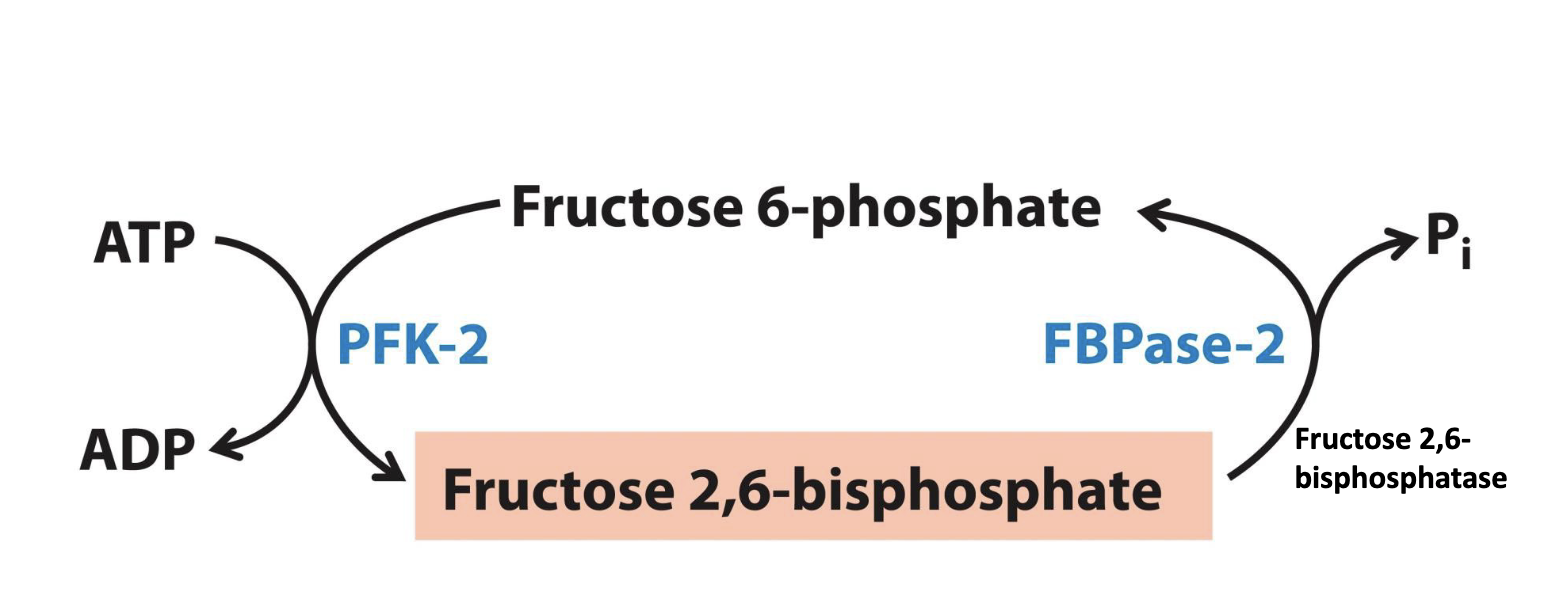
Describe the mechanism for the synthesis of F26BP
F6P + ATP —> F26BP
Describe the mechanism for the breakdown of F26BP
F26BP + P —→ F6P
Counter-signaling hormones _____ and _____ coordinate [F26BP] in the liver
insulin; glucagon
Explain the full mechanism when glucagon levels rise and how it effects the liver
When blood sugar levels drop, glucagon levels rise. This increases the activity of protein kinase A + ATP which causes the phosphoralation of ser32 making PFK-2 inactive. This activates FBPase-2 which catalyzes the breakdown of F26BP into F6P (Favoring Gluconeogenesis)
Explain the full mechanism when insulin levels rise and how it effects the liver
When blood suagr levels rise, insulin levels increase. This causes an increase in the activity of protein phosphatase 1 + H2O, which hydrolyzes PFK-2 converting it to the active form (removing P from Ser32). FBPase-2 is inactive and PFK2 is active. This induces the creation of F26BP. (Favoring glycolysis)
When glucose is abundant, insulin signaling stimulates glucose uptake through…
1) Glycogen synthesis
2) Glycolysis (when glycogen stores are full) to make pyruvate —> acetyl coA —> fatty acids, despite high [ATP]
When glucose is scarce, glucagon signaling activates glucose export through…
1) Glycogen degradation
2) Gluconeogenesis
Glycolysis = increase in ____ and breakdown of ____
ATP; glucose
Gluconeogenesis = increase in _____
glucose
_____ is a local energy signal that tells the cells its intrinsic energy level in low
AMP
What is flux
Flux = the rate of flow of something through a given point, surface, or system, per unit time
Arrange the following enzymes in the order they would be encountered during gluconeogenesis, starting with pyruvate.
phosphoenolpyruvate carboxykinase
phosphoglycerate kinase
phosphoglucose isomerase
aldolase
glucose-6-phosphatase
enolase
phosphoenolpyruvate carboxykinase
enolase
phosphoglycerate kinase
aldolase
phosphoglucose isomerase
glucose-6-phosphatase
Which of the following metabolic enzymes are used exclusively by glycolysis and which are used exclusively by gluconeogenesis?
Glycolysis only _______
Gluconeogenesis only _______
pyruvate kinase
fructose-1-6-bisphosphatase
Triose phosphate isomerase
Phosphoglycerate kinase
Enolase
Phosphoglucose isomerase
Phosphoglycerate mutase
Glyceraldehyde-3-phosphate dehydrogenase
Aldolase
Glycolysis only pyruvate kinase
Gluconeogenesis only fructose-1-6-bisphosphatase
Match the glycolytic reactions with the corresponding gluconeogenic enzyme that catalyzes the reverse reaction.
Glucose ↔ glucose-6-phosphate ________
Fructose-6-phosphate ↔ fructose-1,6-bisphosphate __________
Glyceraldehyde-3-phosphate ↔ 1,3-bisphosphoglycerate ___________
2-phosphoglycerate ↔ phosphoenolpyruvate _________
Phosphoenolpyruvate ↔ pyruvate ___________
Glucose ↔ glucose-6-phosphate — glucose-6-phosphatase
Fructose-6-phosphate ↔ fructose-1,6-bisphosphate — fructose-1,6-bisphosphatase
Glyceraldehyde-3-phosphate ↔ 1,3-bisphosphoglycerate — glyceraldehyde-3-phosphate dehydrogenase
2-phosphoglycerate ↔ phosphoenolpyruvate — enolase
Phosphoenolpyruvate ↔ pyruvate — pyruvate carboxylase / PEP carboxykinase
What is the cost (in ATP equivalents per glucose) of transforming glucose to pyruvate via glycolysis and back again to glucose via gluconeogenesis?
Glycolysis = Gain of 2 ATP
Gluconeogenesis = Loss of 4 ATP, 2 GTP
Net cost = 4 ATP equivalents per glucose
Glucose is transported into cells through 12 different integral membrane protein glucose transporters (GLUT-1 to GLUT-12). The GLUT-1 transporter is especially prevalent in the brain and erythrocytes and shows a high affinity (Km ~1–2 mM) to glucose. Several breast, lung, and colorectal cancers have been found to have an increased expression of these GLUT-1 transporters.
Cancer cells increase GLUT-1 expression to increase glucose uptake, produce ATP, and create the proper intermediates required for cell division. By increasing GLUT-1, which has the lowest efficient for glucose, this is a sacrifice made for speed over efficiency. Cancer cells want energy fast, despite glycolysis making little ATP, it is the speed the cancer cell is looking for. Glycolysis also makes nucleotide intermediates that aide in cellular division.
n skeletal muscles, flux through glycolysis is decreased when cellular energy levels are __________; the regulatory enzyme, phosphofructokinase-1, is __________ by high concentrations of ATP.
a) low; activated
b) low; inhibited
c) high; activated
d) high; inhibited
d) high; inhibited