Flashcards Neural Control of Human Movement Quiz 1 (Chapter 1-3ish) | Quizlet
 Call Kai
 Learn
Learn Practice Test
 Spaced Repetition
 Match
Match Flashcards
 Knowt Play
1/141

There's no tags or description
Looks like no tags are added yet.
Name | Mastery | Learn | Test | Matching | Spaced | Call with Kai | Chat |
|---|
No analytics yet
Send a link to your students to track their progress
142 Terms
Five Basic Questions of Neural Science
1. How does the brain develop? (motor development)
2. How do nerve cells in the brain communicate with each other?
3. How do different patterns of interconnections give rise to different perceptions and motor acts? (motor learning)
4. How is communication between neurons modified by experience? (motor learning)
5. How is that communication altered by diseases?
The Human Brain
- a network of over 100 billion individual nerve cells interconnected in systems (neural circuits)
-these circuits construct our perceptions of the external world (view, how you see)
-in order to understand the brain, we have to learn how the neurons are organized into signaling pathways and how they communicate through synaptic transmissions (communication between nerve cells and the body)
Famous Neurophysiologists of the 20th Century
Sherrington, Grahm Brown, Wachholder, Attenburger, Berstein
Sherrington
synapse, reflexes, active inhibition, basis of locomotion
Grahm Brown
central pattern generators
Wachholder & Attenburger
electromyography
Berstein
father of motor control, evolution-based approach, multilevel scheme for the construction of movements, physiology of activity
Reductionism
reducing the elements of a system to a basic level of functioning elements (break down)
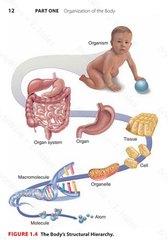
Complex System Approach
Knowledge of the elements is essential to understanding the system but greater emphasis is placed on investigating and understanding the system as a whole (how everything works for system to function)
True
True or False: The complex system approach allows for more succinct description of behavior and the interperation?
What are examples of other complex systems?
all systems that help our body function
False: partially permeable
True or False: The cellular structure exists with a fully permeable membrane?
What are the three major types of substances that can cross membranes?
1) Solvent
2) Electrolytes
3) Nonelectrolytes
Examples of a solvent, electrolyte, and nonelectrolyte
Solvent: water
Electrolyte: ions (Na, Ca, K)
Nonelectrolytes: non-charged molecules
partial permeability
allows what needs to in/out for regulation
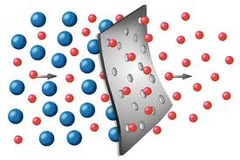
2 movements of molecules in a solution within the membrane
1. Diffusion
2. Convection
Convection
movement of a solute based on pressure gradient. The pressure differential will dictate the rate of flow, the flow always goes from an area of high pressure to and area of low pressure

Diffusion
Movement of particles (molecules) from an area of higher concentration to an area of lower concentration.
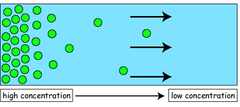
What is being moved in Convection?
Solvent (water)
What is being moved in Diffusion?
Particles (molecules) dissolved in a solvent
Slower
Is diffusion faster or slower than an electric current
Movement of Charged Particles
an electric field creates a difference of potentials (U) that induces a flow of charged particles (a current). The current is proportional to the difference of the potentials, the inverse of the coefficient of proportionality is termed resistance (R).
Movement of Ions
Ions move under the influence of two forces. The first force (Fc) is related to the concentration gradient, and the second force (Fe) is related to the difference of the potentials
Movement of Particles in Solutions
*convection
*diffusion
*electric current
*ohm's law
*osmosis
Osmosis
movement of water under the gradient of concentration of all particles (diffusion of water)
State of Equilibriium
the movements of all particles are counterbalanced, there are no net changes in the concentrations
Membrane Channels
involved with the movement of certain substances through the cell membrane to a certain location

What are the 3 properties of the ion channels importance in signaling the Nervous System?
1) They conduct ions
2) They recognize specific ions
3) They open and close in response to specific electrical, mechanical, and chemical signals
How many ions can pass through a single channel per second?
up to 100 million ions

rapid changes
Ion channels allow for _________________ in membrane potential
When does motor development stop?
At death
What is something that would be studied in the field of motor learning?
learning how to hit a softball, throw a football (how you get better)
Gaining an understanding of how all the parts or elements work together would be an example of what type of approach?
complex system (big picture)
Gaining an understanding of the individual details of the parts or elements would be an example of what type of approach?
reduction
What is the difference between convection and diffusion?
convection is the movement of a solvent in a pressure gradient, diffusion is the movement of particles from areas of high --> low concetration
Action Potential
*a neural impulse; a brief electrical charge that travels down an axon
-allows for the communication of information at a much more rapid pace than convection or diffusion

What is the speed of communication based on for an action potential?
it is based upon the potential of the membrane
Active Ion Pump
*the ion concentration gradients across the membrane requires energy, which is provided by the chemical process that transforms ATP into ADP (sodium-potassium pump)

3 important ions for action potentials
K+ (-99mV)
Na+ (+66mV)
Cl- (-90mV)
Assumption
a charged particle that can cross the membrane
Equilibrium at normal body temperature
*reflects energy available for diffusion
*a potential without net ion motion through the membrane
*corresponds to actual voltage on the membrane if only one ion can move through it
What will happen with the electric potential in an action potential?
*the EP may emerge by itself
*a membrane separates 2 areas, one with and one without ions Na+ and Cl-. Diffusion of the ions may occur at different speeds, resulting in a new state being reached with different ion concentrations to the right, and to the left when the electrical force acts as an addition to the concentration gradient force
Is the membrane a Capacitor?
a membrane may be considered a capacitor
-its charge (Q) is proportional to the difference of potentials across the membrane with a coefficient termed capacitance (C) (good conductor of electricity)
How is the action potential different from the membrane potential?
*the action potential is the dispersion of an electric signal
What are the main types of stimuli that can trigger AP's?
-sharp/painful objects
-pressure
-light
-smell
-taste
False: does dictate the response of the AP
True or False: The intensity of the stimulus does not dictate the response of the AP.
What type of intensity of the stimulus dictates the respone?
-small stimulus leads to a small response
-medium stimulus leads to a medium response
-large stimulus leads to a large response
An action potential only occurs when the stimulus is strong enough to depolarize the membrane beyond the membrane potential
Membrane Potentials
-resting potentials
-sodium-potassium pump
-threshold
-action potential

resting potential
an ion with the highest permeablility
-(around -60 to -70mV)

sodium-potassium pump
an active mechanism maintaining resting potential

threshold
potential when the membrane generates an action potential (how much does it need to be polarized for AP)
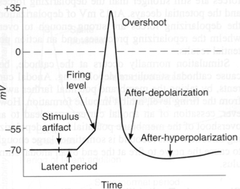
action potential
a standard time series of changes in the membrane potential after reaching the threshold

All or None Law
Either the membrane does NOT generate an action potential (AP) or it GENERATES an AP with standard shape and magnitude.
Depolarization
___________ (Na+in) of the membrane indicates a shift toward the positive end of the mV scale
The changes in membrane potential are facilitated by the movement of ions across the membrane. This movement of ions will influence membrane potential through hyper or de-polarization
Effects of Electrical Stimulation of a Membrane
If you stimulate a membrane with relatively SMALL electrical stimuli, its resting potential will change somewhat in response to each stimulus and then return to its RESTING level.
Depolarizing and Hyperpolarizing Currents
A thin electrode is inserted into the cell without breaking the membrane. Now we can apply electrical current to change the membrane resting potential

Action Potential Stimulus
At low values, an increase in the STIMULATION current will lead to a gradual increase in the deviation of the membrane potential from its resting level. At some value of the stimulus, an action potential will be GENERATED, further increase in the strength of the stimulation will not lead to a change in the membrane response.
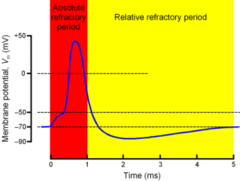
Refractory Period
after an action potential has been generated, there is a period of reduced or no possibility of generating another action potential

Relative Refractory Period
The period following the generation of an action potential in which it is POSSIBLE to generate another action potential. A second action potential may not be generated with the same INTENSITY of stimulus. An increase in intensity is necessary to GENERATE a new action potential

Absolute Refractory Period
The first period following (very short time period) the generation of an AP in which it is NOT possible to generate a new AP
-time is required to allow the membrane potential to hyper-polarize
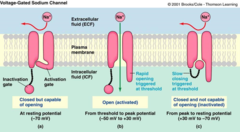
Sodium Channel Inactivation
-after a stimulus leading to an increase in gNa, another stimulus is LESS able to cause an increase in gNa for some time
-for a short period, this inactivation is ABSOLUTE- that is, gNa will not respond to even strong stimulus
-afterward, a stronger than usual stimulus can turn gNa on (relative)
absolute
sodium/repolarization are/is__________
relative
hyper-polarization is _____________
Features of Action Potential
-caused by MEMBRANE DEPOLARIZATION to be the threshold.
-has a sharp peak of positive voltage (abt +30mV): an example of POSITIVE feedback processes
-followed by an afterpotential (HYPER-POLARIZATION)
-the duration is about 1 ms
Properties of a Refractory Period
-caused by inactivation of sodium channels (absolute)
-absolute (1-2ms) and relative (~10 ms)
-limits FREQUENCY of action potential generation by a neuron
-the duration is about 1ms (absolute)
Positive & Negative Feedback Effects
-PF: keeps going in the same direction (amplifies), depolarization tons of Na causes threshold to go way up
-NF: going back to original state, hyper-polarization/relative, brings it back down
Postive Feedback
process leads to a rapid amplification of the effect
-ex: labor contractions until the baby is out
Negative Feedback
process quickly restores back to the original state
-ex: slowing down and completely stopping at traffic
Changes in Ion Conductance at Different Phases of the Action Potential
-changes in Na+ (open/close quickly) and K+ (responsible for normal levels) conductance during an AP
-the peak of the AP is positive and after the AP the membrane remains hyper-polarized for some time.
What is the typical resting membrane potential for a neuron?
resting mp is -60, -70
What is the difference between the absolute and relative refractory periods?
-absolute: comes first, no 2nd AP
-relative: stronger stimulus is needed to reach threshold
How does the all or nothing law relate to the generation of action potentials?
-same AP every time, threshold is reached
Can an action potential backfire?
No, if the AP comes to point 2 from point 1, it cannot go back; only forward to point 3
AP conductions w/ Local Currents
-AP emerge simultaneously at the same point
-local currents decrease with distance (slower in bigger fiber)
-will bring membrane to the threshold at a more distant point
-next AP will emerge at the same delay at point B in F1 and at point C in F2
Large Diameter
equals greater speed/velocity
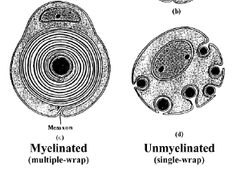
Myelin
fatty layer that protects the axon and speeds up transmissions
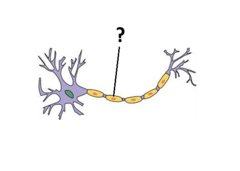
myelinated
faster conduction

unmyelinated
slower conduction
Ranvier Nodes
breaks in the myelin sheath; places where action potentials are generated (saltatory conduction)

Fewer ion channels under the ________, large number of ion channels in the ________
myelin, Ranvier nodes
Myelinated fibers compared to Unmyelinated
much higher of AP transmissions (up to 100-120 m/s)
Conduction of the AP
-an AP produces LOCAL CURRENTS spreading through surrounding tissues
-local currents DEPOLARIZE adjacent segments of the membrane
-an new AP is GENERATED
-thicker fibers have LONGER effective distances of local current spread and conduct at higher velocities
Important Features of AP conductions
-myelin INCREASES the effective distance of local currents
-AP CANNOT BACKFIRE because of the absolute refractory period of the membrane due to the inactivation of sodium channels
orthodromic conduction
conduction from the soma to terminal branches (motor neurons)

antidromic conduction
conduction from the end of the axon to the soma (sensory neurons)
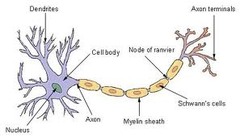
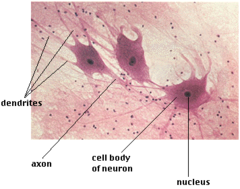
Structure of a Neuron
-soma
-dendrites
-axon
-axon hillock
-terminal branches
-myelin
-ranvier nodes
-nerve (peripheral) or neural tract (central)
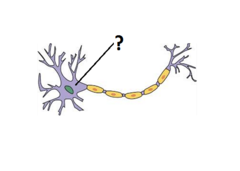
soma
body of the cell; the site of the input signals
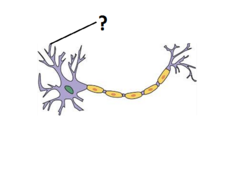
dendrites
short branches originating from the soma
axon
a long branch; transmits output signals (ortho out, anti in)
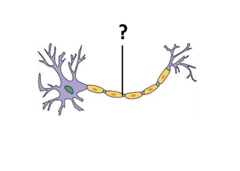
axon hillock
the site where the axon exits the soma; typically, the site of generation of AP
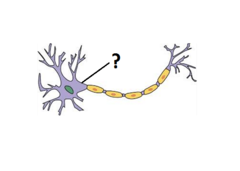
terminal branches
a "brush" at the end of the axon

myelin
a fat-like substance covering the axon (not a continuous covering); it increases the speed of conduction of AP

ranvier nodes
breaks in the myelin sheath; places where AP's are generated
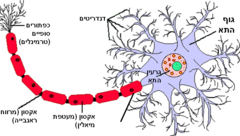
nerve (peripheral) or neural tract (central)
many axons running together
Important Facts about Neurons
-there are virtually NO ion channels under the myelin sheath
-there are MANY ion channels in the Ranvier nodes
-the importance of DENDRITES for. the generation of APs has gained prominence lately (steady depolarization)
Persistant Inward Currents
-currents occurring through ion channels, typically Ca++, without INACTIVATION
-lead to effective DROPS IN THE THRESHOLD for AP generation by other inputs
-can lead to CONTINUOUS GENERATION of AP's in the absence of other excitatory inputs
PIC: What does it mean?
-is a DEPOLARIZATION inward current that activates as long as the MP is depolarized
-PIC's allow for an INCREASE in the number of AP that are GENERATED
-PIC's very strong in HUMAN ALPHA motor-neurons during everyday tasks
-very sensitive to POSTSYNAPTIC INHIBITION, meaning they can be CONTROLLED
-likely strong enough to play a major role in defining the patterns of RECRUITMENT AND DE-RECRUITMENT of motor neurons
What effect does the all or none law have on action potential generation?
each AP transmits 1 bit of information