BIOL 161 Exam 1
 Call Kai
 Learn
Learn Practice Test
 Spaced Repetition
 Match
Match Flashcards
 Knowt Play
1/23

There's no tags or description
Looks like no tags are added yet.
Name | Mastery | Learn | Test | Matching | Spaced | Call with Kai | Chat |
|---|
No analytics yet
Send a link to your students to track their progress
24 Terms
Describe the structure of an atom and use atomic number and electrical charge to interpret atomic diagrams and periodic-table information.
protons, neutrons, electrons. Nucleus contains protons + neurons, electrons on the outside. Atomic number determined by # of protons. + charge = cation; - charge = anion
Compare and contrast the terms: atom, molecule, and element.
An atom is a single unit of matter made up of subatomic particles: protons, neutrons, electrons.
A molecule is made of 2 or more atoms chemically bonded to each other.
An element is a pure substance of the same atom, defined by having a particular # of protons
Explain ionization and distinguish among neutral atoms, cations, and anions.
Ionization: the process in which an atom gains or loses electrons and becomes electrically charged
Neutral: # protons = # electrons; charge = 0
Cations: Positively charged ions; lost >= 1 electrons
Anions: Negatively charged ions; gains >= 1 electrons
Explain why ions are physiologically important and describe their roles in membrane voltage and electrical current.
Ion concentration gradients: differences in ion concentration across a membrane
Electrical Gradients: differences in charge across a membrane
Electrochemical gradients: the combined influence of concentration and electric gradients
Compare ionic, polar covalent, nonpolar covalent, and hydrogen bonds in terms of how atoms or molecules interact.
Ionic bond: one atom transfers >= 1 electrons to another atom —> created charged ions that attract each other
Polar covalent bond: when atoms share electrons unqeually
Nonpolar covalent bond: when atoms share electrons equally or nearly equal
Hydrogen bonds: weak attractions between slightly positive hydrogen atom and slightly negative atom (no sharing of electrons)
Use molecular diagrams to distinguish among the major types of chemical bonds discussed in this lecture.
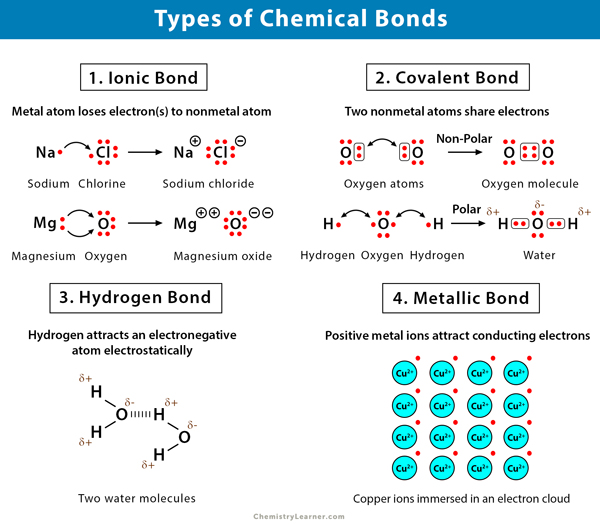
Explain the polarity of water and relate water's polarity to hydrogen bonding.
Water has an uneven distribution of charge (positive hydrogen, negative oxygen)
The O-H bonds within one water molecule are covalent and polar.
Distinguish monomers from polymers and identify the four major categories of organic molecules.
Monomer: smaller molecular subunit that can be joined to other similar subunits
Polymer: a larger molecule made of repeating or linked subunts called monomers
carbohydrates, lipids, proteins, nucleic acids
Describe the basic organization of carbohydrates and relate carbohydrates to their major biological functions.
Carbohydrates: organic molecules composed primarily of carbon, hydrogen and oxygen. Provide/store usable energy, contributing to structural support, participating in cell recognition or cell-surface interactions
Monosaccharides: single sugar units
Disaccharides: two sugar units joined together
Polysaccharides: long chains or sugar units
Describe the structure of a triglyceride and relate its structure to its physiological functions.
One glycerol molecule + three fatty acid chains attached to glycerol by as ester bond
Triglycerides are largely nonpolar and hydrophobic so they do not dissolve well in water
Long term energy storage: hydrocarbon rich fatty acid chains contain substantial energy
Insulation: stored adipose triglycerides can reduce heat loss
Cushioning and protection: adipose tissue can help protect organs
Compare saturated and unsaturated fatty acids in terms of their structure and biological significance.
Saturated: have no carbon-carbon double bonds. maximum # of hydrogen atoms
Unsaturated: one or more carbon-carbon double bonds (liquid room temp)
Monounsaturated: one double bond
Polyunsaturated: two or more double bonds
Describe the structure of a phospholipid and relate its organization to cell and organelle membranes.
Three major parts: glycerol back bone, two fatty acid tails, phosphate-containing polar head
Amphipathic b/x both hydrophobic and hydrophillic
Describe the structural features of steroids and explain the physiological roles of cholesterol and steroid hormones.
4 fused carbon rings
Generally lipic-soluble and can cross the phospholipid bilayer
Different steroids have different function because of differences in: attatched chemical groups, side chains, functional groups]
Cholesterol differs from other steriods b/c of hydrocarbon-containing tail + hydroxyl group
Cholesterol: helps regulate the fluidity + stability of cell membranes, served as a precursor for steroid hormones
Describe how amino acids are organized into proteins and relate protein structure to protein function.
Shape determines function
Amino acids are joined by peptide bonds to form polypeptide chains
Interpret a protein-structure figure to distinguish primary, secondary, tertiary, and quaternary structure.
Primary: the amino acid sequence (bracelet beads)
Secondary: folding (alpha helix, beta sheet)
Tertiary: 3 dimensional shape
Quaternary: association of multiple polypeptide chains (if present)
Describe the organization and major functions of nucleic acids.
Polymers made of repeating nucleotide monomers
Sugar, phosphate group, and nitrogen containing base
Information storage, information transfer, and protein function
Interpret the gene-expression diagram and distinguish transcription from translation.
Information is transferred from a gene to an RNA molecule, then used to produce a protein
Explain how genetic information determines the primary structure of a protein.
DNA stores genetic info → transcription turns that info into RNA transcript → translation makes the nucleotide sequence from RNA according to genetic code → amino acid order is the primary structure
Interpret the ATP hydrolysis diagram and explain the physiological significance of the process.
Hydrolysis uses water to split ATP into ADP, releasing energy
Can often be coupled to process requiring energy like: active transport, muscle contraction, movement of cellular components, and synthesis of larger molecules
Predict the electrical charge of an atom after it gains or loses electrons.
Gaining electrons makes an atom more negative, producing a negative ion
Losing electrons makes an atom more positive, producing. a positive ion
Predict how changing the distribution of shared electrons within a covalent bond would affect molecular polarity
Nonpolar covalent: equally shared
polar covalent: unequal sharing
Predict how altering the hydrophilic or hydrophobic regions of a phospholipid would affect its behavior in a membrane.
hydrophilic, polar heads interacts w/ water
hydrophobic, nonpolar tails avoid water
Changes can affect: phospholipid orientation, bilayer formation, membrane formation, membrane fluidity, permeability, and interactions with other membrane components
Predict how a change in the amino acid sequence of a protein could affect protein function.
Amino acid is primary structure
changes could affect: chemical interactions among amino acid side chains, protein folding + 3D shape, stability, active sites/bonding sites, cellular location, and interactions w/ other molecules
Predict how disrupting transcription or translation would affect protein production.
Transcription produces an RNA copy of genetic information, while translation uses RNA information to assemble an amino-acid sequence.
Disrupting either process affects: RNA production/availability, protein production, the amount or structure of protein produced, and potentially cell function