Parasitology Exam 1 LMU CVM
 Call Kai
 Learn
Learn Practice Test
 Spaced Repetition
 Match
Match Flashcards
 Knowt Play
1/127

There's no tags or description
Looks like no tags are added yet.
Name | Mastery | Learn | Test | Matching | Spaced | Call with Kai | Chat |
|---|
No analytics yet
Send a link to your students to track their progress
128 Terms
Parasitism
____________ is a kind of symbiosis
Host
Parasites live at the measurable expense of the ____________
Biologic
Parasites have the ability to alter their ____________ functions to enhance the odds for survival and reproduction
Obligatory
____________ is a type of parasite that cannot complete its lifecycle without spending part or all of its time on or within a host
Facultative, opportunistically
____________ is a type of parasite that is not normally parasitic, but become so when eaten or ____________ enter a host through and orifice or wound
Endoparasite
____________ are organisms living within a host environment
Ectoparasite
____________ are organisms living on host
Abberant parasite
____________ are organisms found in locations where they do not normally occur
Accidental or incidental host
____________ is when parasitic organisms that enter or attach to host species that are different from the ones with which they are normally associated
Pseudoparasite
____________ a diagnostic parasite stage or artifacts that superficially resemble protozoan cysts or helminth eggs in the feces, blood or urine of an examined animal
Hyperparasite
____________ is when a parasitic organism is host to another parasite species
Definitive
____________ host is where a parasite attains reproductive maturity
Intermediate
____________ host is in which a larval or intermediate stage parasite must undergo development to become infective for the final host
Paratenic
____________ host is a facultative host used by a larval or intermediate stage parasite to facilitate transmission to the definitive or final host
Paratenic
Parasites that infect a ____________ host DO NOT undergo any development
Intermediate
Parasites that infect a ____________ host DOES undergo development
Reservoir
____________ hosts maintain a parasite in the population at sufficient levels to facilitate its transmission between susceptible hosts
Reservoir
____________ hosts is an emphasis on population rather than individual
Vectors
____________ are organisms that facilitate transmission of infective parasite stages between different individuals of a host population
Obligate
Biological vectors assume the existence of an ____________ relationship for successful transmission
Mechanical
____________ vectors DO NOT have an obligate role
Direct
A ____________ lifestyle is when parasites infect the host directly
Indirect obligate
A ____________ ____________ lifestyle requires an intervention of an intermediate host
Indirect facultative
A ____________ ____________ lifestyle has an optional intervention of an intermediate or paramedic host
Horizontal
____________ is a type of transmission that parasites colonize susceptible individuals by usual routes
Vertical
____________ is a type of transmission of parasites from mother to offspring by transplacental or lactogenic routes
High, monospecific
____________ specificity or (____________) is a limited number of hosts capable of completing lifecycle
Low, heterospecific
____________ specificity or (____________) has a wide variety of species capable of hosting parasite and is typical of intermediate and paratenic hosts
Endemic, Enzootic
____________ (____________) is the normal or usual distribution of parasites in a host population or geographic area
Epidemic (Epizootic)
____________ (____________) is an excess number of parasite cases, far exceeding the normal or usual distribution in a host population
Prevalence
____________ is the occurrence of a parasite in a population defined by time and space
Incidence
____________ is the rate at which new cases are added to a host population defined by time and space
Ancylostoma caninum
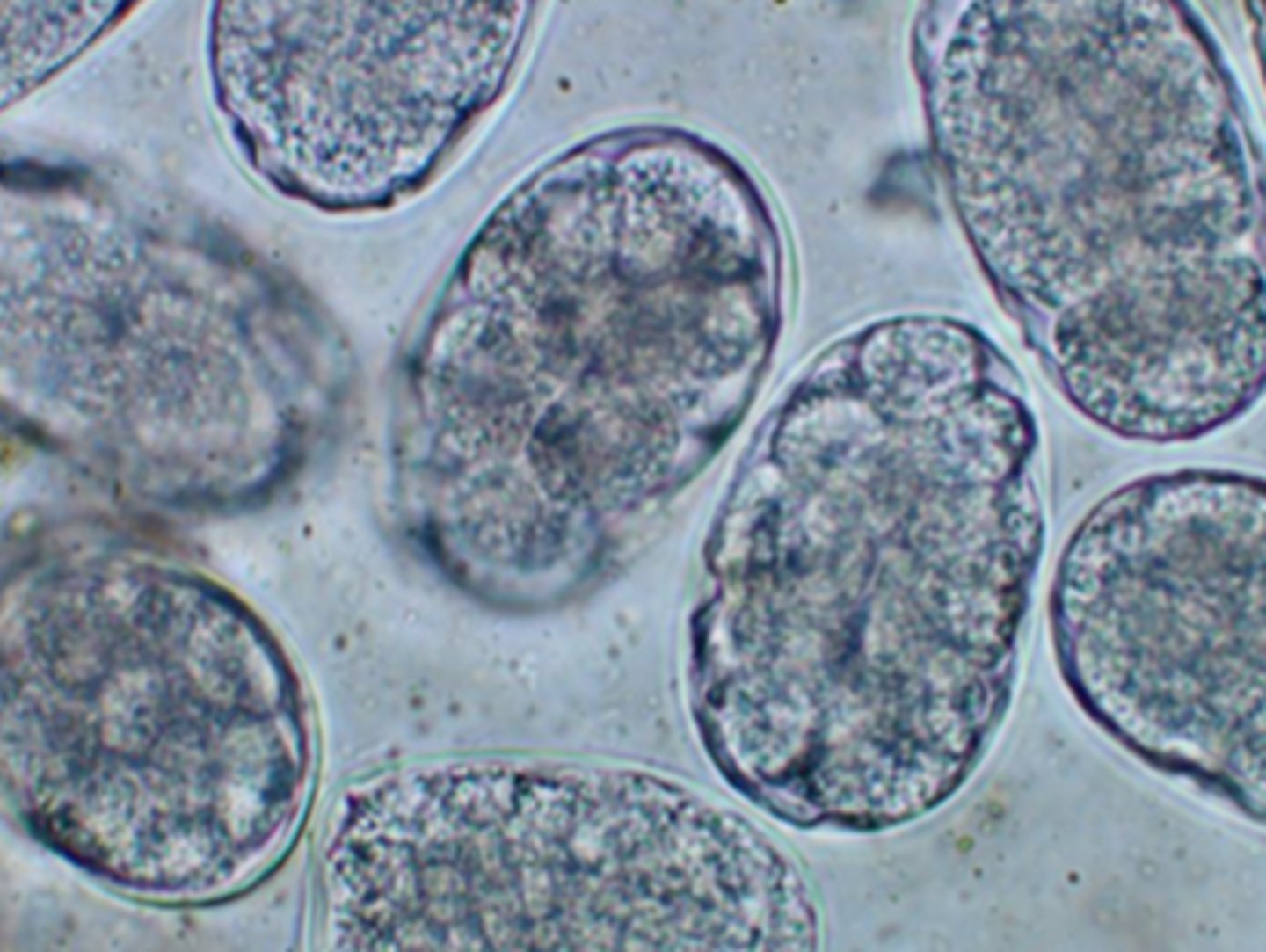
Hookworms
____________ are voracious blood suckers
Hookworms
____________ are small, stout worms ranging from 10 to 16 mm
Hookworms
Generally occupy small intestine of vertebrate hosts
Ancylostoma caninum
Canine hookworm
Ancylostoma caninum
3 pairs or large teeth in a large buccal capsule and males with copulatory bursa and are small worms
Direct Life Cycle
What type of life cycle does ancylostoma canine have?
Direct ingestion of infective larvae and arrested larvae passed by lactogenic route
What are the two modes of oral transmission of the ancylostoma caninum?
8 days
How many days before clinical signs of anemia post-infection in puppies with ancylostoma caninum?
L3 stage
Sources of infective larvae is at the ____________ stage.
Attachment scars
Adult hookworms can cause ____________ ____________ on the small intestine of a canine
Peracute
____________ disease is seen in neonatal puppies with hookworms and has diarrhea with black tarry stools and pale mucous membranes
Acute
____________ disease is seen in exposure of older puppies and adults to large numbers of infective larvae with hookworms
Chronic compensated
____________ ____________ disease is presence of infection without overt clinical signs
Secondary decompensated
____________ ____________ disease is in older dogs with other primary health issues and is in malnourished or emaciated animals and hookworms is the secondary causative effect
Ancylostoma caninum
These eggs on a fecal examination are normally 60 * 40 um and is thin shelled and in morula stage
Pyrantel
____________ is drug of choice with canine hookworms
Fenbendzole or ivermectin
These two types of drugs can be used for prevention of perinatal infection of the canine hookworms
Ancylostoma tubaforme
The scientific name for the feline hookworm
Ancylostoma braziliense
The scientific name for the hookworms that are endemic to the subtropical world wide and the southern US and has buccal capsule with 2 teeth
Uncinaria stenocephala
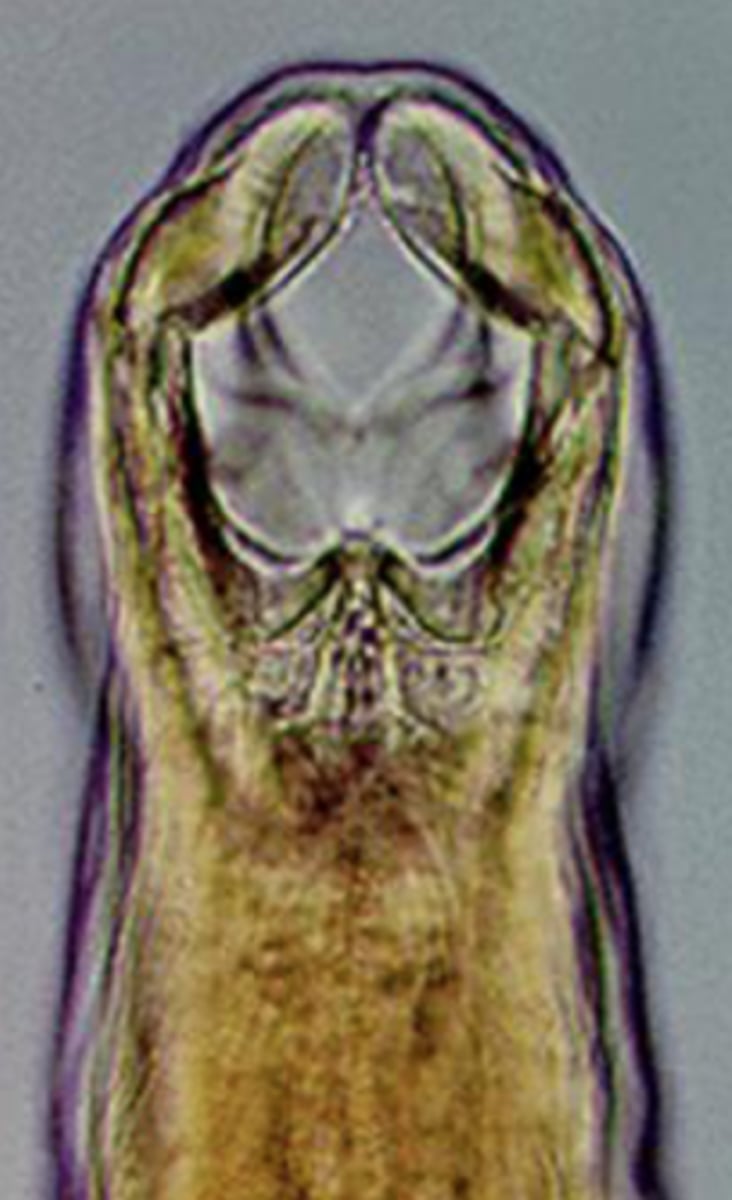
Uncinaria stenocephala
The scientific name of the hookworm that is primarily endemic to temperate climates
Uncinaria stenocephala, acylostoma caninum
Egg on the left is ____________ and the egg on the right is ____________
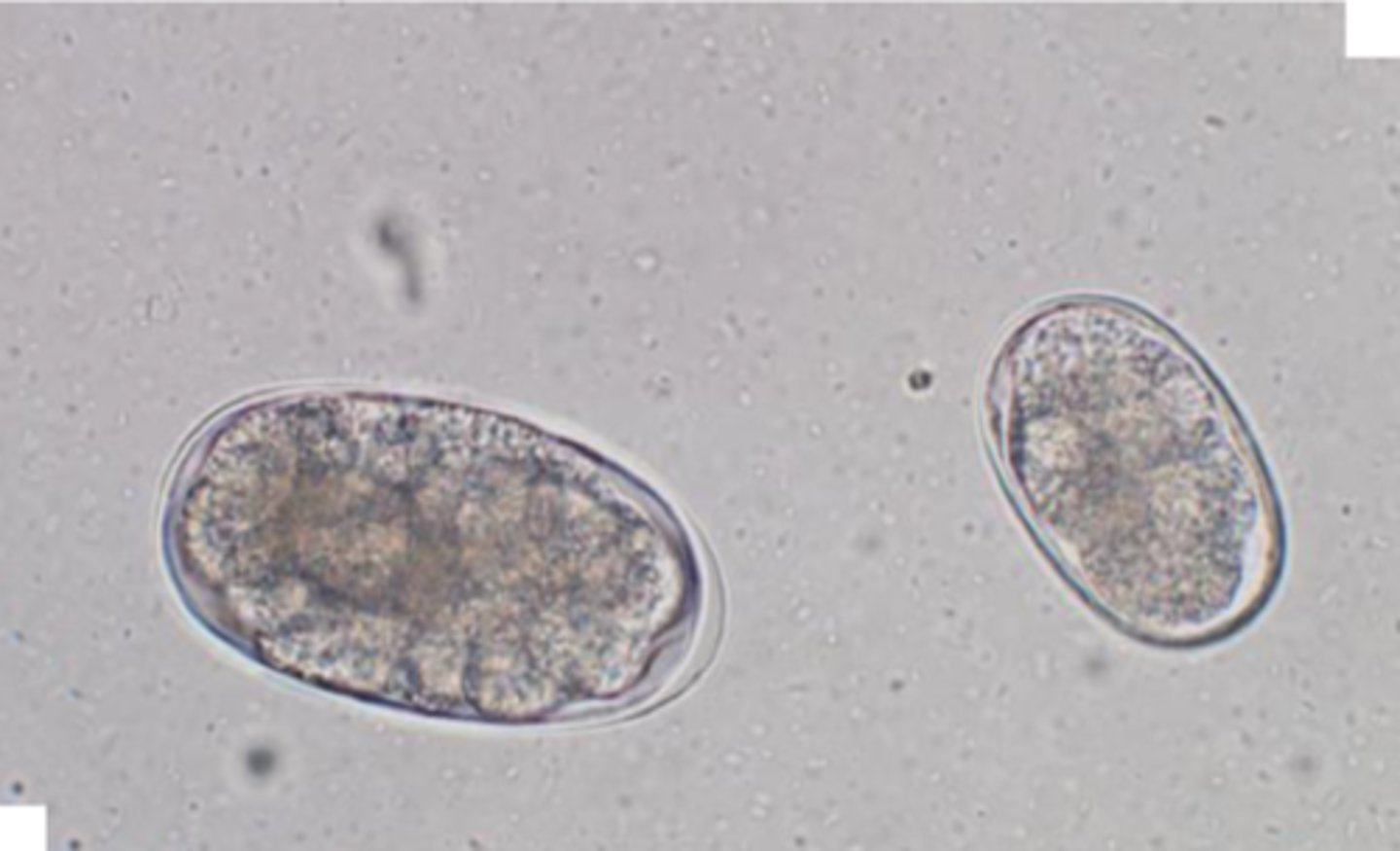
Uncinaria stenocephala
This fecal egg is 70-90 * 40-50 um, has a 68 degrees F optimal and able to develop in cooler climates and has no vertical transmission in cats/dogs
Roundworms
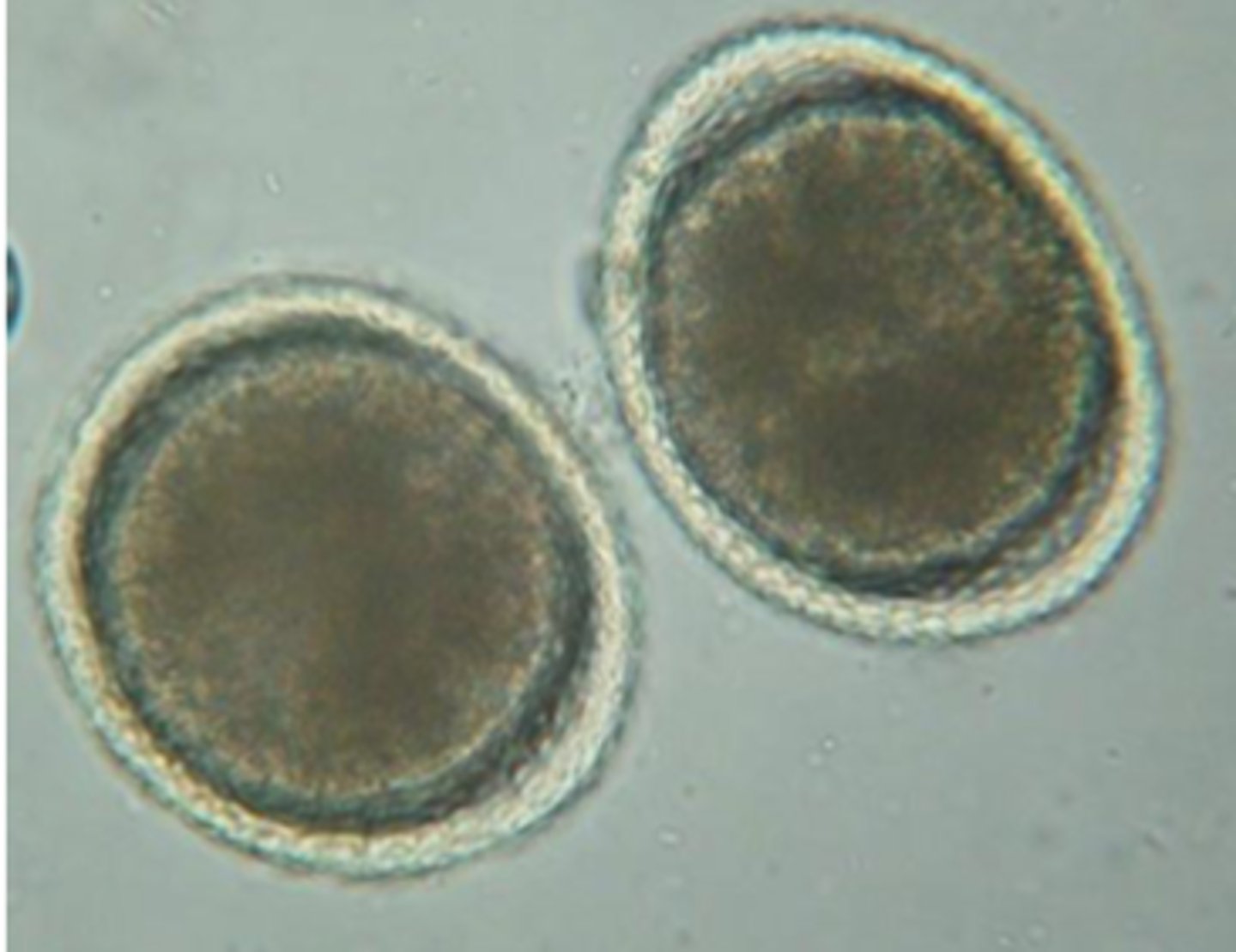
Toxocara canis
What is the scientific name for canine roundworm?
Roundworms
These types of worms are large stout and up to 60 cm in length
Roundworms
These type of worms in the canine has a mouth with 3 lips rather than large (open) buccal capsule
Mechanical, pneumonia
Roundworm can cause ____________ damage from migration through the alveoli leading to ____________
Roundworms
These type of worms cause irritation in gut as worms mature resulting in malaise (ADR), Vomiting, anorexia and diarrhea
Toxocara canis
A clinical presentation of this worm in dogs is a pt bellied appearance, hair coats with dried vomit and diarrhea, poor BCS, emaciated, dull hair coat
Pyrantel
This is the drug of choice for Toxocara canis
Toxocara cati
The feline roundworm scientific name is ____________
Toxocara cati
What roundworm is this in scientific name?
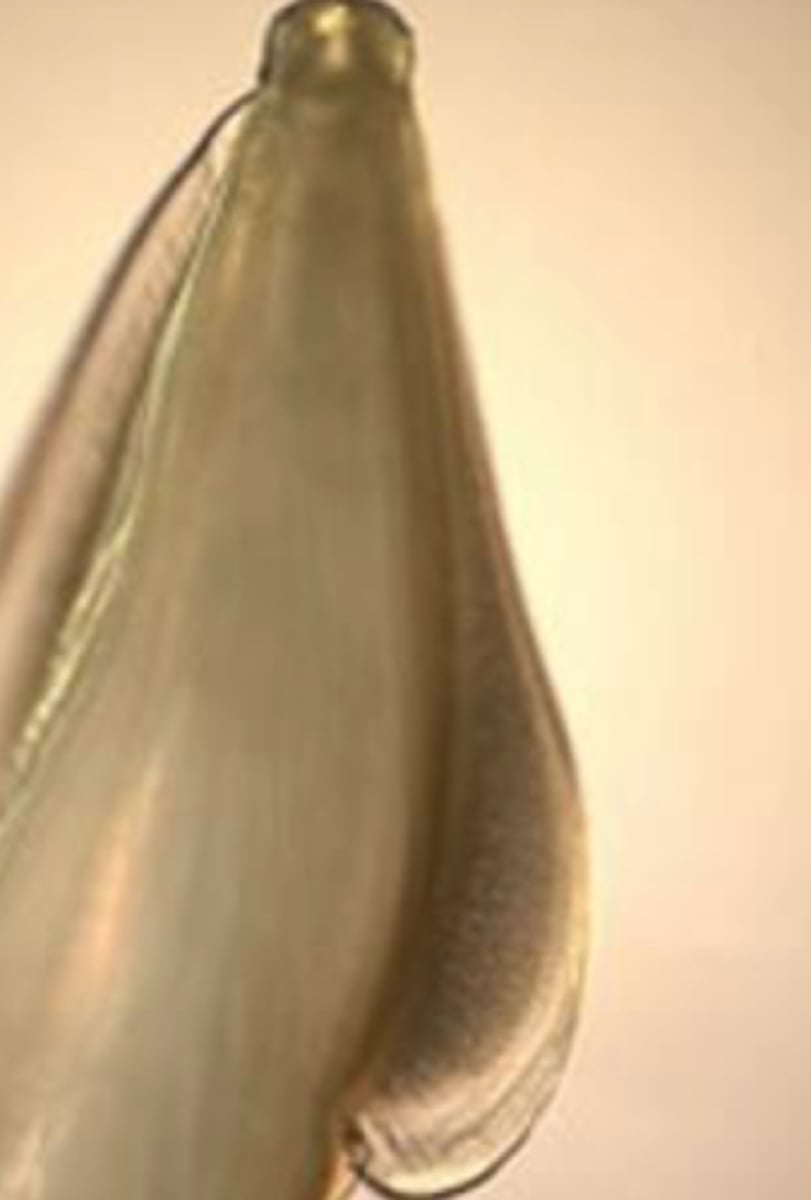
Toxocara canis
What roundworm is this in scientific name?
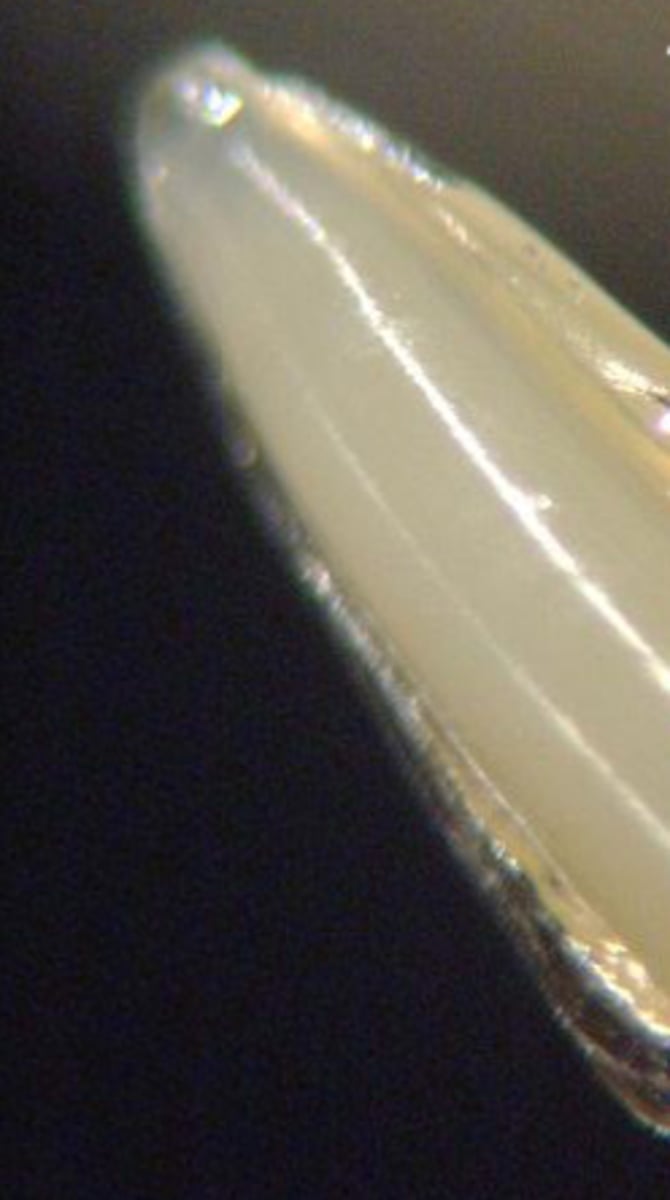
Facultative indirect
____________ ____________ lifecycle is when adult cats typically are infected by consumption of paratenic host (predatory behavior)
Toxocara cati
This type of worm in scientific name has NO in utero infection!
Toxocara cati
What type of worm in scientific name is presented?
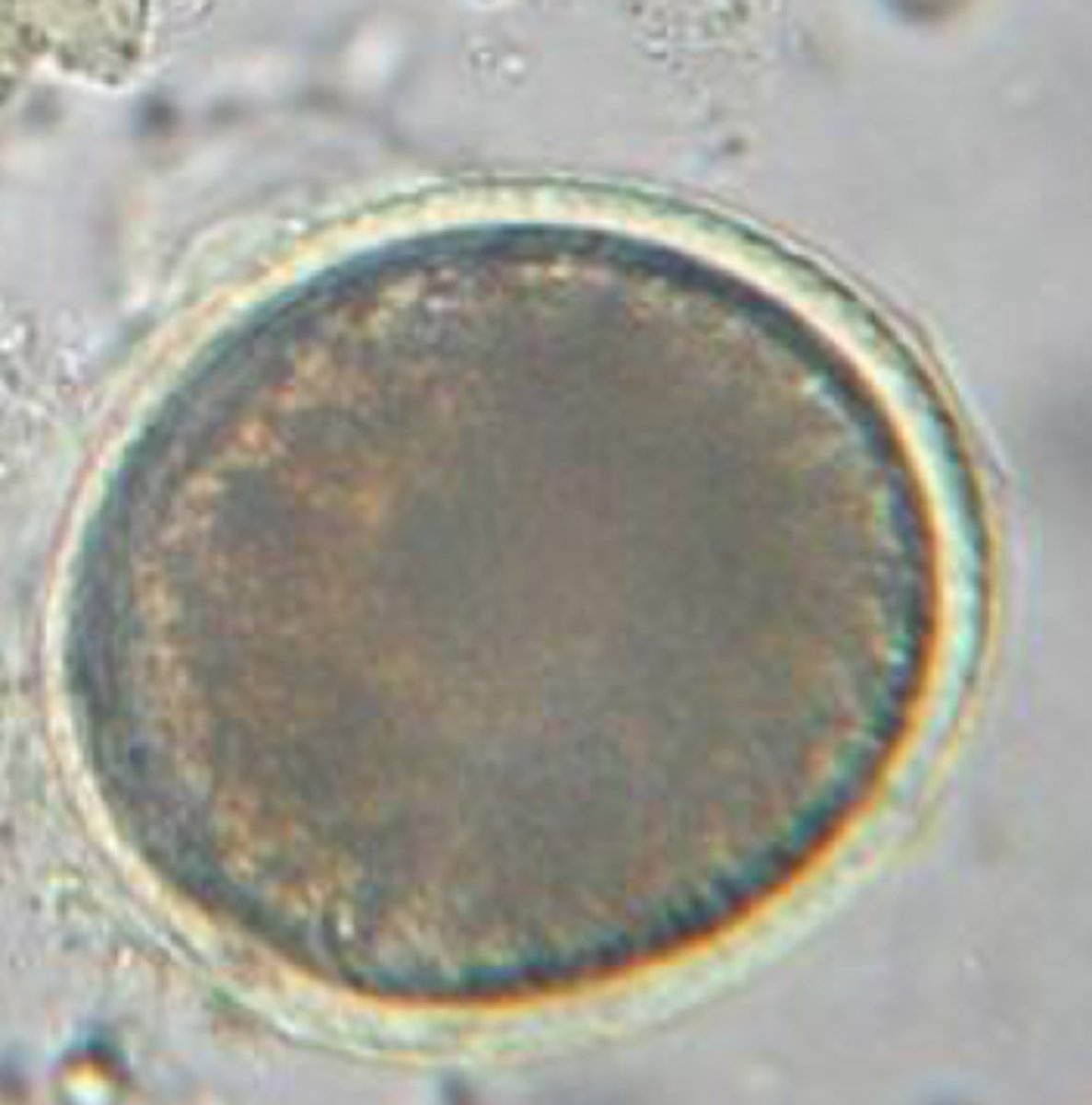
Toxocara cati
What type of worm in scientific name is presented?
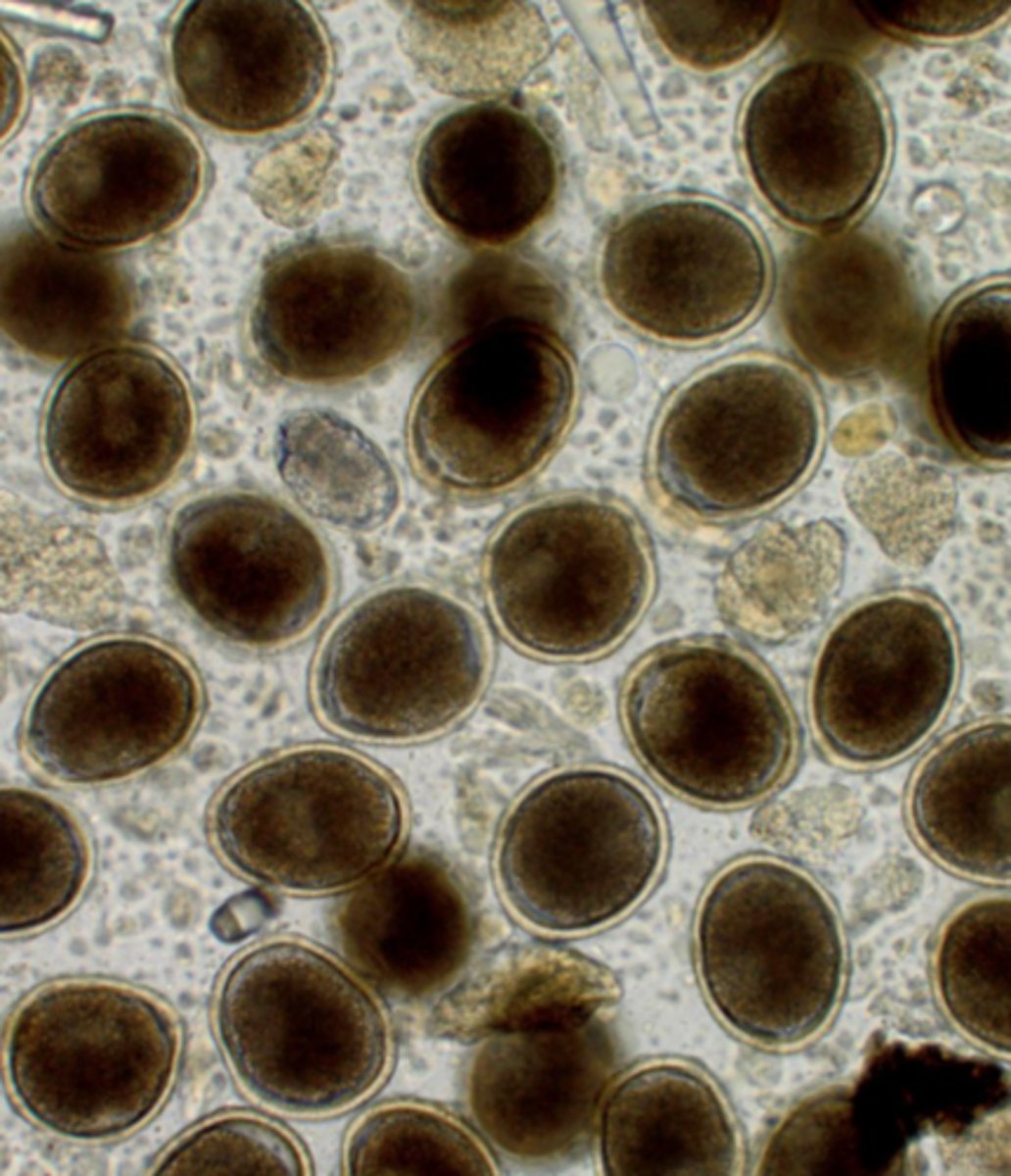
Toxascaris leonia
what type of worm in scientific name is this?
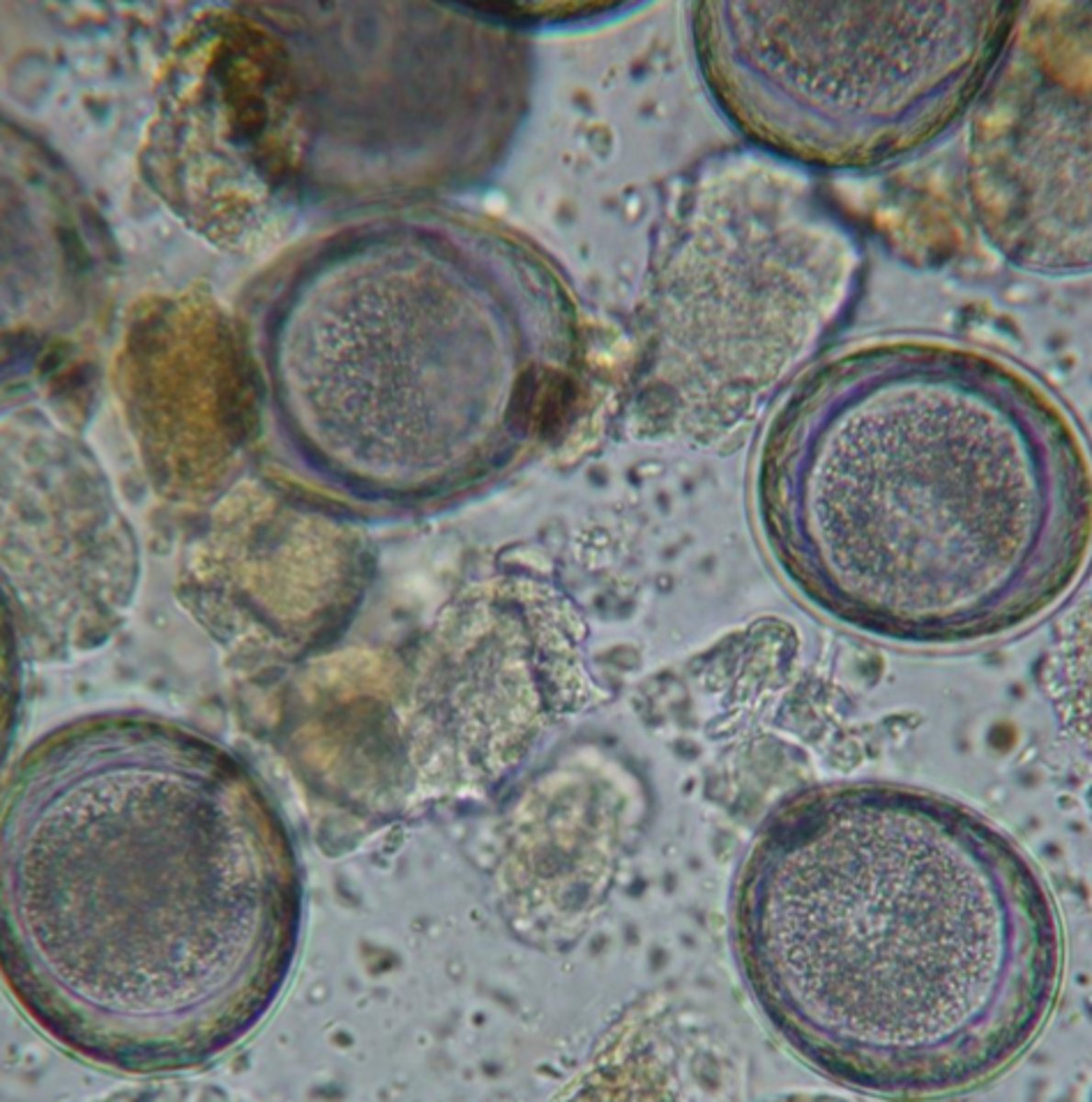
Toxascaris leonia, Baylisascaris procyonis
These types of roundworm does NOT have any tracheal, utero or lactogenic transmission
Toxascaris leonia
These type of roundworms are 85 to 90 um and are often in state of division at room temperature and has a light, translucent single cell embryo
Baylisascaris procyonis
What type of worm in scientific name is presented?
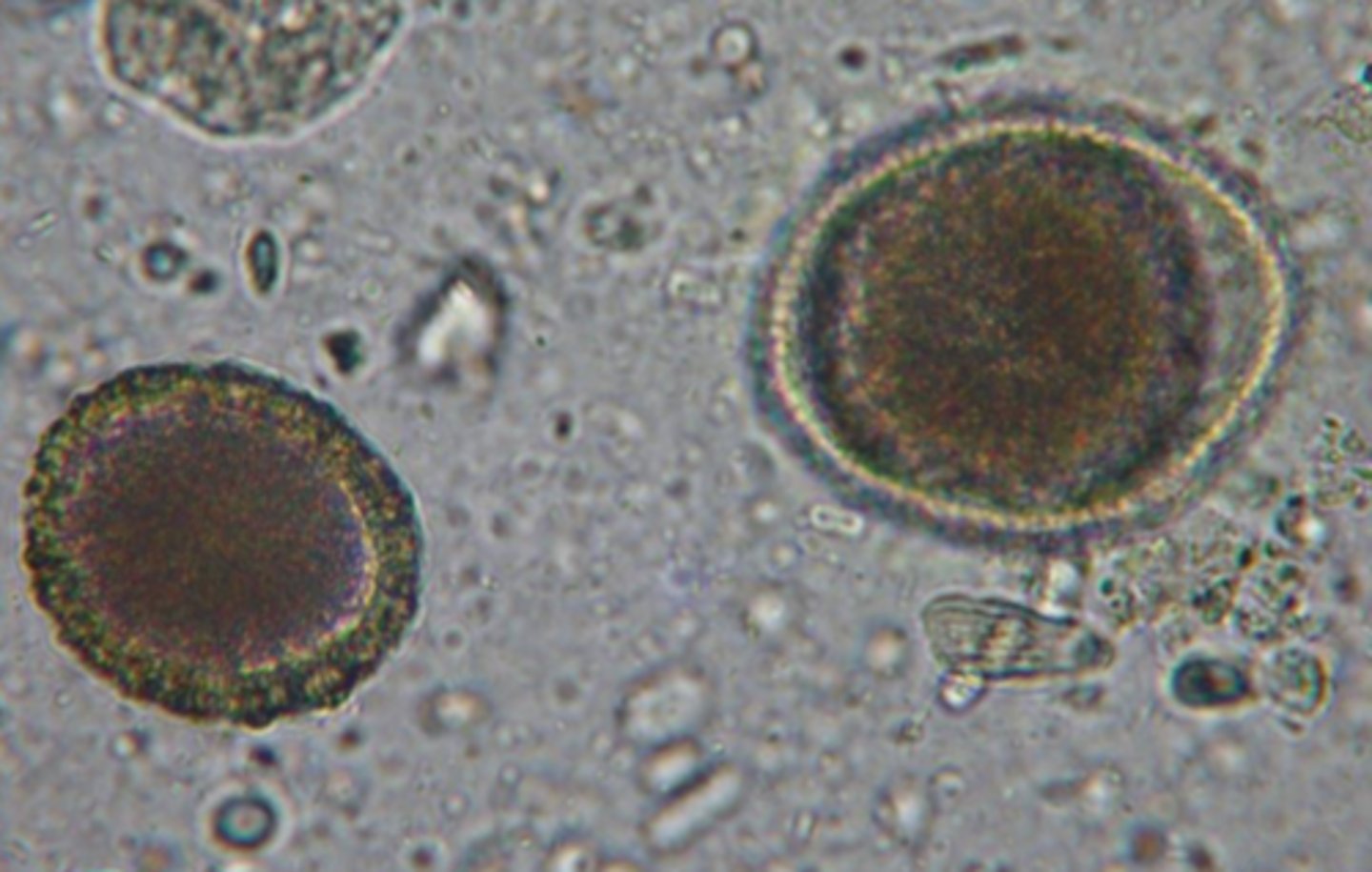
Baylisascaris procyonis
What is the scientific name of the raccoon roundworm?
Baylisascaris procyonis
These eggs on a fecal examination are sub spherical to round to slightly oval, thick albuminous shell, finely pitted surface, golden brown and a dark single embryo and range from 63 to 88 um by 50 to 70 um
Baylisascaris procyonis
What is the scientific name of this worm eggs?
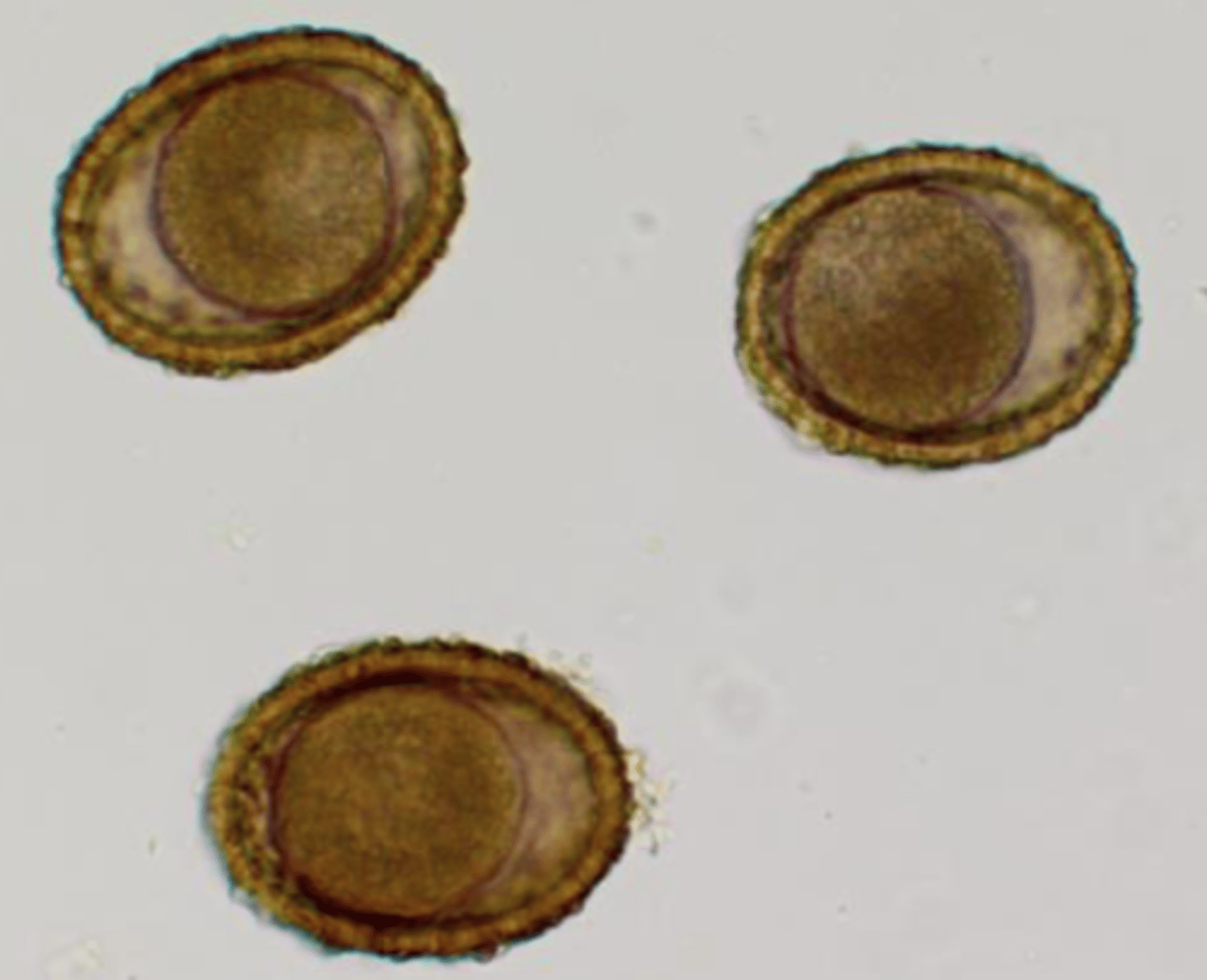
Trichuris vulpis
What is the scientific name for canine whip worm?
Trichuris vulpis
These are small worms with whip like anterior ends and are ~30-5o mm
Trichuris vulpis
This type of worm has a tiny buccal capsule with a long esophagus that is approximately 2/3 of the body length
Intestinal lining, large intestine
The trichuris vulpis larvae hatch and develop beneath the ____________ ____________ and migrates to the ____________ ____________
Bowel, cecum
Trichuris vulpis adults are found in the lower ____________ and ____________ approximately 3 months
Trichuris vulpis
These only have infection by ingestion of larvated eggs
Trichuris vulpis
This type of worm causes dyslexia, weakness and weight loss. Intermittent vomiting and diarrhea as well as flecks of red blood in the diarrhea in severe infections
Trichuris vulpis, sodium/potassium, Psuedo-Addisons
This type of worm (____________) causes electrolyte imbalances with a decreased ____________ ____________ ratio and can cause ____________ disease
Trichuris vulpis
What is the scientific name of these eggs found on this fecal float?
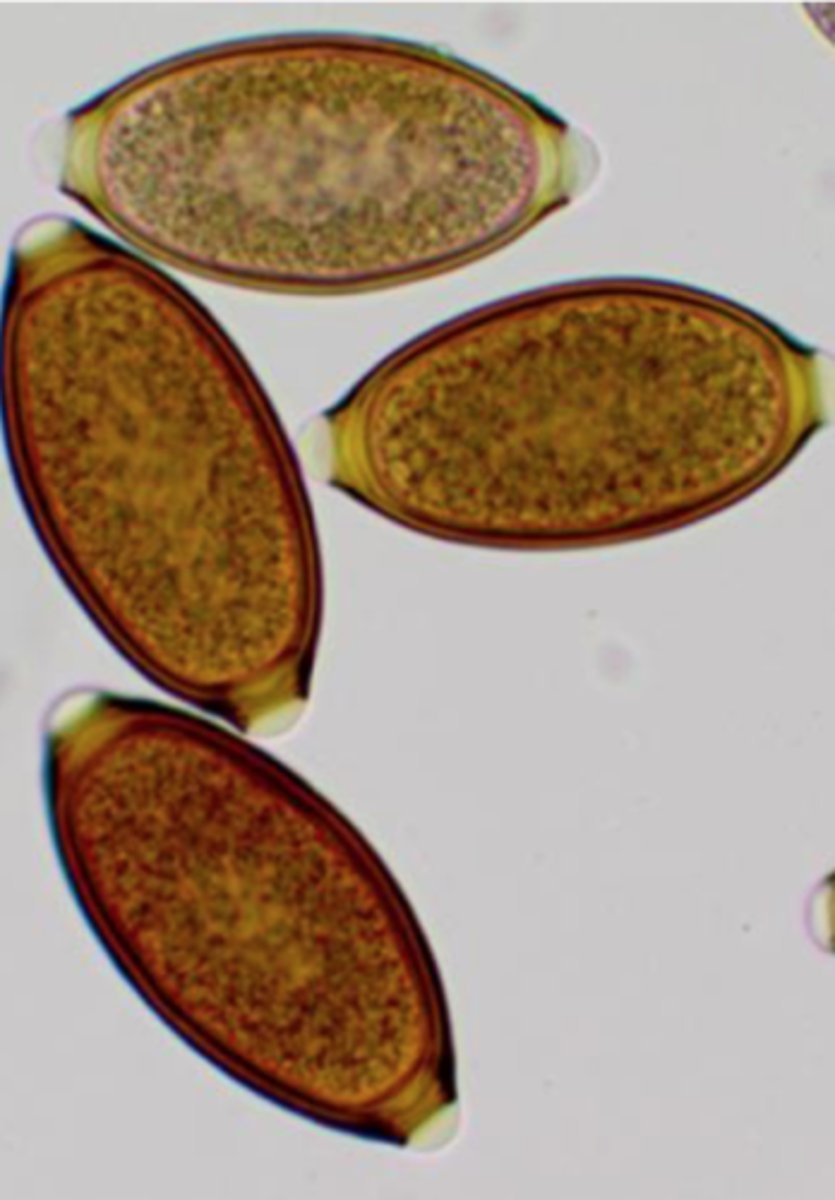
Trichuris vulpis
What is the scientific name of these eggs found on this fecal float?
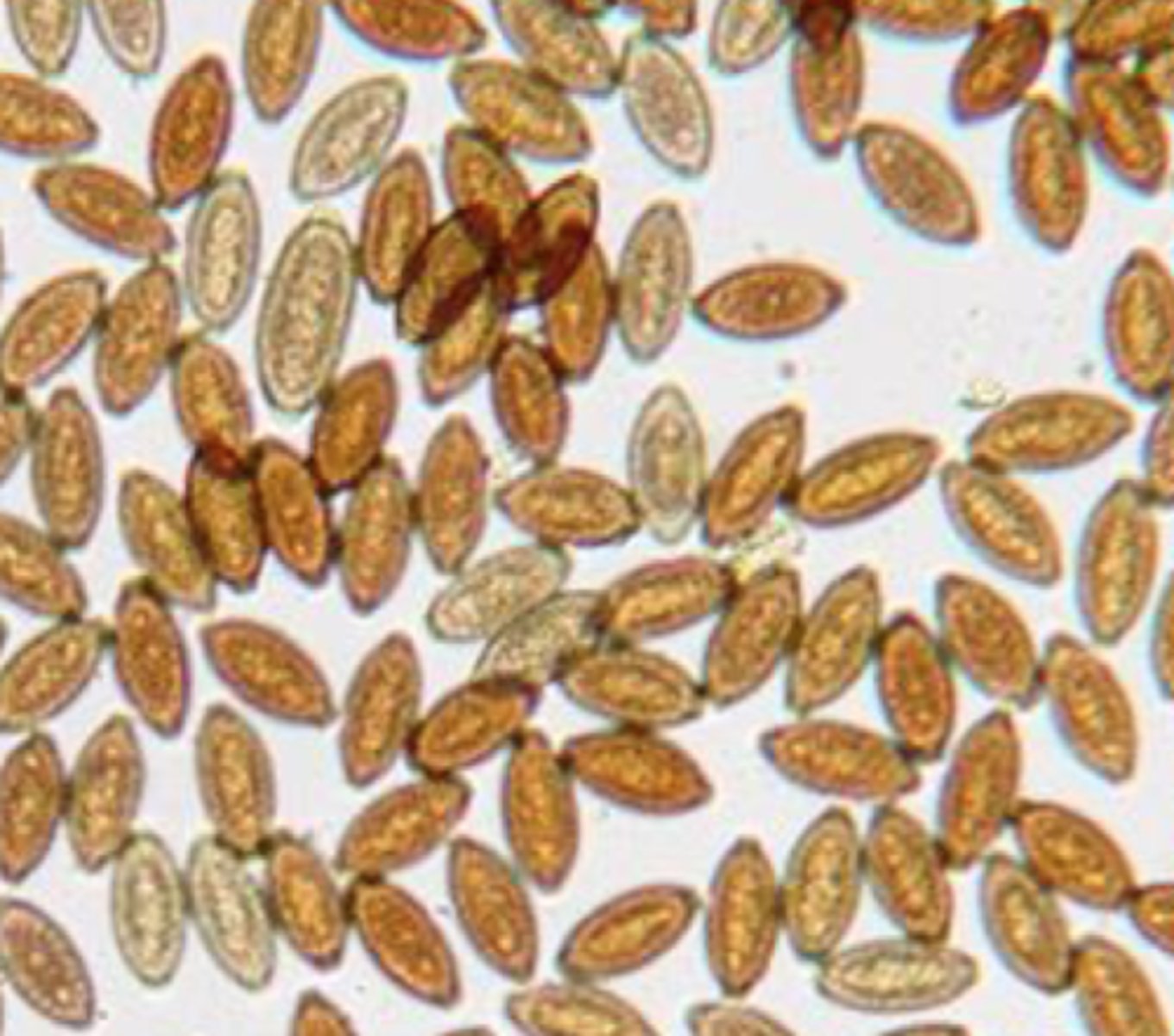
Strongyloides stercoarlis
This type of worm is a causative agent of severe diarrhea and respiratory complaint in neonatal puppies
Strongyloides stercoralis
The phenomena of arrested larval development in the nursing female as a source of infection for neonatal puppies is associated with which type of worm in scientific name?
Strongyloides stercoralis
What is the scientific name of the intestinal threadworm for dogs?
Females, parthenogenesis, homogonic
With strongyloides stercoarlis, only the ____________ are parasitic and the term for this is ____________ and is a ____________ type of life cycle
Heterogonic
With strongyloides stercoralis, a ____________ lifecycle involves free-living males and female worms
Strongyloides stercoarlis
____________ is associated with the clinical disease of watery diarrhea, dehydration, death or verminous pneumonia in puppies
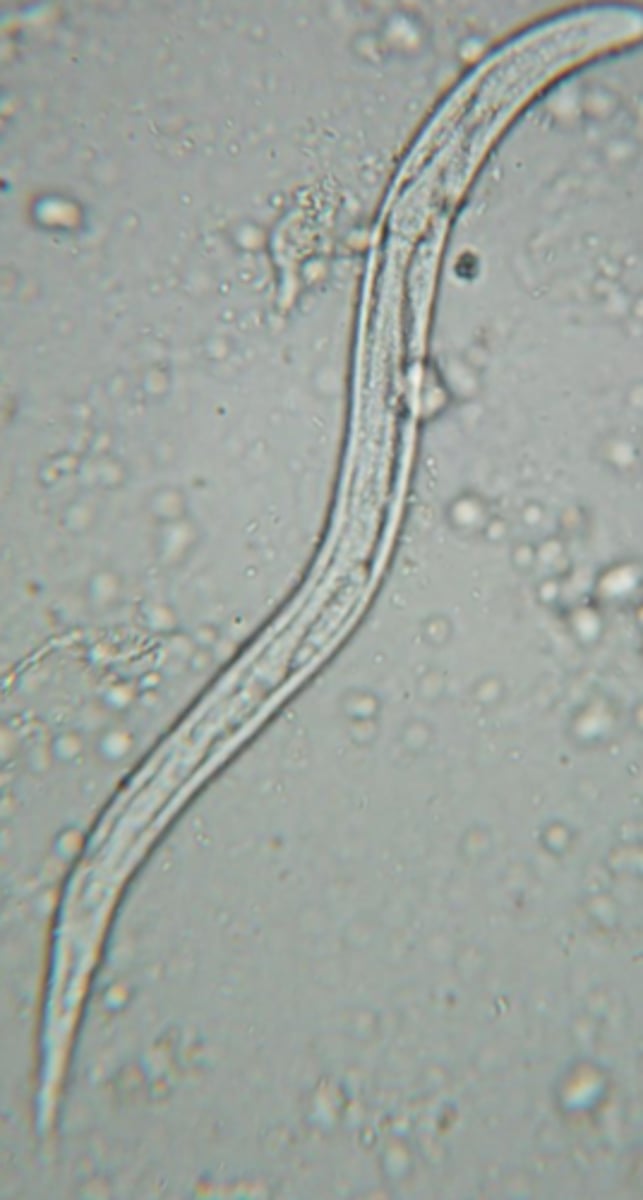
Strongyloides stercoarlis, L1 stage
What type of worm is this and what stage is it currently in?
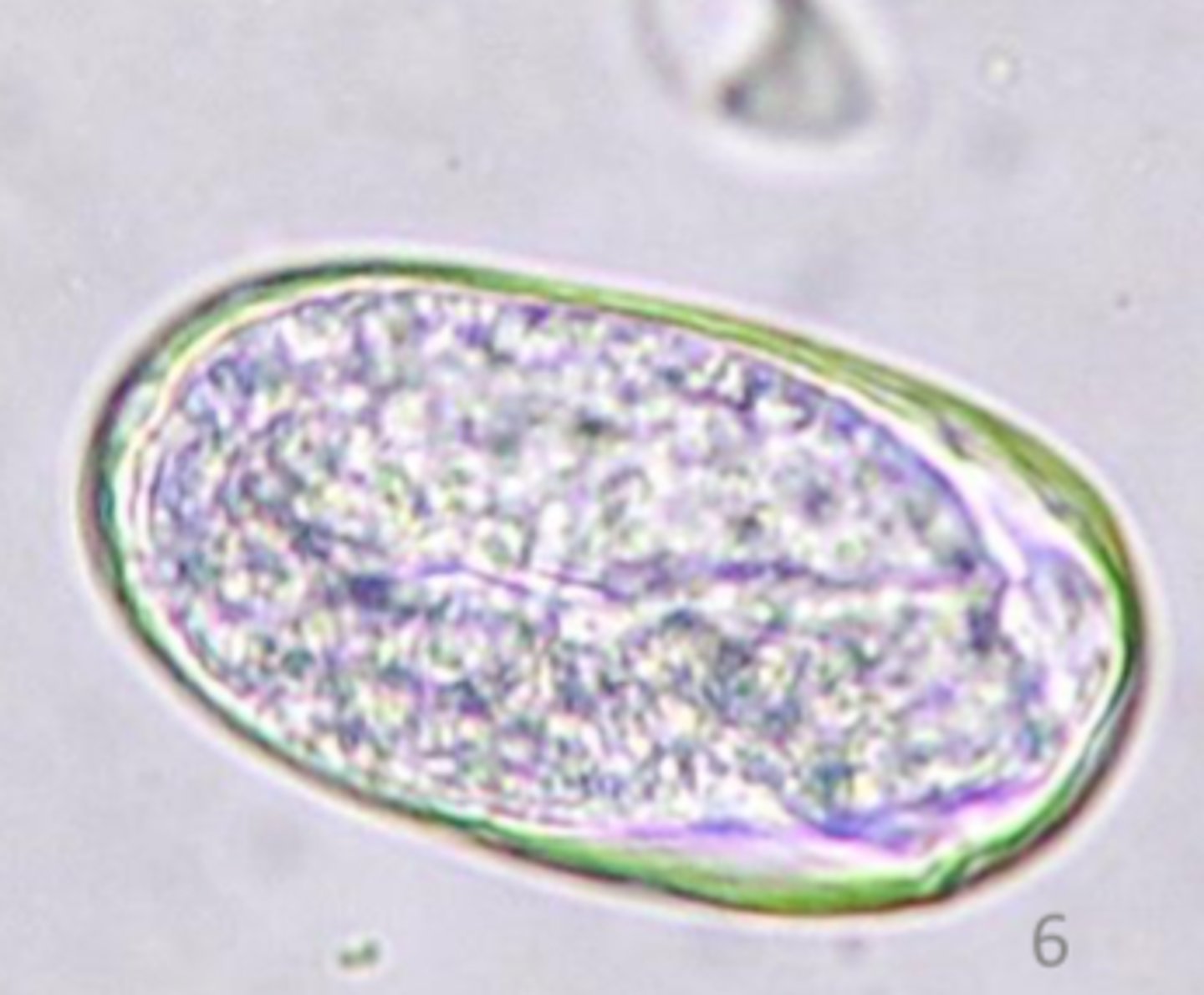
Strongyloides stercoarlis, larvated eggs
What type of egg is found on this fecal float that is ~50 * 35 um?
Strongyloides stercoarlis
With ____________, nothing is effective for tissue stages, but can try to ouse IVM or FBZ to prevent and treat as an extra label
Strongyloides stercoralis
A 12 weeks old aussie presented with a cough of 3 days, vaccines current, purchased from a breeder is BAR, and temp and pulse were normal as well as BCS. You hear broncho-vesicular sounds on auscultation and the fecal exam was negative. You treat with FBZ SID for 3 days. Your patient returns a week later and cough is improved but not resolved. Your patient now has diarrhea and returns to the clinic 7 days later, 14 days from initial and feces contained blood and mucus and cough was much worse. What does your patient most likely have?
Stomach dwelling worms
____________ are causative agent of recurrent gastritis and gastric bleeding in dogs and cats (common name)
Ollulanus tricuspis
What is the scientific name of the feline stomach worm?