Supply Chain Chapter 6
 Call Kai
 Learn
Learn Practice Test
 Spaced Repetition
 Match
Match Flashcards
 Knowt Play
1/50

There's no tags or description
Looks like no tags are added yet.
Name | Mastery | Learn | Test | Matching | Spaced | Call with Kai |
|---|
No analytics yet
Send a link to your students to track their progress
51 Terms
Sourcing
identifying a company that provides a needed good or service
Strategic Sourcing
a comprehensive approach for locating and sourcing key suppliers to leverage its consolidated purchasing power to find the best possible values in the marketplace
How it works:
identifying suppliers
cultivating relationship
continuously improving skills
understanding and embracing the possibilities
Drivers of Strategic Sourcing
improve long-term financial performance
increase customer focus
improve product quality
reduce the cost of materials
reduce delivery lead times
optimize the number of global suppliers (Note: for most companies, this means a reduction in suppliers)
deliver more innovative products in less time and less expensively than competitors
Objective of Strategic Sourcing
improve the value-to-price relationship
understand the category buying and management process to identify improvement opportunities
examine supplier relationships across the entire organization. Share best practices across the organization
develop and implement multi-year contracts with standardized terms and conditions across the organization
leverage the entire organization’s spend
Insourcing
producing goods or services using a company’s own internal resources
Outsourcing
the traditional definition involves purchasing an item or service externally, which had been produced using a company’s own internal resources previously
the term has more recently become synonymous with the concept of buying an item from an external source of supply regardless of whether the item had been previously produced using a company’s internal resources
Reasons for Single Supplier
to establish a good relationship
less quality variability
lower cost
transportation economies
proprietary product or process
volume too small to split
Reasons for Multiple Supplier
need more capacity
spread risk of supply disruption
create competition
more sources of information
dealing with special kinds of business
Functional Products
MRO items and other commonly low profit margin items with relatively stable demands and high levels of competition (i.e., office supplies, food staples, etc.)
Potential Strategy: Reliable, low cost suppliers (Multi-sourced)
Innovation Products
characterized by short product life cycles, volatile demand, high profit margins, and relatively less competition (i.e., technology products such as the iPone)
Potential Strategy: Innovative, high-tech, cutting edge, market leading supplier. Long term partnership (Single-sourced)
Framework for Sourcing Strategy Development
identify the targeted spend area
create the sourcing team
develop a team strategy and communication plan
gather market information
develop a supplier portfolio
develop a future state
select suppliers and negotiate
implement Supplier Relationship Management (SRM)
Spend Analysis
categorizing and analyzing expenditure data for the purpose of decreasing costs, improving efficiency, and monitoring compliance
Basic steps for conducting a spend analysis include:
Defining the scope (e.g., expenditures over a specific time period)
Identify all of the data source
Gathering and consolidating all of the data into one database
Cleansing the data (finding and correcting errors) and standardizing it for easy review
Categorizing the data (e.g., commodity and sub-commodities)
Analyzing the data for:
the best deals per supplier
to ensure that all purchases are from preferred suppliers
to reduce the number of suppliers per category
Repeating the process on a regular schedule
Key area of a typical spend analysis are:
total historic expenditures and volumes
future demand projections or budgets
expenditures categorized by commodity and sub-commodity
expenditures by division, department, or user
expenditures by supplier
Supply Base
the group of suppliers from which a company acquires goods and services
Supply Base Rationalization (supply base reduction, supply base optimization)
reduction in the supply base to the lowest number of suppliers possible without significantly increasing risk
firms emphasize long-term strategic supplier alliance, consolidating volume into one or fewer suppliers, resulting in a smaller supply base
General Sourcing Categories: Non-Critical
routine items that involve a low percentage of the firms’ total spend and involve very little supply risk. e.g., standard screws in a computer factory
Low Level Supply Risk and Low Value to the Company
General Sourcing Categories: Bottleneck
unique procurement problems. Supply risk is high and availability is low. Small number of alternative suppliers. e.g., an integral part of technology hardware, the power pack for a laptop
High Level Supply Rist and Low Value to the Company
General Sourcing Categories: Leverage
commodity items where many alternatives of supply exist, and supply risk is low. Spend is high and there are potential procurement savings. e.g., plastic or raw material for Lego bricks
Low Level Supply Rist and High Value to the Company
General Sourcing Categories: Strategic
strategic items and services that involve a high level of expenditure and are vital to the firm’s success. e.g., the Qualcomm chipsets for mobile phones
High Level Supply Rist and High Value to the Company
Kraljic Model
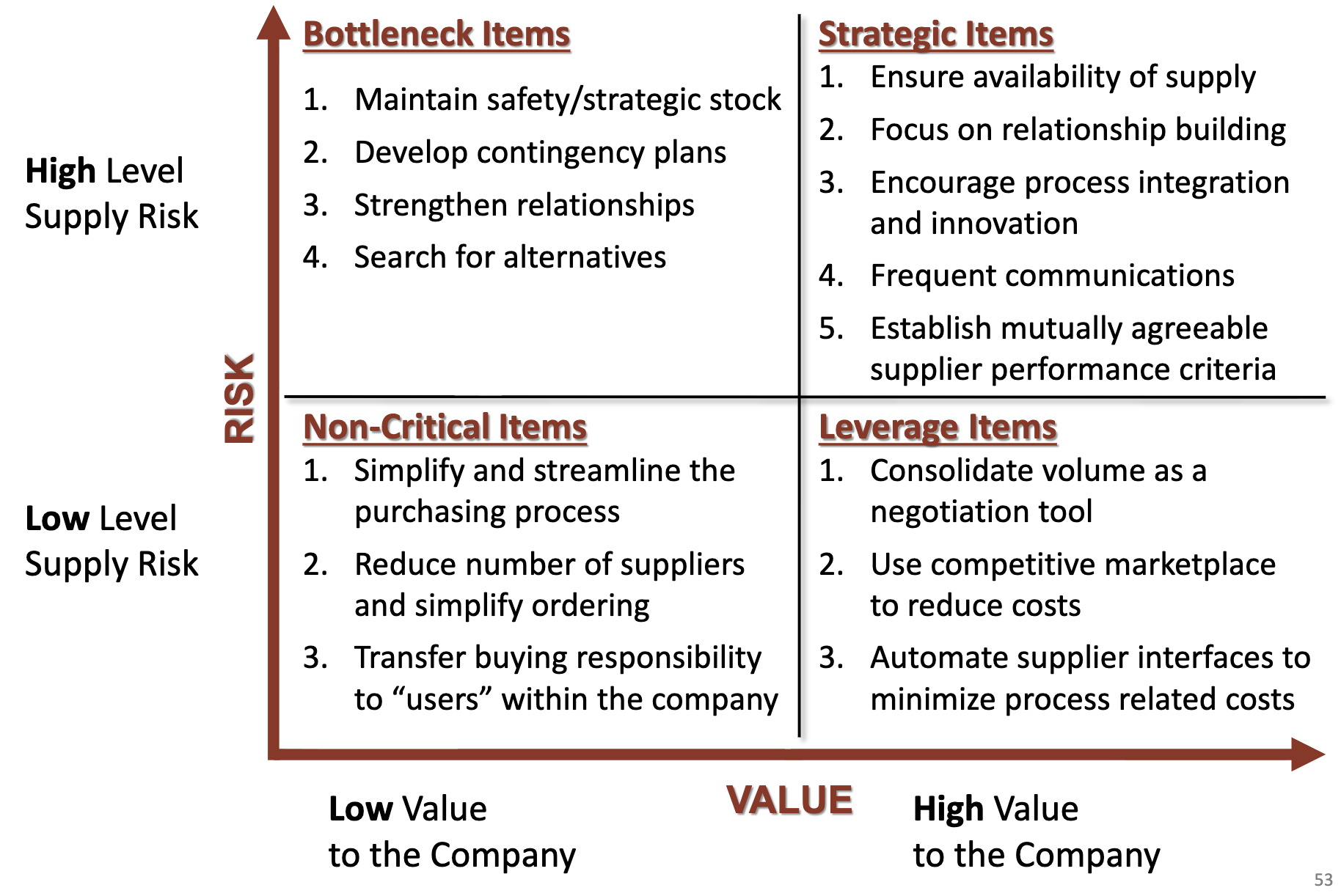
Example of Sourcing Categories
banking services
books and publications
catering and hospitality
chemicals
component parts
computer hardware
consultants
energy/utilities
entertainment
food services
furniture
gases and fuels
insurance
janitorial
legal services
laundry and uniforms
medical supplies
memberships
office supplies
printing
raw materials
shipping services
site/landscaping
software
telecommunications
training
transportation
travel
vehicles/equipment
waste disposal
Supplier Selection
conducted by a cross-functional team
the process of selecting suppliers is complex and should be based on multiple criteria using evaluation forms or scorecards
commonly used criteria:
cost
quality
capacity
service
location
reliability
communication capability
order system and cycle time
willingness to share information
product and process technologies
Artificial Intelligence (AI)
improve supplier selection and increase the effectiveness of supplier relationship management
supplier-related risks are a major consideration for supply chain professionals
just one mistake on the part of a supplier, and a company’s reputation can be damaged significantly
quickly and throughly analyze supplier-related data such as on-time in-full delivery performance, audits, evaluations, and credit scoring and provide information to use for future decisions regarding certain suppliers
a company can make better supplier decisions and improve its customer service
Preferred Suppliers
best meet your company’s overall purchasing requirements
Supplier of Choice
achieve a specific and exceptional level of performance over time as measured by a set of criteria agreed upon by both buyer and supplier
typically trusted partners who know the buyers organization, processes procedures, and requirements
provide a higher value than their competitors and are characterized as reliable, responsive, flexible, and cost effective
Preferred suppliers provide:
product and process technology, and expertise
product development and value analysis
information on latest trends in materials, processes, or designs
capacity for meeting unexpected demand
cost efficiency due to economies of scale
Strategic Alliance
insourcing is an agreement between a buyer and a supplier to pursue some agreed-upon objectives while remaining independent organizations
companies agree to share information and resources to achieve a mutual benefit
preferred suppliers are potentially ideal candidates for a strategic alliance
benefits of these types of arrangements include:
potential to increase revenue and profits for both parties
potential to create a competitive advantage or block a competitor from gaining market share
mitigate risks and ensure continuity of supply
position the partners for future strategic opportunities
Distributive Negotiations
refers to process that leads to self-interested, one-sided outcome
Distributive Negotiations: Counterproductive
also called antagonistic relationships
parties work actively agains the needs of each other
neither party take responsibility for what happens in the relationship
destructive conflict occurs
Distributive Negotiations: Competitive
also called adversarial relationship
parties engage in competitive struggle over fixed value
parties attempt to maximize value for their side
minimal sharing of information
Collaborative Negotiations
both sides worth together to maximize the outcome or create a win-win result. Requires open discussions and free-flow of information between parties
start with a clearly expressed understanding of how each company wants to benefit from the collaboration
alignment between parties regarding motivation, contribution, financial benefit, and the management of the alliance are essential
negotiations are not about each company obtaining the most value, negotiations are more about establishing a relationship that works well for both parties
Collaborative Negotiations: Cooperative
parties work together and share information
closer relationships are a result of mutual goals and trust
supplier and buyer involvement increases
Collaborative Negotiations: Collaborative
congruence of goals exists between parties
parties work together to create new business opportunities and to share risk, rewards and resources
parties work jointly to identify creative solutions to problems
Reverse Auctions
a sourcing technique where pre-qualified suppliers enter a website at a pre-designated time and date and try to underbid competitors to win the buyer’s business
the seller bid against one another to secure the buyer’s business, driving the price for the item downward
bid prices are monitored until the session is officially over. The winning bidder is the seller who offers the lowest price
private companies, public sector agencies, and non-profit organizations all use reverse auctions
Vendor Managed Inventory (VMI)
suppliers directly manage buyer inventories to reduce the buyer’s inventory carry costs and avoid stockouts for the buyer
VMI: Buyer-firm’s perspective
supplier tracks inventories
supplier determines delivery schedules and order quantities
buyer can take ownership at the stocking location
buyer may also be able to avoid taking ownership until the material is actually being used
VMI: Supplier’s perspective
avoids ill-advised customer orders
supplier decides inventory set up and shipments
opportunity for supplier to educate customers about other products
Co-Managed Inventory
an arrangement where a specific quantity of an item is stored at the buyer’s location
once it is used, the item is replaced by the supplier, with the full knowledge and approval of the buyer
the buyer provides systems access to the supplier, who manages the replenishment process in the buyer’s system
the supplier reviews all available information and generates orders in the buyer’s system
the primary difference from VMI is that in CMI, the supplier is just recommending an order, which is not confirmed until and unless the buyer approves it
Supplier Co-location
similar to VMI and CMI, except that a representative of the supplier is actually embedded in the buyer’s purchasing group to forecast demand, monitor inventory, and place orders
the employee is on the payroll of the supplier but works for the buyer and is empowered to forecast demand, monitor inventory and place orders
the arrangement involves the buyer granting the supplier access to potentially proprietary or sensitive data
benefits both buyers and suppliers, from day-to-day operational improvement, to strategic advances in the structure of the supply chain organization
Corporate Social Responsibility (CSR)
practice of business ethics
Business Ethics
application of ethical principles to business
two main ethical approaches:
utilitarianism
rights and duties
Business Ethics: Utilitarianism
ethical act is that which creates the greatest good for the greatest number of people, and should be the guiding principle of conduct
Business Ethics: Right and Duties
some actions are just right in and of themselves, regardless of the consequences. Do the right thing
Ethical Sourcing
consider the public consequences of organizational buying or to bring about positive social change through organizational buying behavior
this involves the procurement organization ensuring that the sourced products are acquired responsibly and sustainably
the people producing these products should be treated fairly and work in a safe environment
the environmental and societal impacts must also be considered as part of the sourcing process
Sustainability
the ability to meet the current needs of the supply chain without hindering the ability to meet future needs in terms of economic, social, and environment challenges
do not mortgage the future for the present
companies must consider worker safety, wages, working conditions, human rights, etc.
Sourcing Programs Should Try: Grow Revenues
growing the company through the launch of new sustainable
Sourcing Programs Should Try: Reduce Costs
increasing resource efficiencies, which will also help to reduce costs
Sourcing Programs Should Try: Go “Green”
ensuring that the products or materials used meet environmental objectives for things like waste reduction, reuse, and recycling
Sourcing Programs Should Try: Manage Risks
link company brands to the social consciousness of consumers
Sourcing Programs Should Try: Build Intangible Assets
such as social and environmental responsibility, increasing consumer awareness of sustainable sourcing and sustainability

