Gavande Steroidal Sex Hormones
 Call Kai
 Learn
Learn Practice Test
 Spaced Repetition
 Match
Match Flashcards
 Knowt Play
1/45

There's no tags or description
Looks like no tags are added yet.
Name | Mastery | Learn | Test | Matching | Spaced | Call with Kai | Chat |
|---|
No analytics yet
Send a link to your students to track their progress
46 Terms
What are steroid hormones synthesized from?
What are their major functions?
Steroid hormones are synthesized from enzymatically modified cholesterol.
They affect the development of reproductive organs and sexual characteristics.
How many carbon atoms are in the steroid core?
How many fused rings?
What types of rings?
17 carbon atoms.
4 fused rings.
Three cyclohexane rings (A, B, and C) and one cyclopentane ring (D).

What are the three major steroid sex hormone classes discussed in the lecture?
Androgens, estrogens, and progestins.
How many carbons do androgens have?
Estrogens?
Progestogens/progestins?
19 carbons.
18 carbons.
21 carbons.
Where is testosterone produced according to the lecture?
What are they responsible for?
Testes, adrenal gland, and ovary.
They are responsible for secondary male sex characteristics.
What are pharmacological actions of testosterone?
It stimulates skeletal muscle growth, accelerates bone epiphysis closure, and stimulates renal erythropoietin (signals your bone marrow to make more red blood cells).
What are listed therapeutic uses of testosterone?
Hypogonadism, anemia, and osteoporosis.
What is the oral absorption of testosterone?
Testosterone has high oral absorption, but has low systemic bioavailability because it undergoes high first-pass metabolism.
What happens when testosterone is esterified? At what carbon?
Esterification at C17 makes testosterone more lipophilic and allows it to be dissolved in oil.

What happens to testosterone esters after administration?
Route of administration?
How often?
Disadvantages/adverse effects?
They are hydrolyzed to testosterone in the circulation.
Intramuscularly.
Approximately every 1-2 weeks.
Cough (injection → tiny oil droplets enter blood → travel to lungs → temporary pulmonary irritation), pain at the injection site, and symptom fluctuations.
What are the two structures for modifying testosterone discussed in the lecture?
17α-esters and 17α-alkyls.
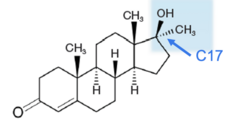
What is a 17α-alkyl androgen?
A testosterone derivative containing a 17α-alkyl modification that slows hepatic metabolism and allows oral administration.
What is 17α-methyltestosterone (Testred® and Android®)?
How often?
Is it recommended?
A 17α-alkylated androgen.
It is short acting and is taken daily.
NOT recommended because of potential liver toxicity, and not easily detectable via immunoassay, making therapy difficult to monitor.
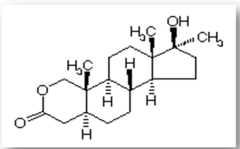
What is oxandrolone and its effects?
A 17α-alkylated androgen with relatively strong anabolic effects + relatively weaker virilizing effect.
(Virilizing effects: Male pattern baldness and facial hair.)
It offsets protein catabolism.
It can relieve osteoporosis bone pain.
What is anabolic steroid abuse according to the lecture?
Three common strategies?
Any use of anabolic steroids without a doctor's prescription.
Stacking, cycling, and pyramiding.
What is stacking?
Cycling?
Pyramiding?
Taking multiple types or formulations of steroids at once to increase results. It is not scientifically proven to work.
Taking multiple doses of steroids for weeks, stopping for weeks, and then restarting. This allows the body to produce its own testosterone and reduce damage to internal organs.
Starting a steroid cycle with a low dose, gradually increasing to a maximum dose around mid-cycle, and then slowly tapering the dose down.
Hypothalamus-pituitary-gonadal axis.
Hypothalamus releases ____→
pituitary releases ___ and ___ →
gonads (testes/ovaries) produce sex hormones such as ______, ______, and ______.
Hypothalamus releases GnRH →
pituitary releases FSH and LH →
gonads (testes/ovaries) produce sex hormones such as estrogen, progestogens, and testosterone.
What are GnRH receptor agonists?
GnRH analogues that initially stimulate GnRH receptors but subsequently cause receptor downregulation and suppression of gonadal hormone production.
What are the listed uses of GnRH receptor agonists?
Prostate cancer, breast cancer, endometriosis, dysfunctional uterine bleeding, fibroids (benign tumors), and precocious puberty (premature puberty).
What GnRH receptor agonists are listed in the lecture?
Route of administration?
Leuprolide, goserelin, and triptorelin.
They are all injectable
What are GnRH receptor antagonists?
Examples?
Synthetic decapeptides that directly inhibit secretion and release of LH and FSH, preventing the release of testosterone.
Ganirelix and cetrorelix.

What are uses of GnRH antagonists listed in the lecture?
Relieving symptoms associated with prostate cancer and controlled ovarian stimulation to inhibit a premature LH surge.
What are nonsteroidal androgen receptor antagonists?
Examples?
Antiandrogen drugs that antagonize the androgen receptor and are used for prostate cancer.
Flutamide, bicalutamide, nilutamide, and enzalutamide.
What are 5α-reductase inhibitors?
Indications?
How often?
Adverse effects?
Antiandrogenic agents that inhibit conversion of testosterone to dihydrotestosterone.
Benign prostatic hyperplasia (BPH) and androgenic alopecia (male pattern baldness).
Requires continuous treatment.
Decreased libido and sexual dysfunction. During pregnancy, they can induce genital abnormalities in a male fetus.
What is abiraterone (Zytiga®)?
What is it combined with?
An antiandrogenic agent that inhibits the enzyme CYP17 (specifically C17,20-lyase) in adrenal, testicular, and prostate cancer tissue, especially cancer that is resistant to hormone blockers.
Prednisone.
What is ketoconazole's antiandrogen mechanism?
An antifungal agent that also inhibits glucocorticoid and androgen synthesis.
What is spironolactone's antiandrogen mechanism?
Used in?
It is a competitive androgen receptor antagonist.
Female hirsutism and polycystic ovary syndrome (PCOS).
What are estrogens formed from?
Estrogens are formed by aromatization of androgens by use of the enzyme aromatase.
Where is aromatase located?
Found in the ovary and numerous other tissues in males and females.
During the follicular phase, FSH stimulates the ______ cells to produce estradiol and estrone, which elevates _____ levels
During the luteal phase, LH stimulates the ______ cells to produce high ______ levels
granulosa, estrogen
theca, progesterone
What is 17β-estradiol?
What structural feature does it have that contributes to estrogen receptor binding?
A naturally occurring estrogen.
A phenolic ring.

What functional group can naturally occurring estrogens have at C17?
Either a hydroxyl group or a ketone.
(ignore the red circle in this pic. Look at C17 !)

What is the bioavailability/absorption of estradiol?
What happens when administered orally?
Estradiol is rapidly absorbed through the GI tract, skin, and mucous membranes.
Orally, it has a short half-life measured in minutes and undergoes significant first-pass hepatic metabolism.
When estradiol does make it to the bloodstream, their lipophilicity helps them undergo rapid tissue distribution.
What is ethinyl estrogen?
What is the half-life?
A synthetic estrogen with a C17 modification that inhibits the first-pass effect. After distribution, it is slowly released from adipose tissue. It also does not bind to globulin, as it is an unbound/active hormone in circulation.
13-27 hours.
What are phytoestrogens?
Example?
Plant-derived compounds with estrogenic and/or anti-estrogenic activity. They have a non-steroid backbone.
Soy isoflavones.
What are progestins?
Route of admin?
Synthetic forms of naturally occurring progesterone. They promote development of a secretory endometrium, maintain pregnancy, and suppress menstruation and uterine contractility.
When taken orally, synthetic derivatives have good oral bioavailability.
What is clomiphene citrate?
A nonsteroidal triphenylethylene derivative that inhibits estrogen action and acts as an estrogen agonist/antagonist.
What is clomiphene's mechanism in the hypothalamus?
It acts as a competitive estrogen receptor antagonist in the hypothalamus and may delay replenishment of intracellular estrogen receptors.

What is the overall mechanism of clomiphene?
It competitively antagonizes estrogen receptors in the hypothalamus → the hypothalamus senses low estrogen → GnRH increases → pituitary stimulation → FSH increases 50-60% → estradiol increases.
What are aromatase inhibitors?
Examples of nonsteroidal and steroidal types?
Anti-estrogen agents that inhibit aromatase and therefore reduce estrogen synthesis from androgens.
Nonsteroidal: letrozole, anastrozole
Steroidal: exemestane
Where are estrogen receptors found?
Besides reproductive function, what systems does it help regulate?
Throughout the body.
Lipid and carbohydrate metabolism, the cardiovascular system, the CNS, and skeletal homeostasis.
What are hormone disruptors?
Possible sources?
Chemicals that interfere with the body's endocrine system.
Natural sources, synthetic sources, pharmaceuticals, environmental exposure, and diet.
Exposure can occur intentionally or unintentionally.
Give a full list of examples of hormone disruptors
BPA (Bisphenol A): an estrogen-mimicking compound.
DES (Diethylstilbestrol).
Dioxins: byproducts of manufacturing and can also naturally occur after forest fires and volcanic eruptions.
Pesticides, arsenic, DEHP in plastics, dietary isoflavones such as clover or some whole grains.
Natural vs. Bioidentical hormones?
Can the body distinguish between these?
Natural: principal ingredient has an animal, plant or mineral source.
Bioidentical: identical in structure to what is made in the body. Examples: 17β-estradiol, estrone, estriol, and progesterone.
The body does not distinguish between these two when they are structurally identical.
What are compounded hormones?
Concerns?
Hormone combinations, doses, or preparations made when the desired is not commercially available.
They lack established tests of safety, effectiveness, or dosing consistency.
There is also no evidence that they have fewer side effects or are more effective.
Does hormone-level monitoring correlate with symptom relief?
No. Hormone-level monitoring does not always correlate with symptom relief.
So clinicians should consider both the patient's symptoms AND laboratory values, rather than treating the lab value alone.