CVA Exam 1
 Call Kai
 Learn
Learn Practice Test
 Spaced Repetition
 Match
Match Flashcards
 Knowt Play
1/73

There's no tags or description
Looks like no tags are added yet.
Name | Mastery | Learn | Test | Matching | Spaced | Call with Kai | Chat |
|---|
No analytics yet
Send a link to your students to track their progress
74 Terms
What is the difference between comparative and functional anatomy? Give examples of each.
Comparative anatomy allows us to see ourselves in a broader biological context and helps us form hypotheses to explain patterns observed in nature. An example of this is comparing muscle scars on bones. Functional anatomy focuses on form vs. function. An example of this is EMG, when a muscle is turned on vs. off.
What are the two mechanisms that Charles Darwin proposed?
Descent with modification
Natural selection
What can you compare anatomy across to explore evolution and adaptation?
Taxa
Who invented comparative anatomy?
T.H. Huxley
Adaptation is a _______ (where evolution tinkered through time) and ______ (anatomical structure)
Process, product
Evolutionary descent leads to __________.
Phylogenies
Match the term to its definition:
A. a monophyletic group that includes a single common ancestor and all of its descendants (living and extinct)
B. connects an ancestor to its descendants and represents a lineage or group of organisms changing over time.
C. Represents the most recent common ancestor of all the lineages that come off from that point
Terms: node, clade, branch
A: clade
B: branch
C: node
Differentiate between allopatric vs sympatric speciation.
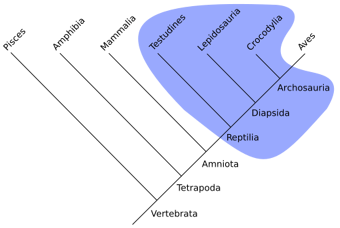
What type of clade is this? Define which type of clade this is.
Paraphyletic: a clade that includes a common ancestor and some but not all of its descendants.

What type of clade is this? Define which type of clade this is.
Monophyletic: includes a single common ancestor and all of its descendants (living and extinct)

What type of clade is this? Define which type of clade this is.
Polyphyletic: a grouping of organisms who are put together based on shared characteristics but do not include a direct common ancestor.
What term goes with this definition?
A group of individuals that descend from a common ancestor that evolved through time and possibly split.
Lineage
Does it matter if you rotate the taxa on a phylogeny?
No, because rotating it does not change the evolutionary relationships.
True or false:
Humans evolved from chimpanzees. We do not share a recent common ancestor.
False. Humans did not evolve from chimpanzees. We’re evolutionary ‘cousins’ & share a recent common ancestor that was neither chimp nor human.
If humans did not evolve from chimpanzees, what is our shared ancestry and how did we accumulate traits during the evolution of homo sapiens?
We are evolutionary cousins who derived from a common ancestor. Over time our adaptations led to bipedalism, big teeth, bigger brains, tools, speech, etc. There was a gradual accumulation of traits and extinctions.
Match the terms with the definitions: (apomorphy, plesiomorphy, autapomorphy, synapomorphy)
A. a self-derived trait that is unique to a specific group. Can diagnose a terminal taxa. Ex: Speech in humans
B. a pre-existing ancestral trait that was present in distant ancestors. Present in outgroups. Ex: having a backbone when looking at fish
C. A shared derived trait that is shared by two or more groups or species. Can diagnose a group. Ex: presence of four limbs in tetrapods
D. A derived trait that evolved from an older ancestral form. Ex: hair in mammals
A - Autapomorphy
B - Plesiomorphy
C - Synapomorphy
D - Apomorphy
Can synapomorphies become plesiomorphies?
Yes.
What term do we use to separate derived vs. ancestral characters? Define this term.
Homology: similarity in structure, sequence, or form due to a shared ancestry or common origin.
What are the two ways we know something is a homology?
Outgroup vs ingroup and careful comparisons of embryology, anatomy, & genetics among many taxa reveal them.
Differentiate between ingroup and outgroup.
Outgroup - basis of comparison; does not have the trait.
Ingroup - has the trait; group is under study.
Define homoplasy. What is it the opposite of?
Shared trait that two or more species have in common, but which did not come from their common ancestor. It is the opposite of homology, and the traits are functionally similar, but they evolved independently.
Match the term to the statement. (homology vs. analogy)
A. traits arose independently (do not have shared phylogenic history)
B. share ancestry
A - analogy
B - homology
What are cladistics and why is it important?
Method of classifying organisms into groups called clades. It shows how traits within clades change through time. It is important so that we can re-trace the history of life.
Define parsimony.
the fewest number of steps required (means that the simplest explanation is likely the correct one.)
What group is the outgroup to Chordata?
Hemichordata
What are the big 5 Chordate synapomorphies?
Dorsal hollow nerve cord (process sensory info and coordinate movement)
Notochord (swimming)
Post-anal tail (beyond anus)
Endostyle (feeding and respiration)
Pharyngeal slits (feeding and respiration)
What are the three embryonic tissue layers that deuterostomes have?
Ectoderm, mesoderm, and endoderm.
Which of the three trait is being compared between the protostomes and deuterostomes?
Protostomes: spiral, 45 degrees, early fate
Deuterostomes: radial, 90 degrees, later fate
Cleavage
Which of the three trait is being compared between the protostomes and deuterostomes?
Protostomes: mesoderm forms as lateral cords
Deuterostomes: mesoderm forms as out pockets
Mesoderm formation
Which of the three trait is being compared between the protostomes and deuterostomes?
Protostomes: mouth develops from this
Deuterostomes: anus develops from this
Blastophore fate
Which clade do these examples of basal deuterostomes come from?
A. sea stars, brittle star, sea urchin, and sea lily
B. acorn worms (contain pharyngeal pores, also a filter feeder that lives in burrows)
C. amphioxus (lancelets - contain myomeres which are striated segments of muscle)
A. Echinoderms
B. Hemichordata
C. Cephalochordata
True or false: Hemichordata, Chordata, and Cephalochordata all have the big 5 synapomorphies.
True
True or False:
Cephalochordata (Amphioxus - Branchiostoma & lancelets) adults have the big 5 chordate synapomorphies. The blood flow resembles craniates, not arthropods which are protostomes. They float as larvae and then swim as adults because of the notochord and myomeres.
True
Which Chordata subphylum does the description correlate to:
adult has big 5 traits
contains myomeres
float as embryo and swim as adults
increased activity and cephalization
blood flow resembles crainiate, not arthropod (protostome)
Cephalochordata (Amphioxus - Brachiostoma & Lancelets)
Which Chordata phylum does the description correlate to:
acornworms
outgroup to Chordata
key feature is pharyngeal pores
they burrow into mud and are filter feeders found in intertidal environments
Hemichordata
Which Chordata subphylum does the description correlate to:
larval version features all of the big 5 synapomorphies; adults do not
adults are sessile filter feeders that have endostyle and pharyngeal slits (only two features retained)
Urochordata (tunicate)
What are paedomorphic traits? Which clade shows proof of this?
Juvenile traits that stayed into adulthood. Urochordata (tunicates)
What are the 12 Craniata synapomorphies?
______ crest
Neurogenic ______
Braincase
Complex ____ organs
______ nerves
Tripartite ____
Complex endocrine system
Muscularized __
Differentiation & regionalization of gut & _____
Gills
Heart
Hemoglobin
Neural crest
Neurogenic placodes
Braincase
Complex sense organs
Cranial nerves
Tripartite brain
Complex endocrine system
Muscularized gut
Differentiation & regionalization of gut & organs
Gills
Heart
Hemoglobin
How does the neural crest form and what does it form into?
Forms from the ectoderm pinching off from neural crest cells separating and migrating. These cells form many different things ranging from parts of teeth, scales, motor neurons, sensory cells, pigment cells, and gill arch skeleton, etc.)
What are the neurogenic placodes?
A placode is a thickening in the ectoderm layer that turns into separate layers and migrates inward. They are found in the head and they form sensory receptors such as the lateral line, and cranial nerves.
What group is the most basal of the living Craniates, and is a sister group to the rest of the Craniates?
Myxiniformes (Hagfish)
Are sensory tentacles a synapomorphy or autapomorphy of Myxiniformes (Hagfish)?
Autapomorphy
These characteristics are apart of which Craniate clade?
numerous skin glands that produce lots of slime (apomorphy)
sensory tentacle (synapomorphy)
keratinized teeth
scavengers
have all 12 craniate characteristics which distinguish them from tunicates & cephalochordates (amphioxus lancelets)
basal craniates that lack jaws, paired appendages, bone, and vertebrae
Myxiniformes (Hagfish)
These characteristics are apart of which Craniate clade?
sister group and basal group to all other vertebrates; basal because they have notochords as adults, lack bone & paired appendages, and have rudimentary neural arches.
some live in sea; breed in rivers (anadromous)
Ammocoetes are the larvae
poisonous adults that release venom (parasites)
Petromyzontiformes (Lampreys)
True or false: the three Vertebrae synapomorphies are
vertebrae
2 semicircular ducts
radial fin muscles
True
Are the characteristics of having no mouth and a rasping oral disc a synapomorphy or autapomorphy of Lampreys?
Autapomorphies
These characteristics are apart of which Craniate clade?
had large head shields and plates along the trunk
first group where we see cellular bone (cells in matrix), presence of them unites them to the Gnathostomes
extinct
Osteostraci
Are the characteristics of heterocercal tail and cellular bone (cells in matrix) a synapomorphy or autapomorphy of Osteostraci?
Synapomorphy
These characteristics are apart of which Craniate clade? Contains 5 synapomorphies.
jaws (allow for increase size & activity)
paired nostrils
5 gill slits
jointed gill arches (visceral arches)
3 semicircular ducts that help with balance & locomotion
(also have cellular bone which unites them with Osteostraci)
Gnathostomata
Waht clade did jaws originate from and how did they evolve?
Gnathostomata; they evolved from an anterior gill arch that lay close to the mouth opening.
1st arch: mandibular arch made of cartilage or endochondral bone
2nd arch: hyoid arch that helps support upper and lower jaws.
3rd - 7th arches: gill arches, pouches, and slits
These characteristics are apart of which Craniate clade?
active predators
optic pedicel (small cartilaginous prop that supports back of the eye - shared with chondrocytes)
cartilaginous skeleton
jaws
heterocercal tail
contain extinct, fish-like organisms called Placodermi
Placoderms
These characteristics are apart of which Craniate clade?
clade contains sharks, skates, rays, and chimaeras
prefix means cartilage
have unique placoid scales (acellular bony base)
fin rays of cartilage (syn)
vertebral centra (syn)
sub-terminal mouth (syn)
teeth in palatoquadrate & mandibular cartilage in their jaw
Chondrichthyes
These characteristics are apart of which Craniate clade?
well ossified skeletons
lungs/swim bladder (syn)
fin rays (= lepidotrichia) (syn)
includes things like reptiles and mammals in addition to typical fish
contains 2 subclades - Actinopterygii and Sarcopterygii
Osteichthyes
These characteristics are apart of which Craniate clade?
basal members include sturgeon, gar, bowfin, teleosts fishes & bichirs
synapomorphy of ganoid scales (covered by 3 layers of a hard enamel like substance)
most fish in a more derived group Teleostei with cycloid and ctenoid scales that reduce drag of water
key innovation is pharyngeal jaws (2nd set of jaws for Teleost)
Actinopterygii
These characteristics are apart of which Craniate clade?
only extant lobe-finned fish (coelacanth)
name comes from the presence of muscular fins/limbs
called living fossils
commonly known as lobe finned fishes that have a humerus, femur, and cosmoid scales
basal to special sub group Rhipidistia
Sarcopterygii (Coelacanth)
These characteristics are apart of which Craniate clade?
lungfish (dipnoi) & tetrapods
labyrinthodont teeth (enamel folds forward) (syn)
name means paraphyletic
dipnoi (lungfish) autapomorphies - breath air w/ gills or lungs, muscularized limbs & walking gait
Rhipidistia
These characteristics are apart of which Craniate clade?
represent transition to terrestrial lifestyle in chordates
represents amphibians, reptiles and mammals
4 limbs with digits (syn)
presence of zygapophyses - interlaced bones on the vertebrae (syn)
sacral vertebrae that transfer weight to pelvic girdle and legs (syn)
lack skull - pectoral girdle connection (syn)
earliest known organism: Ichthyostega & Acanthostega (lived at water/land interface and made short ventures onto land, had many digits, lateral line, & lungs and internal nares (choana))
Temnospondyls showed transition to modern (living) amphibians, had unique columella & tympanum
Tetrapoda
Which living fish looks like the extinct Ichthyostega and Acanthostega and had choana and leg like fins?
Tiktaalik
These characteristics are apart of which Craniate clade? These are some autapomorphies.
reduced digit number to 5 or fewer
bimodal life history (larvae)
short ribs
incomplete ossification of carpal and tarsal bones
amphibian papilla (inner ear)
Amphibia/Lissamphibia
These characteristics are apart of which Craniate clade?
reptiles and mammals
development of amniotic egg
evolutionary significance for amniotic egg allowed for major radiation of animals, and no larval stage (can invade land & carry its own water and energy).
amniotic egg contains 4 membranes
- yolk sac (nutrition)
- amnion (fluid-bath protection)
- allantois (collects waste)
- chorion (allows gas exchange)
dry, heavily keratinized skin
Amniota
These characteristics are apart of which Craniate clade?
have scales or feathers
2 clades (Testudines & Diapsida)
Testudines are anapsids that have no temporal fenestrae, beak or teeth, and have fused elements (turtles)
Diapsida are lizards, snakes, gators & birds, have two temporal fenestrae (holes of temporal region of skull)
Sauropsida (Reptilia)
These characteristics are apart of which Craniate clade?
Malleus, incus, and stapes
cochlea, dentary/squamosal jaw joint, hair, and mammary glands
3 major clades
- Monotremata (platypus & echidnas) have 1 opening for fecal & urogenital products, only mammals to lay eggs.
- Metatheria (marsupials - kangaroos, possums, etc.) have placenta but unique developmental pattern, embryo in pouch
- Eutheria (placental mammals - humans, dogs, etc.) have long embryonic & fetal development, unique placenta with O2 and nutrient exchange
Mammalia