3.3.4 Alkenes
 Call Kai
 Learn
Learn Practice Test
 Spaced Repetition
 Match
Match Flashcards
 Knowt Play
1/28

There's no tags or description
Looks like no tags are added yet.
Name | Mastery | Learn | Test | Matching | Spaced | Call with Kai | Chat |
|---|
No analytics yet
Send a link to your students to track their progress
29 Terms
What are alkenes?
Unsaturated hydrocarbons with a C=C double bond
General formula: CnH2n
What is the origin of stereoisomers in alkenes?
Restricted rotation around the C=C double bond
Two different groups on each carbon of the C=C double bond
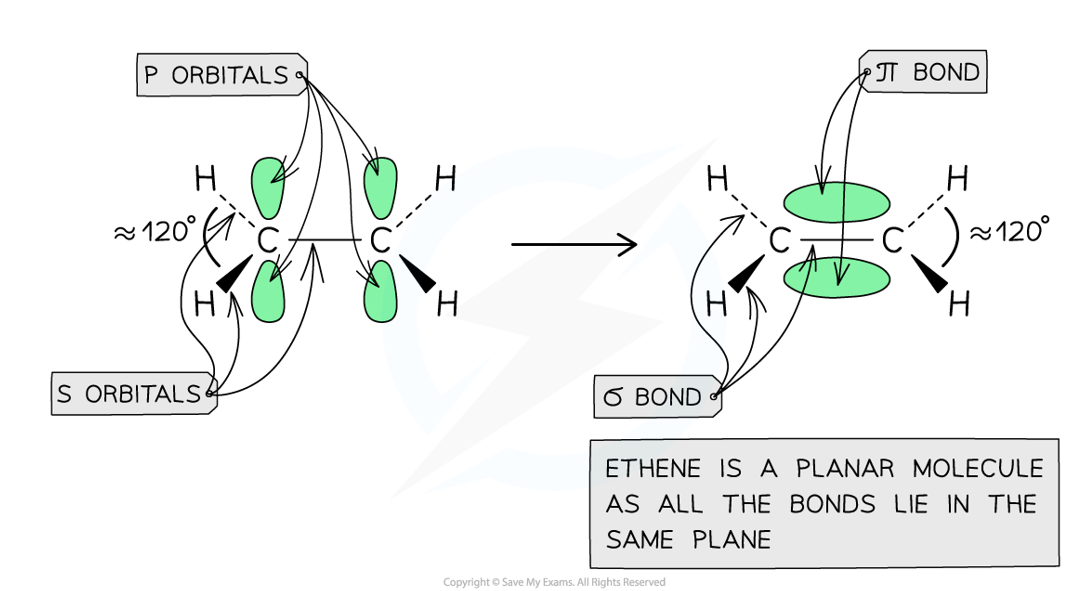
Why is there limited/restricted rotation about the C=C double bond?
A C=C double bond contains a sigma bond (formed by a head-on overlap) & a pi bond (formed by a sideways overlap of p orbitals)
Rotation would break the pi bond, as the sideways overlap of p orbitals would be lost
Are alkenes more or less reactive than alkanes & why?
More reactive, due to the high electron density of C=C double bond & the pi-bond is slightly easier to break
What intermolecular forces of attraction to alkenes have?
Only Van der Waals forces due to non-polar bonds
Are alkenes soluble or insoluble in water & why?
Insoluble:
alkenes have non-polar bonds, meaning the hydrogen bonds in water molecules are stronger than the Van der Waals forces in alkenes
What are the 3 types of isomers alkenes can have?
Chain isomers (branched chains)
Positional isomers (C=C on different carbon atom)
Geometric E/Z isomers
What reactions do alkenes undergo & what happens during this reaction?
Electrophilic addition:
the C=C double bond in the alkene opens up & atoms are added to the carbon atoms
this is because the C=C double bond has high electron density & is easily attacked by electrophiles
What is an electrophile?
Electron-pair acceptor
What are 3 examples of electrophiles?
HBr
H2SO4
Br2
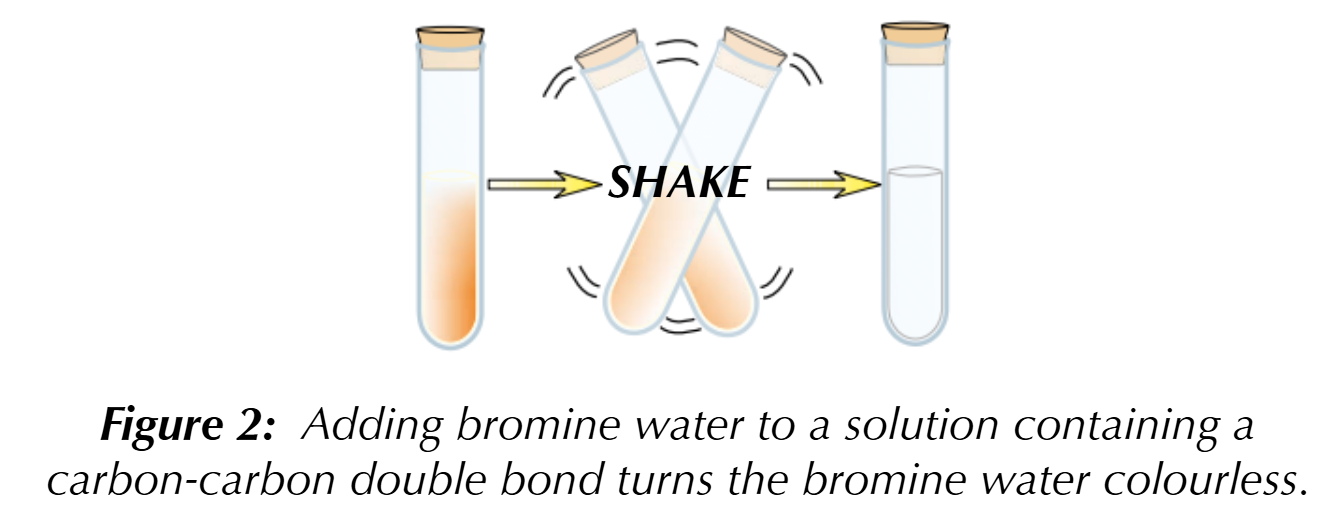
What is the chemical test for alkenes?
Bromine water: an alkene will quickly decolourise orange bromine water when shaken in test tube
What is the most stable kind of carbocation intermediate & why?
Tertiary carbocation: greatest positive inductive effect (bonded to the most other carbon atoms)
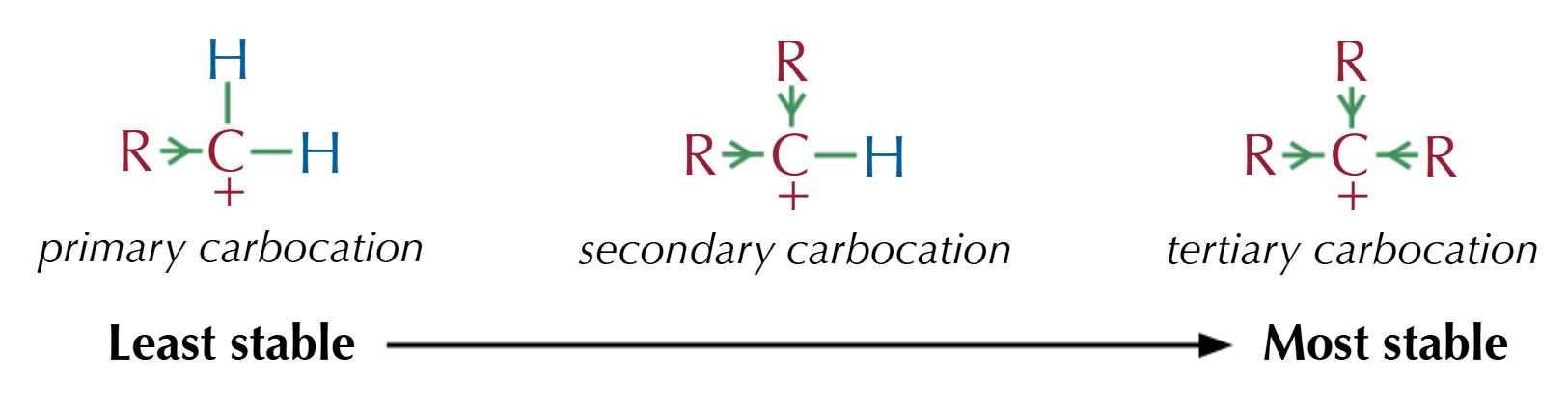
Major products will be formed from which kinds of carbocations?
Tertiary (or the most stable available)
What is Markovnikov’s rule?
The major product is formed when there is the most stable carbocation intermediate (3º > 2º > 1º)
What is the condition needed for electrophilic addition?
Room temperature & an electrophile
How does a molecule with a non-polar bond react as if it is an electrophile?
The C=C double bond with a high electron density induces a temporary dipole in the halogen molecule (δ+ atom is attracted to double bond)
e.g. Br2 becomes Brδ+— Brδ-
What is addition polymerisation?
Many monomers are bonded together by the rearrangement of bonds without the loss of any atom or molecule
Formed from alkenes & substituted alkenes
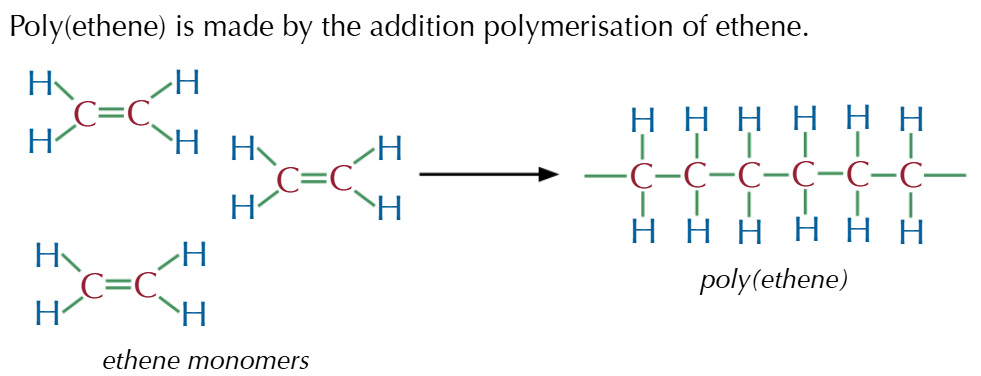
What are monomers?
Molecules which combine to form a polymer
Usually have a C=C double bond (alkene) which breaks to leave a repeating pattern
What is the difference in drawing when a questions asks for the repeating monomer vs repeating unit?
Repeating monomer: alkene
Repeating unit: molecule with trailing bonds (polymer)

What is the IUPAC rule for naming addition polymers?
“poly(X)” → where X is is the name of the monomer
What are the properties of polymers?
The main carbon chain of polyalkenes is usually non-polar, so addition polymers are very unreactive
The monomers within a polymer chain have strong covalent bonds, but the intermolecular forces between the polymer chains are weak

What are 3 uses of PVC / poly(chloroethene) ?
Drain pipes & window frames
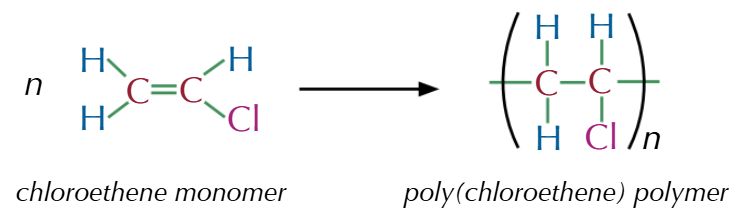
What are plasticisers?
Small molecules that get between polymer chains to force them apart, allow them to slide over each other
Makes PVC more flexible by disrupting the Van der Waals forces, weakening the chains
What are 3 uses of plasticised PVC?
Electrical cable insulation
Flooring tiles
Clothing
Why do things containing mainly C-C & C-H bonds not decompose easily?
The C-C & C-H bonds are non-polar, so are not attacked by enzymes
Why is a lack of biodegradability in compounds with C-C or C-H bonds a problem?
Disposal is very problematic
What is mechanical recycling?
Plastics are separated into different types, washed, ground down, melted & re-moulded (physical process)
Used to turn soft drinks bottles into fleeces
What is feedstock recycling?
Plastics are heated to a temperature which breaks the polymer bonds, leaving the original monomers which can be made into new plastics (chemical process)
What is a problem with recycling?
Each time thermosoftening plastics are melted & re-moulded, their properties degrade, meaning they can only be re-moulded a limited amount of times