II. Raw Materials QC Part 1 (copy)
 Call Kai
 Learn
Learn Practice Test
 Spaced Repetition
 Match
Match Flashcards
 Knowt Play
1/107

There's no tags or description
Looks like no tags are added yet.
Name | Mastery | Learn | Test | Matching | Spaced | Call with Kai | Chat |
|---|
No analytics yet
Send a link to your students to track their progress
108 Terms
c. First In First Out
The warehouse distribution process where the first stocked products or the products that are brought first are moved first
a. Last In First Out
b. First Expiry First Out
c. First In First Out
d. First Come First Serve
d. First Expiry First Out
The warehouse distribution process where products whose expiration dates are approaching are moved out of the warehouse first
a. First In First Out
b. Last In First Out
c. First Come First Serve
d. First Expiry First Out
c. Last In First Out
The warehouse distribution process used in the wine industry
a. First Expiry First Out
b. First In First Out
c. Last In First Out
d. First Come First Serve
a. Identification Test
A test that confirms the identity of a chemical substance
a. Identification Test
b. Purity Test
c. Limit Test
d. Assay Test
a. Identification Test
The identification test that includes evaluation of organoleptic properties
a. Identification Test
b. Purity Test
c. Limit Test
d. Assay Test
a. Precipitation
b. Evolution of Gas
c. Color Rxns
Identification test: chemical methods (3)
d. Color Rxns
[METHODS OF IDENTIFICATION]
The chemical method of identification that involves color reactions
a. Precipitation
b. Evolution of Gas
c. Spectroscopy
d. Color Rxns
d. Color Rxns
[METHODS OF IDENTIFICATION]
Ex: Starch + I2 in KI TS =dark blue or blue violet
a. Precipitation
b. Evolution of Gas
c. Spectroscopy
d. Color Rxns
a. Precipitation
white curdy PPT = (+) chloride ion
[METHODS OF IDENTIFICATION]
Ex: Chloride + AgNO3 TS = silver chloride PPT
a. Precipitation
b. Evolution of Gas
c. Spectroscopy
d. Color Rxns
b. Evolution of Gas
[METHODS OF IDENTIFICATION]
Ex: Ammonium cation + NaOH TS + heat = pungent odor / red to blue litmus paper
a. Precipitation
b. Evolution of Gas
c. Spectroscopy
d. Color Rxns
a. Spectroscopy
b. Chromatography
[METHODS OF IDENTIFICATION]
Identification test: instrumental methods (2)
a. Spectroscopy
b. Chromatography
a. Spectroscopy
[METHODS OF IDENTIFICATION]
Ex: IR, NMR, MS, UV Vis
a. Spectroscopy
b. Chromatography
b. Chromatography
[METHODS OF IDENTIFICATION]
Ex: HPLC
a. Spectroscopy
b. Chromatography
c. Assay
The test that determines the percentage purity or the potency of the active pharmaceutical ingredient (API)
a. Identification Test
b. Limit Test
c. Assay
d. Purity Test
d. Chemical Assay
[METHODS OF ASSAYING]
The type of assay based on chemical concentration
a. Biological Assay
b. Microbial Assay
c. Animal Assay
d. Chemical Assay
c. Biological Assay
[METHODS OF ASSAYING]
The type of assay based on biologic potency on living systems
a. Chemical Assay
b. Gravimetric Assay
c. Biological Assay
d. Instrumental Assay
a. Titrimetry Assay
[METHODS OF ASSAYING]
The type of chemical assay based on volume
a. Titrimetry Assay
b. Gravimetric Assay
b. Gravimetric Assay
[METHODS OF ASSAYING]
The type of chemical assay based on width
a. Titrimetry Assay
b. Gravimetric Assay
Classical (Titrimetry, Gravimetry)
Instrumental methods (Spectrometry, Chromatography)
[METHODS OF ASSAYING]
Chemical Assay examples (3)
Animal Assay
Microbial Assay
[METHODS OF ASSAYING]
Biological Assay examples (2)
d. Pigeon
[ANIMAL ASSAYS]
The animal assay used to test Digitalis
a. Rabbit
b. Cat
c. Rat
d. Pigeon
d. Tubocurarine
"TubocuRABBIT"
[ANIMAL ASSAYS]
The drug tested using the Rabbit animal assay associated with the
a. Oxytocin
b. Digitalis
c. Oxytocin
d. Tubocurarine
c. Insulin
"RABBInsulin"
[ANIMAL ASSAYS]
The drug tested using the Rabbit animal assay associated
a. Heparin
b. Glucagon
c. Insulin
d. Vasopressin
d. Iron Dextran
“Iron DextRABBIT”
[ANIMAL ASSAYS]
The drug tested using the Rabbit animal assay associated with the
a. Oxytocin
b. Digitalis
c. Oxytocin
d. Iron Dextran
c. Cat
[ANIMAL ASSAYS]
The animal assay used to test Glucagon
a. Rabbit
b. Dog
c. Cat
d. Rat
d. Atropine
"CATropine"
[ANIMAL ASSAYS]
The drug tested using the Cat animal assay associated
a. Glucagon
b. Oxytocin
c. Insulin
d. Atropine
a. Chicken
“Chicken tocino”
[ANIMAL ASSAYS]
The animal assay used to test Oxytocin
a. Chicken
b. Rabbit
c. Dog
d. Rat
c. Dog
“ParaDOG”
[ANIMAL ASSAYS]
The animal assay used to test Parathyroid Hormone
a. Rat
b. Sheep
c. Dog
d. Cat
d. Rat
“CoRAT”
[ANIMAL ASSAYS]
The animal assay used to test Corticotropin
a. Dog
b. Sheep
c. Chicken
d. Rat
c. Rachitic Rat
“CoRAT”
[ANIMAL ASSAYS]
The animal assay used to test Cod Liver Oil
a. Female Rat
b. Male Rat
c. Rachitic Rat
d. Rabbit
d. Female Rat
“CoRAT”
[ANIMAL ASSAYS]
The animal assay used to test Chorionic Gonadotropin
a. Male Rat
b. Rachitic Rat
c. Sheep
d. Female Rat
c. Vasopressin
"VasoRAT"
[ANIMAL ASSAYS]
The drug tested using the Male Rat animal assay
a. Corticotropin
b. Chorionic Gonadotropin
c. Vasopressin
d. Cod Liver Oil
a. Sheep
“SHEEParin”
[ANIMAL ASSAYS]
The animal assay used to test Heparin
a. Sheep
b. Dog
c. Rabbit
d. Rat
d. Protamine SO4
"Protamine SHEEPate"
[ANIMAL ASSAYS]
The drug tested using the Sheep animal assay associated with the
a. Heparin
b. Vasopressin
c. Corticotropin
d. Protamine SO4
1. Cylinder Plate Method
2. Turbidimetric Method
METHODS OF MICROBIAL ASSAY (2)
c. Cylinder Plate Method
The microbial assay method that uses stainless steel cylinders or paper discs placed on top of solidified nutrient medium inside a petri dish or plate
a. Turbidimetric Method
b. Serial Dilution Method
c. Cylinder Plate Method
d. Diffusion Method
d. Cylinder Plate Method
larger diameter= more potent
The microbial assay method based on the diameter of zone of inhibition
a. Turbidimetric Method
b. Serial Dilution Method
c. Broth Dilution Method
d. Cylinder Plate Method
a. Turbidimetric Method
The microbial assay method that uses a test tube filled with fluid nutrient medium where the test organism is inoculated
a. Turbidimetric Method
b. Serial Dilution Method
c. Broth Dilution Method
d. Cylinder Plate Method
a. Turbidimetric Method
The microbial assay method based on turbidity or amount of light transmitted
a. Turbidimetric Method
b. Serial Dilution Method
c. Broth Dilution Method
d. Cylinder Plate Method
transmittance at 530 nm
higher transmittance = more clear= more potent
[METHODS OF MICROBIAL ASSAY]
Turbidimetric Method is based on
c. Less turbid
[MICROBIAL ASSAYS]
In microbial assays, antibiotics produce results that are
a. More turbid
b. More opaque
c. Less turbid
d. Colorless
d. More turbid
[MICROBIAL ASSAYS]
In microbial assays, vitamins produce results that are
a. Less turbid
b. Colorless
c. More opaque
d. More turbid
a. Staphylococcus aureus
[MICROBIAL ASSAYS]
The test organism used in the microbial assay of Penicillin G
a. Staphylococcus aureus
b. Klebsiella pneumoniae
c. Bacillus subtilis
d. Escherichia coli
a. Staphylococcus aureus
[MICROBIAL ASSAYS]
The test organism used in the microbial assay of Tetracycline
a. Staphylococcus aureus
b. Klebsiella pneumoniae
c. Bacillus subtilis
d. Escherichia coli
a. Staphylococcus aureus
[MICROBIAL ASSAYS]
The test organism used in the microbial assay of Cloxacillin
a. Staphylococcus aureus
b. Klebsiella pneumoniae
c. Bacillus subtilis
d. Escherichia coli
a. Staphylococcus aureus
[MICROBIAL ASSAYS]
The test organism used in the microbial assay of Tylosin
a. Staphylococcus aureus
b. Klebsiella pneumoniae
c. Bacillus subtilis
d. Escherichia coli
c. Staphylococcus epidermidis
[MICROBIAL ASSAYS]
The test organism used in the microbial assay of Gentamicin
a. Staphylococcus aureus
b. Klebsiella pneumoniae
c. Staphylococcus epidermidis
d. Escherichia coli
c. Staphylococcus epidermidis
[MICROBIAL ASSAYS]
The test organism used in the microbial assay of Neomycin
a. Staphylococcus aureus
b. Klebsiella pneumoniae
c. Staphylococcus epidermidis
d. Escherichia coli
c. Staphylococcus epidermidis
[MICROBIAL ASSAYS]
The test organism used in the microbial assay of Novobiocin
a. Staphylococcus aureus
b. Klebsiella pneumoniae
c. Staphylococcus epidermidis
d. Escherichia coli
c. Staphylococcus epidermidis
[MICROBIAL ASSAYS]
The test organism used in the microbial assay of Paramomycin
a. Staphylococcus aureus
b. Klebsiella pneumoniae
c. Staphylococcus epidermidis
d. Escherichia coli
b. Klebsiella pneumoniae
[MICROBIAL ASSAYS]
The test organism used in the microbial assay of Streptomycin
a. Staphylococcus aureus
b. Klebsiella pneumoniae
c. Staphylococcus epidermidis
d. Escherichia coli
b. Klebsiella pneumoniae
[MICROBIAL ASSAYS]
The test organism used in the microbial assay of Neomycin
a. Staphylococcus aureus
b. Klebsiella pneumoniae
c. Staphylococcus epidermidis
d. Escherichia coli
b. Klebsiella pneumoniae
[MICROBIAL ASSAYS]
The test organism used in the microbial assay of Capreomycin
a. Staphylococcus aureus
b. Klebsiella pneumoniae
c. Staphylococcus epidermidis
d. Escherichia coli
b. Klebsiella pneumoniae
[MICROBIAL ASSAYS]
The test organism used in the microbial assay of Troleandomycin
a. Staphylococcus aureus
b. Klebsiella pneumoniae
c. Staphylococcus epidermidis
d. Escherichia coli
b. Micrococcus luteus
[MICROBIAL ASSAYS]
The test organism used in the microbial assay of Bacitracin
a. Staphylococcus aureus
b. Micrococcus luteus
c. Escherichia coli
d. Bacillus subtilis
b. Micrococcus luteus
[MICROBIAL ASSAYS]
The test organism used in the microbial assay of Erythromycin
a. Staphylococcus aureus
b. Micrococcus luteus
c. Escherichia coli
d. Bacillus subtilis
c. Bordetella bronchiseptica
[MICROBIAL ASSAYS]
The test organism used in the microbial assay of Chloramphenicol
a. Klebsiella pneumoniae
b. Staphylococcus aureus
c. Bordetella bronchiseptica
d. Escherichia coli
c. Bordetella bronchiseptica
[MICROBIAL ASSAYS]
The test organism used in the microbial assay of Polymmyxin B
a. Klebsiella pneumoniae
b. Staphylococcus aureus
c. Bordetella bronchiseptica
d. Escherichia coli
d. Escherichia coli
[MICROBIAL ASSAYS]
The test organism used in the microbial assay of Chloramphenicol
a. Enterococcus hirae
b. Pseudomonas aeruginosa
c. Bacillus subtilis
d. Escherichia coli
a. Enterococcus hirae
[MICROBIAL ASSAYS]
The test organism used in the microbial assay of Gramicidin and thristrepton
a. Enterococcus hirae
b. Pseudomonas aeruginosa
c. Bacillus subtilis
d. Escherichia coli
b. Pseudomonas aeruginosa
[MICROBIAL ASSAYS]
The test organism used in the microbial assay of Carbenicillin
a. Enterococcus hirae
b. Pseudomonas aeruginosa
c. Bacillus subtilis
d. Escherichia coli
a. Mycobacterium senegalense
[MICROBIAL ASSAYS]
The test organism used in the microbial assay of Bleomycin
a. Mycobacterium senegalense
b. Pseudomonas aeruginosa
c. Saccharomyces cerevisiae
d. Escherichia coli
c. Saccharomyces cerevisiae
[MICROBIAL ASSAYS]
The test organism used in the microbial assay of Amphotericin B
a. Mycobacterium senegalense
b. Pseudomonas aeruginosa
c. Saccharomyces cerevisiae
d. Escherichia coli
c. Saccharomyces cerevisiae
[MICROBIAL ASSAYS]
The test organism used in the microbial assay of Nystatin
a. Mycobacterium senegalense
b. Pseudomonas aeruginosa
c. Saccharomyces cerevisiae
d. Escherichia coli
c. Lactobacillus plantarum
[MICROBIAL ASSAYS]
The test organism used in the microbial assay of Niacin (B3)
a. Lactobacillus leichmanii
b. Escherichia coli
c. Lactobacillus plantarum
d. Micrococcus luteus
c. Lactobacillus plantarum
[MICROBIAL ASSAYS]
The test organism used in the microbial assay of Calcium Pantothenate (B5)
a. Lactobacillus leichmanii
b. Pediococcus acidilactici
c. Lactobacillus plantarum
d. Micrococcus luteus
b. Pediococcus acidilactici
[MICROBIAL ASSAYS]
The test organism used in the microbial assay of Dexpanthenol
a. Lactobacillus leichmanii
b. Pediococcus acidilactici
c. Lactobacillus plantarum
d. Micrococcus luteus
a. Lactobacillus leichmanii
[MICROBIAL ASSAYS]
The test organism used in the microbial assay of Cyanocobalamin (B12)
a. Lactobacillus leichmanii
b. Pediococcus acidilactici
c. Lactobacillus plantarum
d. Micrococcus luteus
c. Limit Test
The test used to measure small amounts of impurities in a raw material
a. Identification Test
b. Assay
c. Limit Test
d. Purity Test
a. Gross Impurities
b. Chemical Impurities
c. Biological Impurities
The type of impurities (3)
a. Gross Impurities
b. Chemical Impurities
c. Biological Impurities
d. Physical Impurities
d. Gross Impurities
[TYPES OF IMPURITIES]
The type of impurity referring to dirt or insoluble matter
a. Chemical Impurities
b. Biological Impurities
c. Residual Impurities
d. Gross Impurities
c. Biological Impurities
[TYPES OF IMPURITIES]
The type of impurity that includes microorganisms, metabolic products, and cell debris
a. Gross Impurities
b. Chemical Impurities
c. Biological Impurities
d. Physical Impurities
b. Chemical Impurities
[TYPES OF IMPURITIES]
The type of impurity that includes by-products, degradation products, heavy metals, and residual solvents
a. Gross Impurities
b. Chemical Impurities
c. Biological Impurities
d. Physical Impurities
d. H2S TS
[CHEMICAL IMPURITIES]
The reagent used to test for heavy metals in the limit test
a. AgNO3 TS
b. NH4SCN TS
c. BaCl2 TS
d. H2S TS
c. Black precipitate
[CHEMICAL IMPURITIES]
The result of a positive heavy metals test using H2S TS
a. Red complex
b. White precipitate
c. Black precipitate
d. Yellow precipitate
a. NMT: 0.1 ppm
must be less intense

[CHEMICAL IMPURITIES]
Heavy metals limit
a. NMT: 0.1 ppm
b. NMT: 0.01 ppm
c. NMT: 1 ppm
d. NMT: 0.001 ppm
a. Ag diethyldithiocarbamate TS
[CHEMICAL IMPURITIES]
The reagent used to test for Arsenic in the limit test
a. Ag diethyldithiocarbamate TS
b. BaCl2 TS
c. NH4SCN TS
d. H2S TS
c. Red
[CHEMICAL IMPURITIES]
The result of a positive Arsenic test using Ag diethyldithiocarbamate TS
a. White precipitate
b. Black or brown precipitate
c. Red
d. Red complex
d. NH4SCN TS
[CHEMICAL IMPURITIES]
The reagent used to test for Iron in the limit test
a. H2S TS
b. BaCl2 TS
c. AgNO3 TS
d. NH4SCN TS
d. Red complex
[CHEMICAL IMPURITIES]
The result of a positive Iron test using NH4SCN TS
a. White precipitate
b. Black or brown precipitate
c. Red
d. Red complex
d. AgNO3 TS
[CHEMICAL IMPURITIES]
The reagent used to test for Chloride in the limit test
a. BaCl2 TS
b. NH4SCN TS
c. H2S TS
d. AgNO3 TS
a. White curdy complex
[CHEMICAL IMPURITIES]
The result of a positive Chloride test using AgNO3 TS
a. White curdy complex
b. Black or brown precipitate
c. Red
d. Red precipitate
c. BaCl2 TS
[CHEMICAL IMPURITIES]
The reagent used to test for Sulfate in the limit test
a. AgNO3 TS
b. NH4SCN TS
c. BaCl2 TS
d. H2S TS
a. White curdy complex
[CHEMICAL IMPURITIES]
The result of a positive Sulfate test using BaCl2 TS
a. White curdy complex
b. Black or brown precipitate
c. Red
d. Red precipitate
a. Dithone TS
[CHEMICAL IMPURITIES]
The reagent used to test for Lead in the limit test
a. Dithizone TS
b. NH4SCN TS
c. BaCl2 TS
d. H2S TS
a. Purple
[CHEMICAL IMPURITIES]
The result of a positive Lead test using Dithizone TS
a. Purple
b. Black or brown precipitate
c. Red
d. Red precipitate
b. Specific Gravity (unitless)
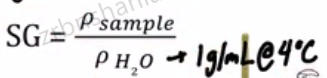
[PHYSICAL TESTS]
The ratio of the density of a substance to that of a reference substance at 25°C
a. Viscosity
b. Specific Gravity
c. Density Index
d. Relative Density
4 degree C
[PHYSICAL TESTS]
BEQ temperature closest to density of water (1g/mL)
b. H2O at 4°C
[PHYSICAL TESTS]
BEQ: The reference substance used in the determination of specific gravity
a. H2O at 25°C
b. H2O at 4°C
c. H2O at 15.56°C
d. H2O at 37°C
d. Hydrometer
[PHYSICAL TESTS]
The instrument used to measure the specific gravity of alcohol
a. Pycnometer
b. Refractometer
c. Mohr-Westphal balance
d. Hydrometer
c. Pycnometer
Pycnometer or Mohr-Westphal balance if non-official
non- official= never naging official
unofficial= dating official na not in the current usp edition
[PHYSICAL TESTS]
The official usp instrument used to measure specific gravity
a. Hydrometer and Refractometer
b. Viscometer and Hydrometer
c. Pycnometer
d. Refractometer or Pycnometer
d. 15.56°C
60°F
[PHYSICAL TESTS]
The temperature at which the specific gravity of alcohol is measured using a hydrometer
a. 25°C
b. 4°C
c. 37°C
d. 15.56°C
c. Refractive Index
[PHYSICAL TESTS]
The ratio of the velocity of light in air to the velocity of light in the substance at 25°C
a. Specific Gravity
b. Optical Rotation
c. Refractive Index
d. Absorbance Index
a. n = sin i / sin r
n = refractive Index
i = angle of incident
r = angle of refraction
[PHYSICAL TESTS]
The formula used to calculate the Refractive Index
a. n = sin i / sin r
b. n = cos i / cos r
c. n = tan i / tan r
d. n = sin r / sin i
c. Abbe Refractometer
[PHYSICAL TESTS]
The instrument used to measure the Refractive Index
a. Polarimeter
b. Pycnometer
c. Abbe Refractometer
d. Mohr-Westphal Balance
d. n
[PHYSICAL TESTS]
The symbol used to represent the Refractive Index
a. α
b. ρ
c. μ
d. n
c. Optical Rotation
[PHYSICAL TESTS]
The measure of a substance's ability to rotate an incident plane of polarized light
a. Refractive Index
b. Specific Gravity
c. Optical Rotation
d. Absorbance Index
a. α
[PHYSICAL TESTS]
The symbol used to represent Optical Rotation
a. α
b. ρ
c. μ
d. n
c. Polarimeter
[PHYSICAL TESTS]
The instrument used to measure Optical Rotation
a. Abbe Refractometer
b. Pycnometer
c. Polarimeter
d. Mohr-Westphal Balance
c. D-Ethambutol
[PHYSICAL TESTS]
The optical isomer of Ethambutol used for the treatment of Tuberculosis
a. L-Ethambutol
b. Meso-Ethambutol
c. D-Ethambutol
d. DL-Ethambutol