Platyhelminths (Exam 3)
 Call Kai
 Learn
Learn Practice Test
 Spaced Repetition
 Match
Match Flashcards
 Knowt Play
1/190

Earn XP
Description and Tags
Exam 3 of Parasitology is the Platyhelminths. Blue text is testable material, black text is general info or potential extra credit. General note: Dr. Wu uses the class name Secernentea, but Modern genetic studies use name Chromadorea (Secernentea is deeply nested within Chromadorea, making them closely related in taxonomy. Secernentea is not considered a separate, co-equal class; it is now typically reclassified as the order Rhabditida under the class Chromadorea)
Name | Mastery | Learn | Test | Matching | Spaced | Call with Kai |
|---|
No analytics yet
Send a link to your students to track their progress
191 Terms
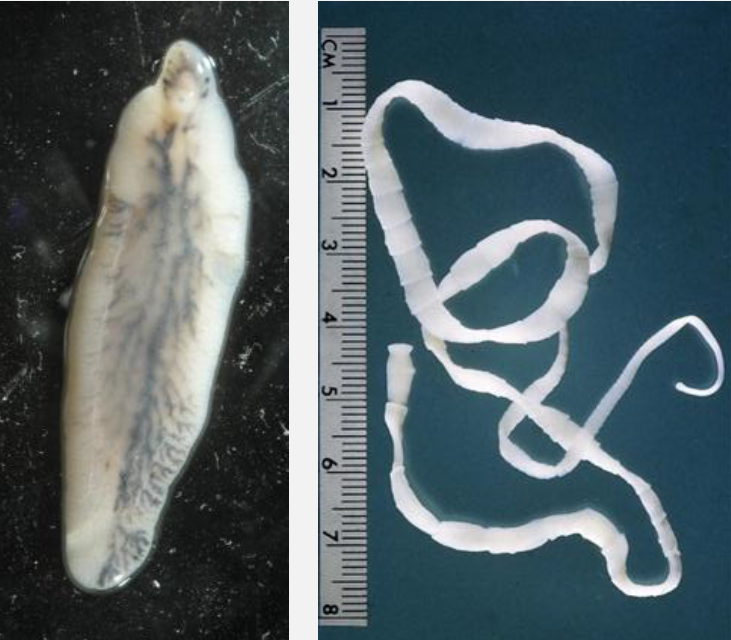
The scientific and common name for these parasites
Platyhelminths AKA Flatworms
Trematodes are also known as
Flukes
Platyhelminths > Trematodes
Cestodes are also known as
Tapeworms
Platyhelminths > Cestodes
Platyhelminths: Morphologic features
No body cavity (Acoelomate)
Typically hermaphroditic
Muscular suckers
Cestodes lack what?
Digestive tract is absent
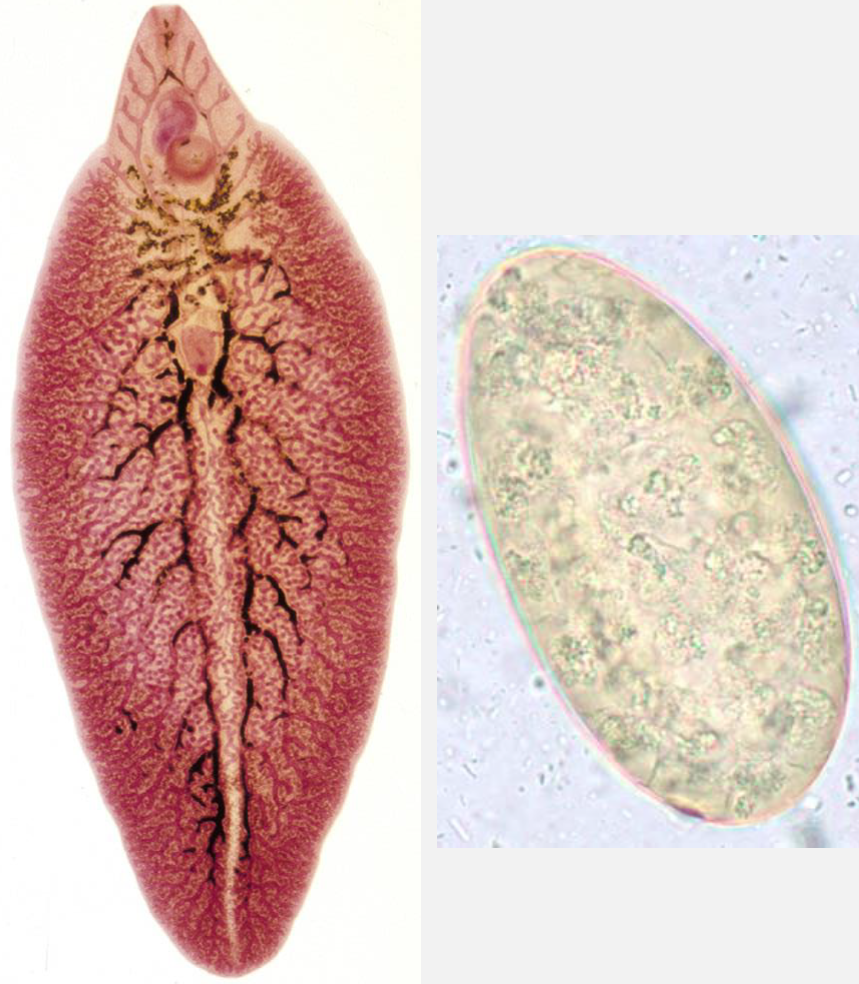
This is an example of an adult and egg of a ___
Platyhelminths > Trematodes
The adult sexual stages of Trematodes are found in what parts of the body of the hosts?
Adult sexual stages found in intestines, bile ducts, lungs, blood vessels of vertebrate final hosts → eggs passed in feces
Asexual stages of Trematodes are found in what?
Often found in mollusks (such as snails)
True or False: It is common for Trematodes to have second intermediate or paratenic hosts
True!
Describe a Typical Trematode Lifecycle
Adults in host (intestines, bile ducts, lungs, blood vessels) pass eggs into feces
Eggs fall into water and develop to Miracidium (a free-swimming ciliated larvae)
Miracidium hatches through operculum
Miracidium enters snail intermediate host, and forms a sporocyst
Sporocyst develops rediae (another larval stage)
Cercariae (a free swimming larvae) develop in rediae and exit snail
Cercariae swim to vegetation and encyst as metacercariae (dormant) or infect a second intermediate host
Metacercariae ingested by definitive host. Fluke travels to its location in host
What is the infective stage of a Trematode life cycle?
Metacercariae
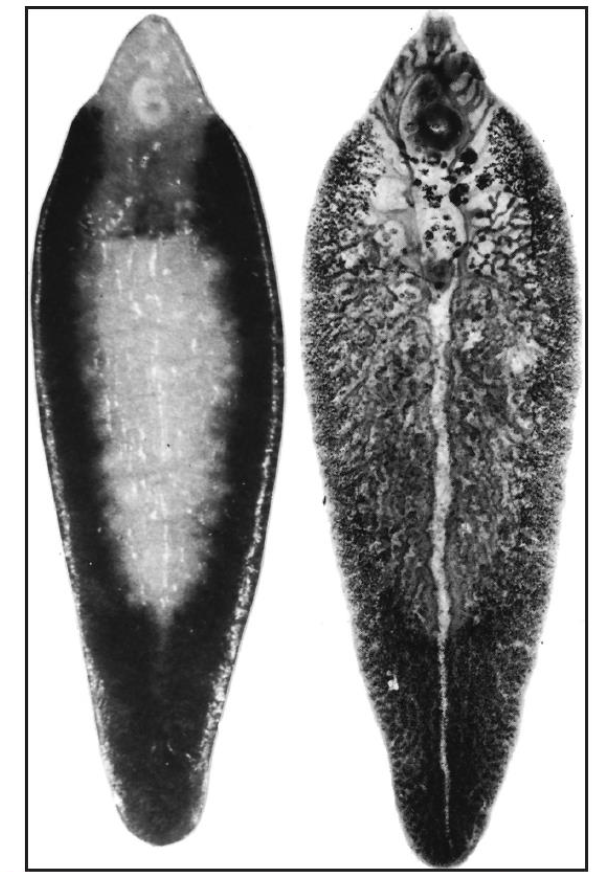
Name this Trematode
Platyhelminths > Trematodes > Fasciolidae
Leaf-like body, dendritic ovaries and testes
(Trematodes from ingesting vegetation group)
Where do Fasciola trematodes live in their hosts?
Reside in liver and bile ducts of mammals and humans
How is Fasciola acquired?
Acquired through ingestion of metacercariae on plants
Metacercariae survive in environment for months
Fasiola hepatica: Where in world?
Gulf Coast, Pacific Northwest
Fasciola gigantica: Where in world?
Hawaii, tropical and subtropical regions
Fasciola hepatica: Common name, Hosts
Platyhelminths > Trematodes > Fasciolidae > Fasciola hepatica
Common Liver Fluke
Most commonly in cattle, sheep and goats, can infect humans
(Trematodes from ingesting vegetation group)
Fasciola hepatica: Is often fatal in what species?
Often fatal in sheep and camelids
Rarely fatal in cattle
Life cycle of Fasciola hepatica once ingested
Ingested metacercariae excyst in the duodenum of host, penetrate intestinal wall, migrate to liver to bile ducts. Migration lasts 6-8 weeks
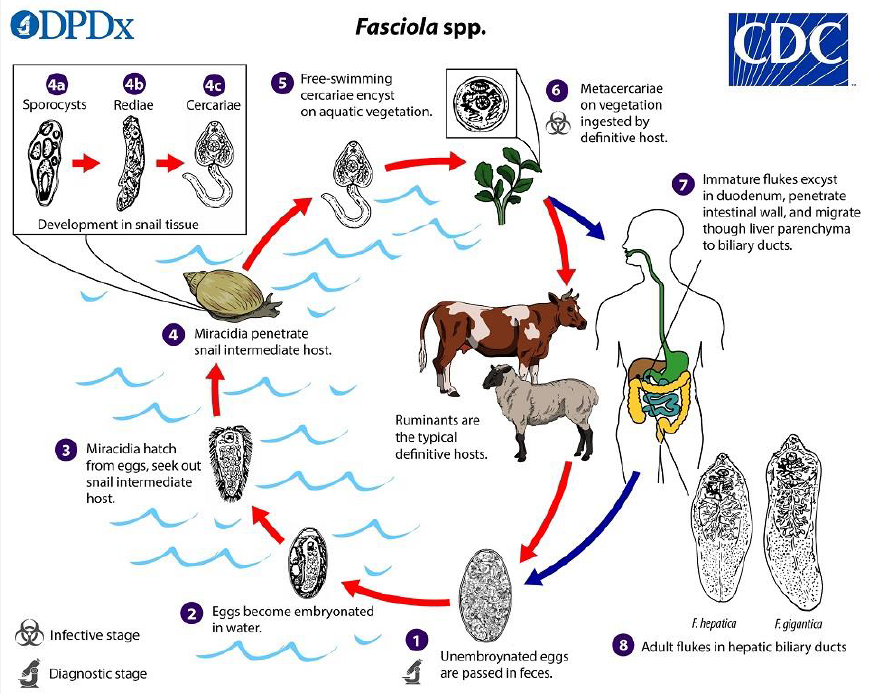
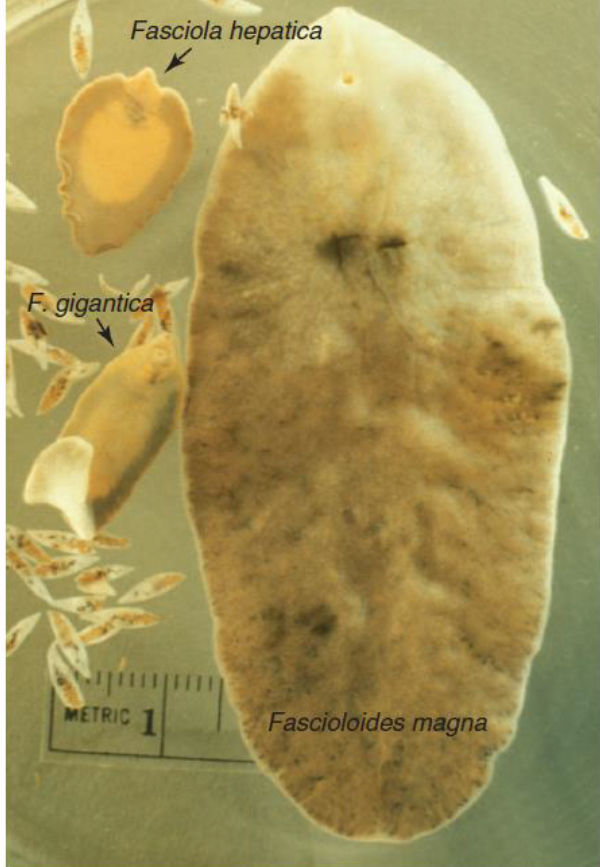
Name this Trematode: Common and scientific
Platyhelminths > Trematodes > Fasciolidae > Fascioloides magna
Giant Liver Fluke
(Trematodes from ingesting vegetation group)
Fascioloides magna is larger or smaller than Fasciola? Another morphologic difference?
Fascioloides magna is larger than Fasciola.
Fascioloides magna also lack an anterior cone projection
Fascioloides: Where in world? Definitive host? Other hosts?
Worlwide distribution, more common in Northeast than Fasciola hepatica
White tailed deer definitive host
Nonpatent infections in cattle, sheep, goats, llamas and alpacas
Does Fascioloides pass eggs in feces of its definitive host? In other hosts?
Yes eggs passed in deer. No not in other hosts (cattle, sheep. goats, llamas, alpacas)
Fascioloides magna causes severe damage when?
When migrating through the liver
Fasciolidae (Fasciola and Fascioloides): Disease
Can cause similar disease
Fascioloides more pathogenic than Fasciola, especially in small ruminants
Fascioloides can be walled off in cattle, but continuously migrates in sheep and goats
Aberrant migration to diaphragm and vena cava reported
Potential transplacental spread reported
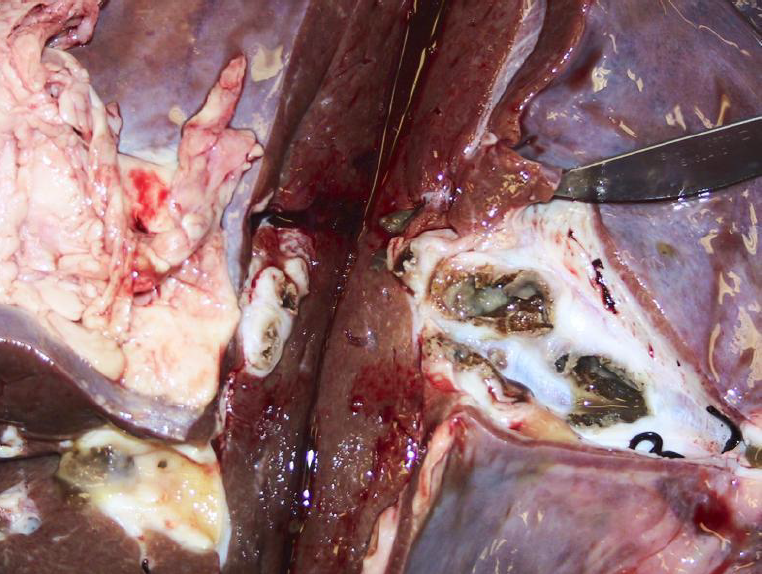
Acute fluke disease
Invasion of liver by young flukes cause significant damage to liver → rapid death
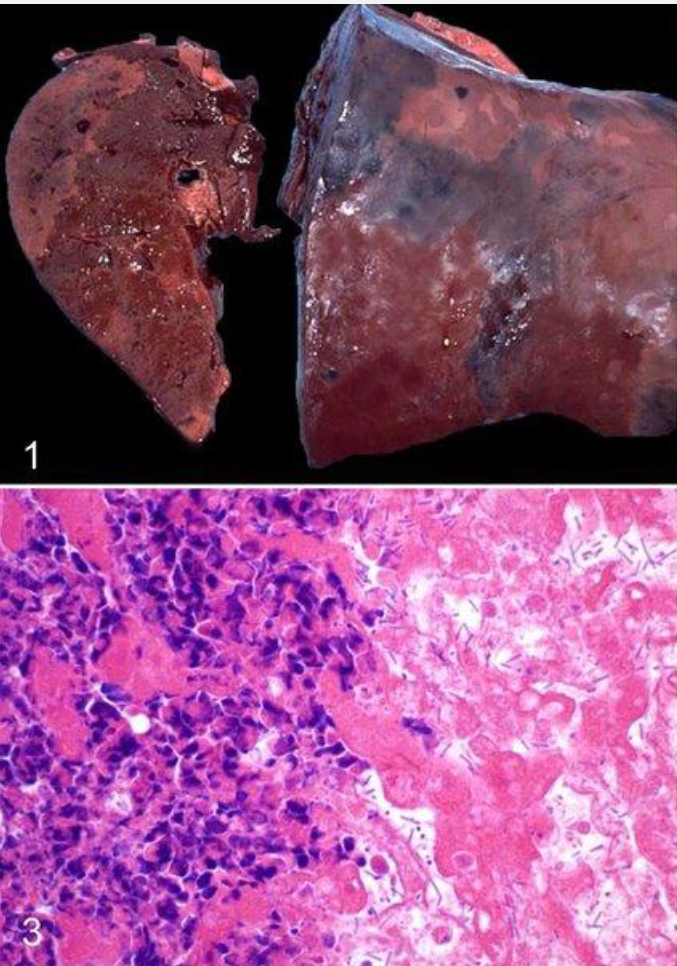
Black Disease: Common name, caused by
Infectious necrotic hepatitis
Fluke damage to liver (necrotic anaerobic area) reactivates dormant Clostridium novyi bacterium spores, causing release of clostridial toxins → causes fatal toxemia
Fasciolidae: Diagnosis
Eggs passed in feces detected on sedimentation ONLY in patent hosts (White-tailed deer)
Premortem diagnosis of fascioliasis difficult in aberrant hosts
Prepatent period 60 days for Fasciola hepatica
Prepatent period 270 days for Fascioloides magna
Fasciolidae hepatica, Fascioloides magna: Treatment
Fasciolidae hepatica: Clorsulon + ivermectin, albendazole. Resistance demonstrated
Fascioloides magna: Much harder to kill juvenile flukes, can try albendazole, off-label clorsulon, triclabendazole, closantel
Prevent infection with proper snail and deer control
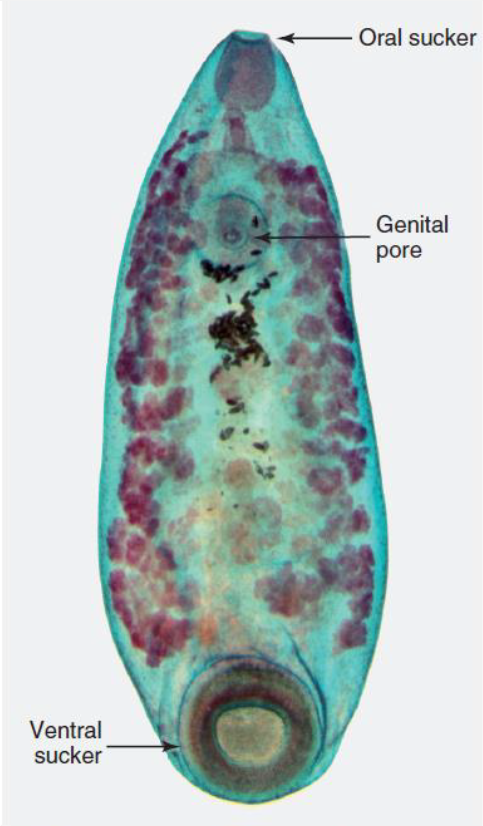
Name this Trematode: Scientific and Common names
Platyhelminths > Trematodes > Paramphistomum cervi
Rumen flukes
(Trematodes from ingesting vegetation group)
Paramphistomum cervi: Where live in what hosts?
Live in rumen of cattle, sheep and goats
Paramphistomum cervi: Morphologic feature
Adults have a ventral sucker at posterior end of body (acetabulum)
Paramphistomum cervi: Life Cycle (brief)
Eggs passed in feces, miracidia hatch and invade snail, cercariae encyst as metacercariae on aquatic vegetation, ingested by host
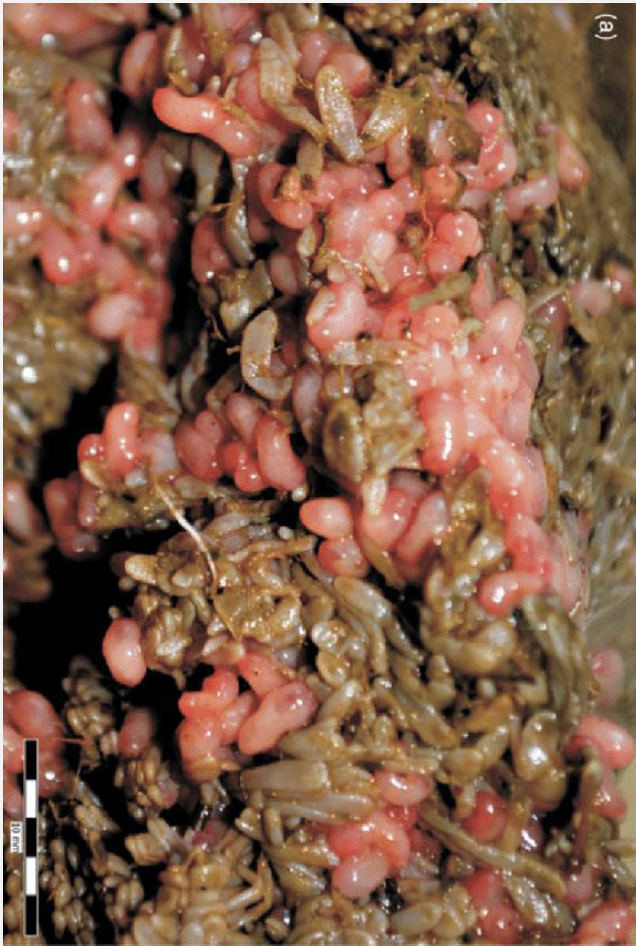
Paramphistomum cervi: Fluke migration path in host, migration causes?
Ingested metacercariae excyst in small intestine, migrate through small intestine back to rumen
Migration of immature flukes can rarely cause prolonged etneric disease
Diarrhea, depression, anorexia
Young cattle more affected
Sheep and goats of any age can be affected
True or false: Adult Paramphistomum cervi flukes are pathogenic
False. The adult flukes are nonpathogenic.
Paramphistomum cervi: Treatment
No labeled treatments in US
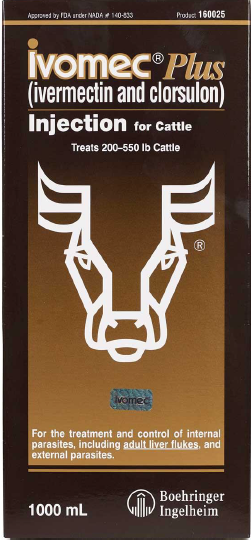
Clorsulon: MOA, effective against
Works by blocking glycolytic enzymes, impairing energy production
Effective against immature and mature Fasciola hepatica
Available in a combination with ivermectin (for nematodes and arthropods)
Given as SQ injection
Practice Question: Which of the following trematode life stages is infective on ingestion by the final host?
Answer = Metacercaria
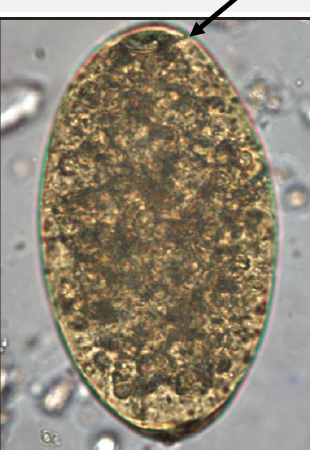
Practice Question: What is the name of the structure indicated by the arrow?
Answer = Operculum
Practice Question: Which of the following bacteria is involved in the pathogenesis of Black Disease in ruminants?
Answer = Clostridium novyi
Practice Question: Which is the most appropriate method to control Fascioloides magna infection in sheep and goats?
Answer = Fencing off ponds and marshy areas (Snail control)
Practice Question: Which of the following is true regarding paramphistomes?
Answer= There are no approved treatments for this parasite. (cattle sheep and goats NOT horses, migration of immature flukes cause disease not adults)
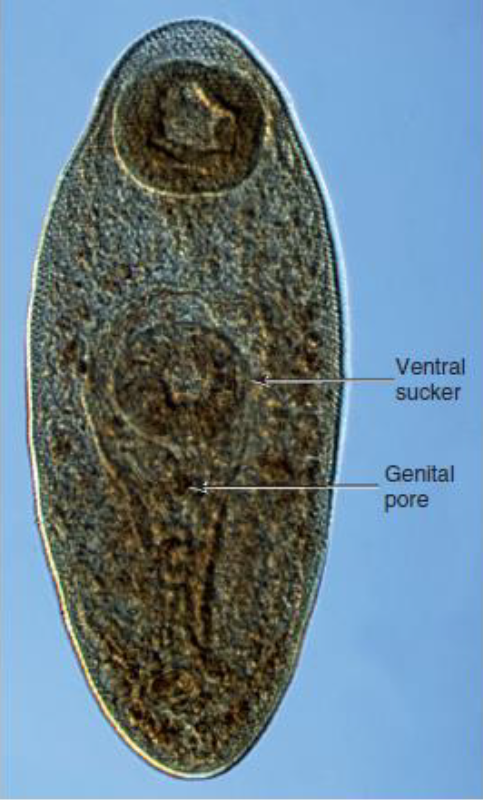
Name this Trematode
Platyhelminths > Trematodes > Nanophyetus salmincola
(Trematodes from ingesting hosts and skin penetration group)
Nanophyetus salmincola: Where live in host? Host?
Live as adults in small intestine of definitive host
Definitive hosts include dog, cat, coyote, fox, bear, raccoon, mink
Nanophyetus salmincola: Life Cycle
Eggs passed in feces from host, miracidia enter snail, cercariae penetrate salmonid skin, encysts as metacercariae, host ingests the salmon fish to become infected
Nanophyetus salmincola: Disease in host, What Disease can they cause?
Typically fluke infection itself causes no clinical signs
Enteritis can occur with large numbers
Flukes can cause a bacterial disease called salmon poisoning disease
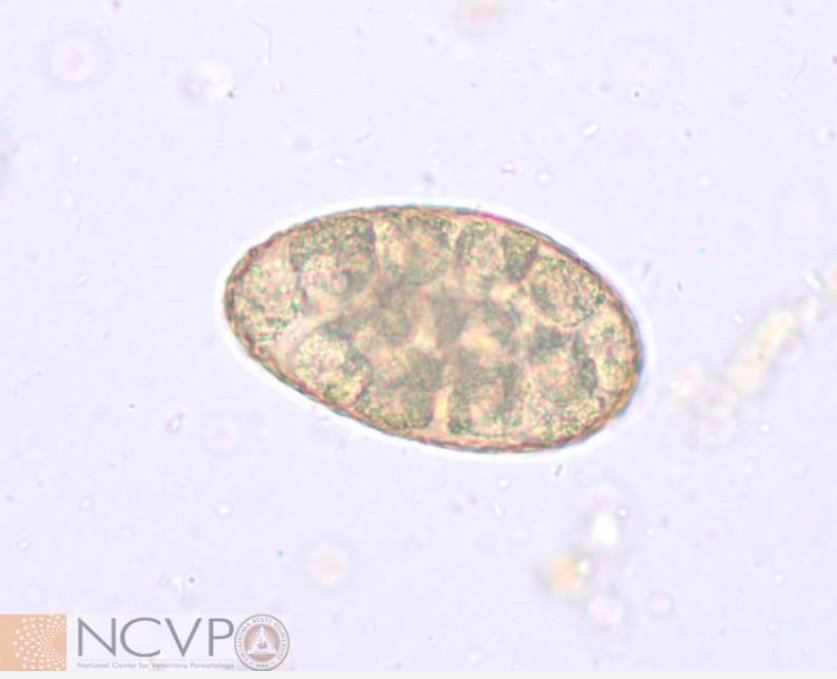
Nanophyetus salmincola: Diagnosis and Treatment
Diagnosis: Eggs on fecal flotation
Treatment: Praziquantel
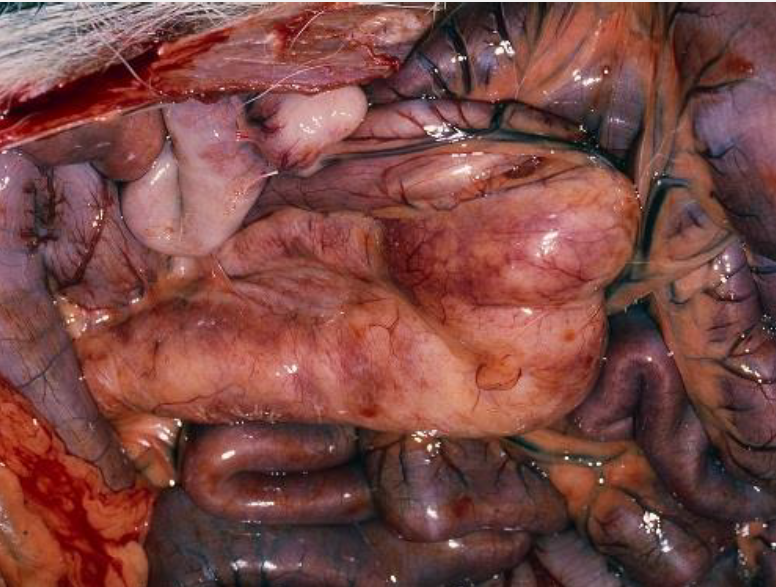
Pictured is hemorrhagic enteritis from what disease? What bacterial agent causes this disease and carried by what fluke?
Nanophyetus salmincola flukes contain the rickettsial agent Neorickettsia helminthoeca → Causes Salmon Poisoning disease in dogs
Common in West Coast of US
Salmon Poisoning Disease: Clinical Signs
Fever, anorexia, vomiting, diarrhea
Lymphadenomegaly of cervical and mesenteric lymph nodes
Hemorrhagic enteritis
→ Clinical signs resemble canine parvoviral infection
Salmon Poisoning Disease: Treatment
Doxycycline, oxytetracycline
What percentage of Salmon Poisoning Disease cases are fatal without treatment?
90%
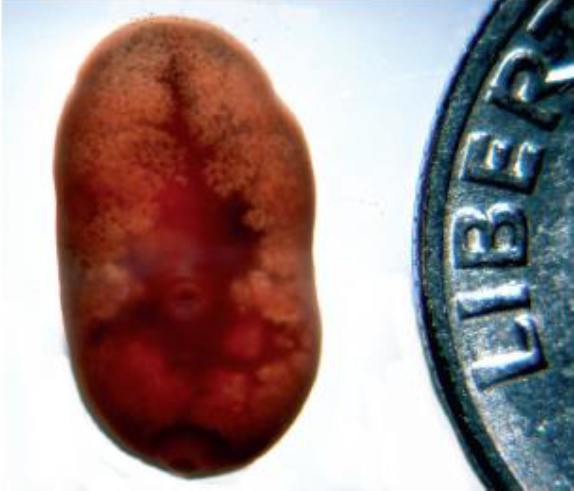
Name this trematode: Definitive Host?
Platyhelminths > Trematodes > Paragonimus
(Trematodes from ingesting host/skin penetration group)
Cat and dog definitive host
Paragonimus kellicotti present in U.S. around Mississippi River basin
Zoonosis of Paragonimus westermani reported in Asia
Where do Paragonimus flukes live in host?
Live in pairs or groups in cysts within lungs of mammal definitive hosts (cats and dogs)
Paragonimus: What are the intermediate hosts?
Snail is the first intermediate host
The second hosts are crabs/crayfish
How is infection of Paragonimus flukes acquired?
Cats/Dogs acquire infection through ingestion of metacercariae in crabs and crayfish
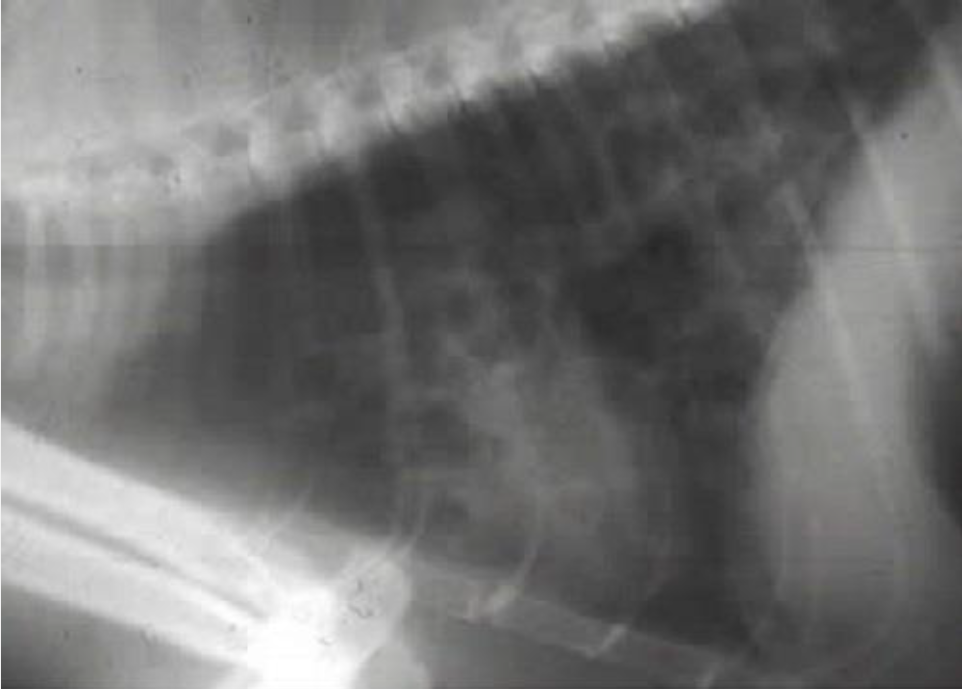
Paragonimus: Disease
Immature flukes penetrate intestinal wall and migrate through diaphragm to lungs
Infection can be asymptomatic but can cause chronic coughing
Bullae can form and rupture leading to pneumothorax
Aberrant migration to viscera and brain reported
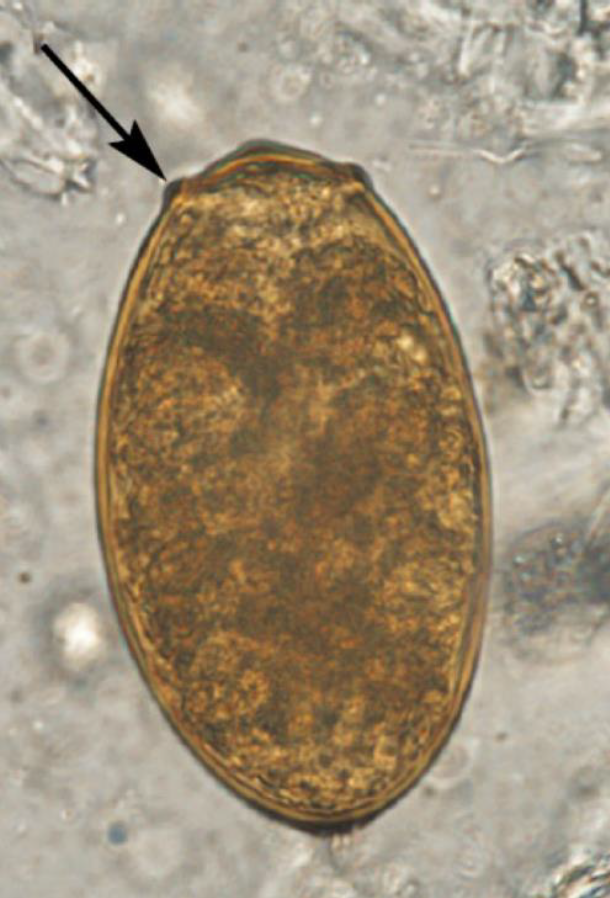
Paragonimus: Diagnosis (egg morphology)
Large, vase-shaped operculated eggs in feces or sputum. Have a thickened ridge surrounding operculum
Fecal sedimentation recommended because flotation less reliable
Transtracheal wash
Paragonimus: Treatment
Praziquantel, Fenbendazole, albendazole
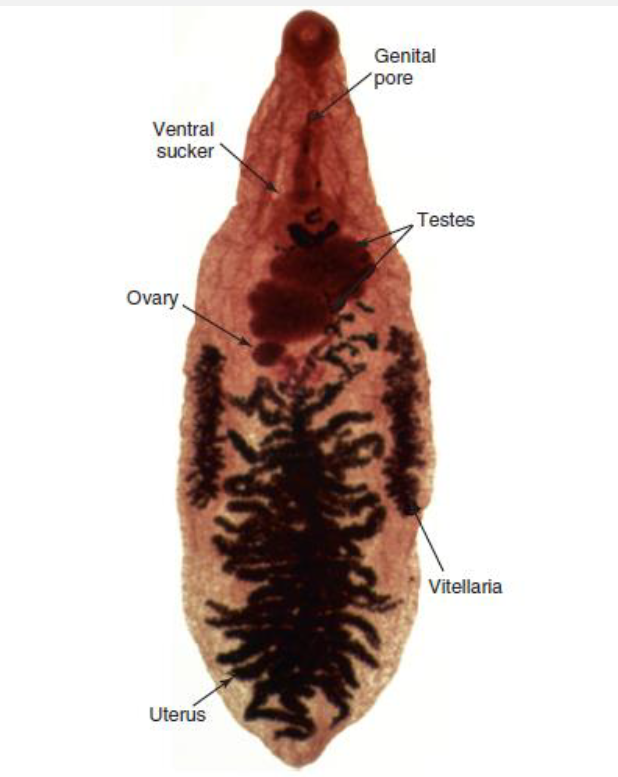
Name this Trematode: Morphologic feature
Platyhelminths > Trematodes > Dicrocoelium dendriticum
(Trematodes from ingestion of host/skin penetration group)
Translucent bodies
Where do Dicrocoelium dendriticum flukes live and in what hosts?
Live as adults in gallbladder, bile and pancreatic ducts of mammals, birds and reptiles
Definitive Hosts: Sheep, cattle, pigs, llamas, alpacas, deer, woodchucks, rabbits
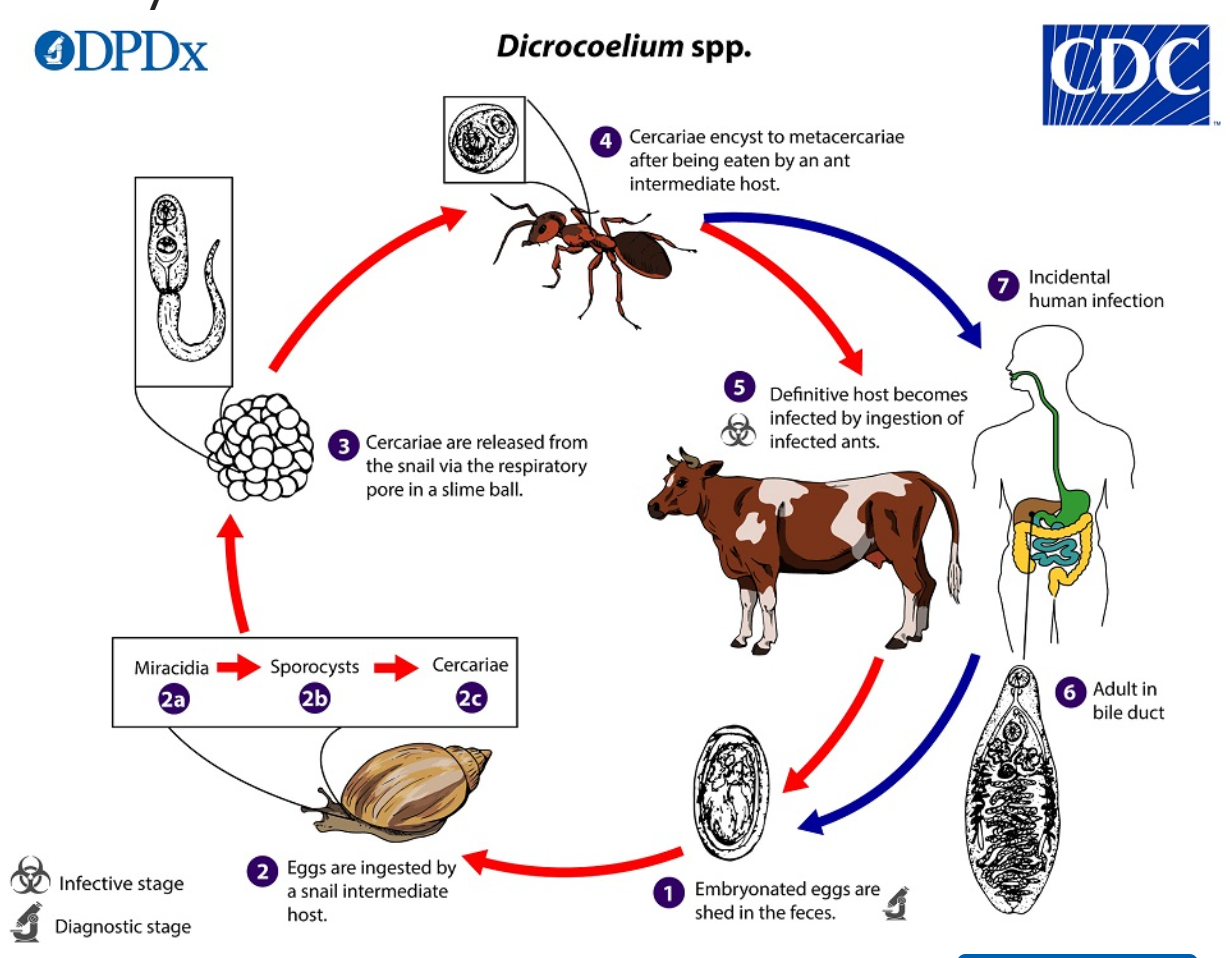
Dicrocoelium dendriticum: Life Cycle
Eggs from host ingested by land snail, cercariae leave snail in slime balls, ingested by ants and form metacercariae, (alters behavior of ants after flukes migrating to brain, ants travel to vegetation to be ingested by definitive host, burrow out of stomach and migrate to liver)
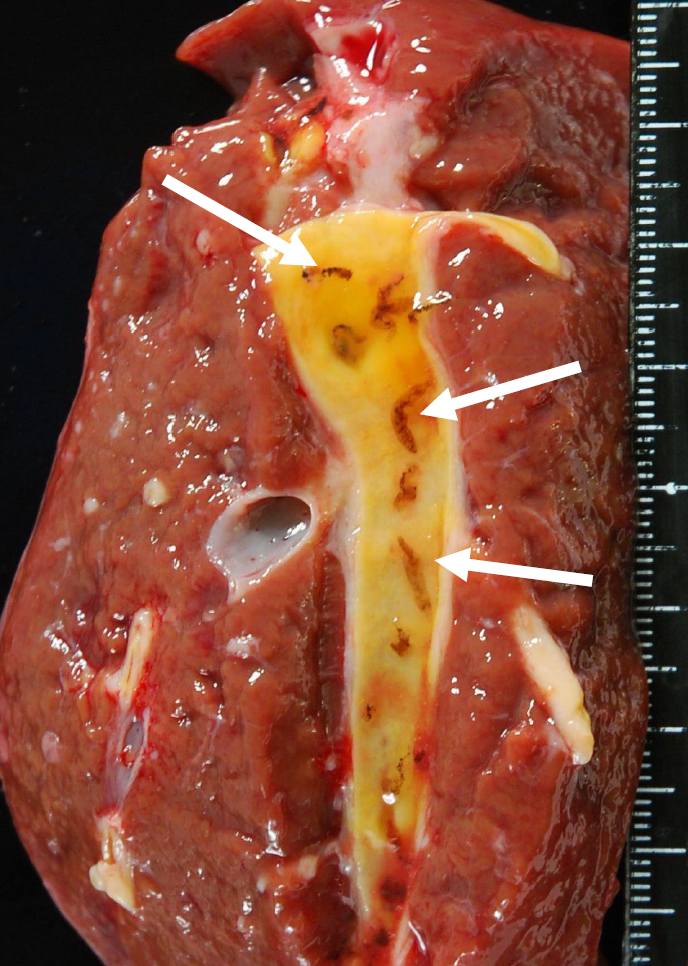
Dicrocoelium dendriticum: Disease, causes this seen in the picture
Large number of flukes usually with no clinical signs
Chronic disease can rarely cause progressive hepatic cirrhosis with cachexia, low wool production, decreased lactation
→economic losses from liver condemnation
acute decline and anemia can occur in new world camelids
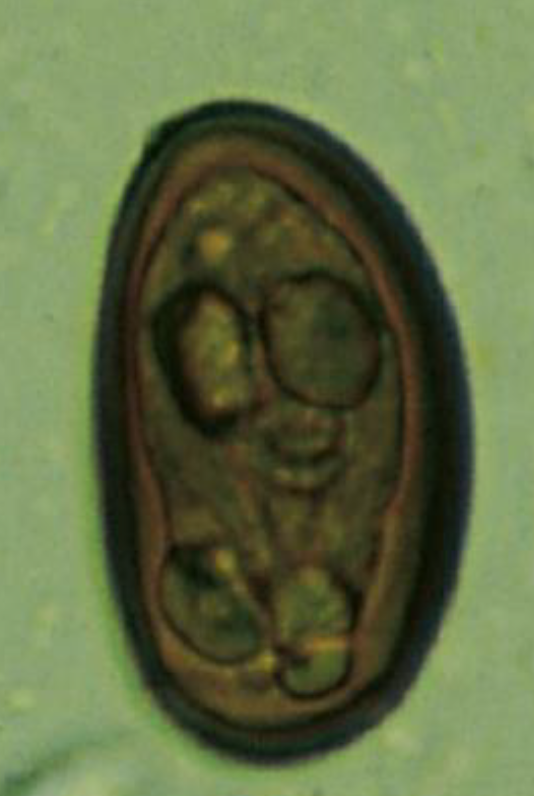
Diagnosis this trematode infection passed on this egg morphology
Dicrocoelium dendriticum
Fecal flotation or sedimentation
Small lopsided yellow-brown operculated eggs
Dicrocoelium dendriticum: Treatment and prevention
Treatment: Albendazole, Praziquantel
Prevention relies on covering anthills or keeping insectivores to eat the ants (ducks, turkeys, chickens)
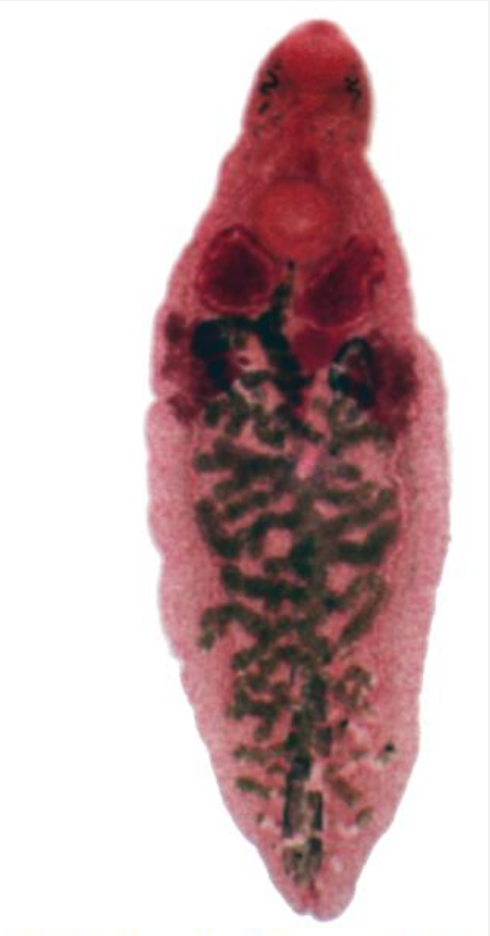
Name this Trematode
Platyhelminths > Trematodes > Platynosomum fastosum
(Trematode from ingesting host/skin penetration group)
Platynosomum fastosum infection is also known as?
Lizard poisoning disease
Platynosomum fastosum flukes live where and in what host?
Live as adults in bile and pancreatic ducts of cats
Where in the world are Platynosomum fastosum flukes live?
Common in southeastern US and Caribbean
Platynosomum fastosum: Life cycle
Eggs passed in feces
Develop to cercariae in land snails
Cercariae ingested by pill bugs and develop to metacercariae
Lizards, toads, skinks, geckos act as paratenic hosts after ingesting pill bugs
Cats infected by either ingesting pill bugs directly or the paratenic hosts
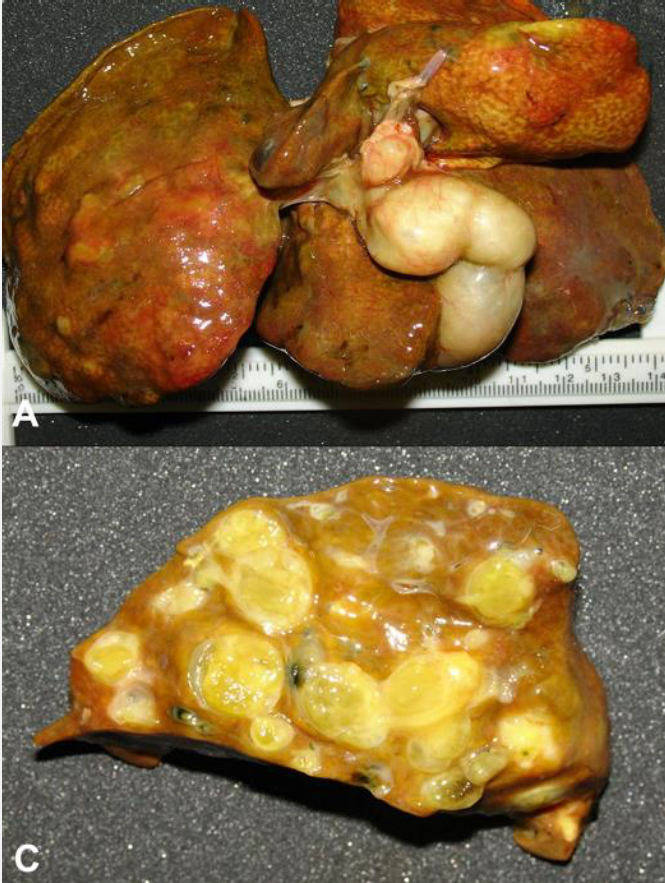
Platynosomum fastosum infections can cause this pictured? Disease clinical signs?
Most cats unaffected
Can cause acute and chronic cholangitis with fever, hepatomegaly, abdominal distension, jaundice, vomiting and diarrhea
Platynosomum fastosum infection/Lizard Poisoning disease is associated with development of what?
Associated with development of liver cancer such as cholangiocarcinoma
Platynosomum fastosum: Diagnosis and Treatment
Diagnosis: Eggs in feces on sedimentation
Treatment: Praziquantel, surgical removal
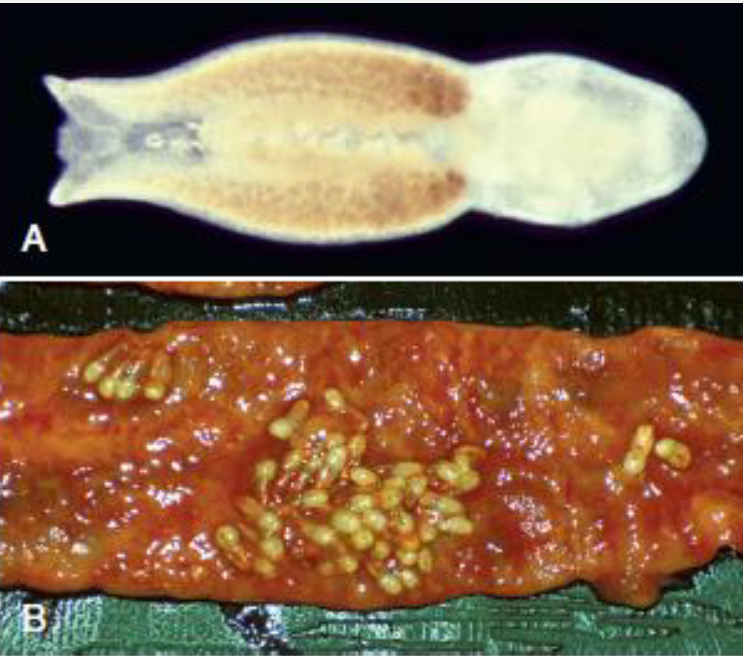
Name this Trematode: Where does it live and in what hosts?
Platyhelminths > Trematodes > Alaria
small flattened spoon-shaped flukes that live as adults in intestinal tract of canids and felids
Alaria: Life Cycle
Eggs passed in feces hatch in water
Infect Snail
Exit and penetrate tadpoles, develop to mesocercariae (unencysted metacercariae)
Mesocercariae can be passed to frogs, snakes or mice that eat the tadpoles
Definitive host (dogs, cats) ingest mesocercariae in intermediate host, develop to metacercariae in lungs, then coughed up and swallowed to mature to adult in intestine
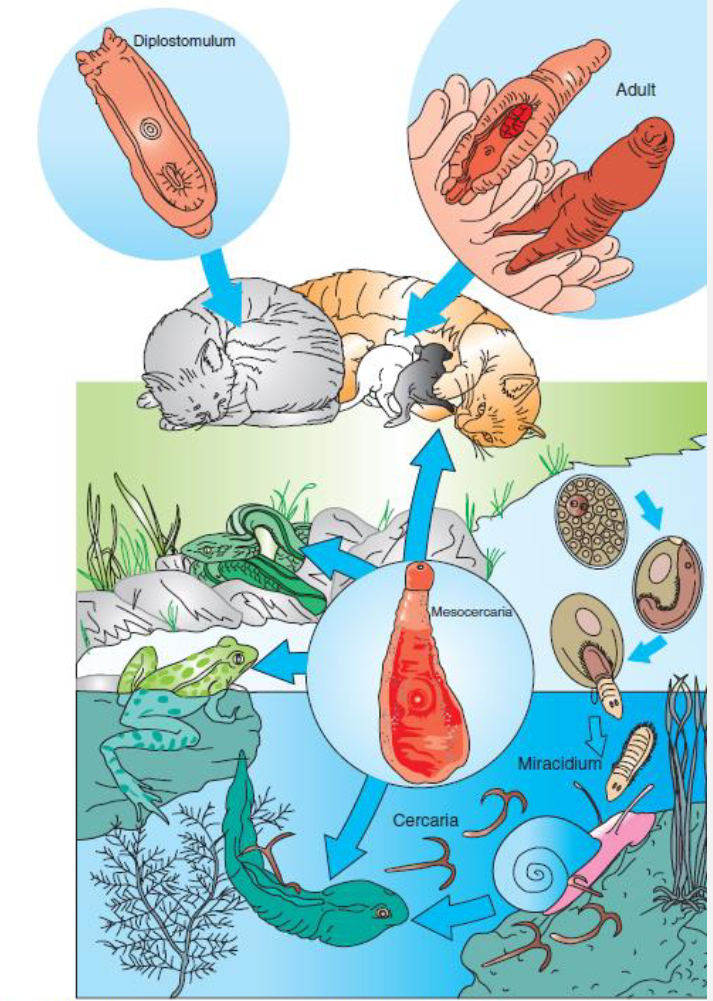
Alaria: Disease
Usually no clinical signs from infection
Migration of mesocercariae can cause disease such as pulmonary hemorrhage
Adults can be associated with enteritis
Alaria: Diagnosis and Treatment
Diagnosis: Fecal sedimentation, flotation not as sensitive
Treatment: Praziquantel
How can Alaria be potentially zoonotic to humans?
If a human eats undercooked frog meat
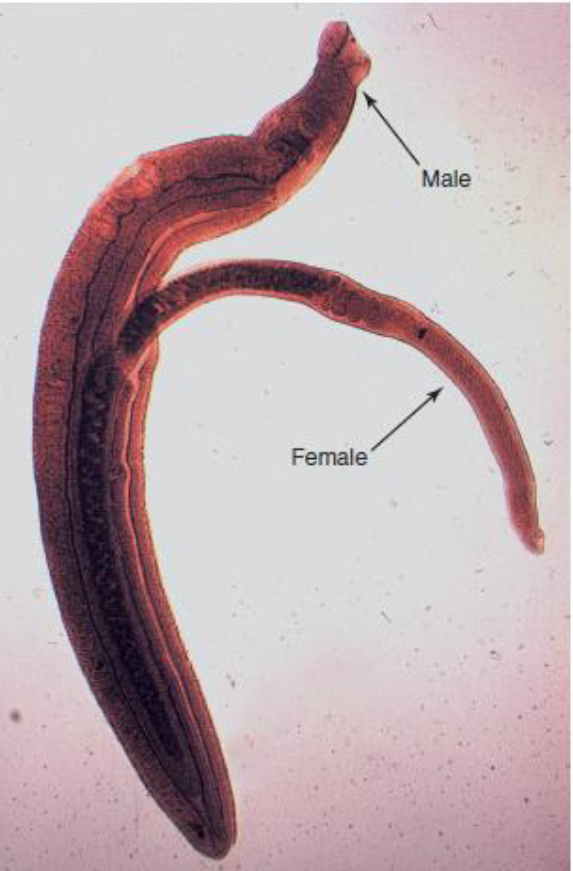
Name this Trematode: Where does it live and in what host?
Platyhelminths > Trematodes > Schistosoma (Schistosomes)
Live as adults in mesenteric veins of birds and mammals
Schistosomes are unique in that there are what?
Separate sexes
Schistosomes mate where in the host?
The separate sexes of Schistosomes mate within mesenteric veins and pass eggs into bloodstream to then enter the intestine
Schistosomes eggs produce what and what does this cause?
Schistosomes eggs produce proteolytic enzymes that erode the mesenteric vein and intestinal walls → inducing granulomatous inflammation
Schistosomes: Life Cycle
Eggs hatch in water
Develop to cercariae in snail
Cercariae penetrate skin of definitive hosts
Migrate to Lungs, liver then mesenteric veins
Sexes mate within the veins, eggs pass into blood into intestine, passed in feces
Heterobilharzia americana is a species of _____ Trematode that can infect dogs where in the US?
Platyhelminths > Trematodes > Schistosoma > Heterobilharzia americana
Southern US
What animals can act as final hosts for Schistosomes?
Raccoons and dogs
How do final hosts acquire Schistosoma infections?
Cercareiae penetrate the skin of hosts while swimming
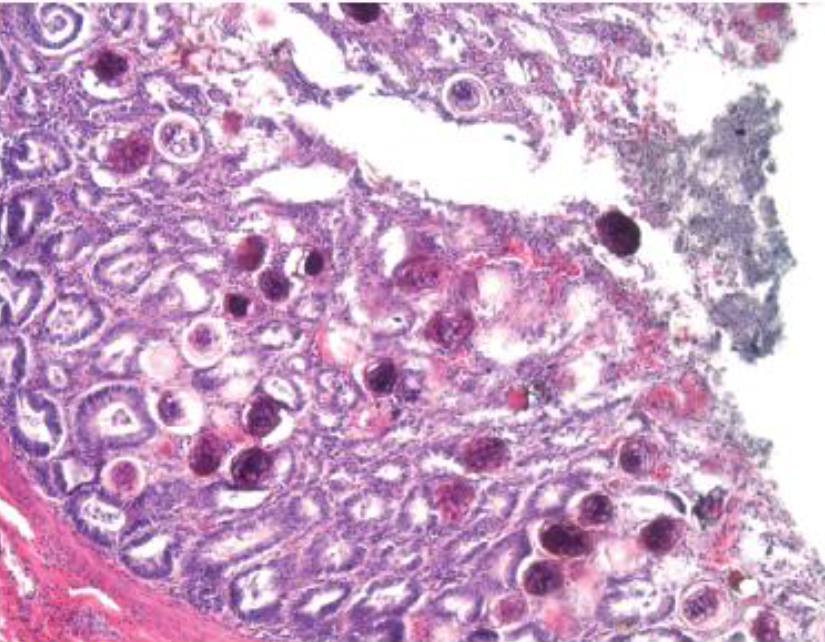
Schistosomiasis: Disease
Liver and intestinal lesions
Lethargy, weight loss, vomiting, diarrhea, hyporexia, anorexia, hypercalcemia, polyuria/polydipsia
Eggs can disseminate into body, causing widespread granulomas
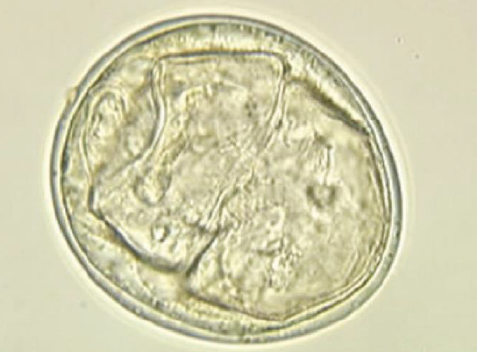
Schistosomiasis: Diagnosis and Treatment
Diagnosis: Fecal sedimentation in NaCl → Eggs will hatch on exposure to water
Treatment: Fenbendazole, praziquantel, but treatment often unrewarding
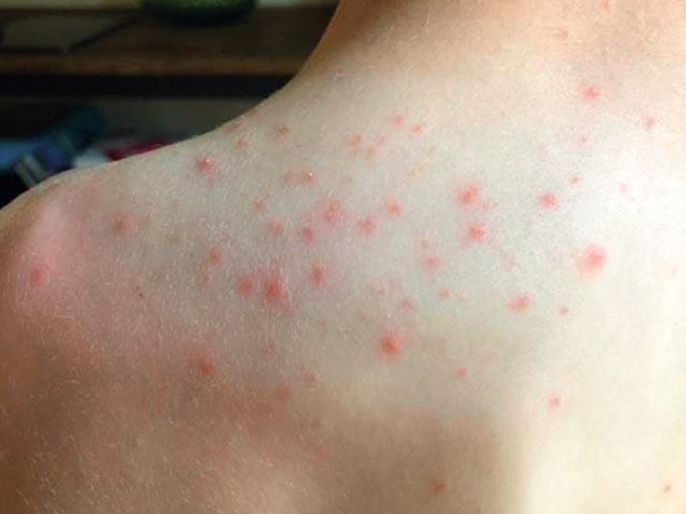
Schistosomiasis can cause what in humans in the US? Patent or nonpatent infection?
Swimmer’s Itch → cercarial dermatitis is caused by waterfowl schistosomes
Caused by Cercariae invade human skin when swimming in ponds, which causes skin rash due to hypersensitivity reaction
Pruritus can last up to a week but eventually fades
(Schistosomiasis common in South America, Africa, and Eastern Asia. Can cause abdominal pain, diarrhea, anemia, and bloody stool)
Nonpatent infection in humans
Praziquantel: Effective against?
Isoquinolone anticestodal and antitrematodal drug, MOA uncertain.
Effective against a wide range of cestodes and trematodes
Oral and SQ injection
Related drug, espiprantel, also effective against cestodes and trematodes in dogs and cats
True or False: Praziquantel is not safe for use in breeding and pregnant animals because it crosses the blood-brain barrier.
False! It does cross the BBB but is still considered very safe for breeding and pregnant animals
Praziquantel: Side Effects
Can cause vomiting and tremors at high doses
Anorexia, diarrhea, salivation, sleepiness, and weakness reported
Resistance to Praziquantel developing in what cestode?
Dipylidium caninum
Other evidence of resistance in other cestodes and trematodes emerging
Practice Question: Which of the following is a clinical sign expected in a dog with salmon poisoning disease?
Answer = Swollen lymph nodes (cervical and mesenteric)
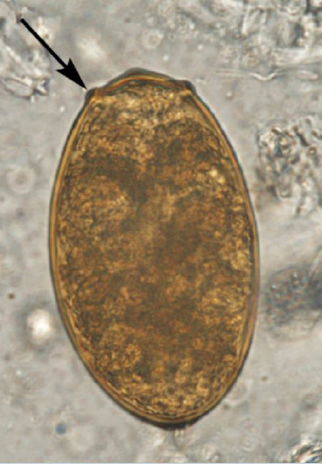
Practice Question: Identified on a transtracheal wash of a cat. How was this parasite acquired?
Answer = This is Paragonimus trematode, acquired through ingestion of crayfish (or crab) intermediate host
Practice Question: Which is true regarding Dicrocoelium dendriticum?
Answer = Large number of flukes can occur with no clinical signs
Practice Question: Which of the following is a clinicopathologic abnormality associated with schistosomiasis in dogs?
Answer = Hypercalcemia
Practice Question: Which of the following is a means by which final hosts can be infected with Alaria spp.?
Answer = Ingestion of mesocercariae in mother’s milk
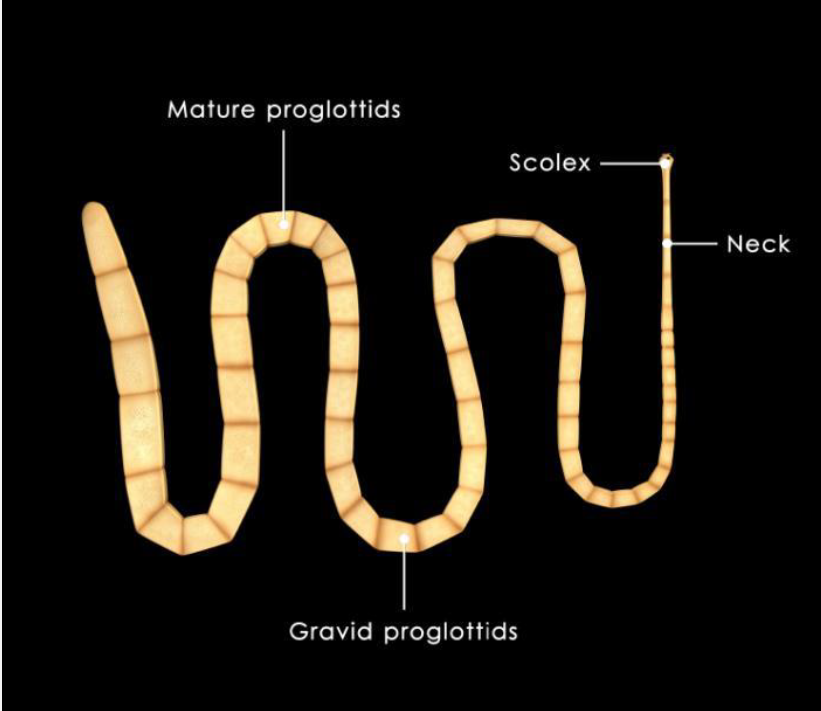
Name this Class of Platyhelminths: Scientific and Common
Platyhelminths > Cestodes
AKA Tapeworms
Cestode adult morphologic features
Adults consist of a chain (Strobila) of individual reproductive segments (proglottids) attached by a holdfast (scolex)
Cestode egg morphology
Eggs are oncospheres = six-hooked embryo (hexacanth embryos)