Microeconomics
 Call Kai
 Learn
Learn Practice Test
 Spaced Repetition
 Match
Match Flashcards
 Knowt Play
1/114

There's no tags or description
Looks like no tags are added yet.
Name | Mastery | Learn | Test | Matching | Spaced | Call with Kai |
|---|
No analytics yet
Send a link to your students to track their progress
115 Terms
Opportunity Cost
The value of the next best alternative
Marginal analysis
Comparing the benefits and costs of choosing a little more or a little less of a good
Law of diminishing marginal utility
As a person receives more of a good, the additional (or marginal) utility from each additional unit of the good declines
Sunk costs
costs that were incurred in the past and cannot be recovered, should not affect the current decision
Law of diminishing returns
As additional increments of resources are added to a certain purpose, the marginal benefit from those additional
increments will decline
Productive efficiency
when it is impossible to produce more of one good (or service) without decreasing the quantity produced of another good (or service)
Allocative efficiency
The particular mix of goods a society produces represents the combination that society most desires
comparative advantage
When a entity can produce a good at a lower opportunity cost than another entity.
budget constrain
all possible consumption combinations of goods that someone can afford, given the prices of goods, when all income is spent; the boundary of the opportunity set
opportunity set
all possible combinations of consumption that someone can afford given the prices of goods and the individual’s income
production possibilities frontier (PPF)
a diagram that shows the productively efficient combinations of two products that an economy can produce given the resources it has available
absolute advantage
producing a good over another entity using fewer resources to produce that good
Socialist Planned Economy
Allocation and ownership is planned by the government
Capitalism
Private allocation and ownership
Command Capitalism
allocation is planned by the government while ownership is private
Market Socialism
government planned ownership private allocation
Marginal analysis
examination of the associated costs and potential benefits of specific business activities or financial decisions
Incentives/disincentives
change the costs or benefits of a choice, therefore may alter the decision someone makes
demand
the relationship between price and the quantity demanded of a certain good or service (refers to the entire demand curve)
quantity demanded
The total number of units purchased at a price (refers to one point on a demand curve)
supply
the relationship between price and the quantity supplied of a certain good or service
law of supply
a higher price leads to a higher quantity supplied and a lower price leads to a lower quantity supplied
law of demand
a higher price leads to a lower quantity demanded and a lower price leads to a higher quantity demanded
equilibrium
The point where the supply curve (S) and the demand curve (D) cross
equilibrium price and quantity
the amount of the product consumers want to buy (quantity demanded) is equal to the amount producers want to sell (quantity supplied) at that price
surplus/excess supply
the quantity supplied exceeds the quantity demanded (all above equilibrium prices)
shortage/excess demand
at the existing price, the quantity demanded exceeds the quantity supplied
ceteris paribus
The assumption behind a demand curve or a supply curve is that no relevant economic factors, other than the product’s price, are changing
normal good
A product whose demand rises when income rises, and vice versa
inferior good
A product whose demand falls when income rises, and vice versa
substitute
good or service that can be used in place of another good or service
complements
the goods are often used together, because consumption of one good tends to enhance consumption of the other
shift in supply
a change in the quantity supplied at every price
Price controls
Laws that government enacts to regulate prices
price ceiling
keeps a price from rising above a certain level
price floor
keeps a price from falling below a certain level
consumer surplus
The amount that individuals would have been willing to pay, minus the amount that they actually paid
producer surplus
the amount that a seller is paid for a good minus the seller’s actual cost
social/total/economic surplus
the sum of consumer surplus and producer surplus
deadweight loss
The loss in social surplus that occurs when the economy produces at an inefficient quantity
Elasticity
an economics concept that measures responsiveness of one variable to changes in another variable
Price elasticity
the ratio between the percentage change in the quantity demanded (Qd) or supplied (Qs) and the corresponding percent change in price
price elasticity of demand
the percentage change in the quantity demanded of a good or service divided by the percentage change in the price
price elasticity of supply
the percentage change in quantity supplied divided by the percentage change in price
Zero elasticity/perfect inelasticity
the extreme case in which a percentage change in price, no matter how large, results in zero change in quantity
tax incidence
The analysis, or manner, of how the burden of a tax is divided between consumers and producers
cross-price elasticity of demand
the idea that the price of one good is affecting the quantity demanded of a different good
Elasticity of labor supply
% change in quantity of labor supplied / % change in wage
elasticity of savings
the percentage change in the quantity of savings divided by the percentage change in interest rates
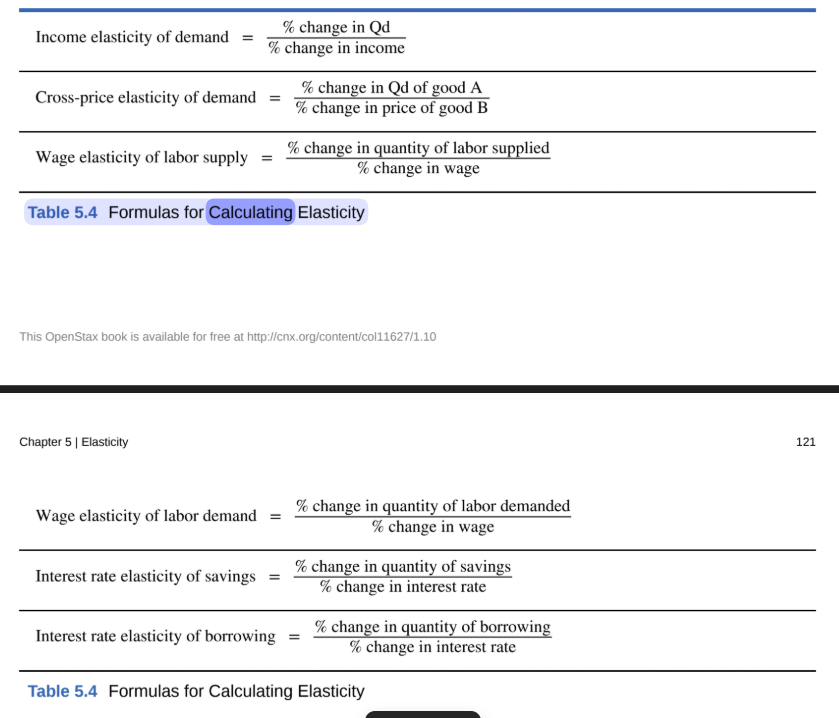
Formulas for calculating elasticity
increasing the price of inelastic goods
increases total revenue
increasing the price of elastic goods
decreases total revenue
Marginal Utility formula
change in total utility / change in quantity
total utility
satisfaction derived from consumer choices
marginal utility per dollar formula
marginal utility / price
maximizing utility formula
MU1 / P1 = PU2 / P2
consumer equilibrium
hen the price of good 1 is divided by the price of good 2, at the utility-maximizing point this will equal the marginal utility of good 1 divided by the marginal utility of good 2 (P1 / P2 = MU1 / MU2)
substitution effect
occurs when a price changes and consumers have an incentive to consume less of the good with a relatively higher price and more of the good with a relatively lower price
income effect
is that a higher price means, in effect, the buying power of income has been reduced, which leads to buying less of the good (when the good is normal).
backward-bending supply curve for labor
the situation of high-wage people who can earn so much that they respond to a still-higher wage by working fewer hours
behavioral economics
seeks to enrich the understanding of decision-making by integrating the insights of psychology into economics
fungible
units of good eg.dollars have equal value to the individual, regardless of the situation
firm (or business)
combines inputs of labor, capital, land, and raw or finished component materials to produce outputs.
production
goes beyond manufacturing (i.e., making things). It includes any process or service that creates value, including transportation, distribution, wholesale and retail sales
Explicit costs
out-of-pocket costs, that is, payments that are actually made
Implicit costs
represent the opportunity cost of using resources already owned by the firm
Accounting profit
a cash concept. It means total revenue minus explicit costs—the difference between dollars brought in and dollars paid out
Economic profit
total revenue minus total cost, including both explicit and implicit costs.
total cost
the sum of fixed and variable costs of production
Fixed costs
expenditures that do not change regardless of the level of production, at least not in the short term.
Variable costs
incurred in the act of producing—the more you produce, the greater the variable cost.
Average total cost
total cost divided by the quantity of output.
Average variable cost
obtained when variable cost is divided by quantity of output
Marginal cost
the additional cost of producing one more unit of output
average profit
divide profit by the quantity of output produced we get
long-run average cost curve
shows the lowest possible average cost of production, allowing all the inputs to production to vary so that the firm is choosing its production technology
short-run average cost curves
the average total cost curve in the short term; shows the total of the average fixed costs and the average variable costs
constant returns to scale
allowing all inputs to expand does not much change the average cost of production
economies of scale
refers to the situation where, as the quantity of output goes up, the cost per unit goes down
diseconomies of scale
the long-run average cost of producing each individual unit increases as total output increases
Marginal Cost Formula
TC2-TC1 / Q2-Q1
Point where profits are maximized with amount of goods produced
when marginal revenue = marginal cost
market structure
the conditions in an industry, such as number of sellers, how easy or difficult it is for a new firm to enter, and the type of products that are sold
entry
the long-run process of firms entering an industry in response to industry profits
marginal revenue
the additional revenue gained from selling one more unit
perfect competition
each firm faces many competitors that sell identical products
price taker
a firm in a perfectly competitive market that must take the prevailing market price as given
shutdown point
level of output where the marginal cost curve intersects the average variable cost curve at the minimum point of AVC; if the price is below this point, the firm should shut down immediately
allocative efficency
producing the optimal quantity of some output; the quantity where the marginal benefit to society of one more unit just equals the marginal cost (P=MC)
barriers to entry
the legal, technological, or market forces that may discourage or prevent potential competitors from entering a market
deregulation
removing government controls over setting prices and quantities in certain industries
legal monopoly
legal prohibitions against competition, such as regulated monopolies and intellectual property protection
marginal profit
profit of one more unit of output, computed as marginal revenue minus marginal cost
monopoly
a situation in which one firm produces all of the output in a market
natural monopoly
economic conditions in the industry, for example, economies of scale or control of a critical resource, that limit effective competition
predatory pricing
when an existing firm uses sharp but temporary price cuts to discourage new competition
trade secrets
methods of production kept secret by the producing firm
cartel
a group of firms that collude to produce the monopoly output and sell at the monopoly price
collusion
when firms act together to reduce output and keep prices high
differentiated product
a product that is perceived by consumers as distinctive in some way