9. Secondary Glaucomas - Management of Glaucoma Summer 2026
 Call Kai
 Learn
Learn Practice Test
 Spaced Repetition
 Match
Match Flashcards
 Knowt Play
1/212

There's no tags or description
Looks like no tags are added yet.
Name | Mastery | Learn | Test | Matching | Spaced | Call with Kai | Chat |
|---|
No analytics yet
Send a link to your students to track their progress
213 Terms
What is the definition of the secondary glaucomas?
Result in the characteristic optic neuropathy of POAG BUT are associated with an increase in IOP secondary to another cause
What are the causes of secondary glaucomas?
-an acquired ocular condition
-an acquired systemic condition
-use of meds
-trauma
Essentially, secondary glaucomas exhibit different ways in which there can be an increase in IOP aside from typical _________
POAG or PACG
What are the examples given of secondary glaucomas?
-pigmentary glaucoma
-pseudoexfoliation glaucoma
-inflammatory glaucoma
-steroid-induced glaucoma
-traumatic glaucoma
-neovascular glaucoma
-phacolytic and phacomorphic glaucoma
-developmental glaucoma
What is pigmentary glaucoma (PG) secondary to?
pigment dispersion syndrome (PDS)
What is pseudoexfoliation glaucoma (PXG) secondary to?
pseudoexfoliation syndrome (PXE)
What is inflammatory glaucoma from?
-regular uveitis
-special uveitic episode
What are the subsets of inflammatory glaucoma?
-Glaucomatocyclitic crisis (Posner-Schlossman syndrome)
-Fuch's Heterochromatic Iridocyclitis
-UGH Syndrome
What is the epidemiology of pigmentary dispersion syndrome?
Liberation of pigment granules from the posterior pigmented epithelium of the back surface of the iris
PDS may occur in up to ____% of Caucasians
2.5
When is the onset of PDS?
-as early as mid-teens
-usually diagnosed between 20-40yo
Does PDS have a predilection for males v females?
No
More (males/females) convert to PG
males -- 3x more likely to convert
PDS converts to PG with the development of what?
optic nerve head damage or VF loss
Like other glaucomas, PDS is typically (unilateral/bilateral)
bilateral
Like other glaucomas, PDS is typically (symmetric/asymmetric)
asymmetric
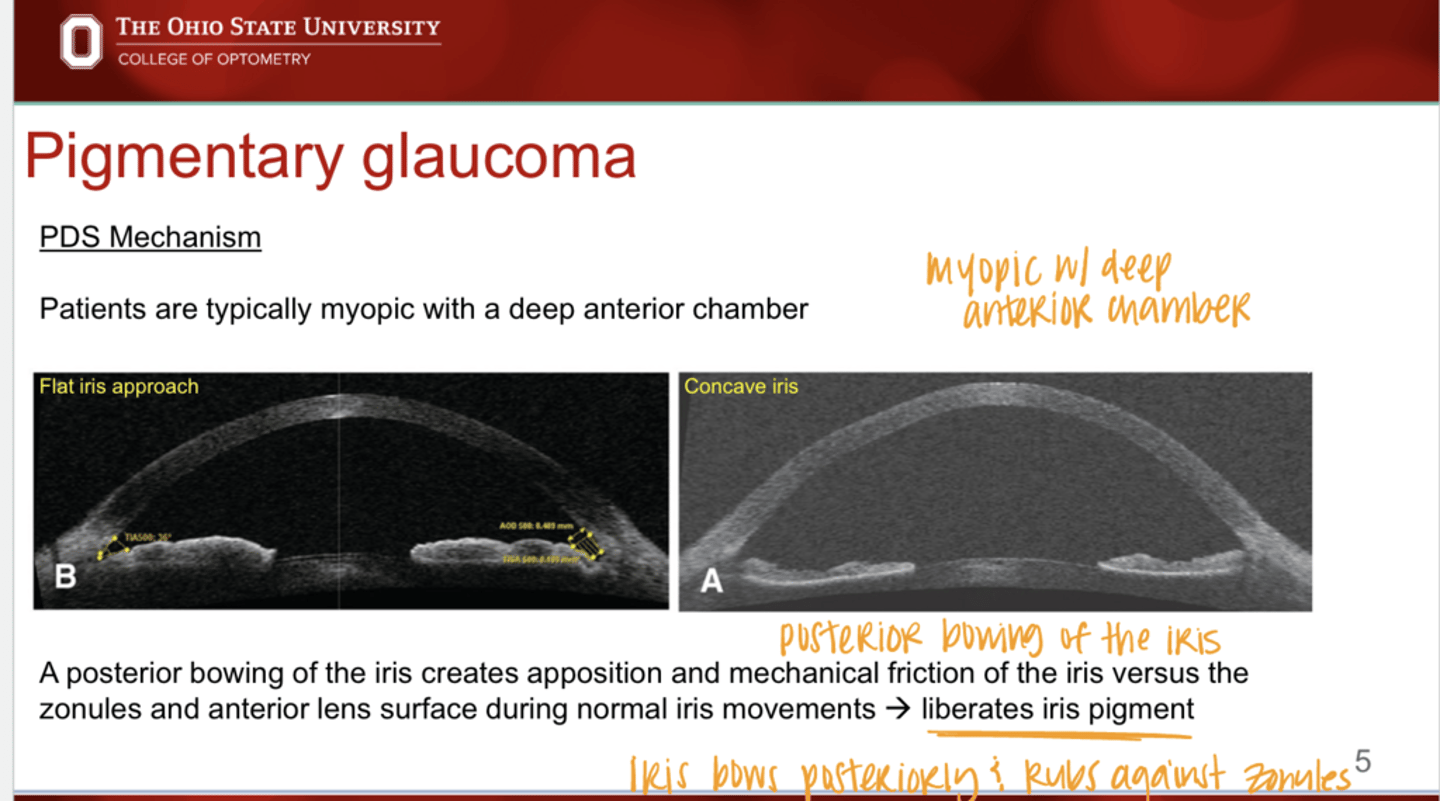
What is the etiology of PDS?
Patients are typically myopic with a deep anterior chamber
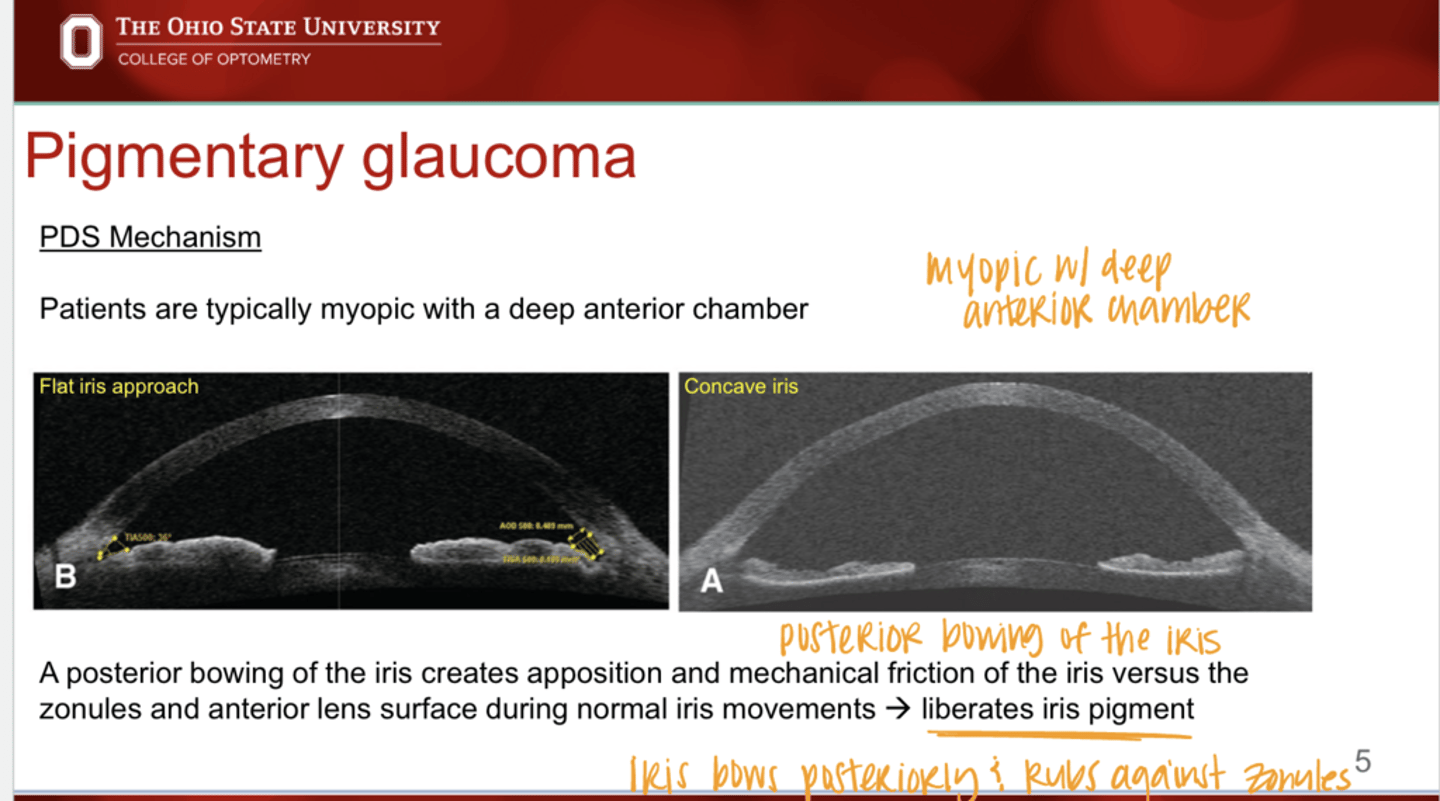
A _____ bowing of the iris creates apposition and mechanical friction of the iris & the zonules/lens during normal iris movements
posterior
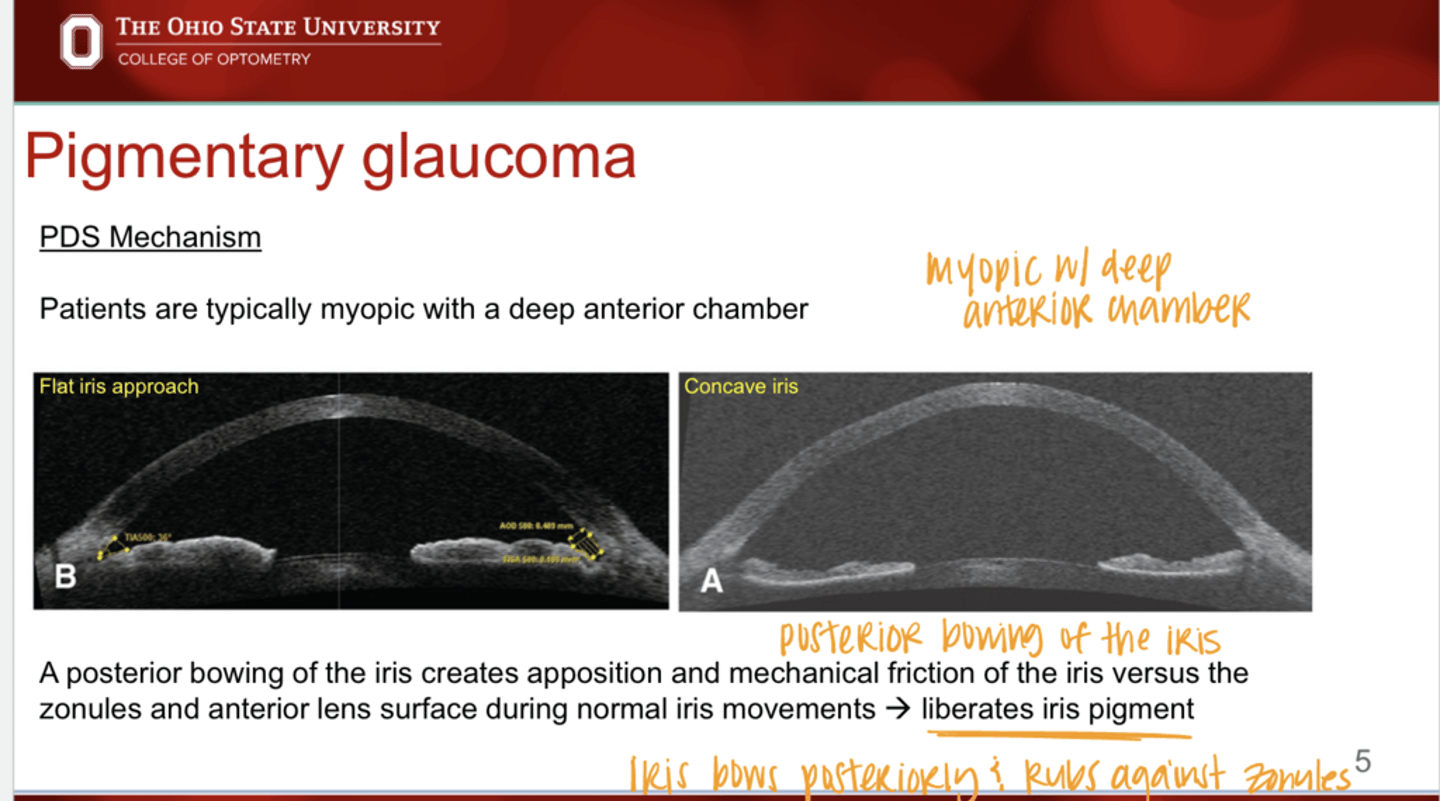
As a result of the iris creating friction between it and the zonules/lens, what happens to the pigment?
pigment of the iris is liberated
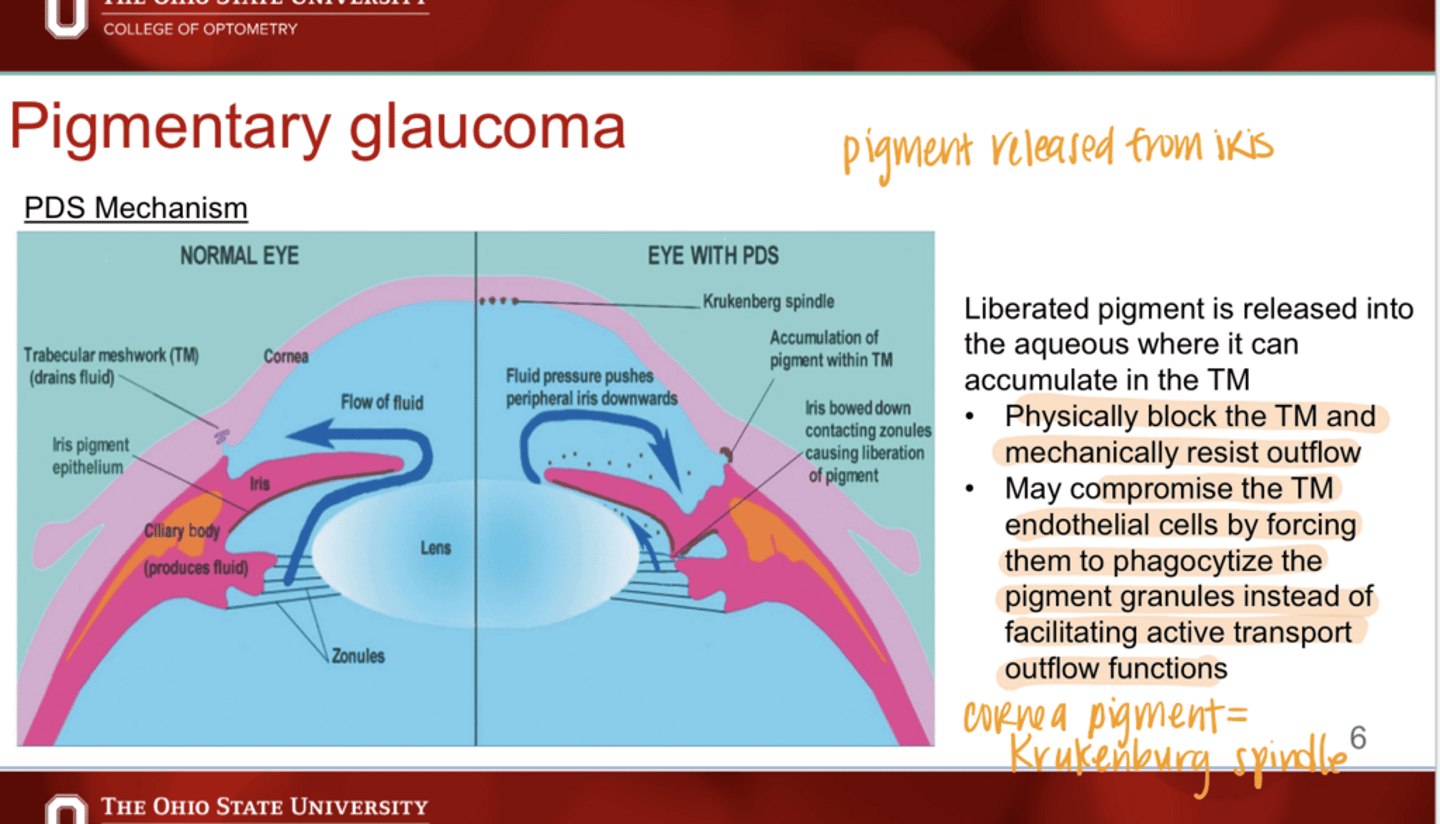
Liberated pigment in PDS is released into where?
into the anterior vitreous
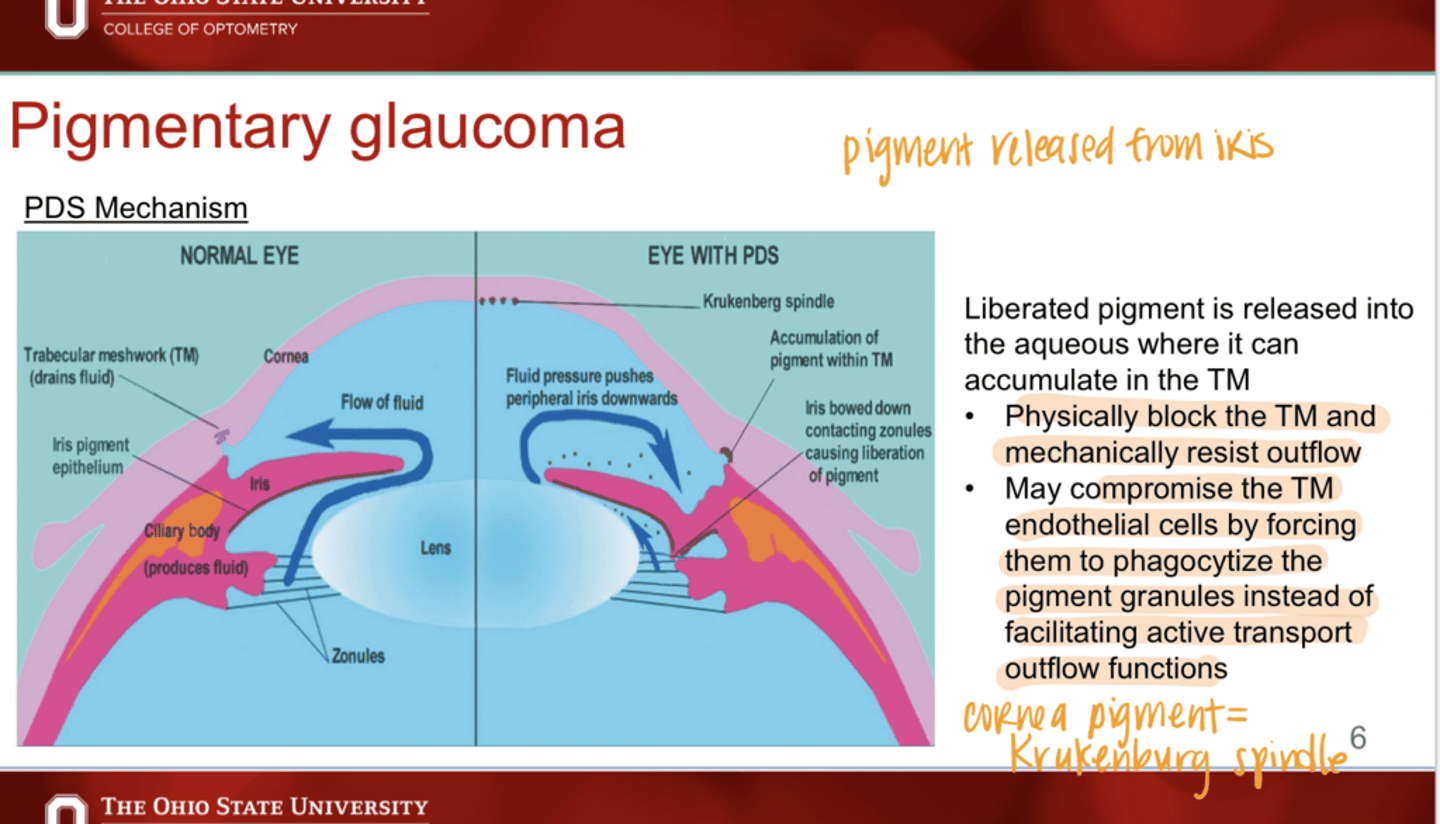
Where does the pigment of PDS accumulate?
in the TM of the angle
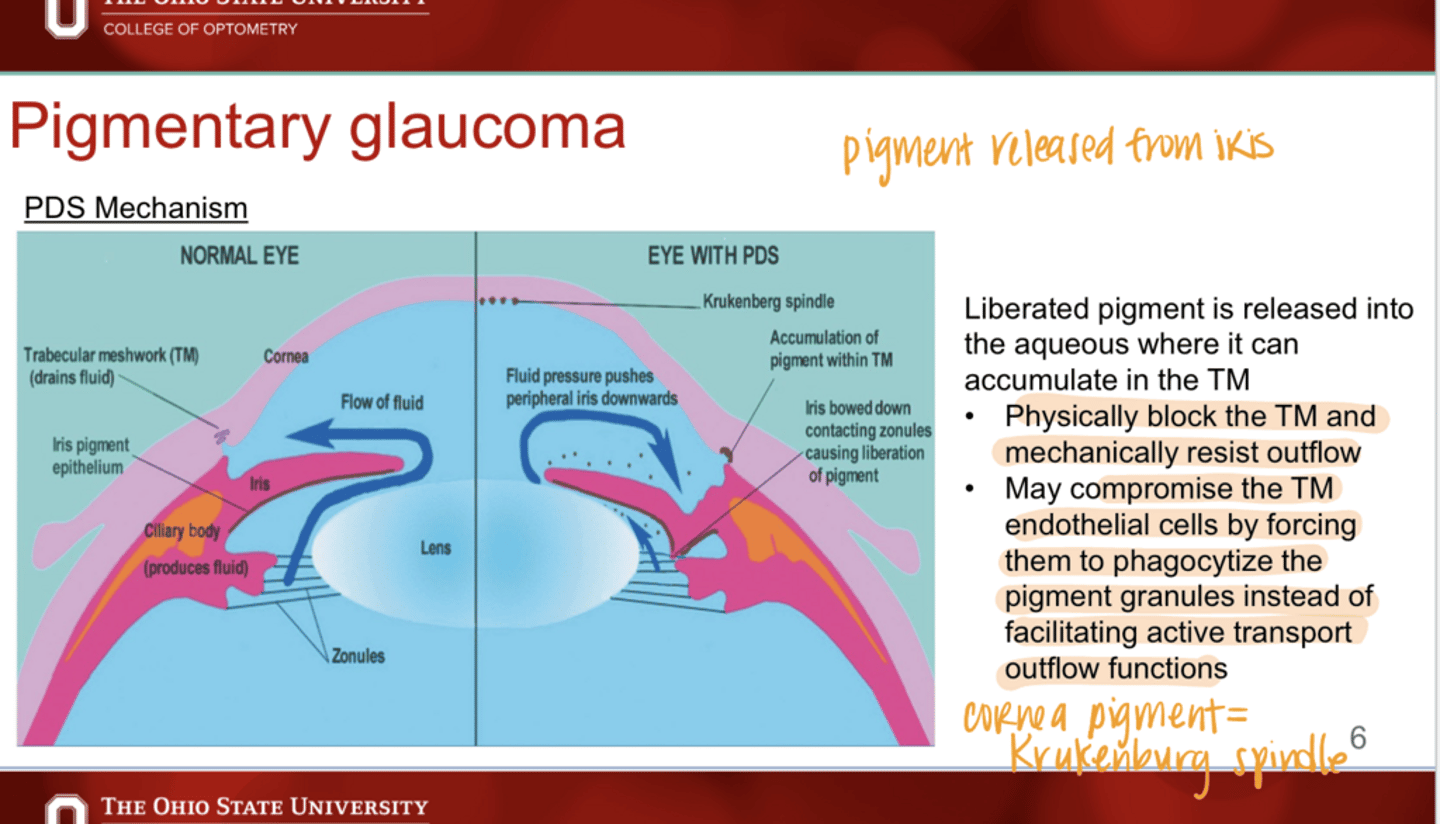
What happens as a result of increased pigment in the angle with PDS?
-Physically block the TM and mechanically resist outflow
-May compromise the TM endothelial cells by forcing them to phagocytize the pigment granules instead of facilitating active transport outflow functions
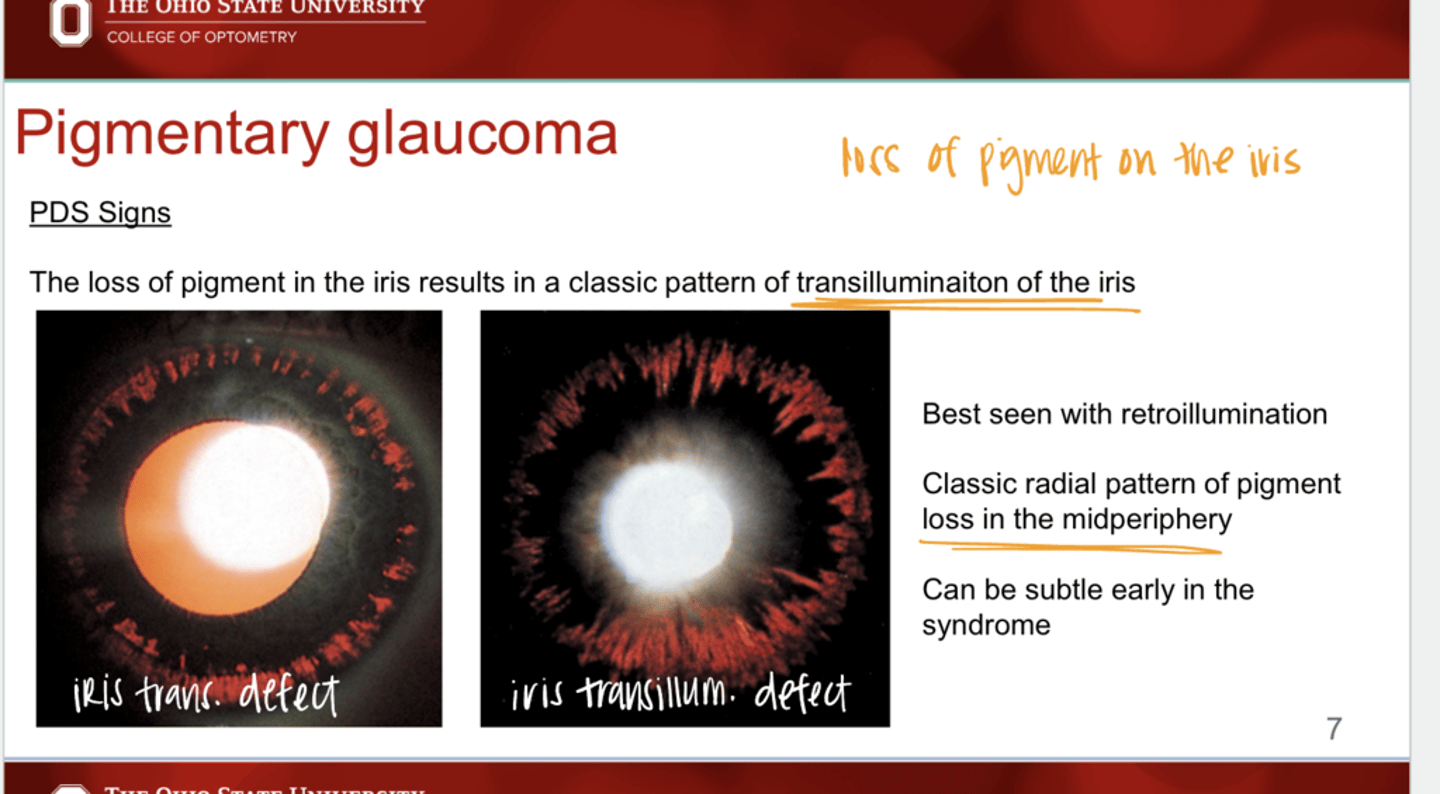
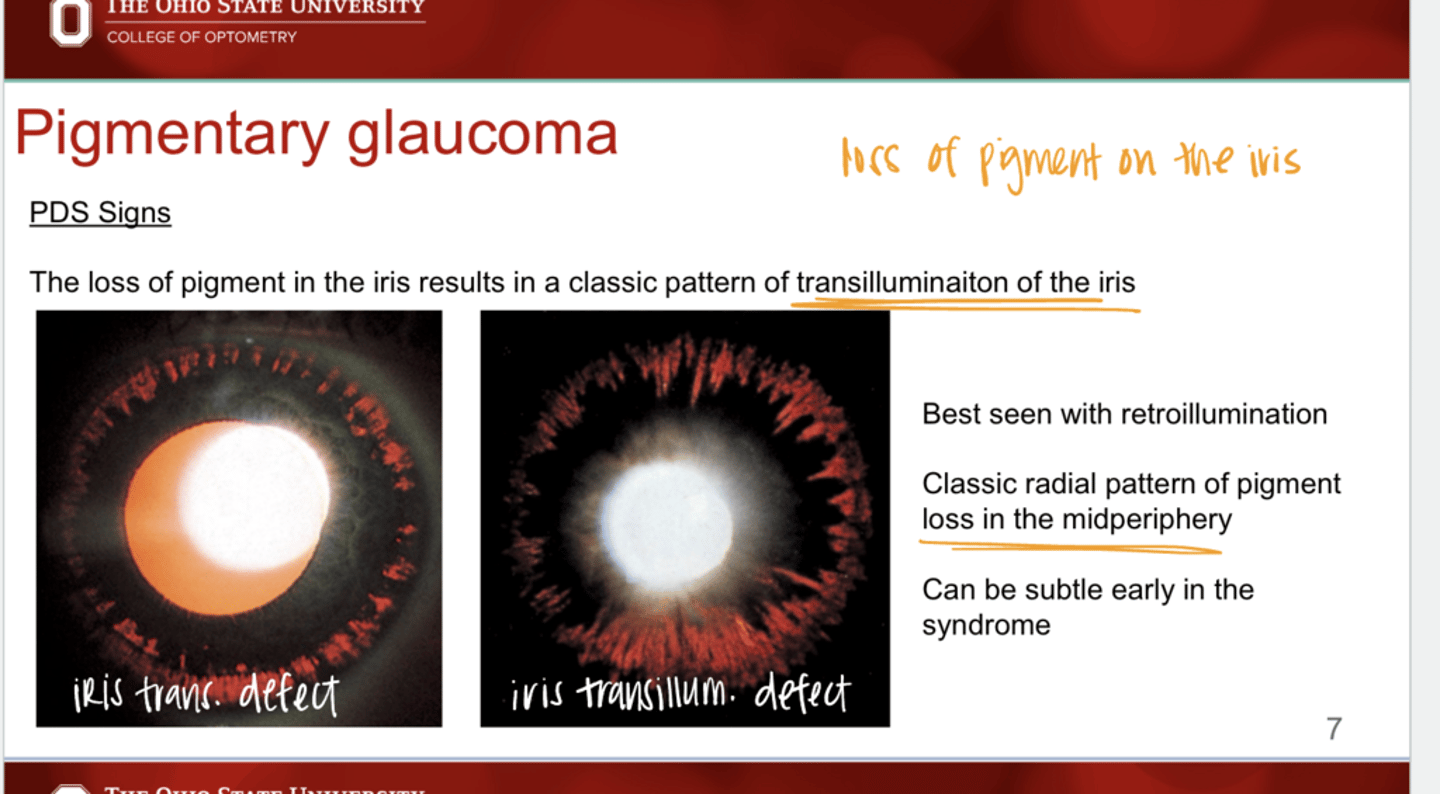
The loss of pigment in the iris with PDS will result in the classic pattern of ________ of the iris
transillumination
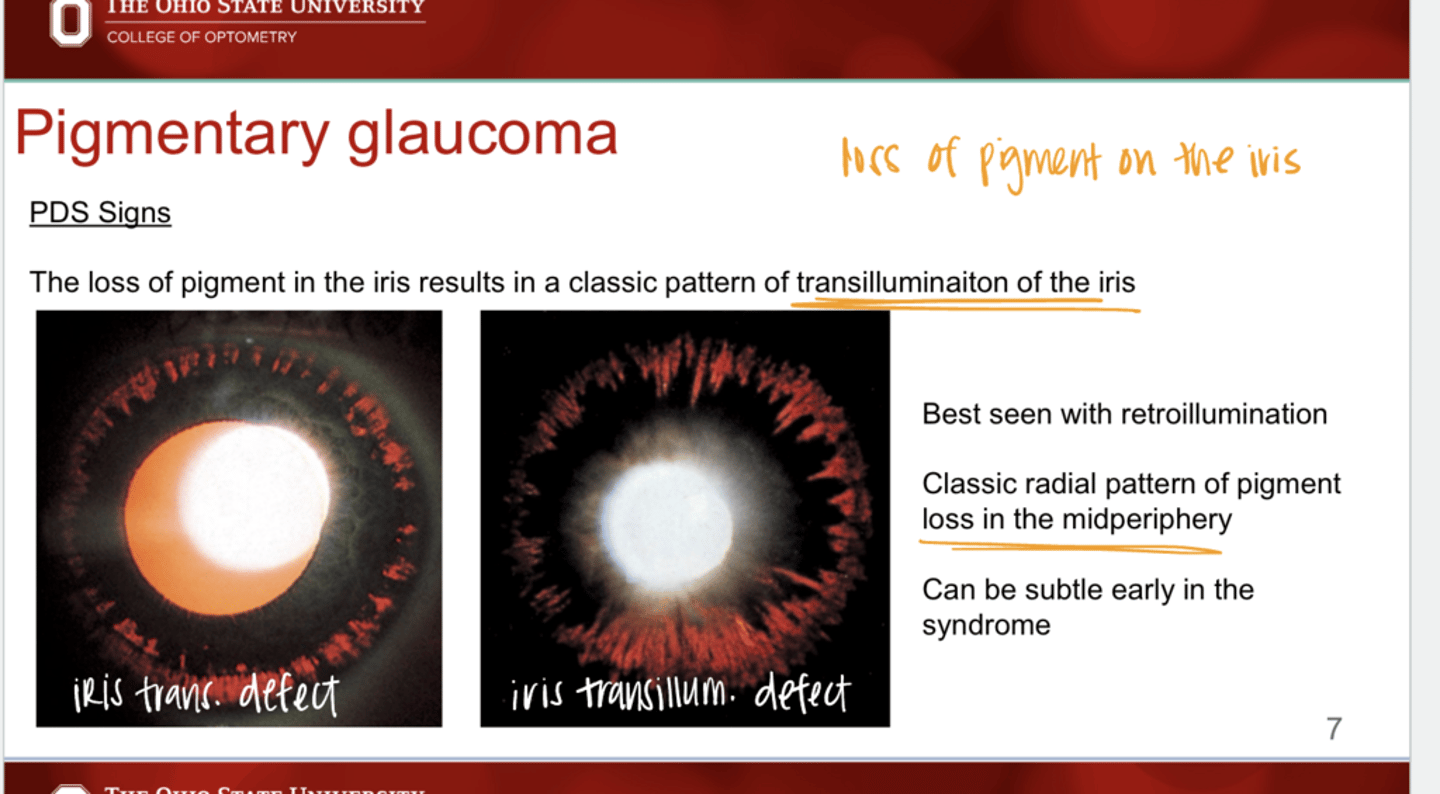
Transillumination defects of the iris are best seen in what form of lighting?
retroillumination
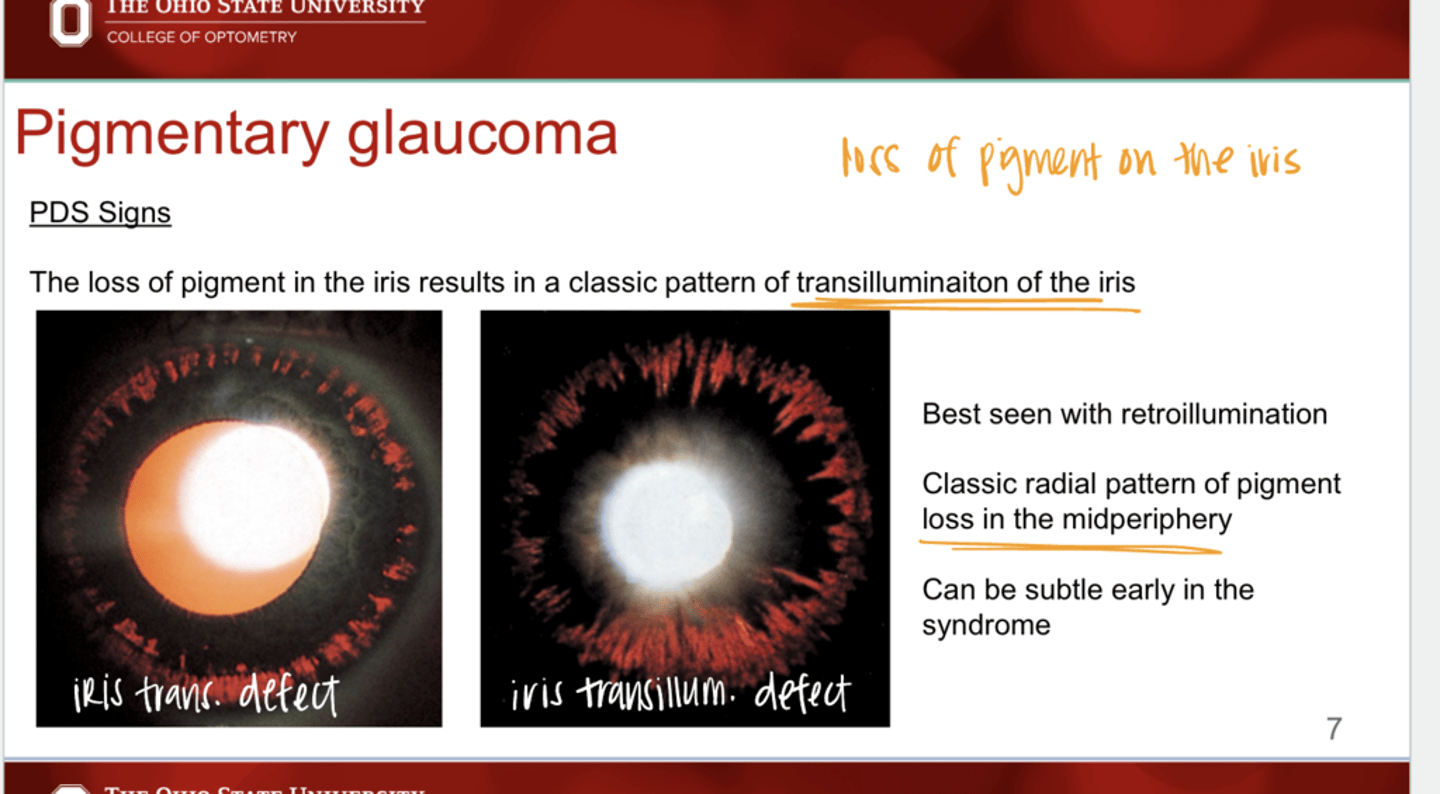
Characteristics of the iris pigmentary defects in PDS
Classic radial pattern of pigment loss in the midperiphery
True or False:
Pigment loss of the iris can be subtle early in PDS
true
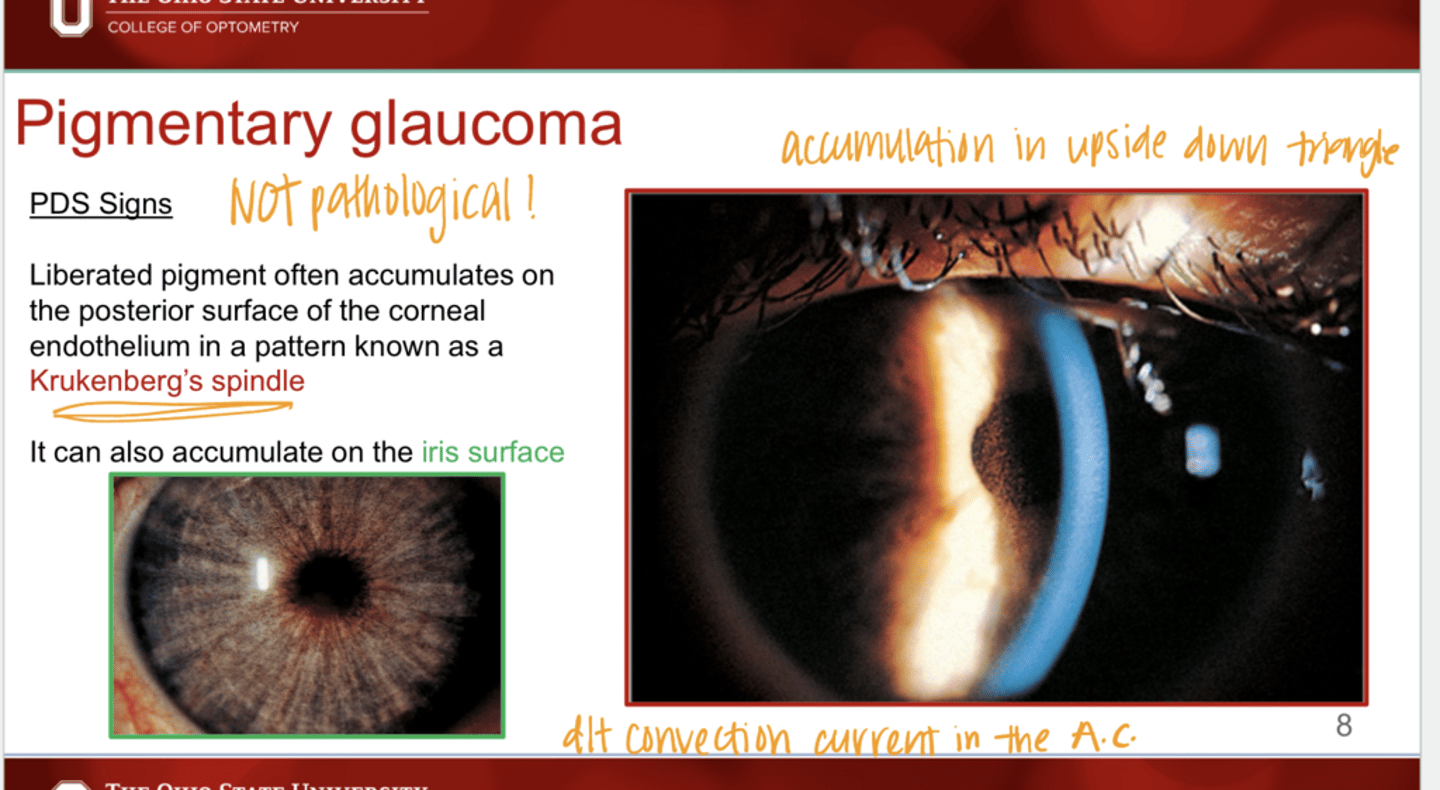
Liberated pigment in PDS often accumulated on the posterior surface of the corneal endothelium in a pattern known as what?
Krukenberg's spindle
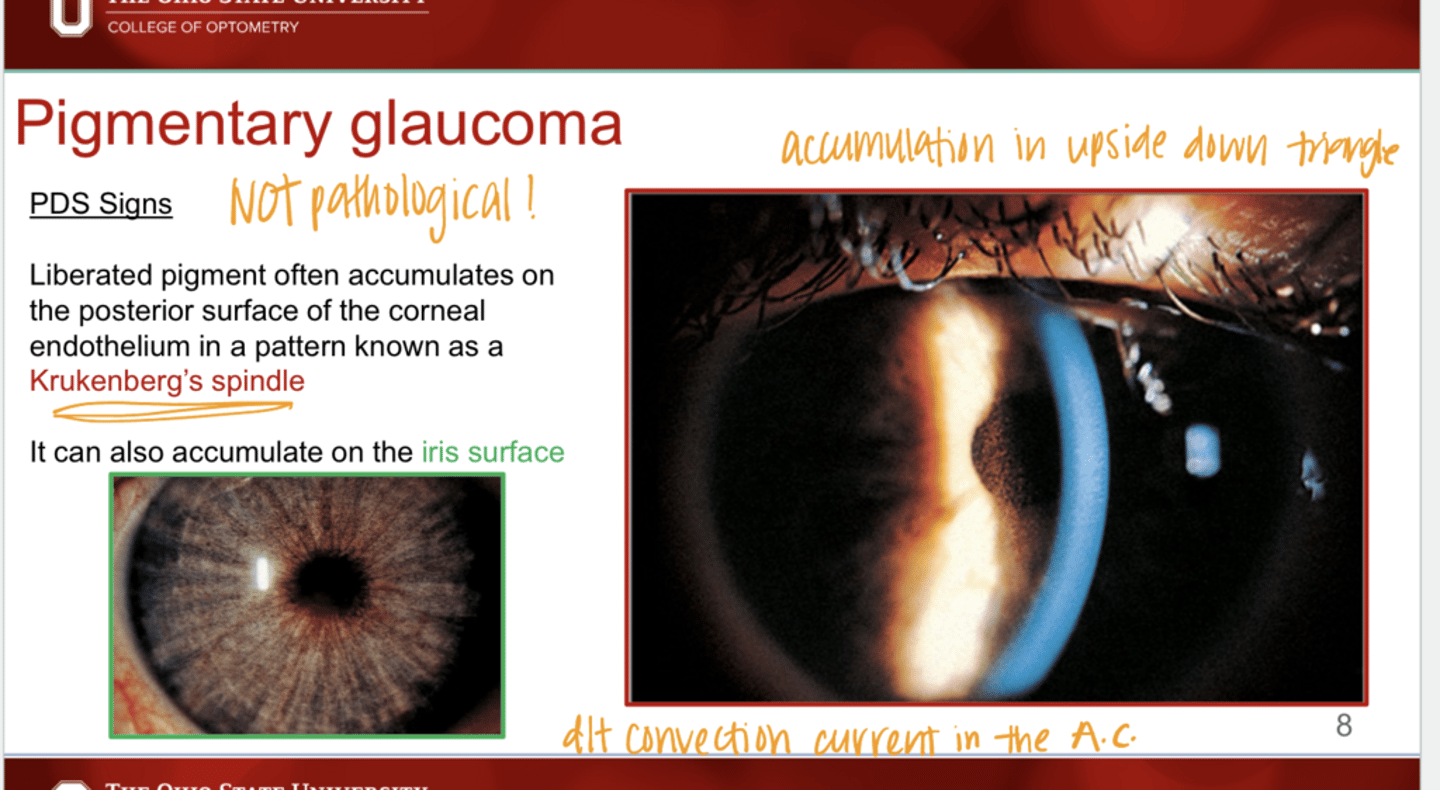
Can pigment of PDS accumulate on the iris itself?
Yes -- on the iris surface
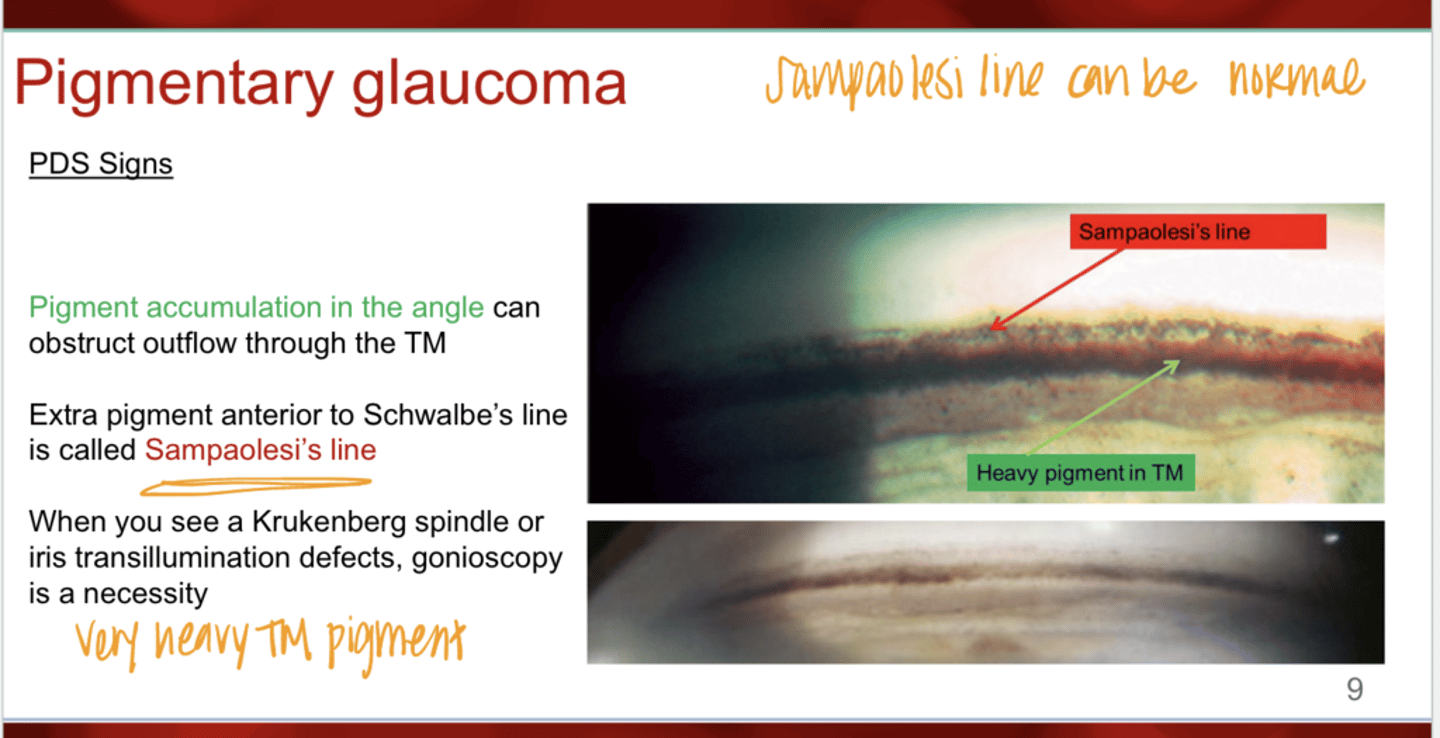
Pigment accumulation in the angle can do what?
obstruct outflow through the TM
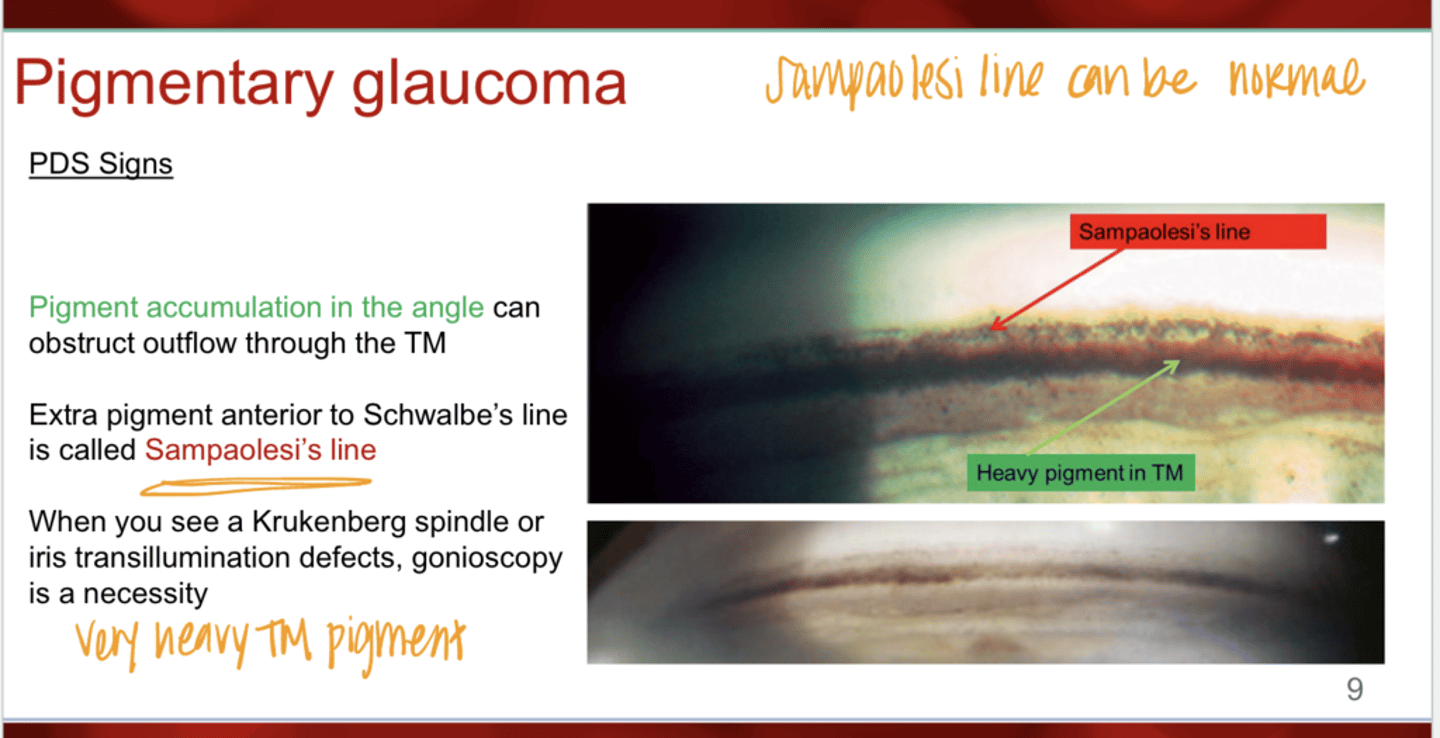
Extra pigment in the angle anterior to Schwalbe's line is called what?
Sampaolesi's line
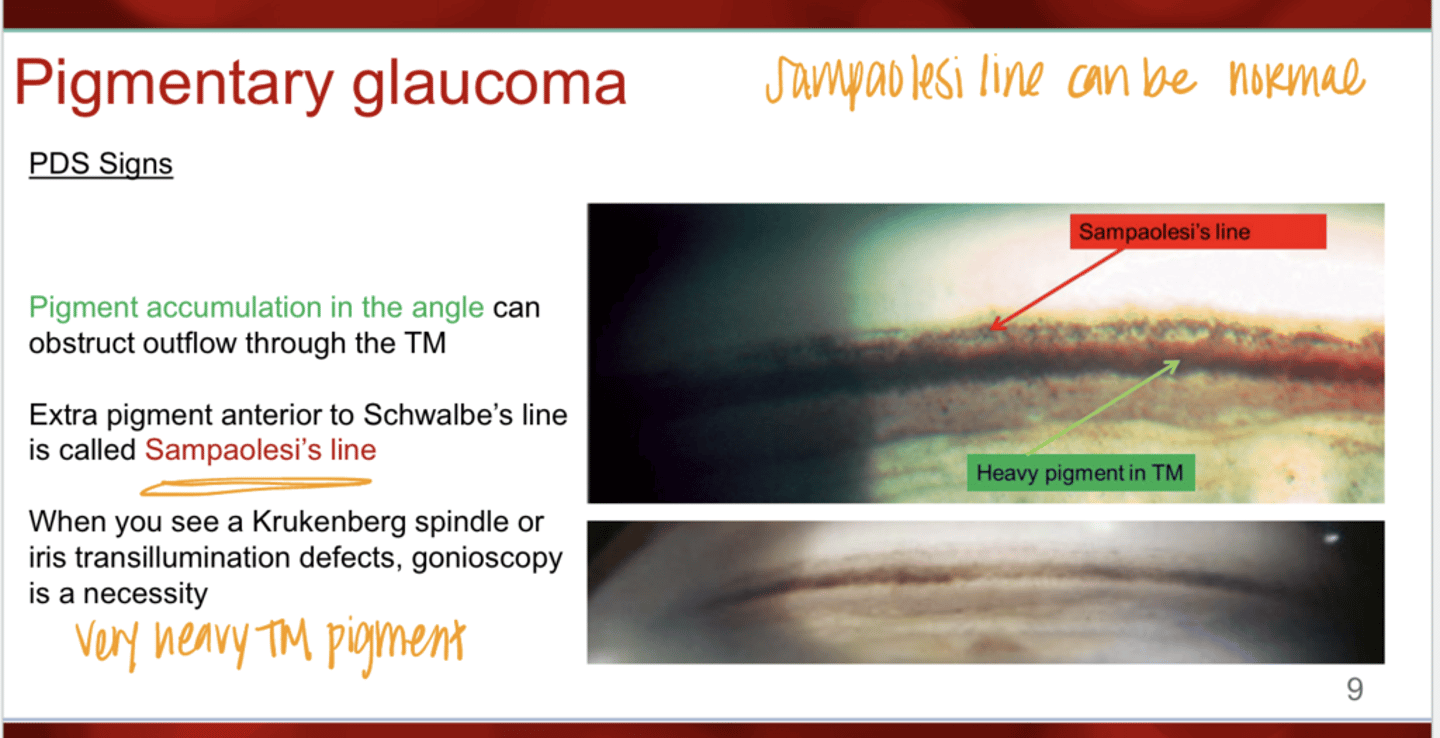
When you see a Krukenberg spindle or iris transillumination defects, _____ is a necessity
gonio
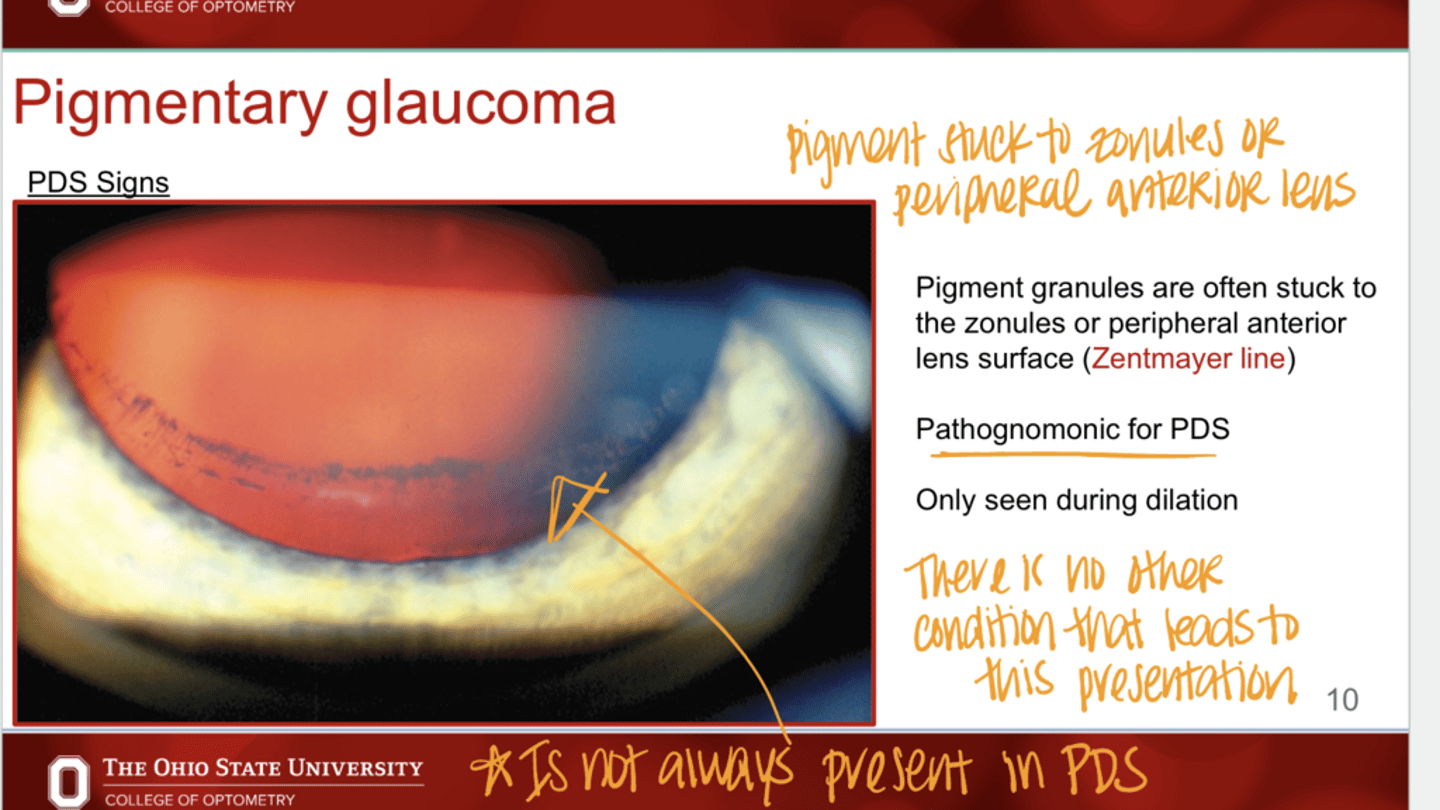
In PDS, pigment granules are often stuck to the zonules or to the peripheral anterior lens surface. This is known as what?
Zentmayer line
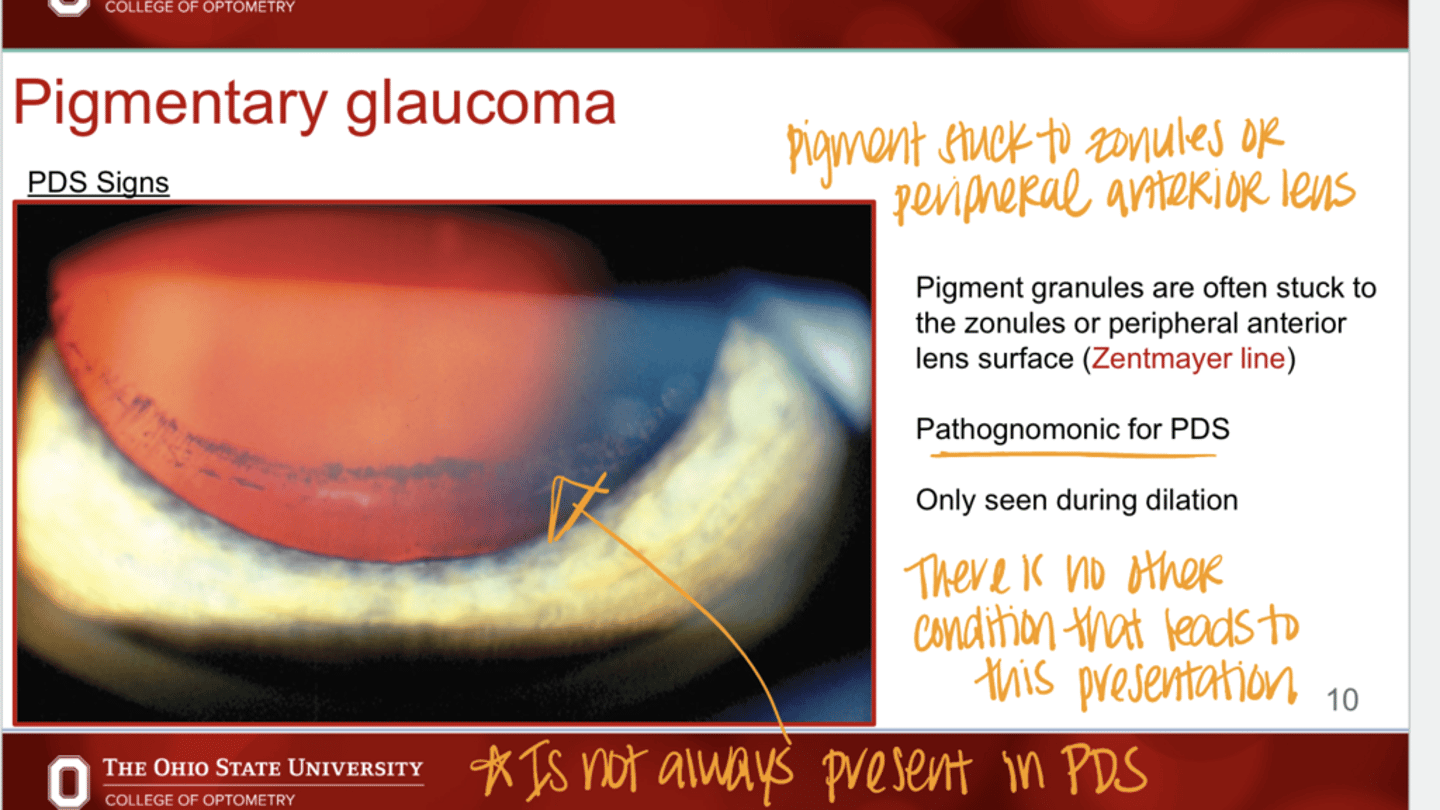
Zentmayer line is _____ for PDS
pathognomonic
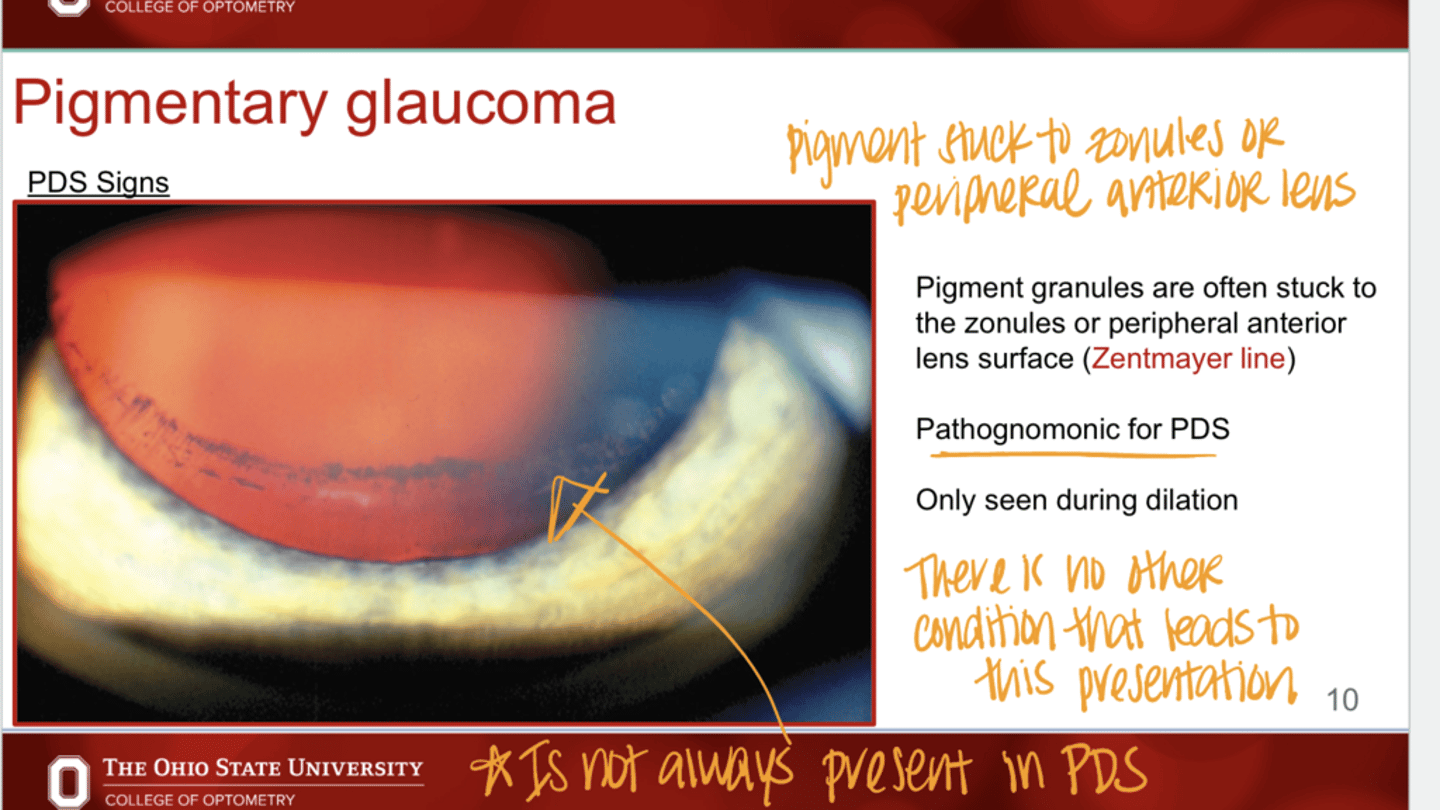
Zentmayer line is only seen when?
during dilation
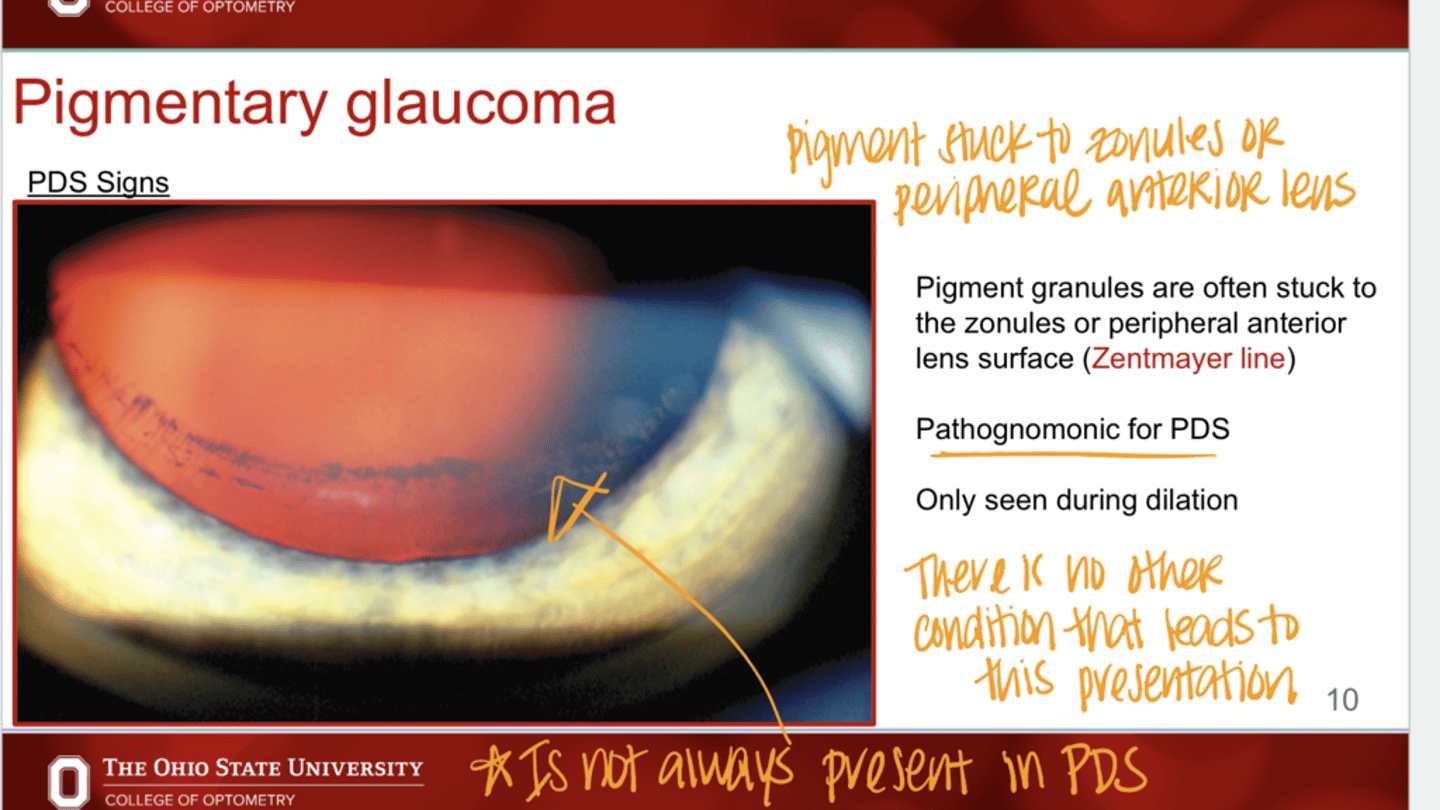
Is Zentmayer line always present with PDS?
No
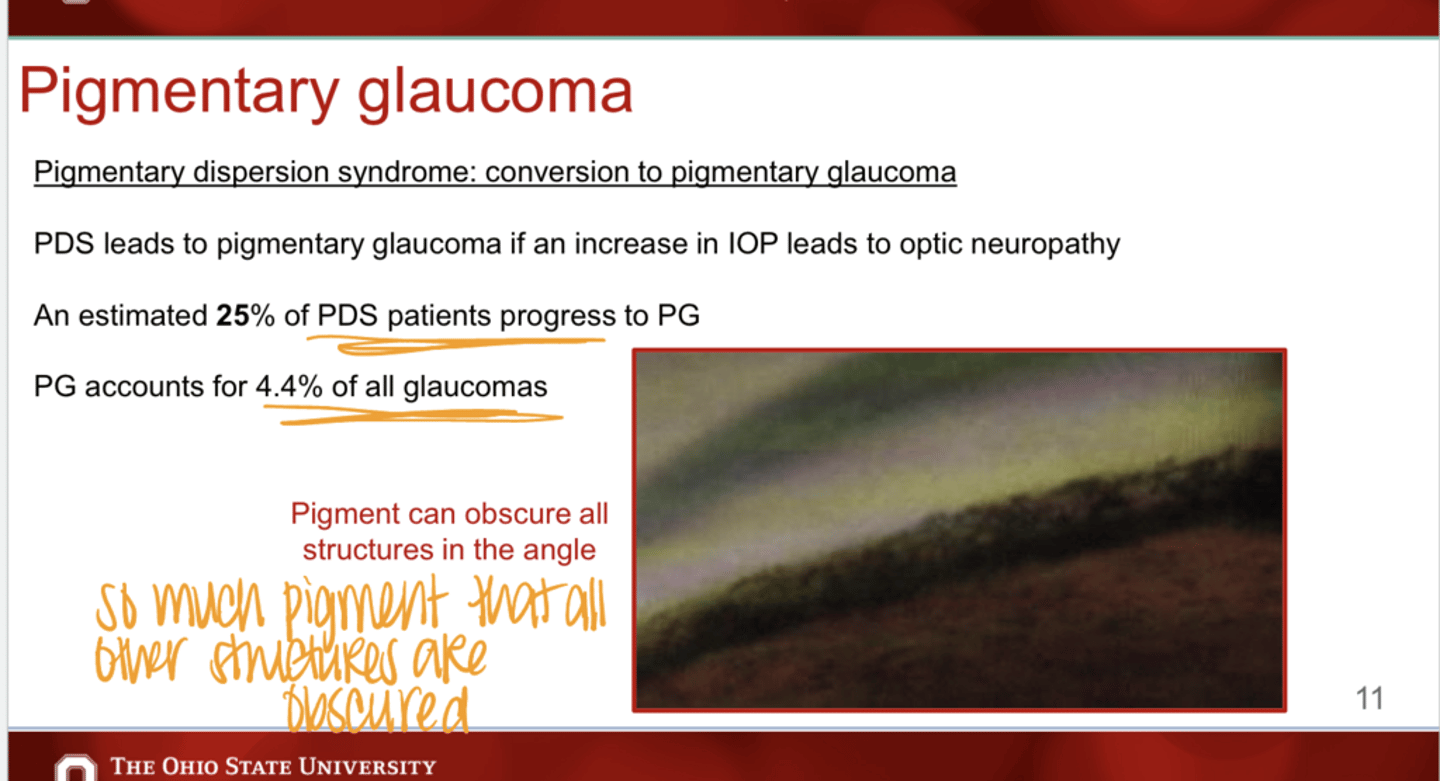
PDS leads to pigmentary glaucoma if an increase in IOP leads to what?
optic neuropathy
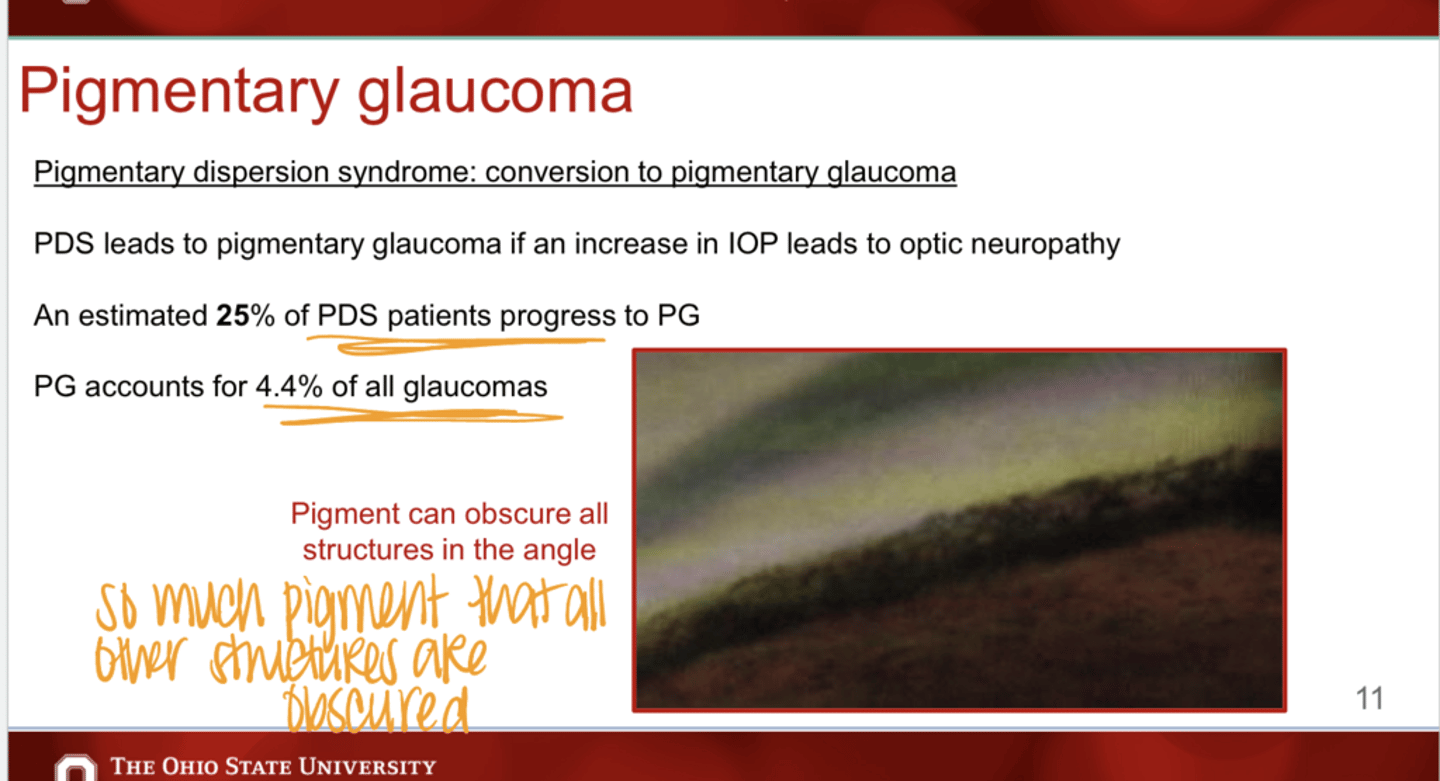
As estimated ____% of PDS patients progress to PG
25
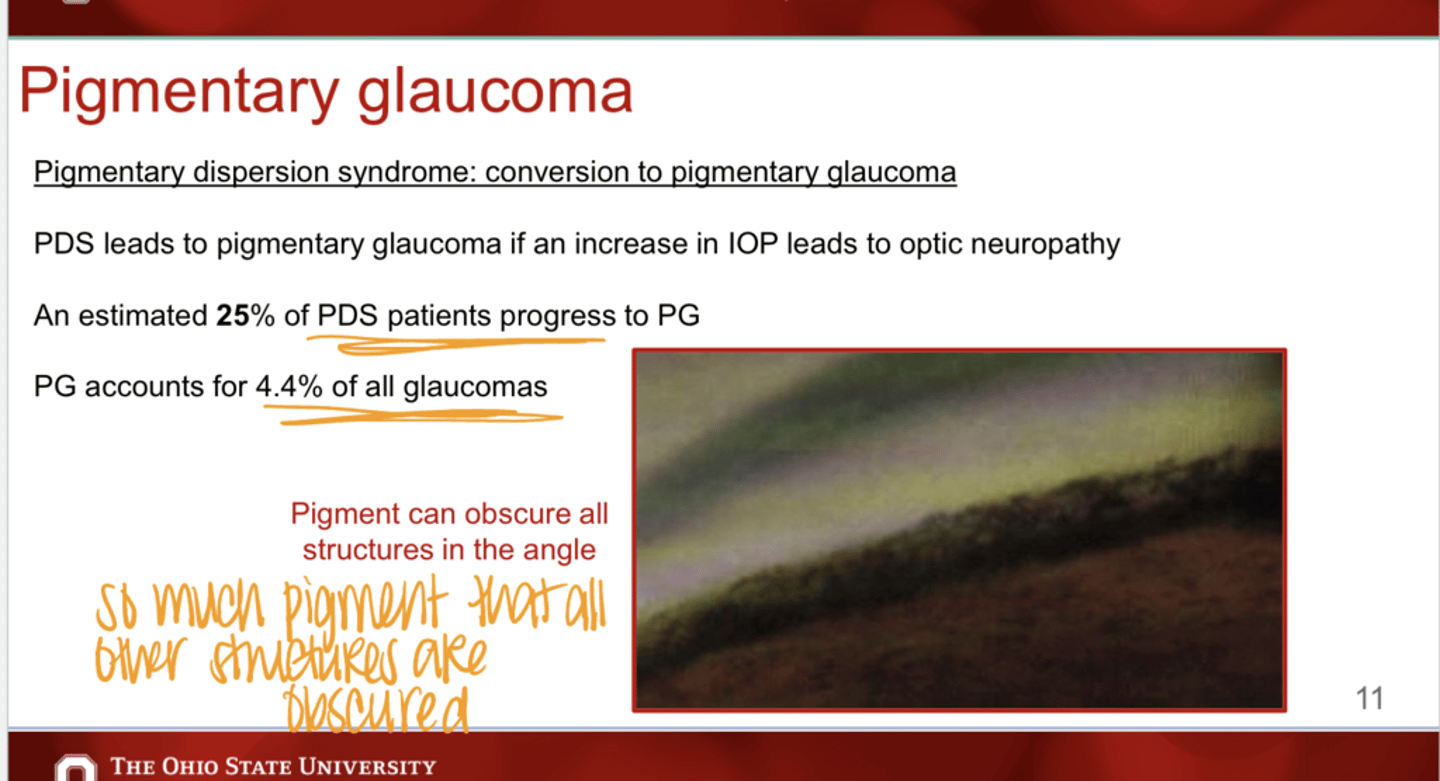
PG accounts for _____% of all glaucomas
4.4%
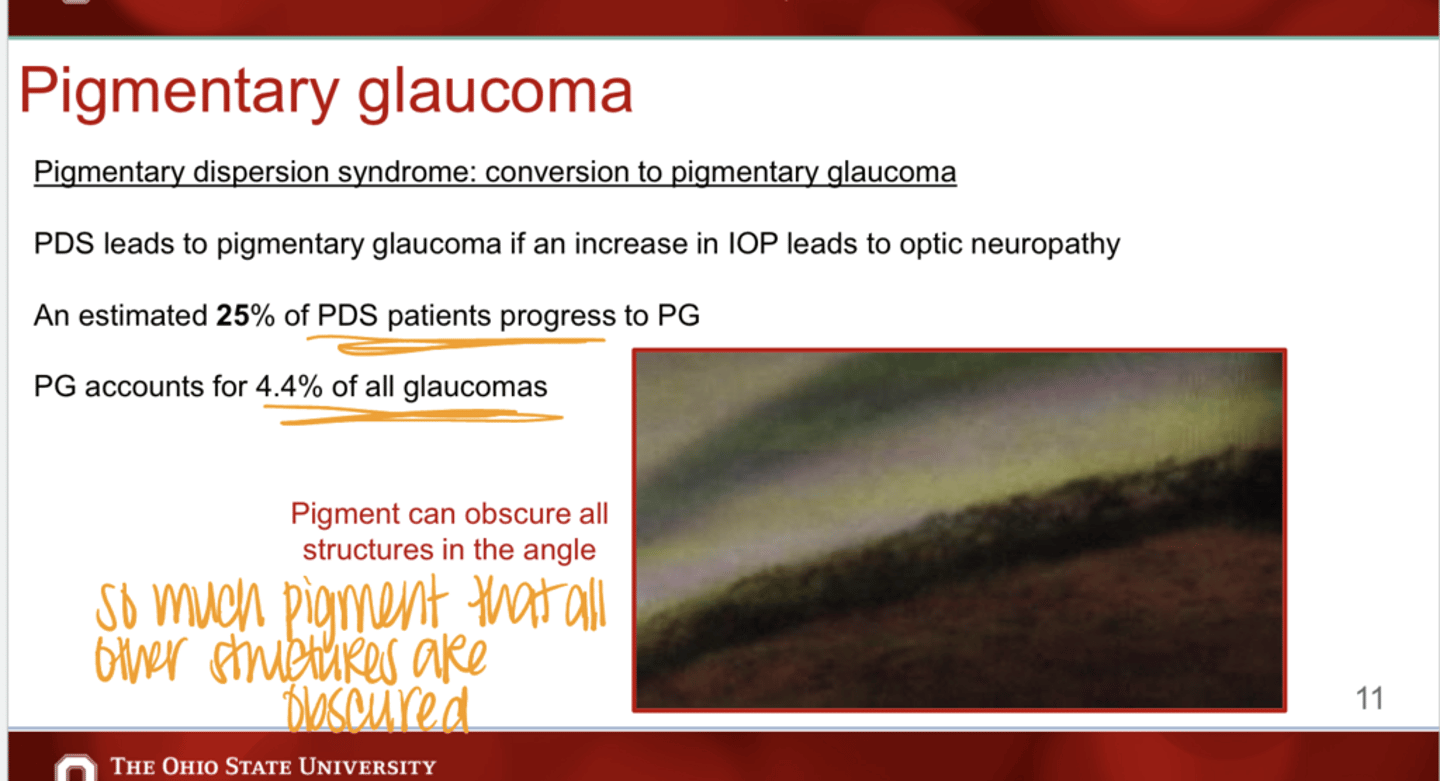
True or False:
Pigment from PDS/PG can obscure ALL structures of the angle
true
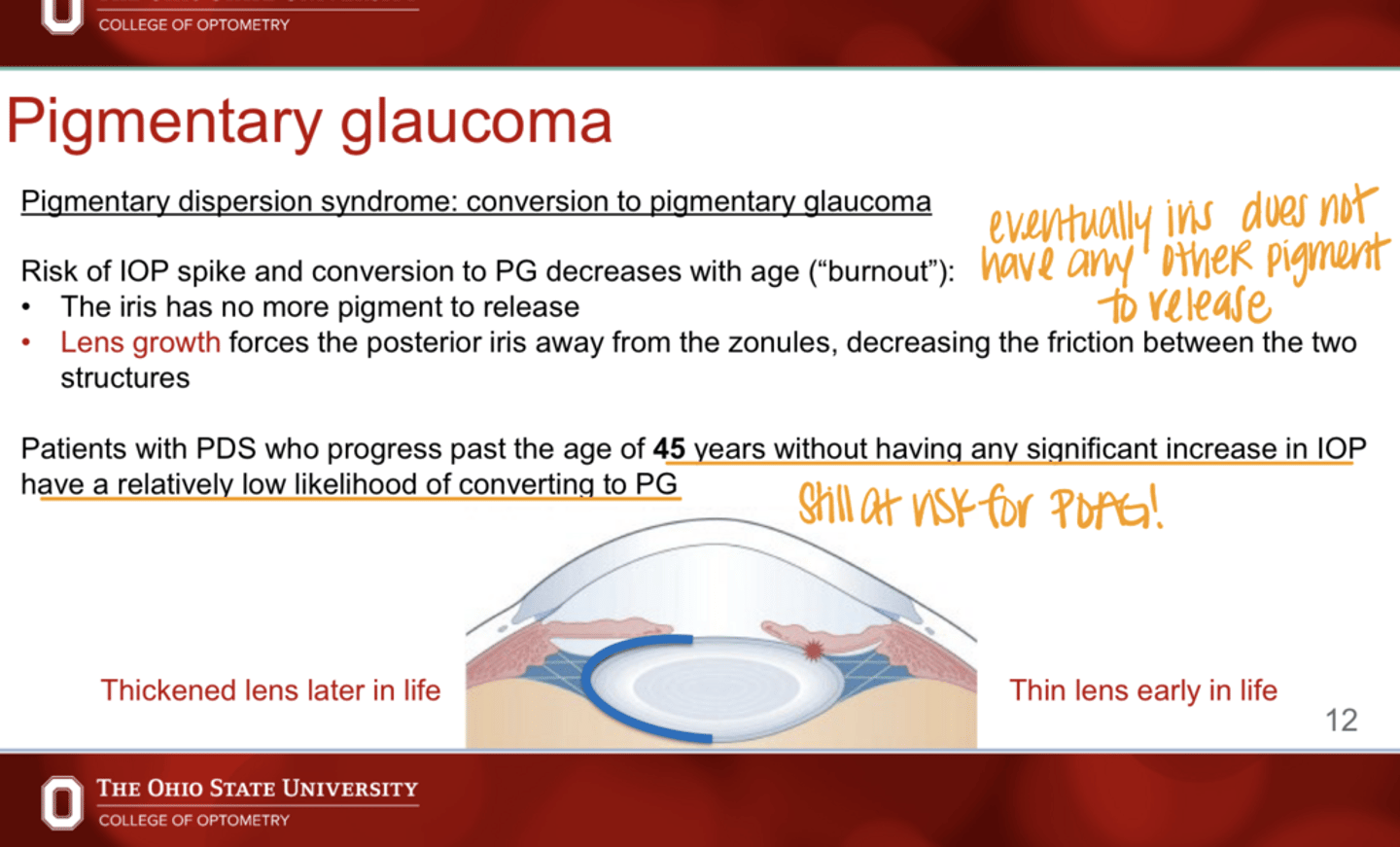
Risk of IOP spike and conversion of PDS to PG (increases/decreases) with age
decreases
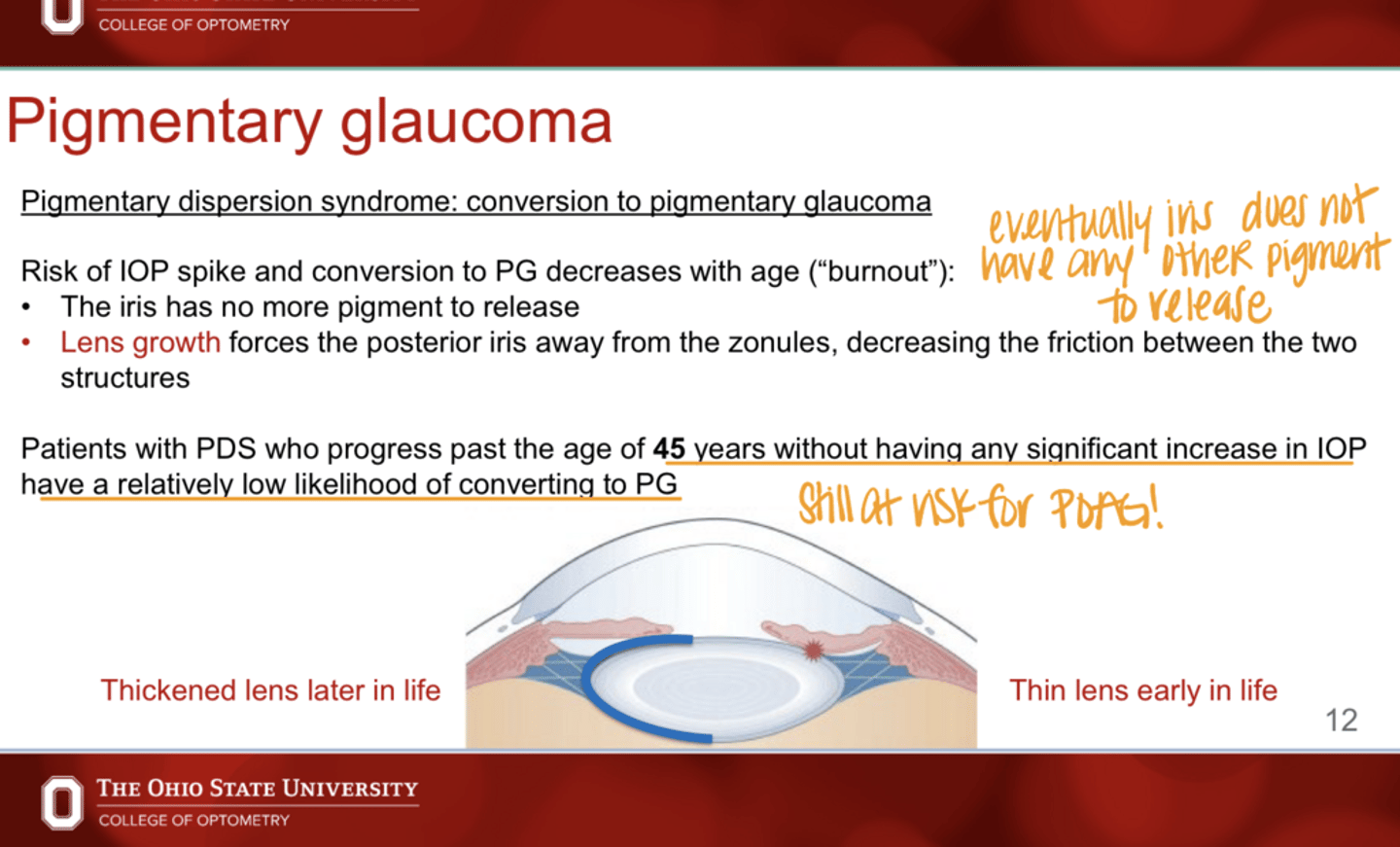
With is the decrease of risk of IOP spike and conversion of PDS to PG with age called?
Burnout
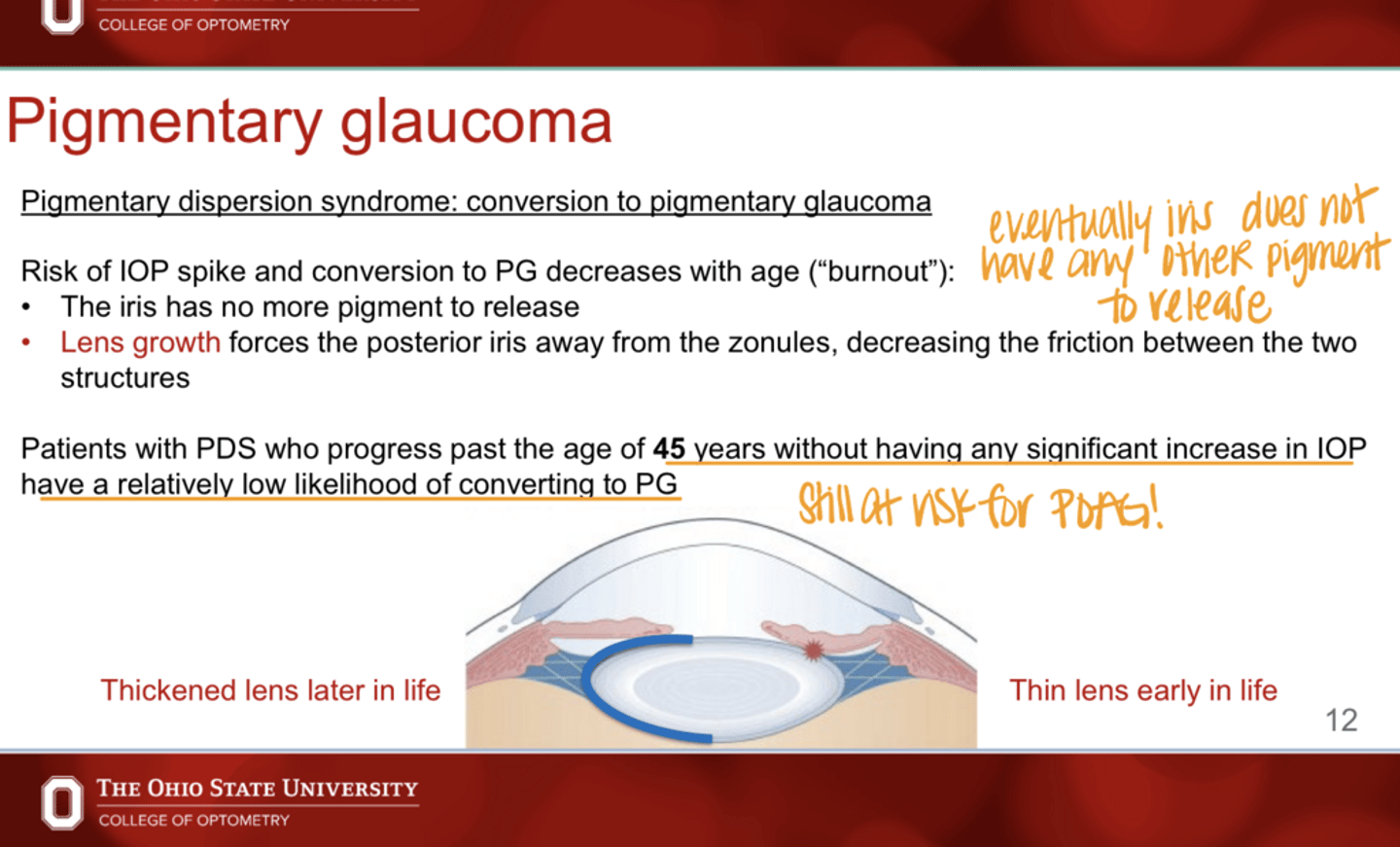
Why does burnout occur in PDS?
-The iris has no more pigment to release
-Lens growth forces the posterior iris away from the zonules, decreasing the friction between the two structures
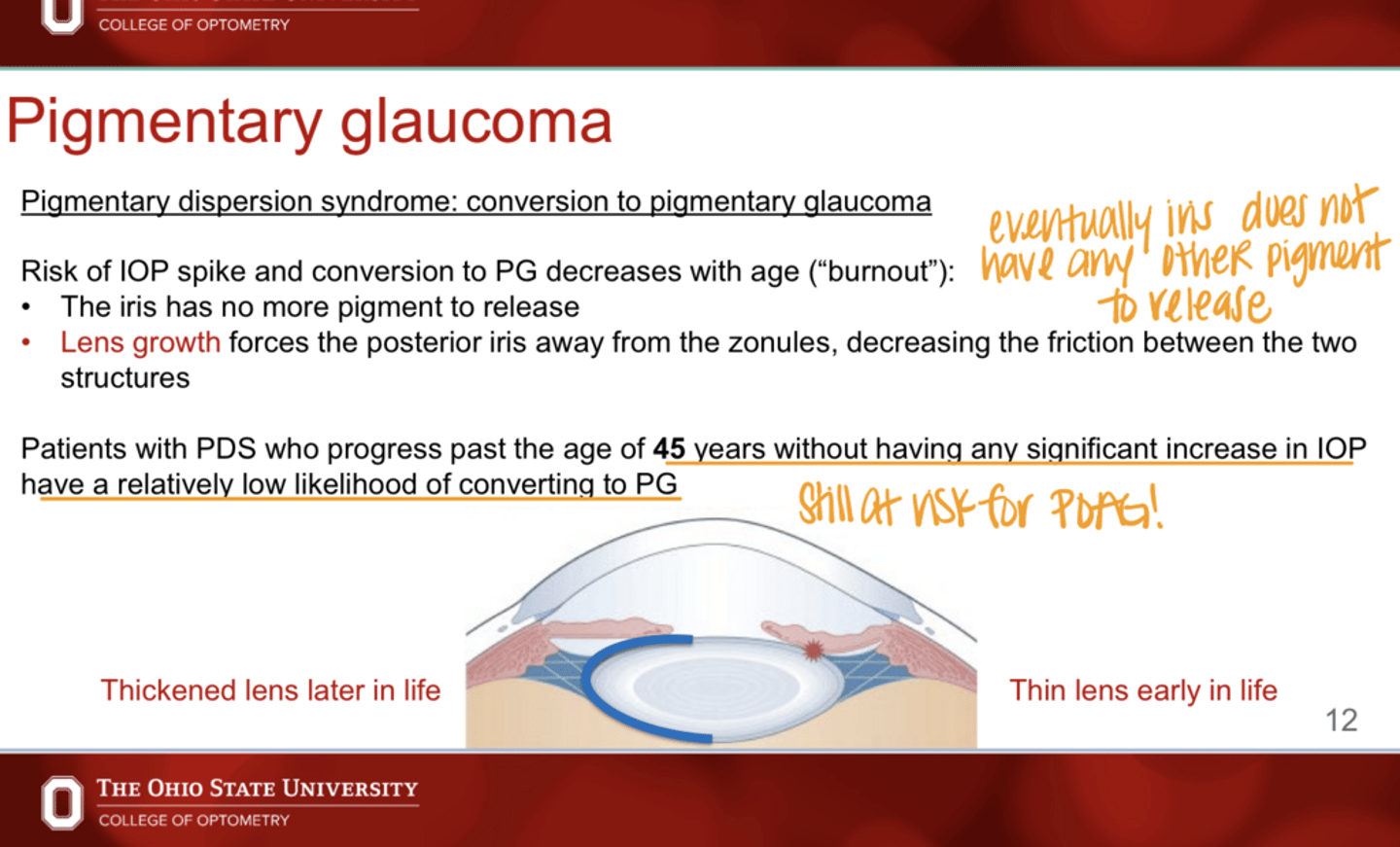
Patients with PDS who progress past 45yo without having any significant increases in IOP have a relatively (high/low) likelihood of converting to PG
low
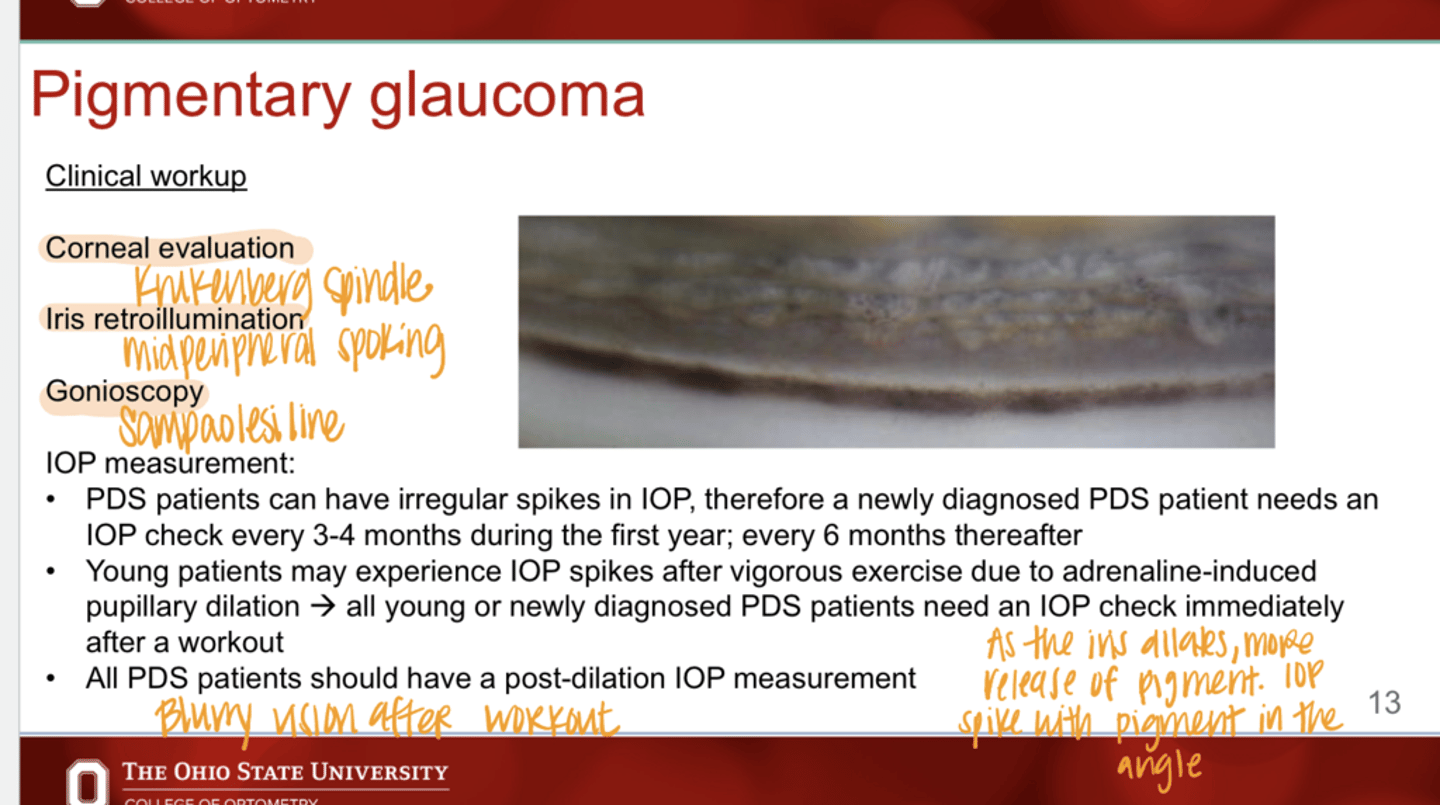
What is the clinical workup for PG?
-Corneal evaluation
-Iris retroillumination
-Gonioscopy
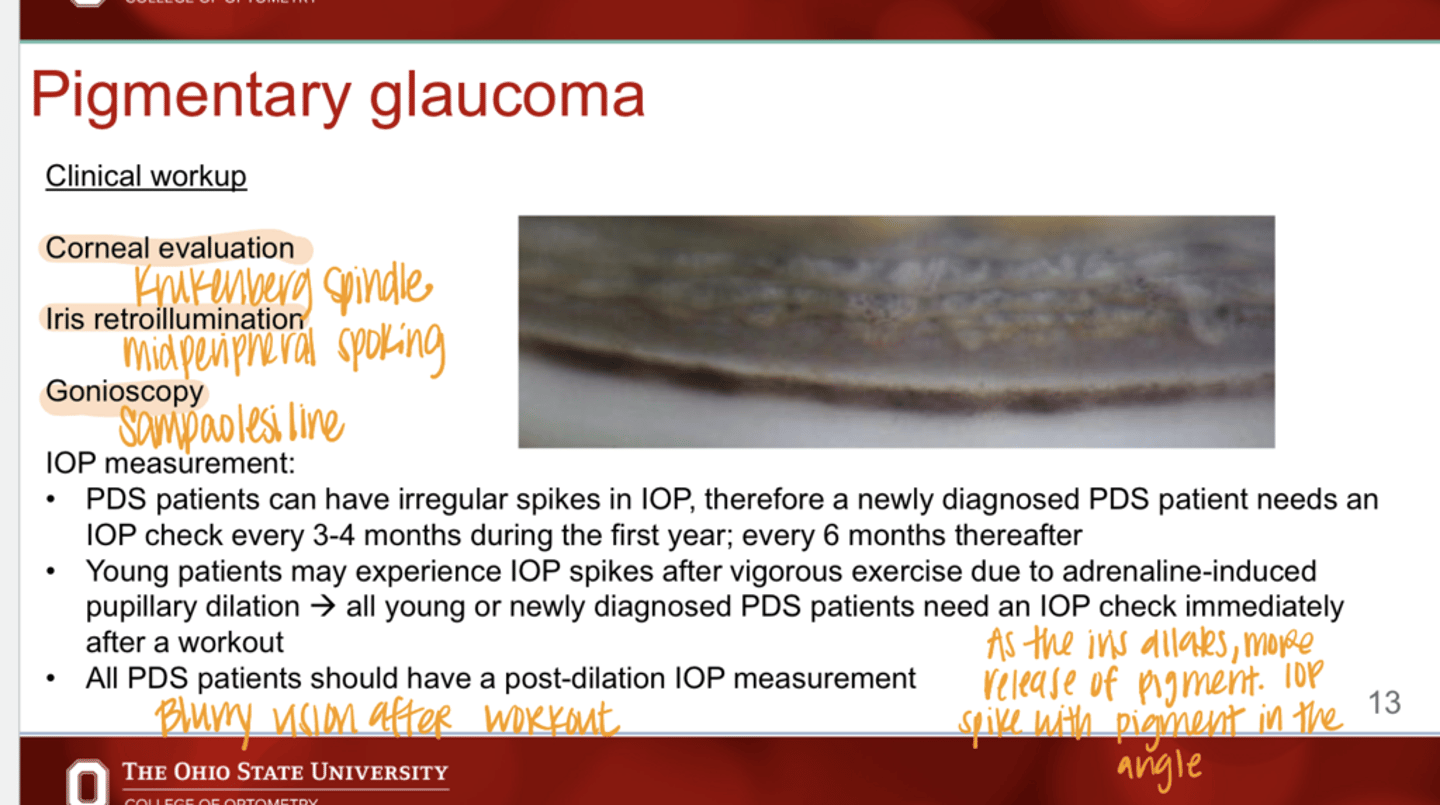
PDS patients can have irregular spikes in IOP, therefore a newly diagnosed PDS patient needs an IOP check every ________ during the first year; every _____ thereafter
3-4 months; 6 months
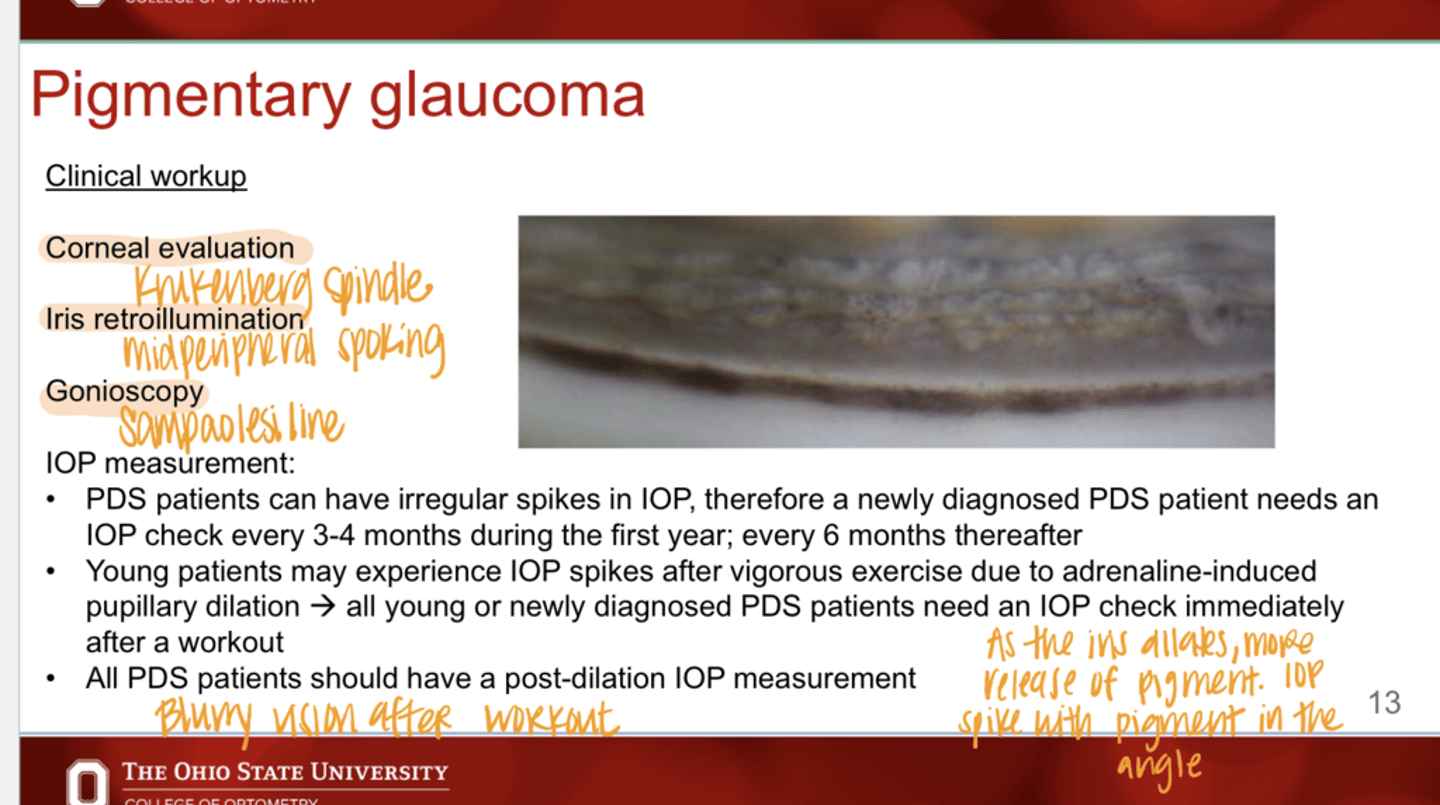
Young patients may experience IOP spikes after ______ with PDS
vigorous exercise
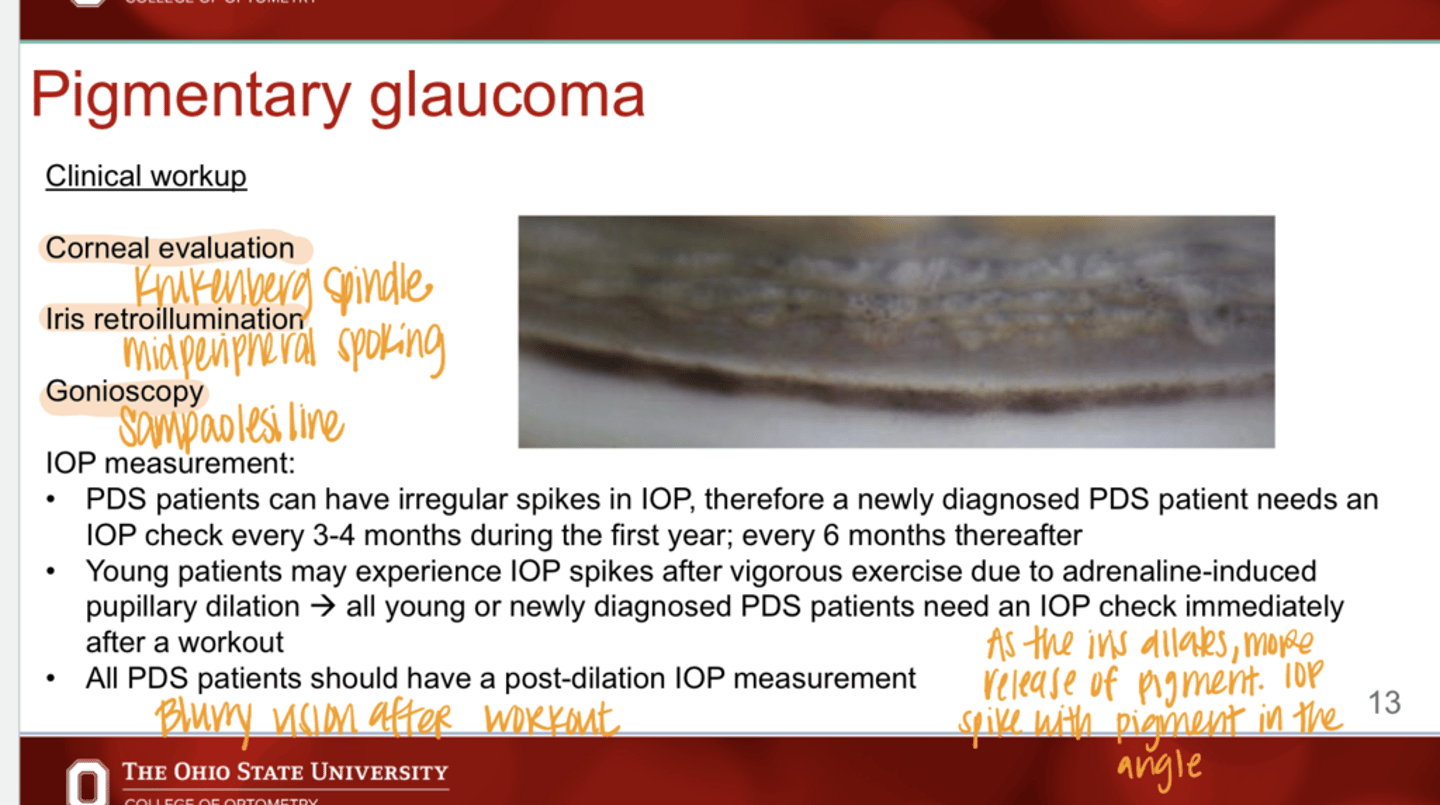
Why do young patients experience IOP spikes after exercise with PDS?
adrenaline-induced pupillary dilation
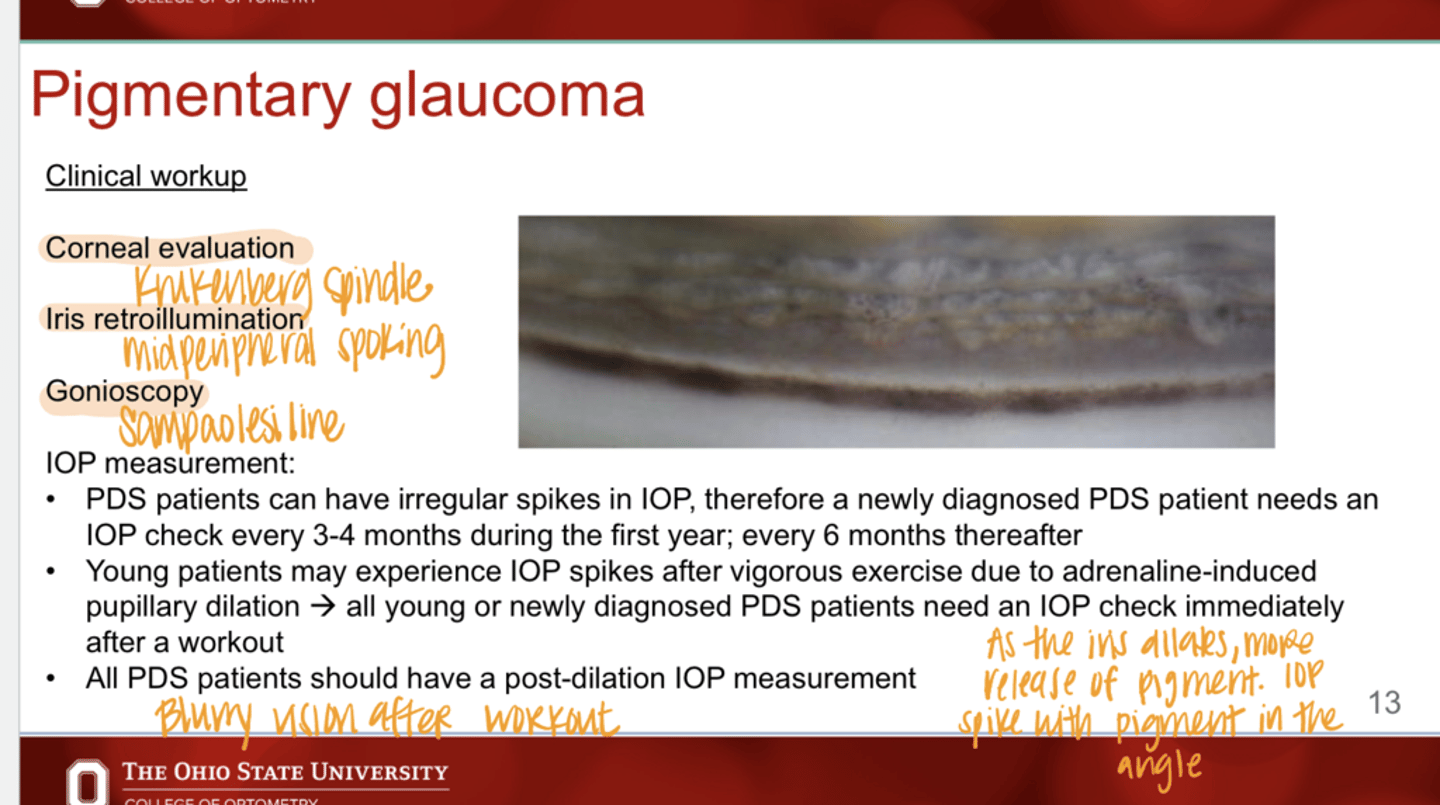
All young or newly diagnosed PDS patients need an IOP check immediately after a ______
workout
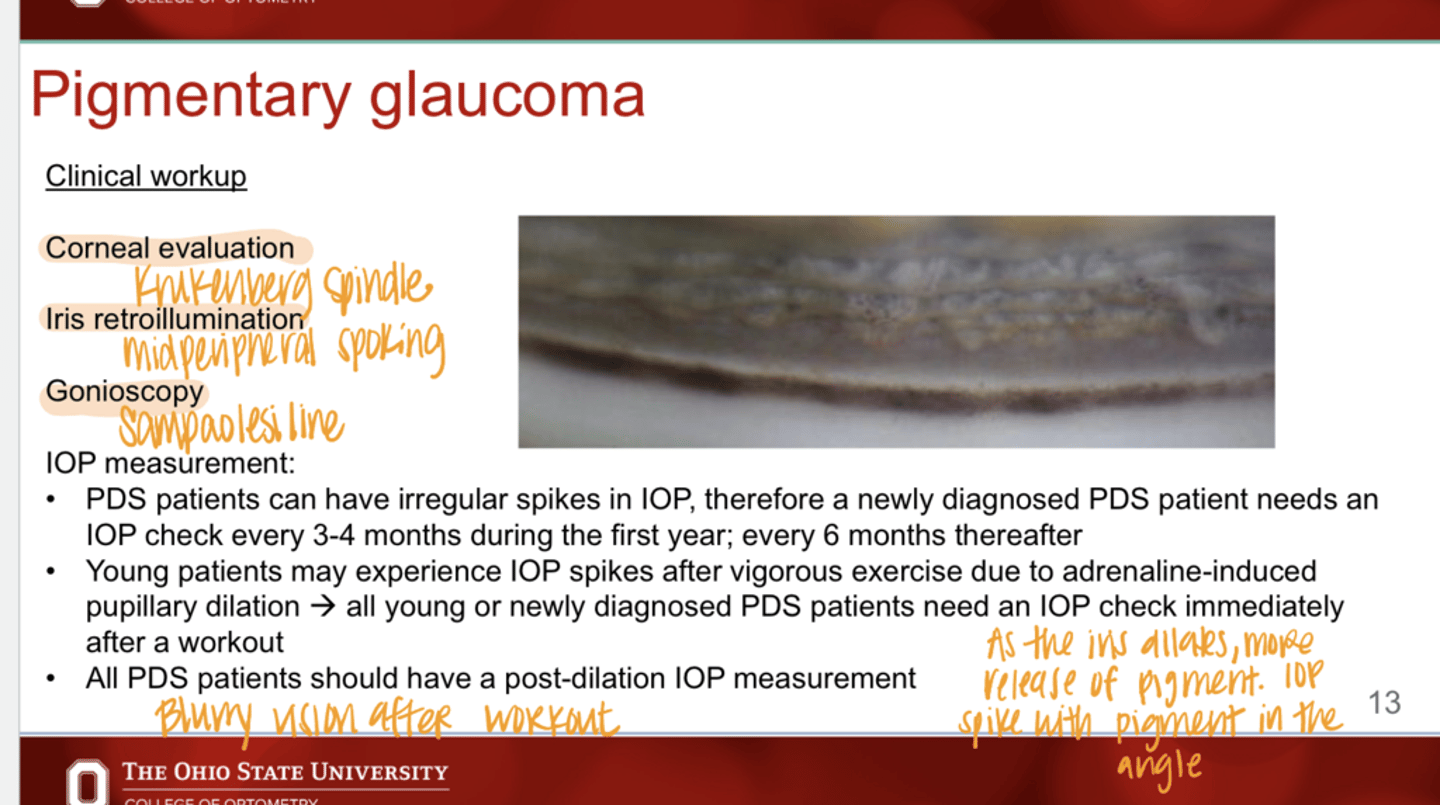
All PDS patients should have a _______ IOP measurement
post-dilation
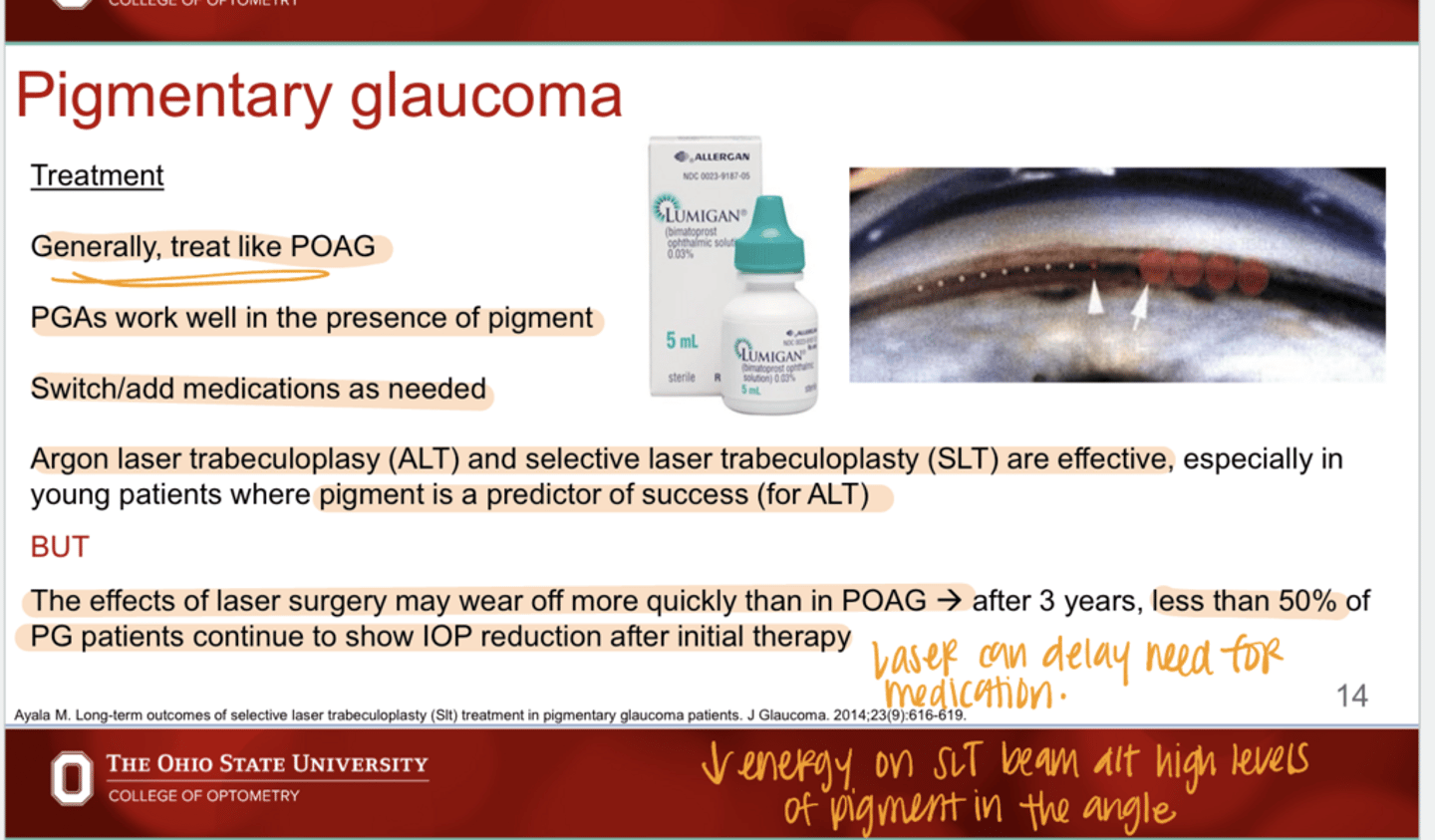
What is the treatment of PG?
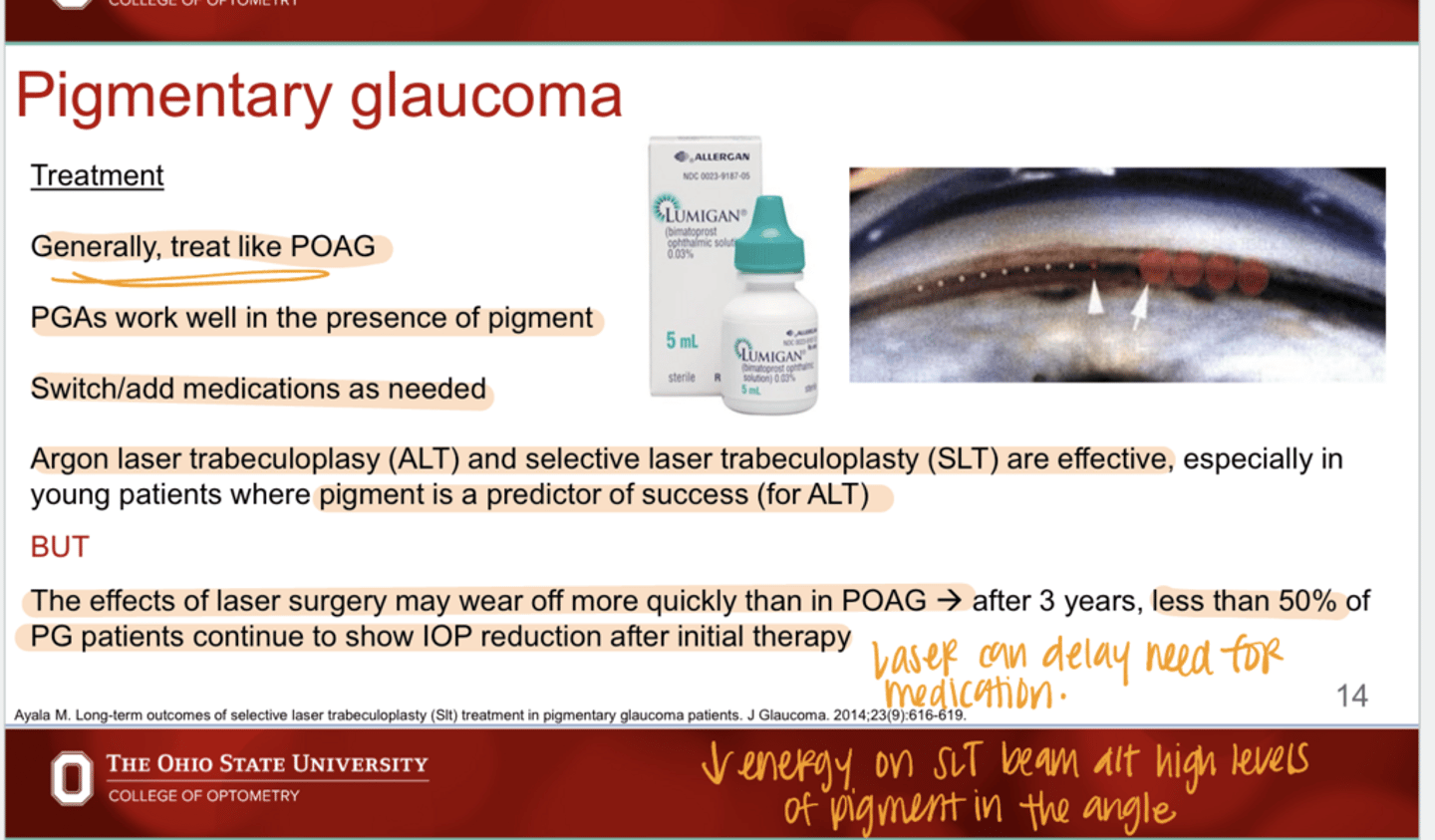
-Generally, treat like POAG
-PGAs work well with the presence of pigment in the angle
-Can switch/add meds as needed
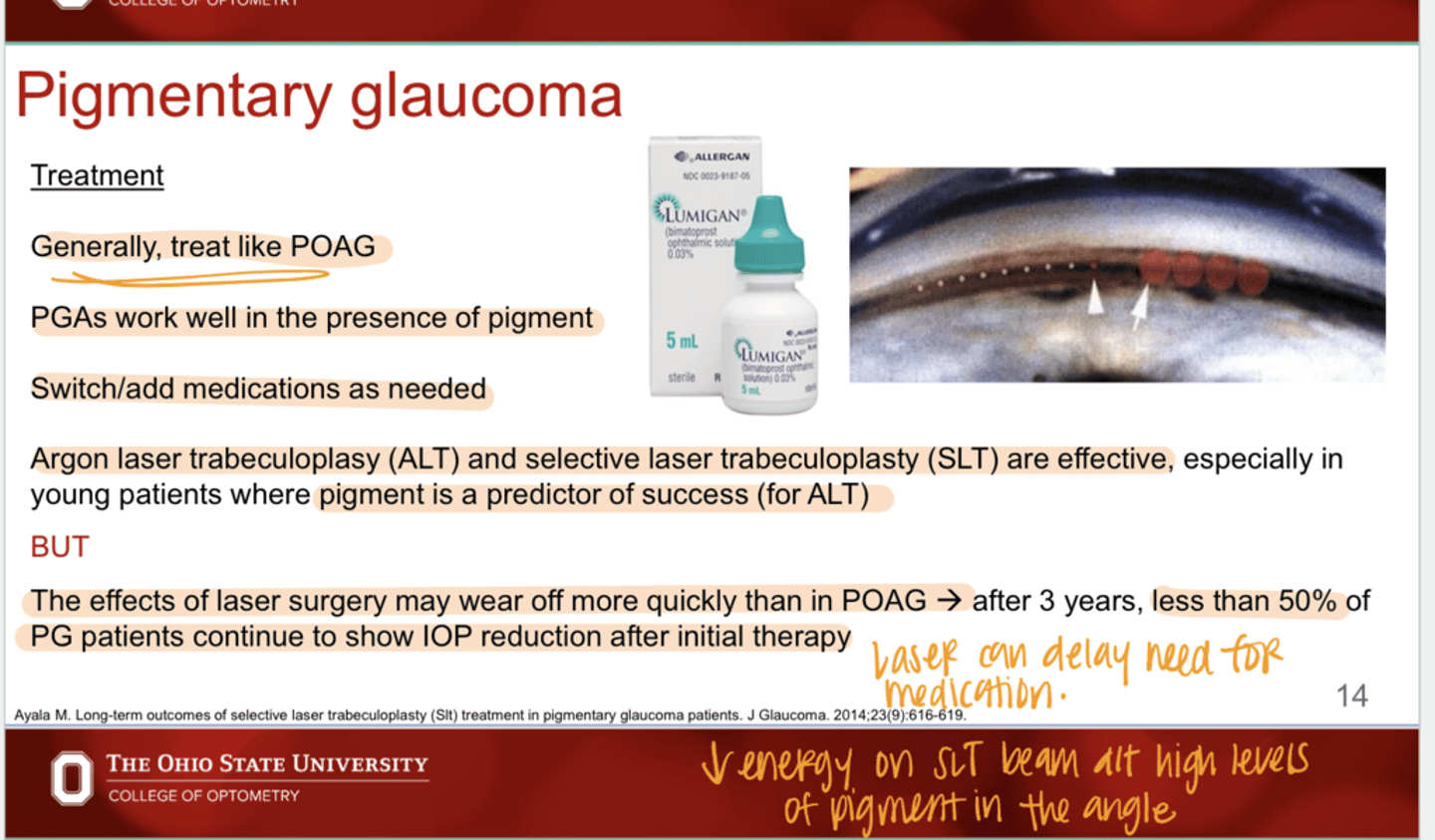
_____ and ____ are effective for PG, esp in young patients where pigment is a predictor of success
SLT, ALT
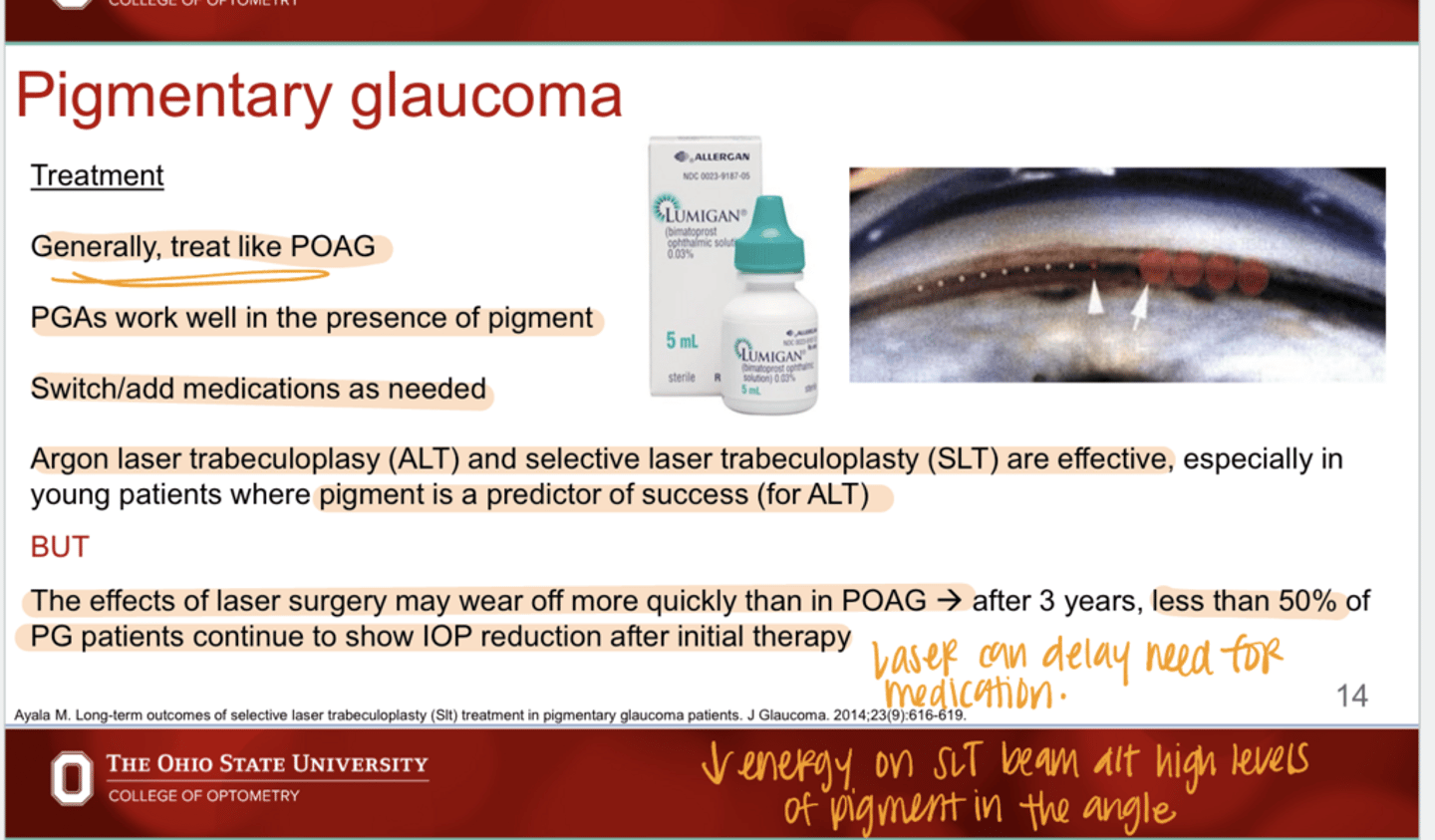
The effects of laser sx for PG may wear off (slower/quicker) than in POAG
quicker -- after 3 years, less than 50% of PG patients continue to show IOP reduction after initial therapy
In young patients who are still actively liberating pigment, _______ could be a mitigating factor
pilocarpine
Why may pilocarpine be recommended in young PG patients who are still liberating pigment?
-neutralizing the mechanics that cause pigment liberation
-increases outflow and decreases the concave configuration of the iris
What is the downside to pilocarpine use in young PG patients?
Pilocarpine has significant ocular side effects (accommodative spasm, miosis, blurred vision). Increases the risk of retinal detachment.
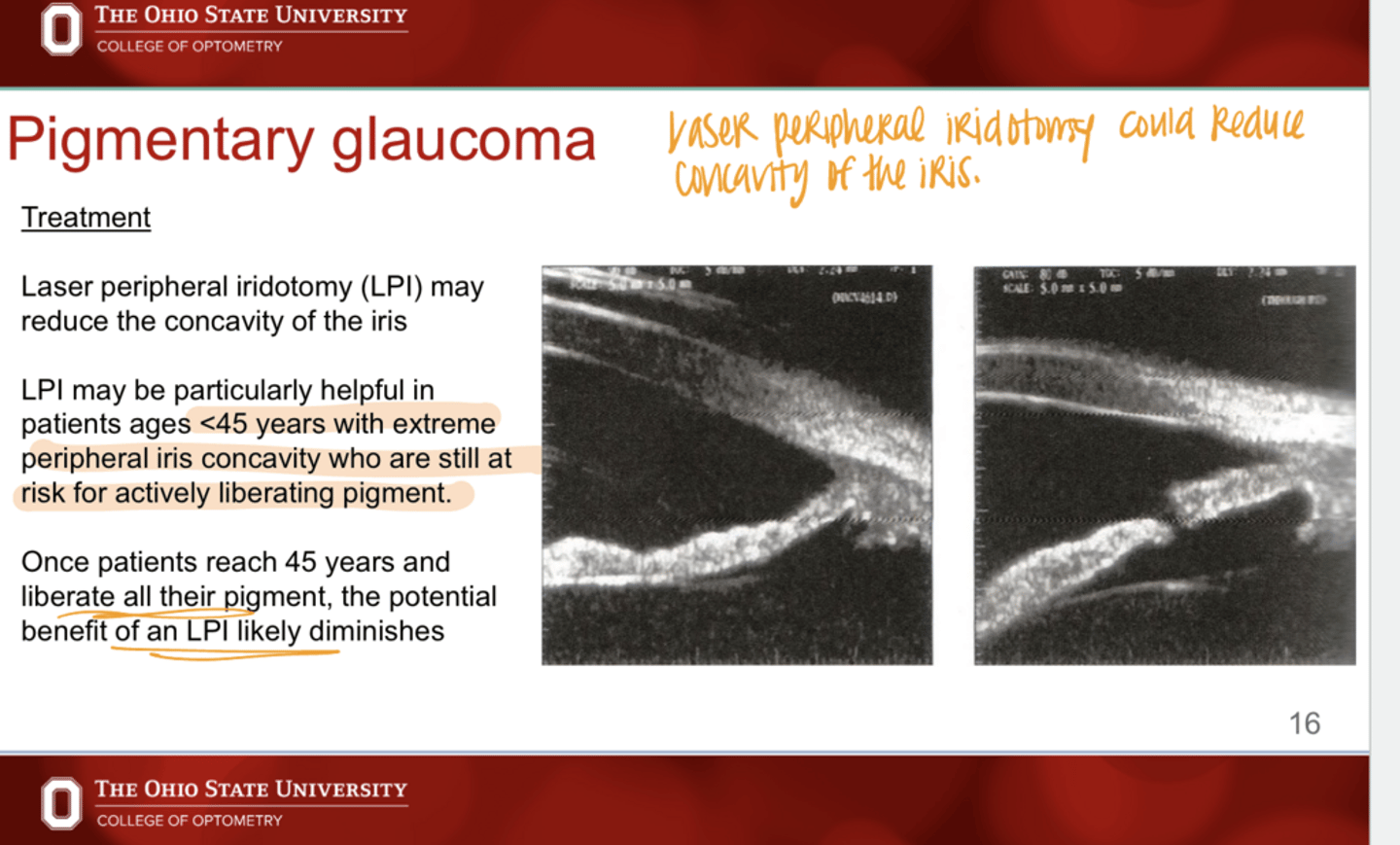
Can LPI be used as a treatment for PG? Why?
Yes -- may reduce the concavity of the iris
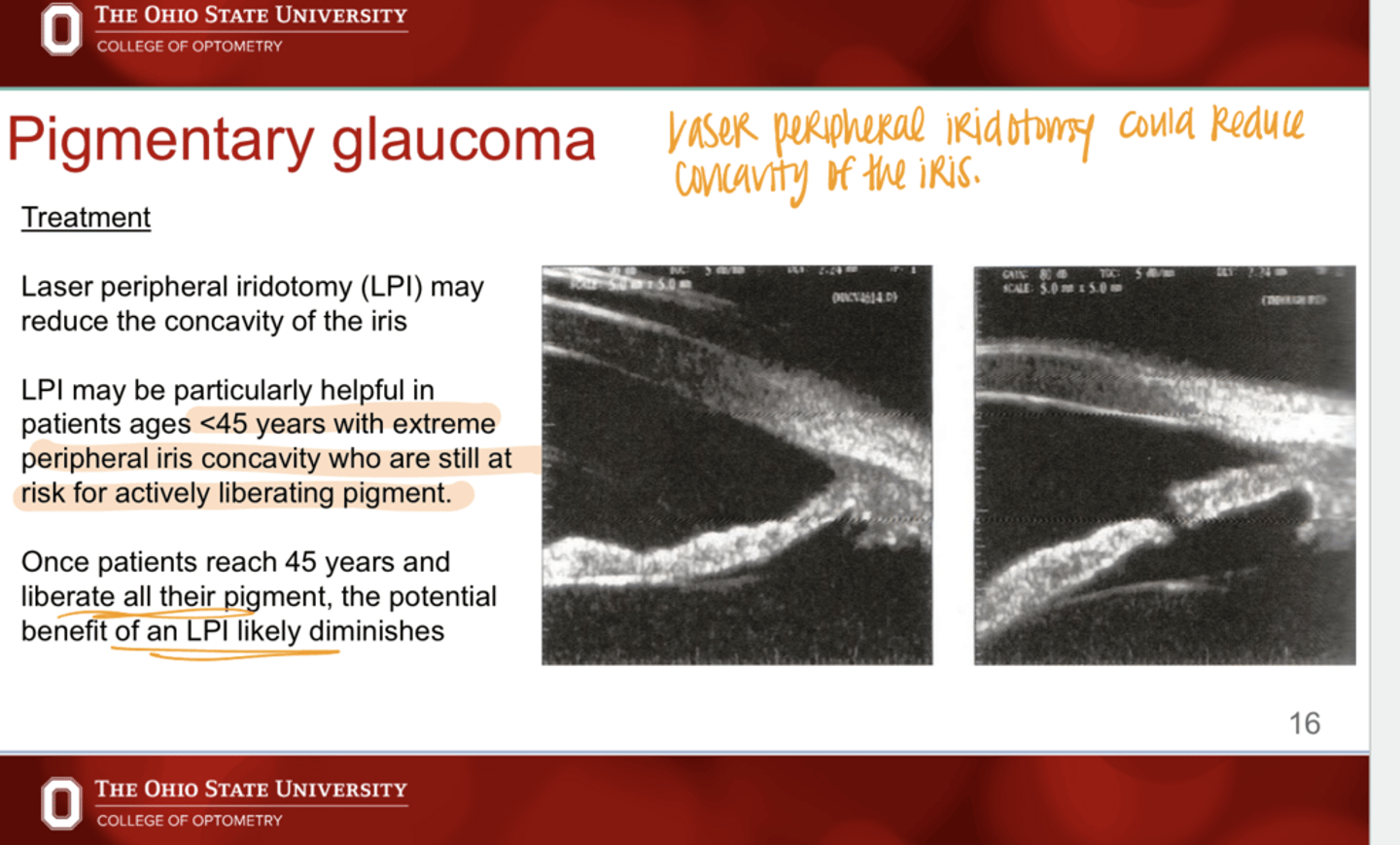
LPI is especially helpful in what patients?
In patients aged <45yo with extreme peripheral iris concavity who are still at risk for actively liberating pigment
Once patient reach 45yo and liberate all pigment, the potential benefit of an LPI will (increase/decrease)
decrease
What is pseudoexfoliation syndrome?
systemic condition association with abnormal basement membranes involving "elastosis" from a mutation in the LOX1 gene
What are the systemic associations with pseudoexfoliation syndrome?
-vascular insufficiency
-TIAs
-Heart attack
-stroke
-Alz disease
What is the most common Etiology of pseudoexfoliation syndrome?
-Caucasians of Scandinavian descent
-60-80yo
pseudoexfoliation syndrome causes ____% of open angle glaucoma around the world
20-25
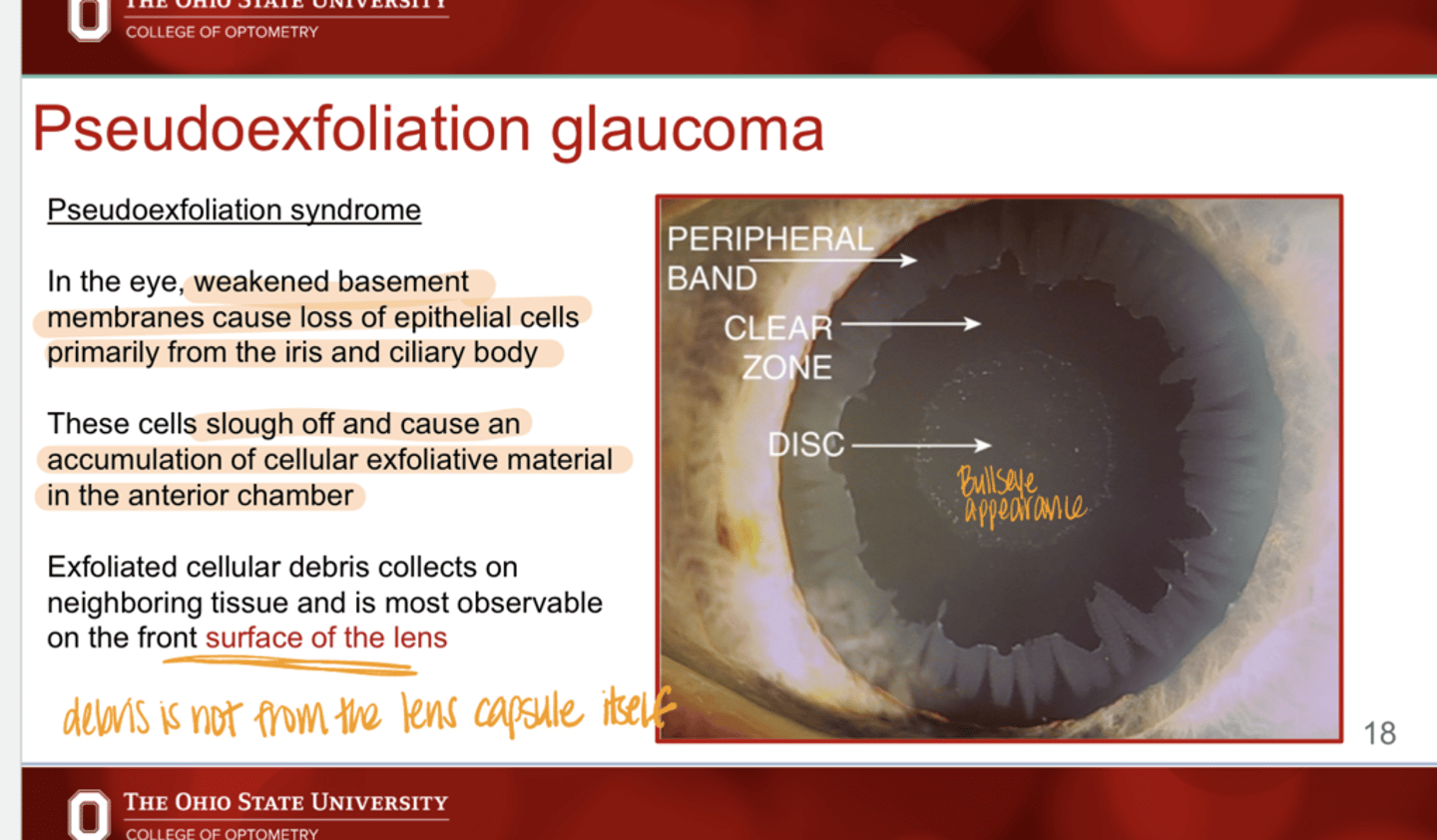
What is the effect of pseudoexfoliation syndrome in the eye?
-Weakened basement membranes cause loss of epithelial cells primarily from the iris and the CB
-These cells slough off and cause an accumulation of cellular exfoliative material in the A.C.
-Exfoliated cellular debris collects on neighboring tissue and is most observable on the front surface of the lens
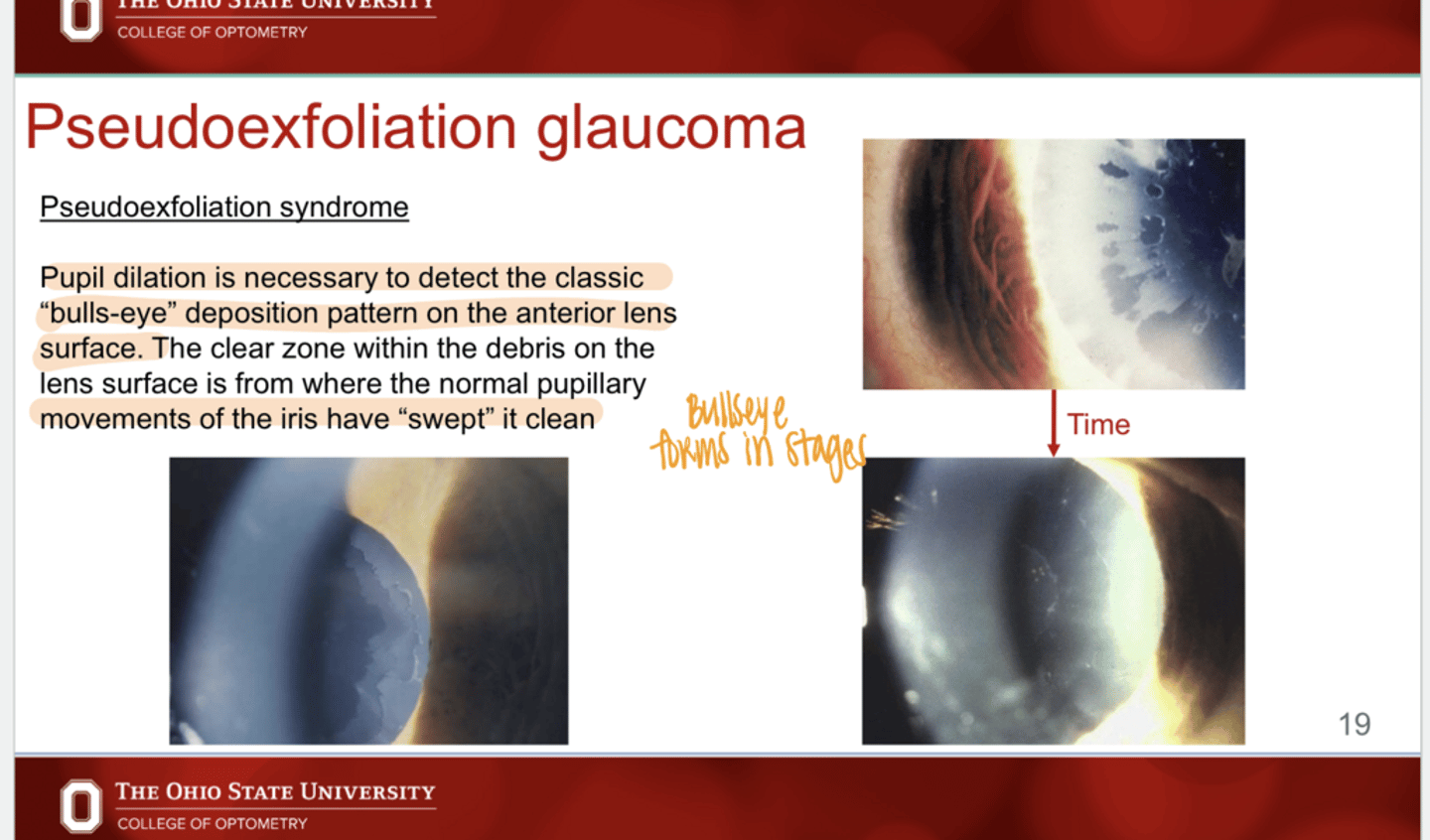
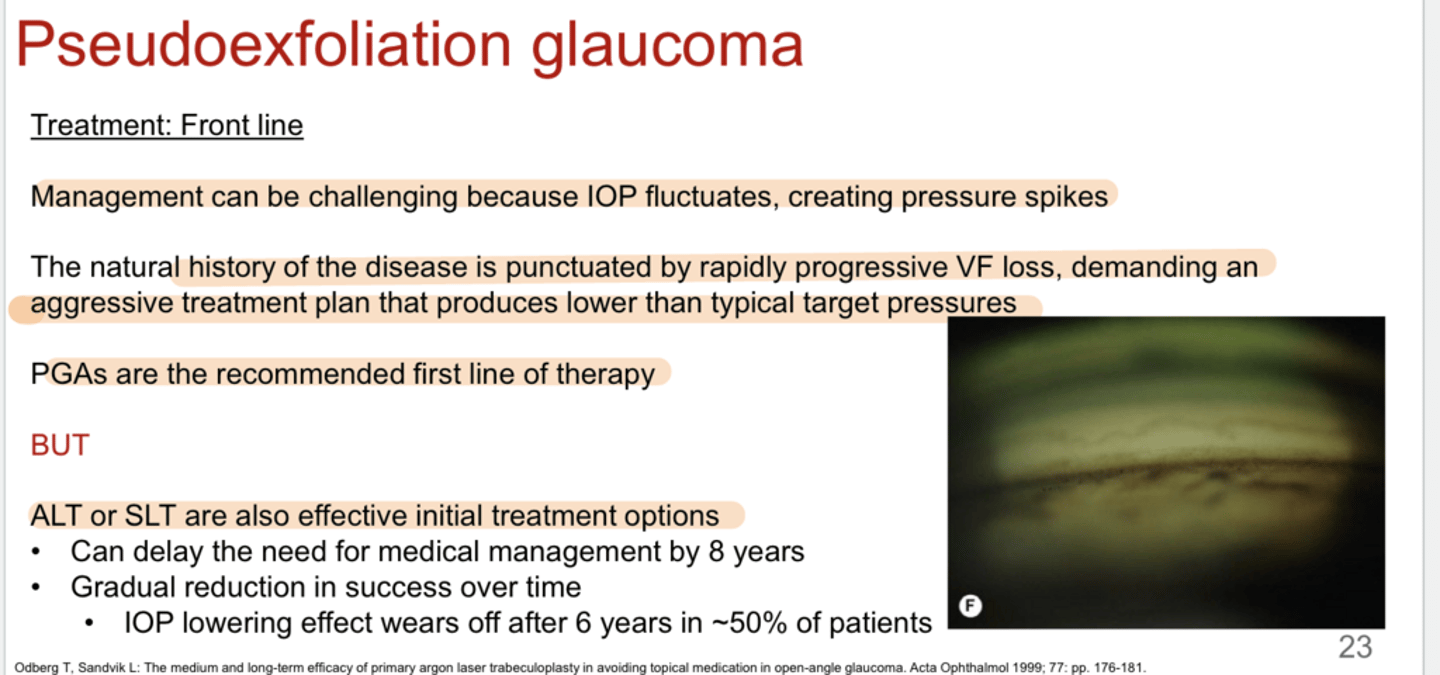
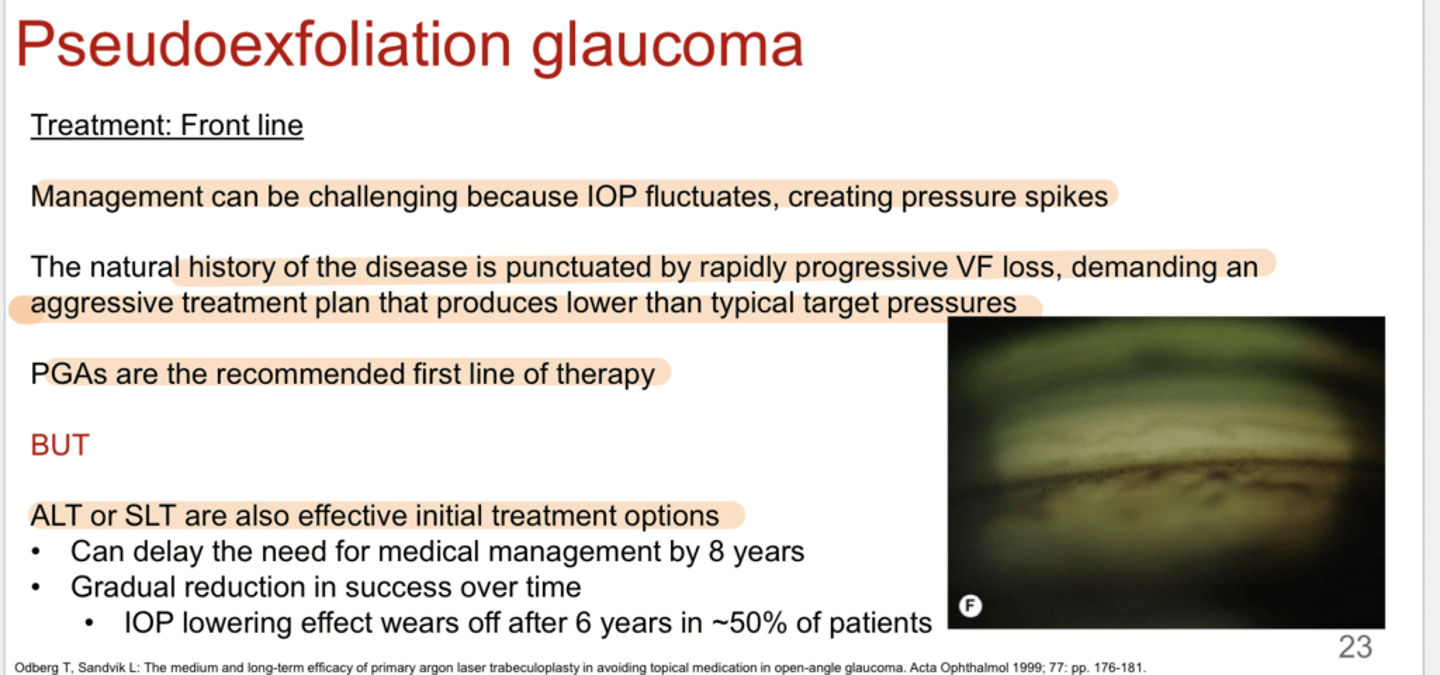
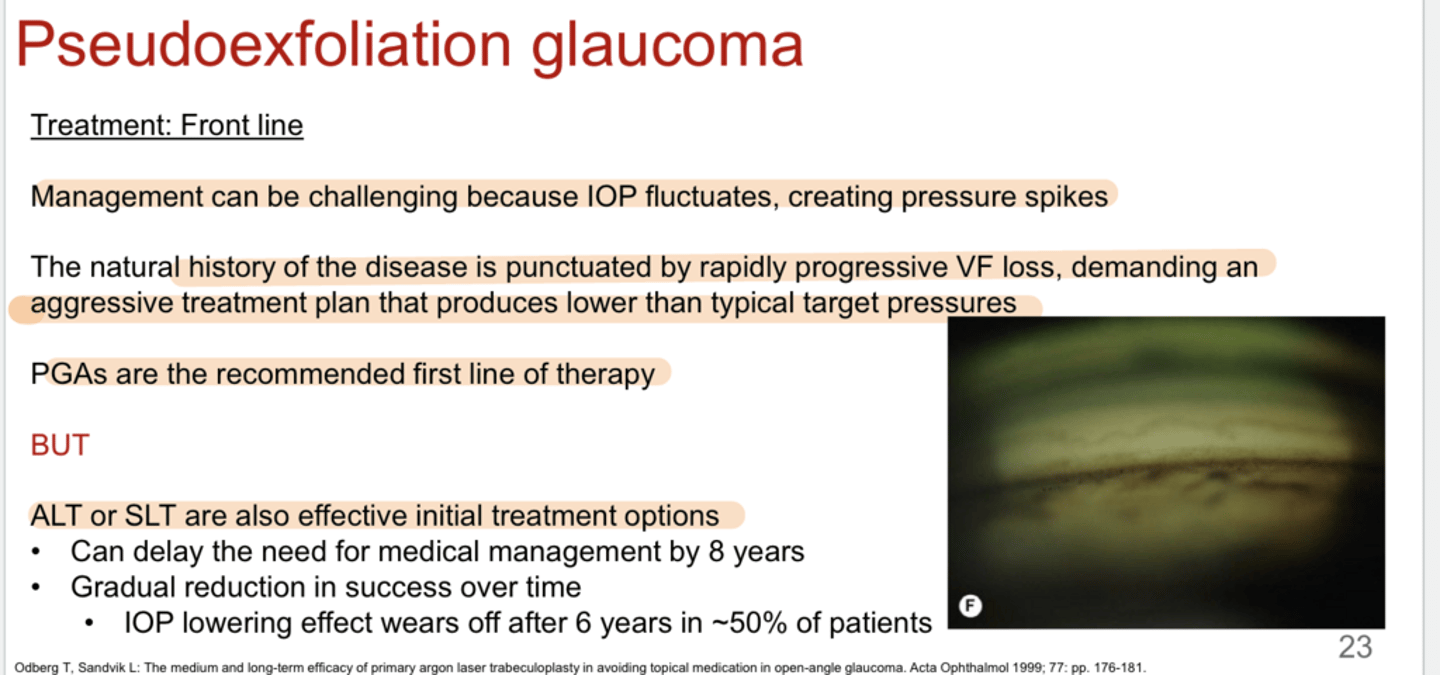
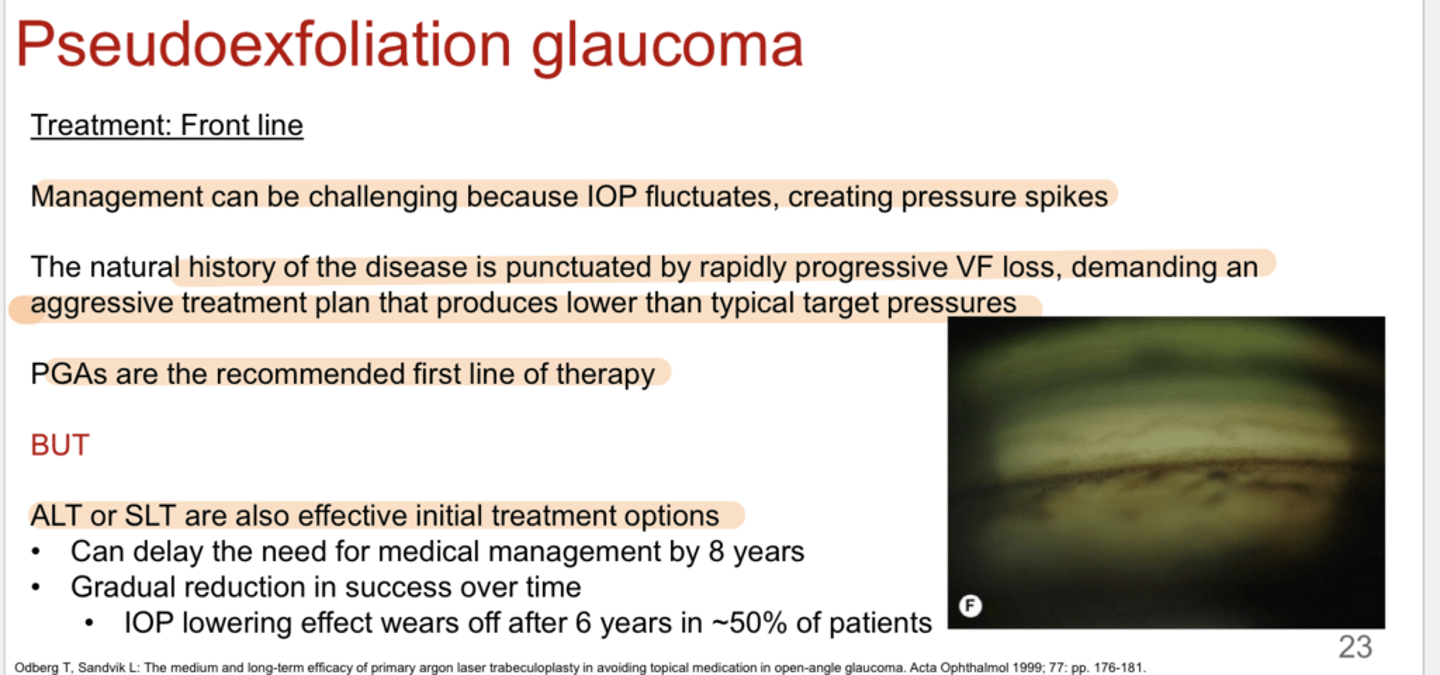
_____ is necessary to detect the classic "bulls-eye" deposition pattern on the anterior lens surface of PXE
Pupil dilation
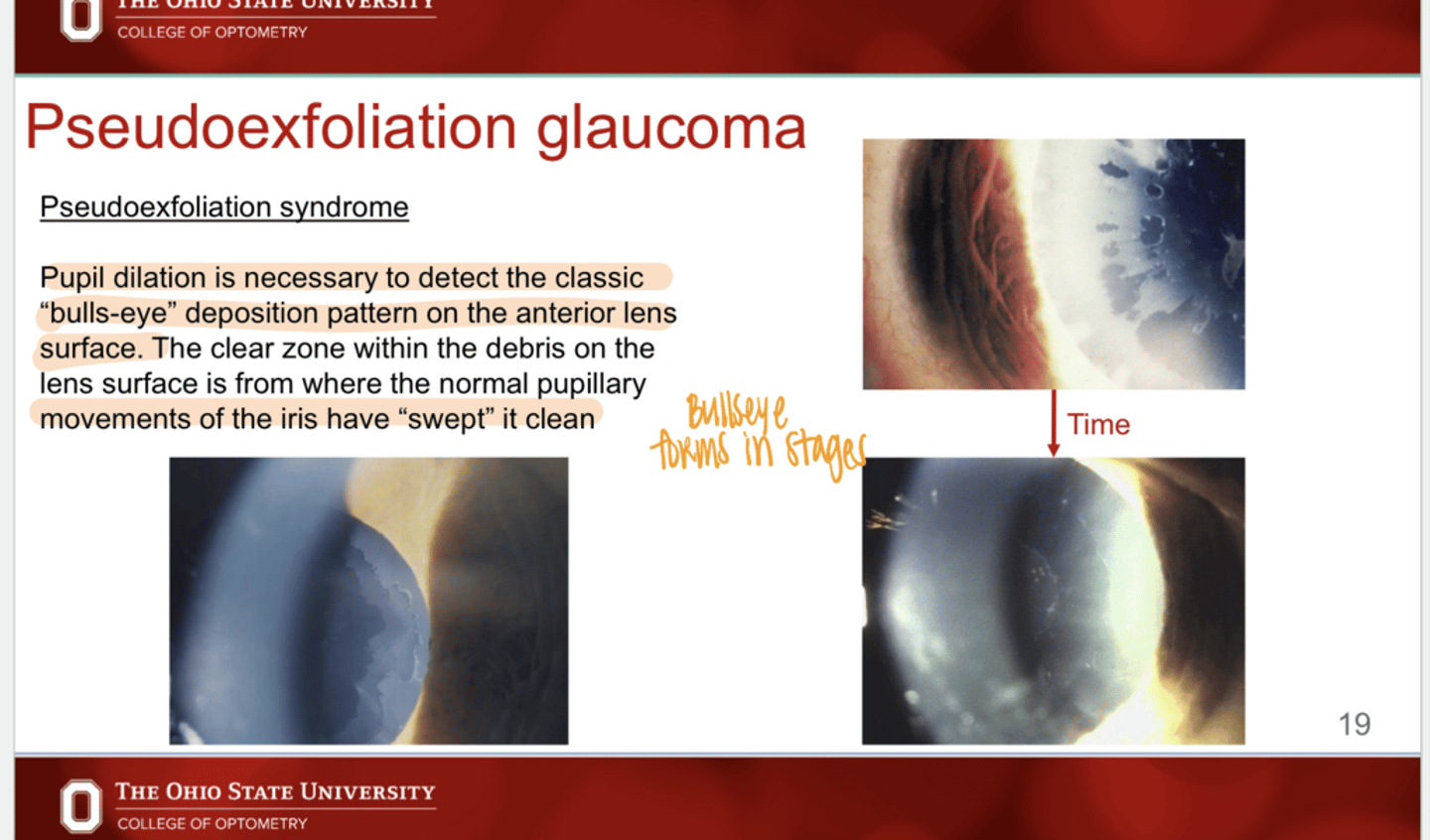
Why is there a clear zone in PXE on the surface of the lens (referring to the bulls-eye pattern)?
The clear zone within the debris on the lens surface is from where the normal pupillary movements of the iris have "swept" it clean
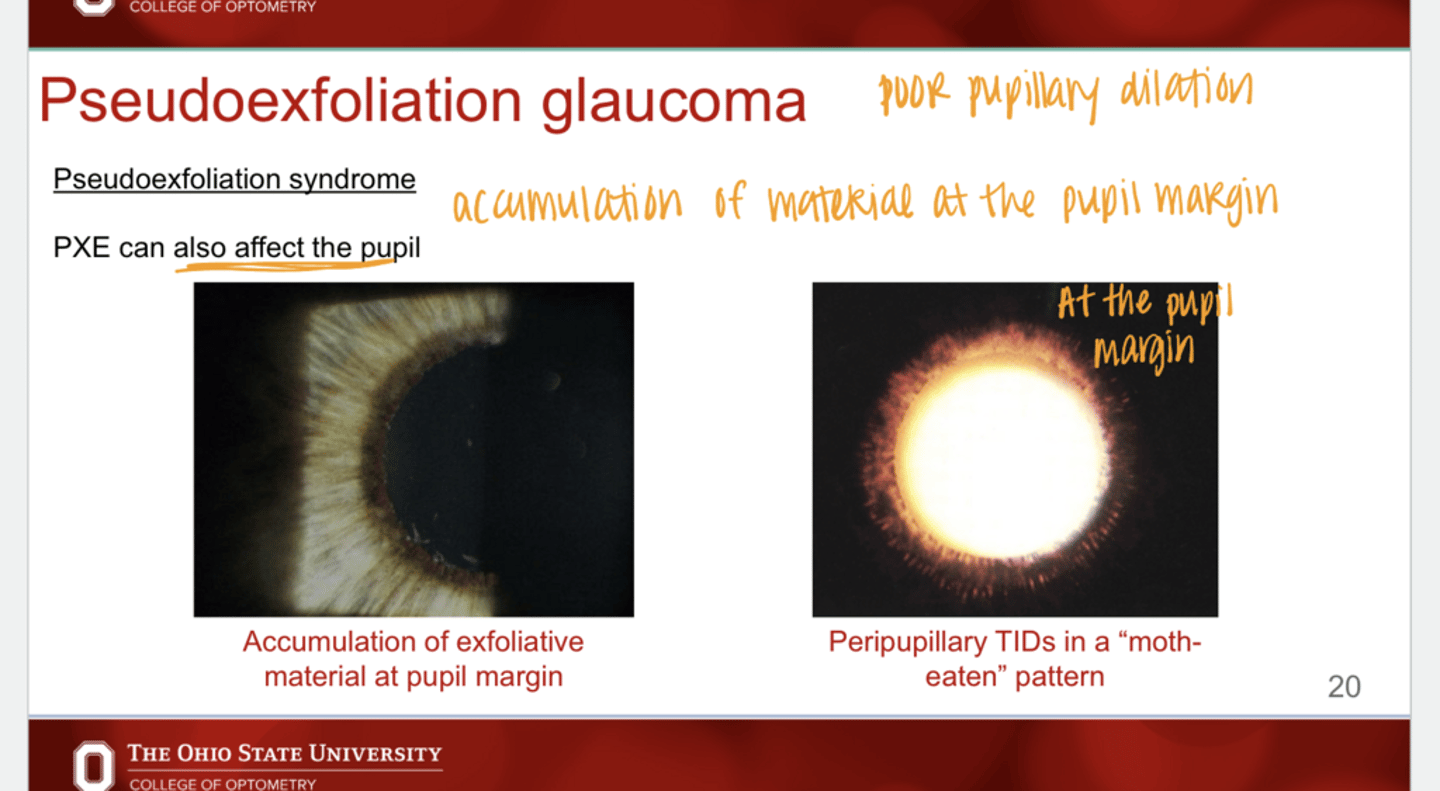
Can PXE affect the pupil?
Yes - accumulation of PXE exfoliative material can be present at the pupil margin
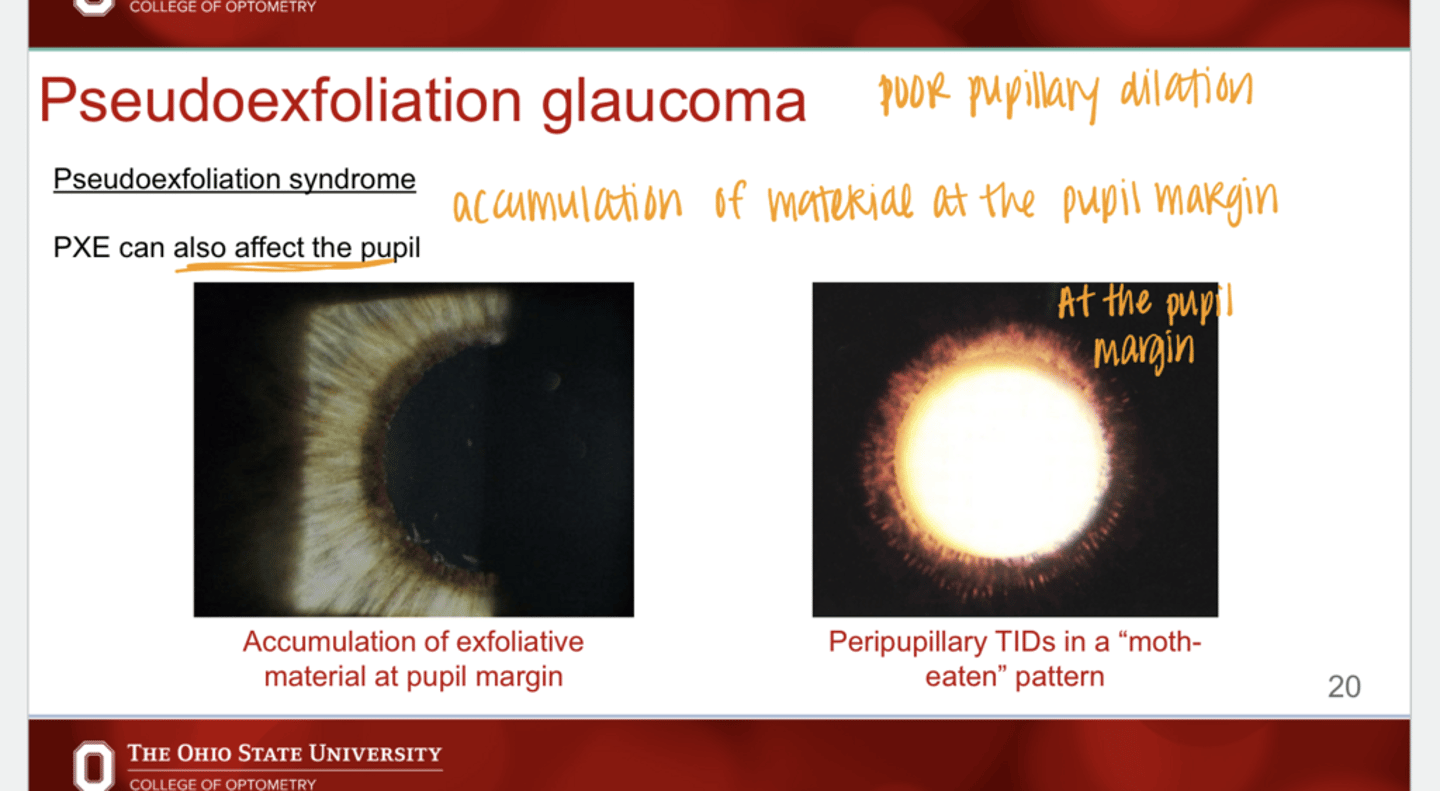
What are the transilluminationd defects that are possible with PXE?
Moth-eaten pattern -- peripupillary TIDs
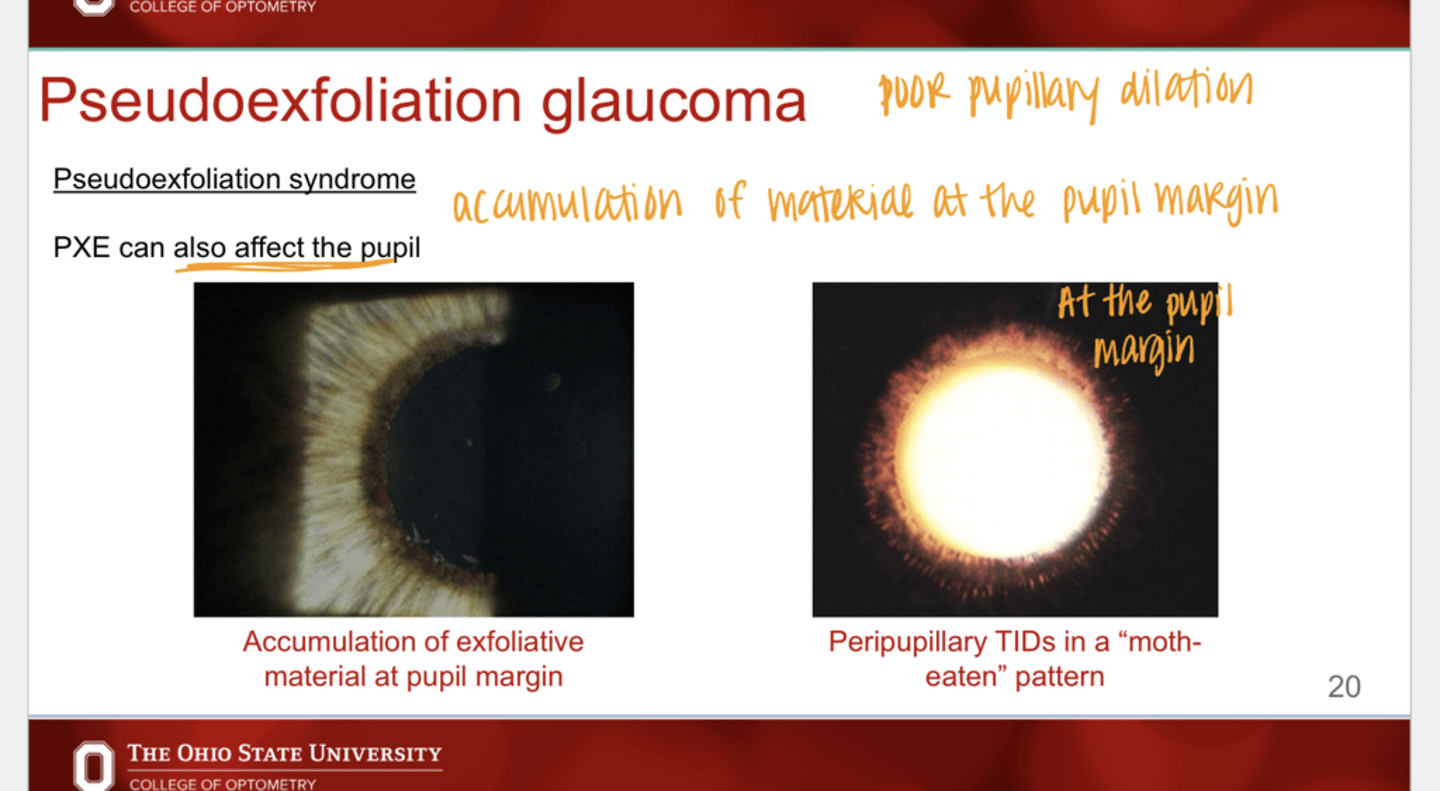
Patients with PXE typically dilate (well/poorly)
poorly
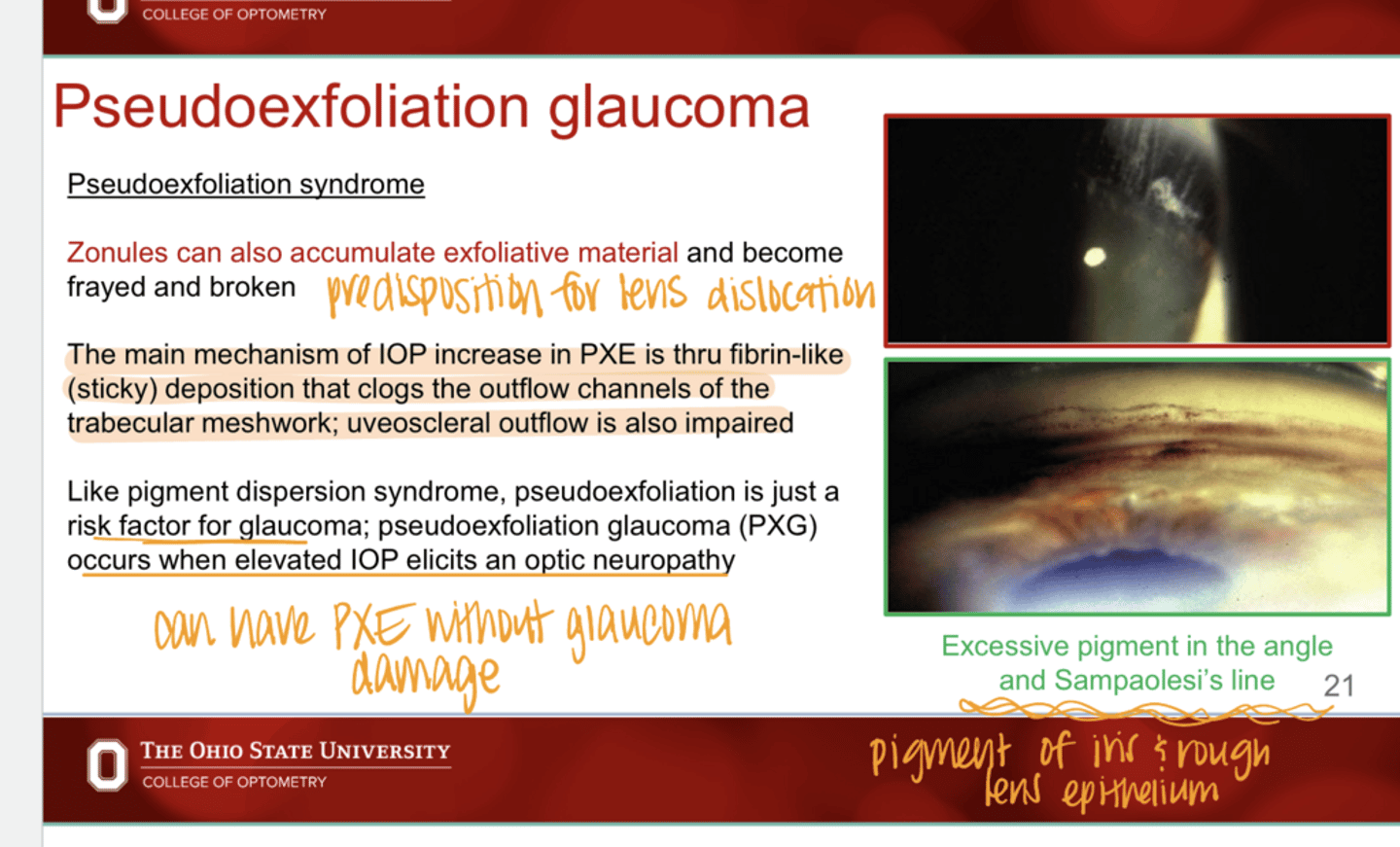
_____ can accumulate exfoliative material in PXE and become frayed or broken
Zonules
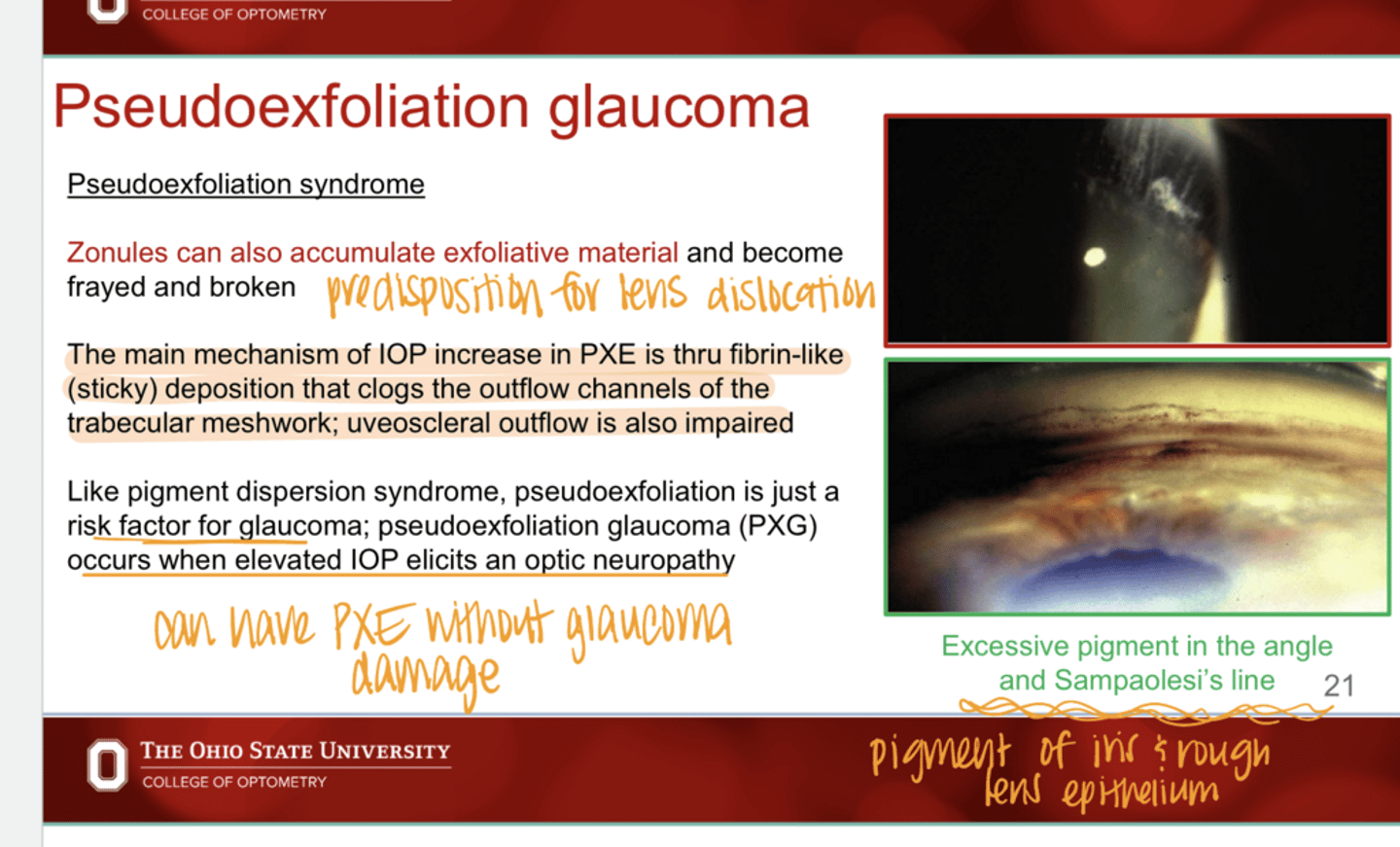
What is the main mechanism of IOP increase in PXE?
fibrin-like (sticky) deposition that clogs the outflow channels of the TM, uveoscleral outflow can also be impaired
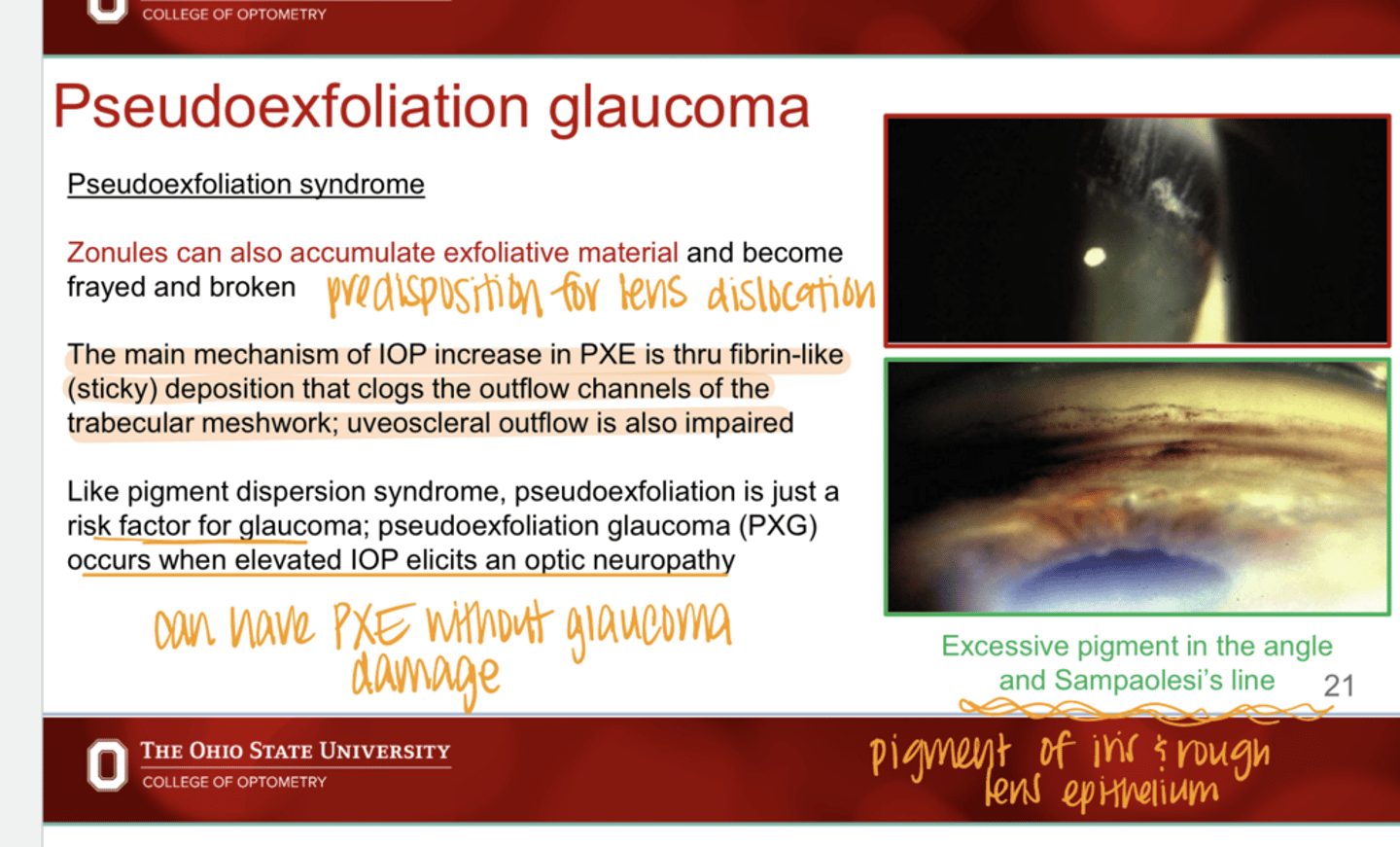
True or False:
Like PDS, PXE is just a risk factor for glacoma
True
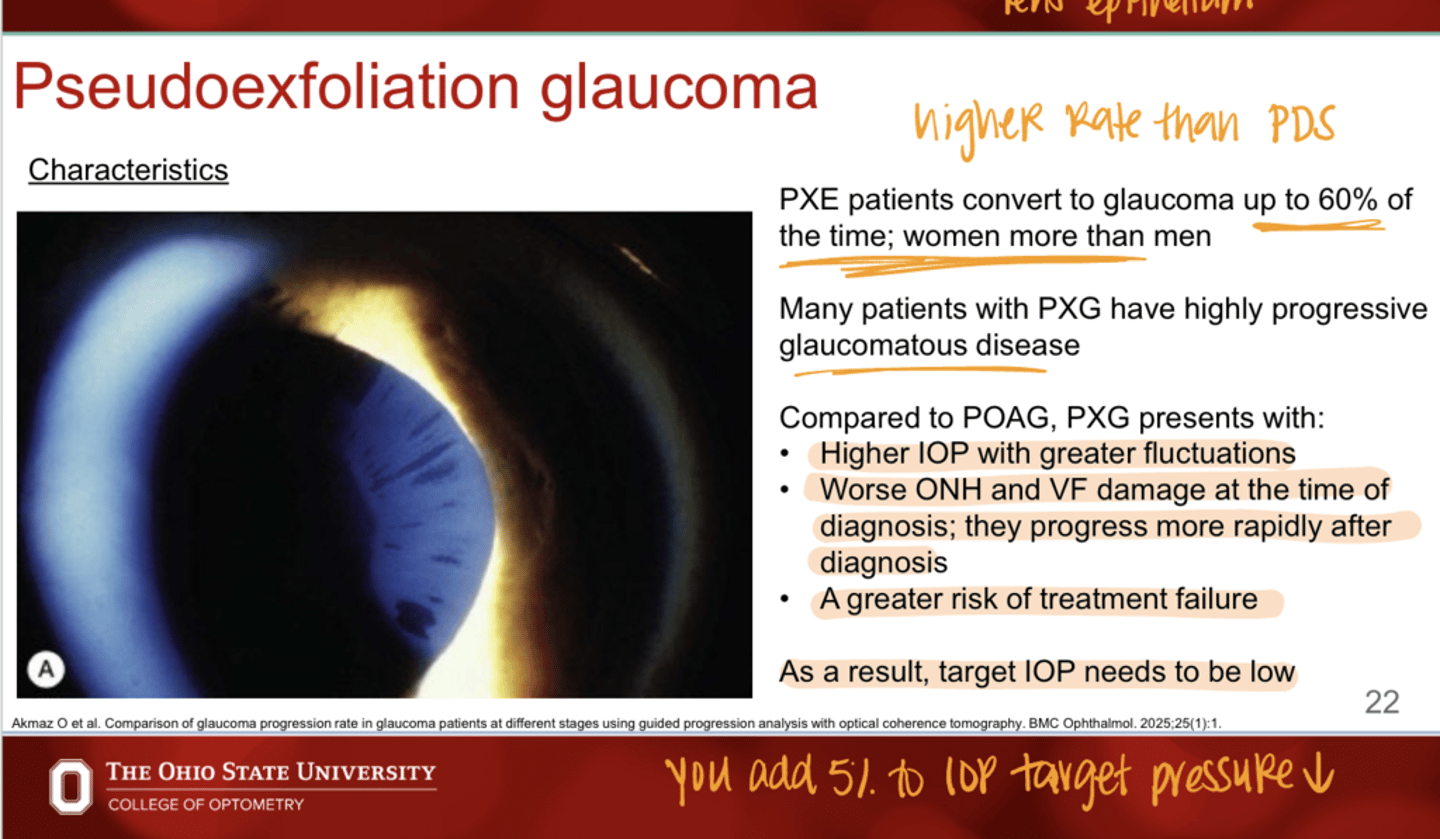
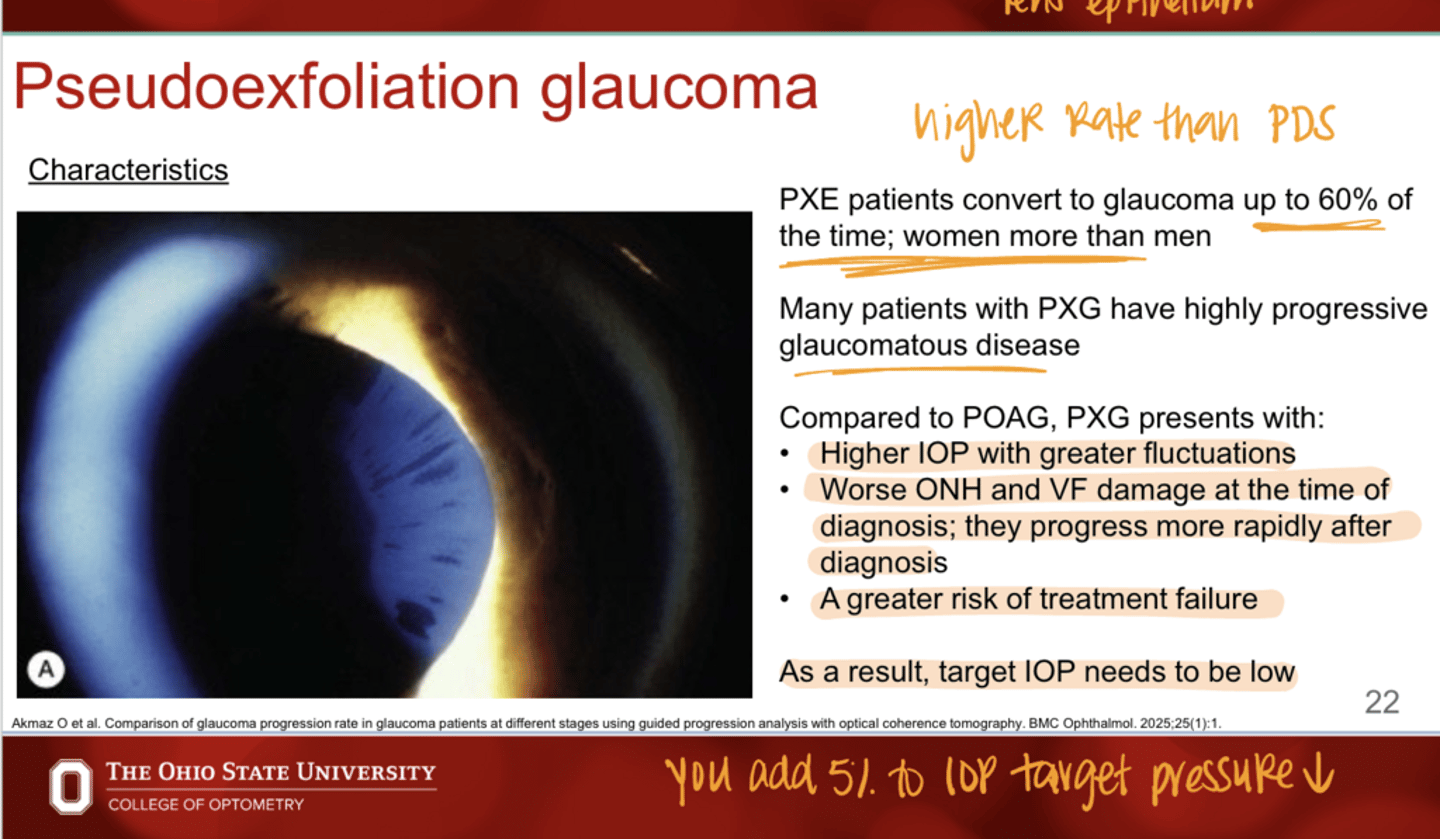
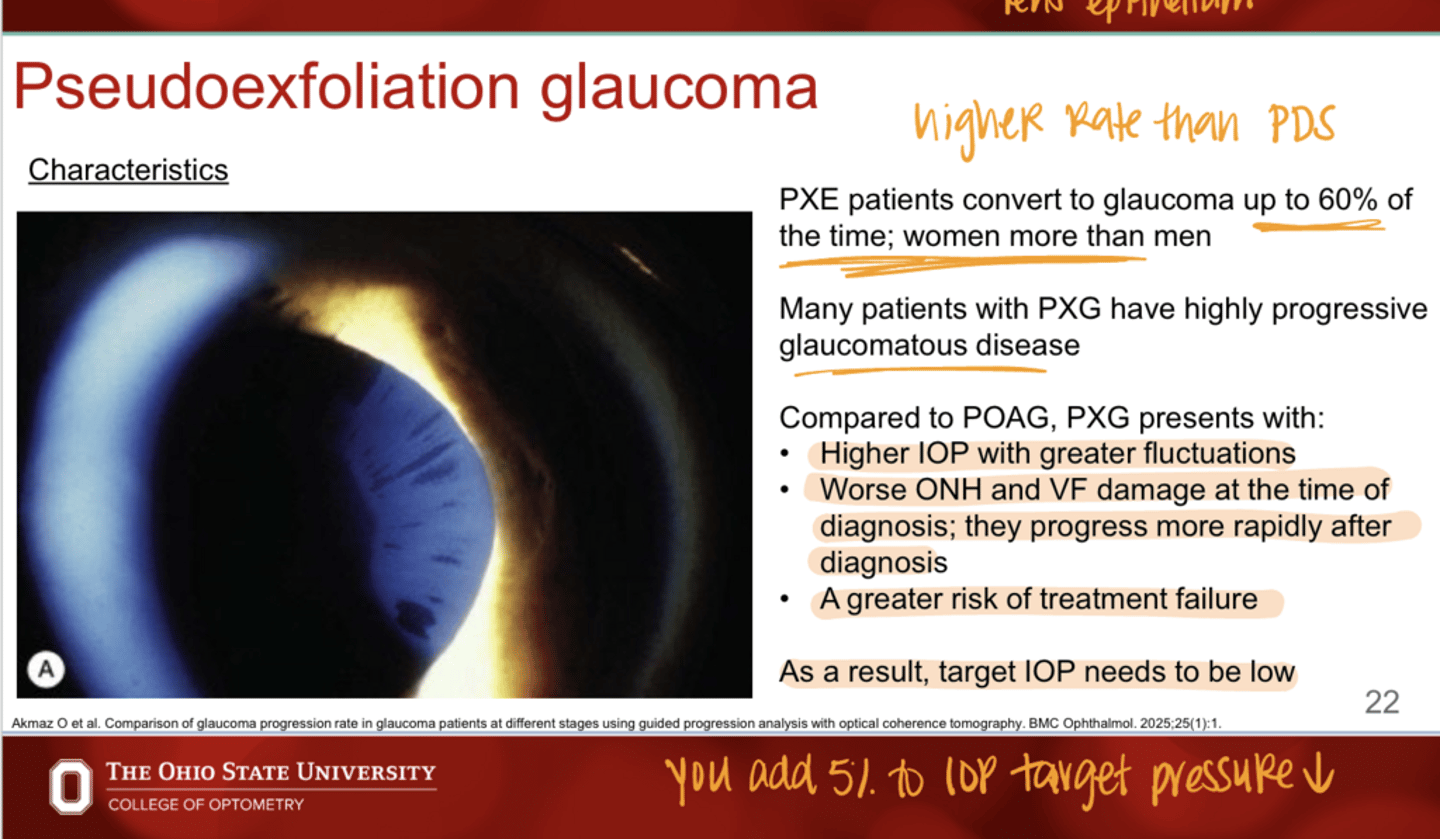
Pseudoexfoliation glaucoma (PXG) will occur when elevated IOP elicits a what?
optic neuropathy
PXE patients convert to glaucoma ____% of the time
up to 60%
PXE has a predilection for _______
women
Many patients with PXG have a highly ________ glaucoma
progressive
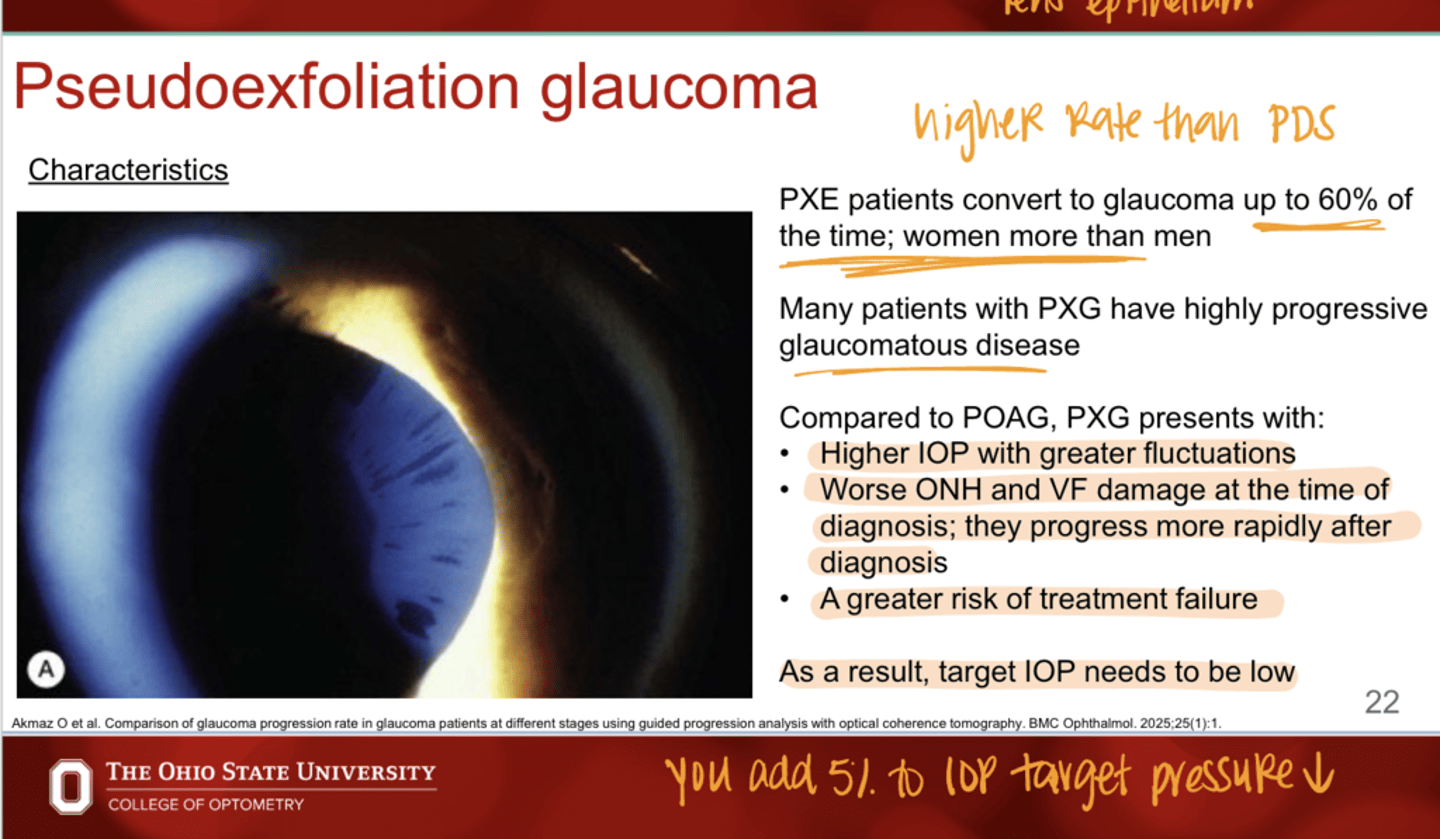
Compared to POAG, PXG present swith (higher/lower) IOP
higher
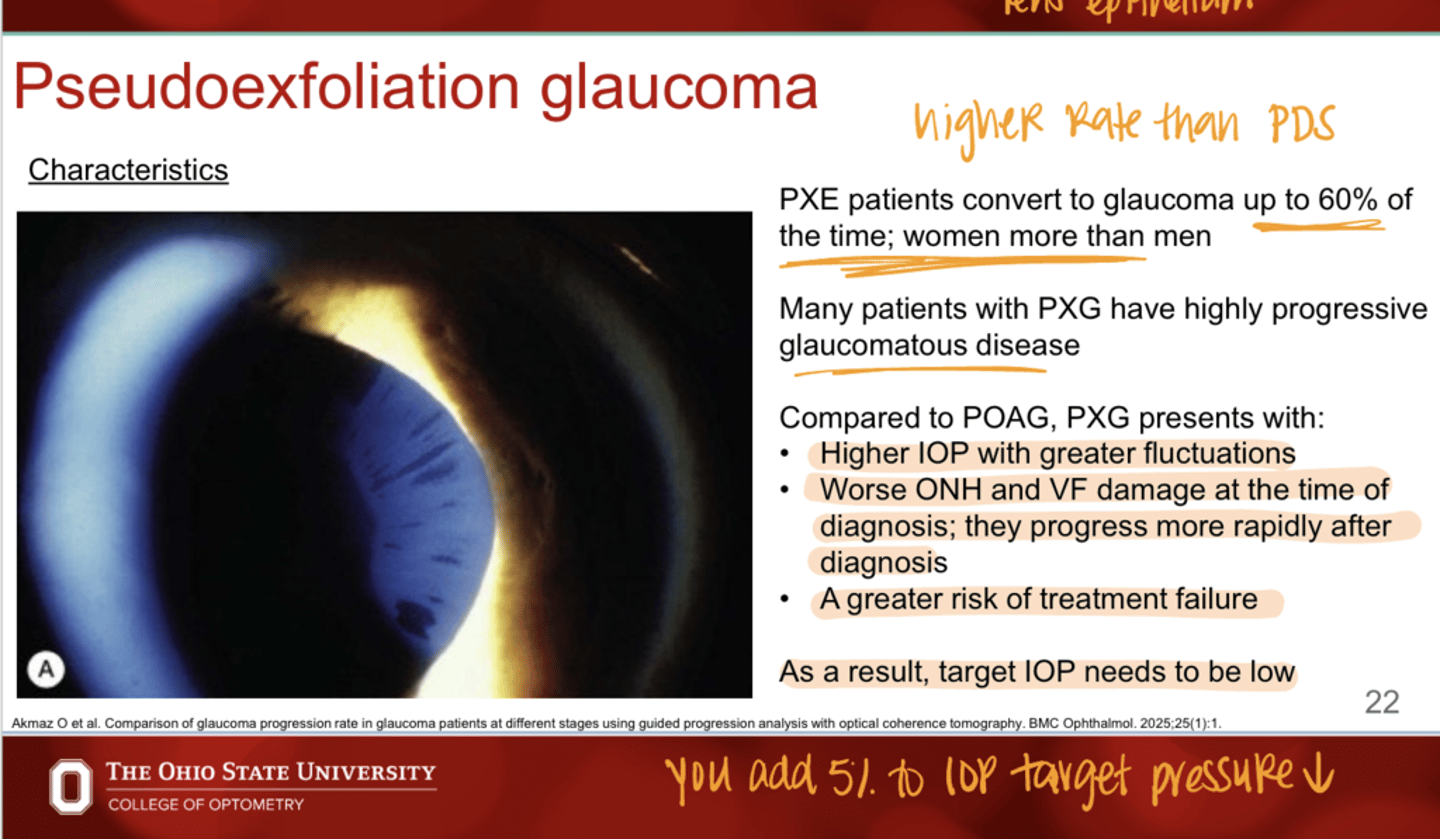
Compared to POAG, PXG presents with (greater/lesser) IOP fluctuations
greater
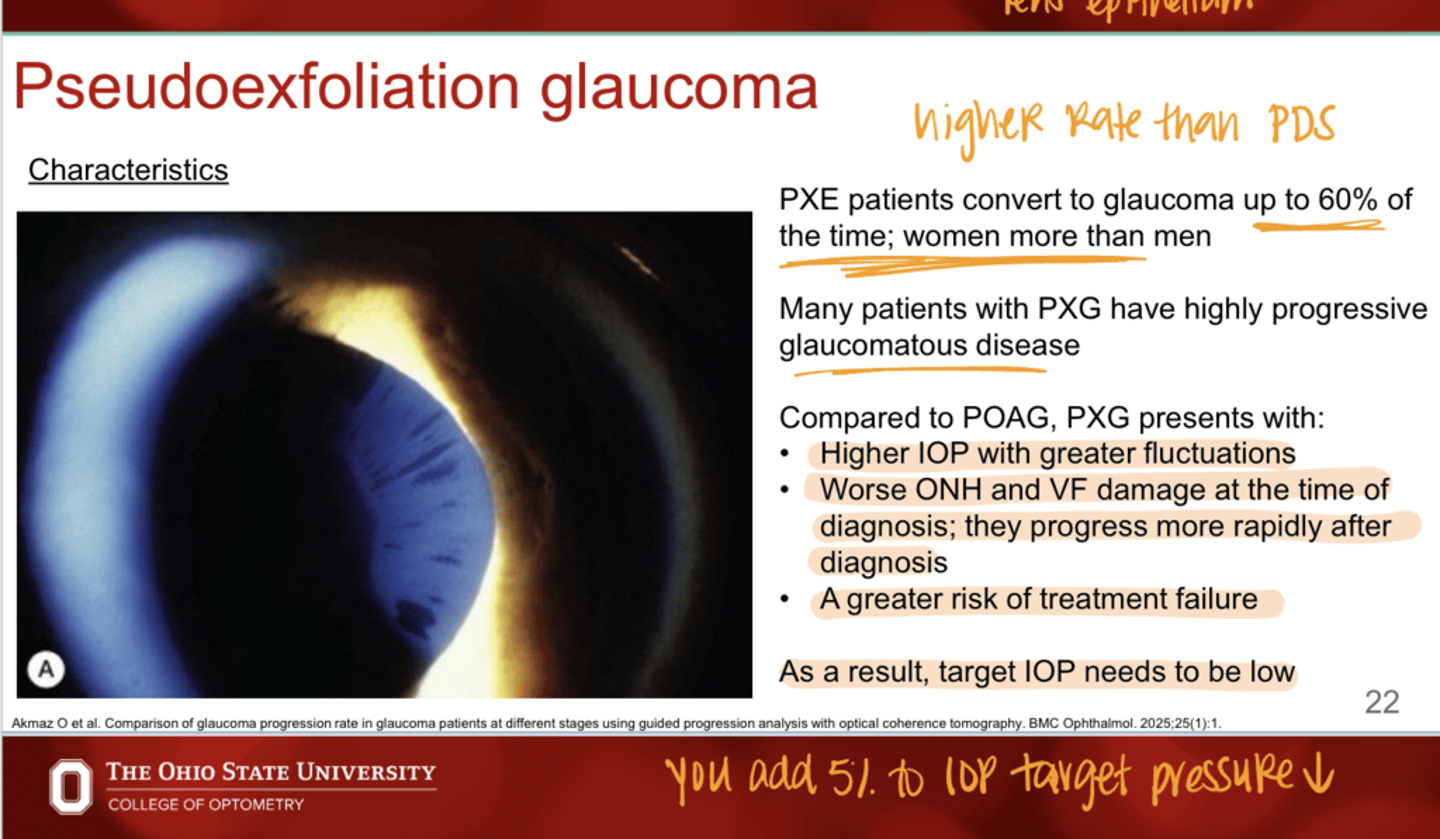
Compared to POAG, PXG presents with (better/worse) ONH and VF damage at the time of diagnosis
worse
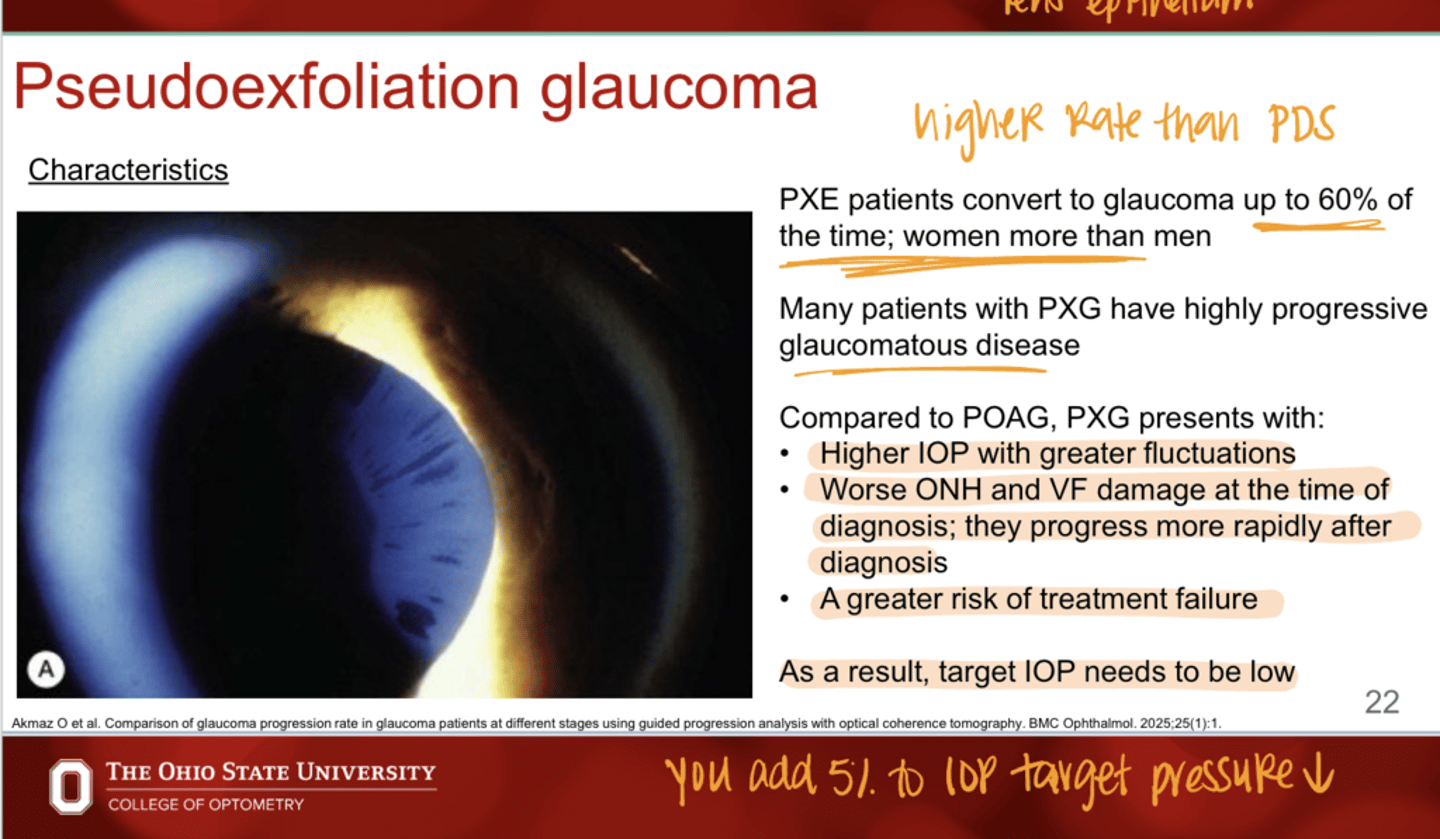
Compared to POAG, PXG patients progress (faster/slower)
faster
Compared to POAG, PXG has a (greater/lesser) risk of treatment failure
greater
As a result of PXG severity, target IOP needs to be set _____
low
You need to reduce IOP by an added ____% when PXG is present
5
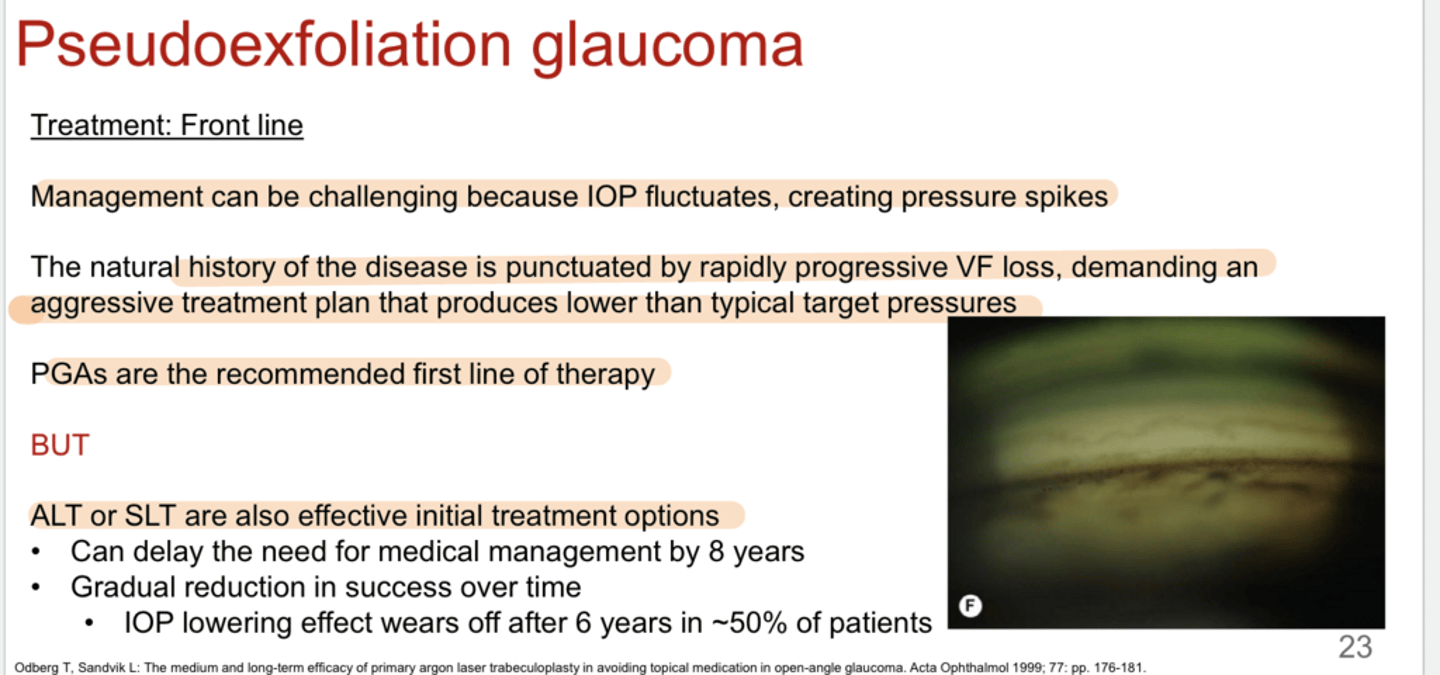
Is the management of PXG challenging?
Yes -- IOP fluctuates easily, creating pressure spikes
The natural history of PXG is punctuated by rapidly progressive VF loss, what does this demand?
an aggressive treatment plan that produces lower than typical target pressures
_____ are the recommended first line of therapy for PXG
PGAs
____ and ____ are effective initial treatment options for PXG
SLT; ALT
What is the benefit of SLT/ALT for PXG?
-Can delay need for medical management by 8 years
-Gradual reduction over time
-IOP lowering may wear off after 6 years in 50% of patients
______ is the preferred method to medically treat PXG
Outflow enhancement
If PGA therapy fails for PXG, _____ is often utilized
2% pilocarpine QHS
Why is 2% pilocarpine QHS used for PXG when PGAs fail?
Found to be both effective and well tolerated in older population unless they have dense nuclear sclerosis where pupillary miosis will hinder vision
In theory, should pilocarpine and PGA be used at the same time?
No -- Pilocarpine causes CB muscle fibers to contract. limiting the extracellular space between these fibers where PGAs carry out their MOA
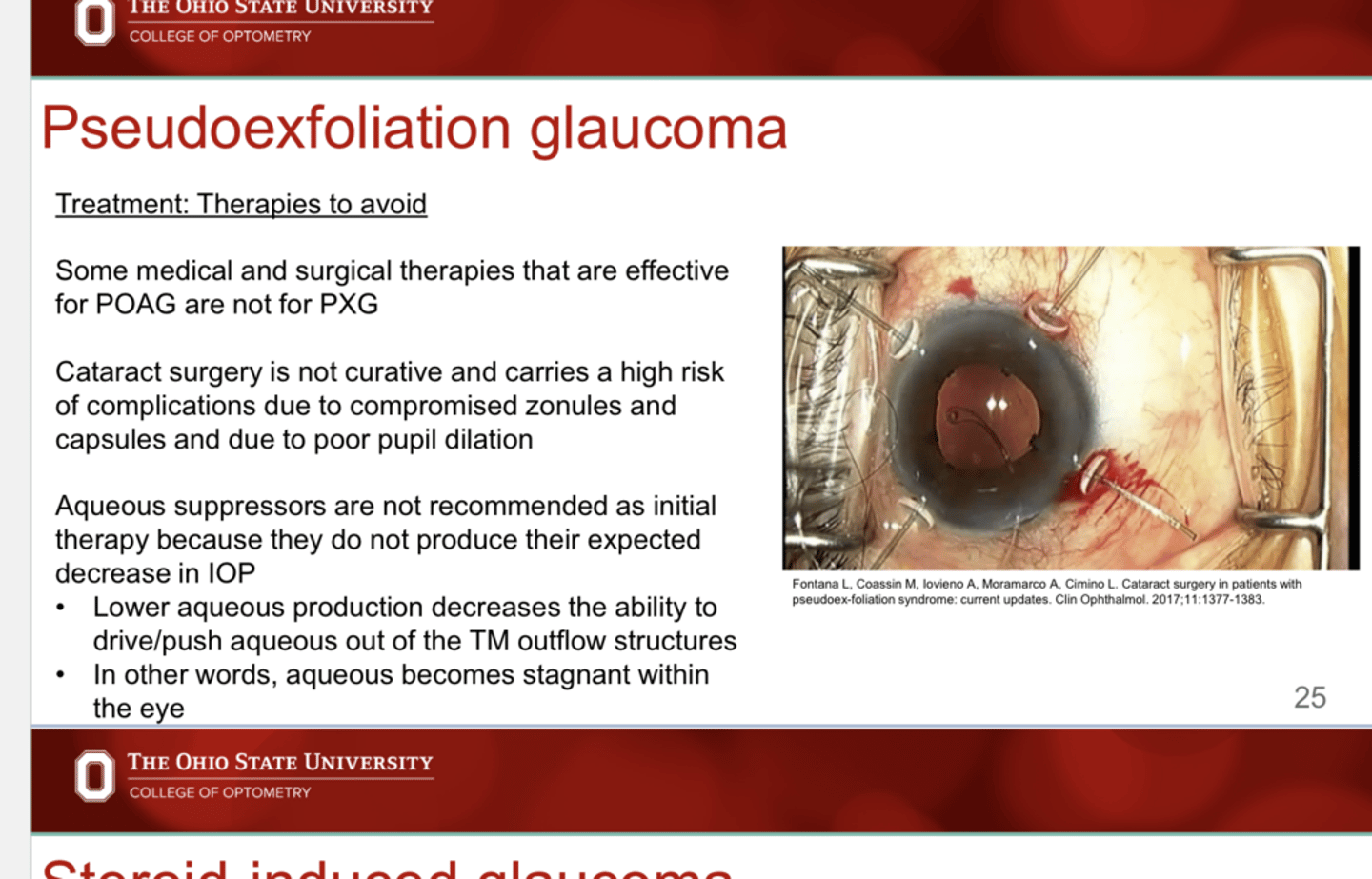
Is cataract sx curative for PXG?
No -- and it carries a HIGH RISK of complications d/t compromised zonules and capsules. Also d/t poor dilation in these patients
________ are NOT recommended as initial therapy for PXG because they DO NOT produce their expected decrease in IOP
Aqueous suppressors
Why are aqueous suppressors NOT recommended as initial therapy for PXG?
-Lower aqueous production decreases ability to drive/push aqueous out of the TM outflow structures
-Aqueous becomes stagnant within the eye
_______% of individuals treated with topical steroids will develop an increase in IOP
3-30
3-30% of individuals treated with topical steroids will develop an increase in IOP of ____mmHg
6-15
10
Steroid-induced glaucoma typically occurs after ____ days of steroid use
Can steroid-induced glaucoma occur with systemic and inhaled steroids as well?
yes
Steroid-induced glaucoma is most common in who?
-older adults
-in those who already have glaucoma themselves
-in those who have a family hx of glaucoma
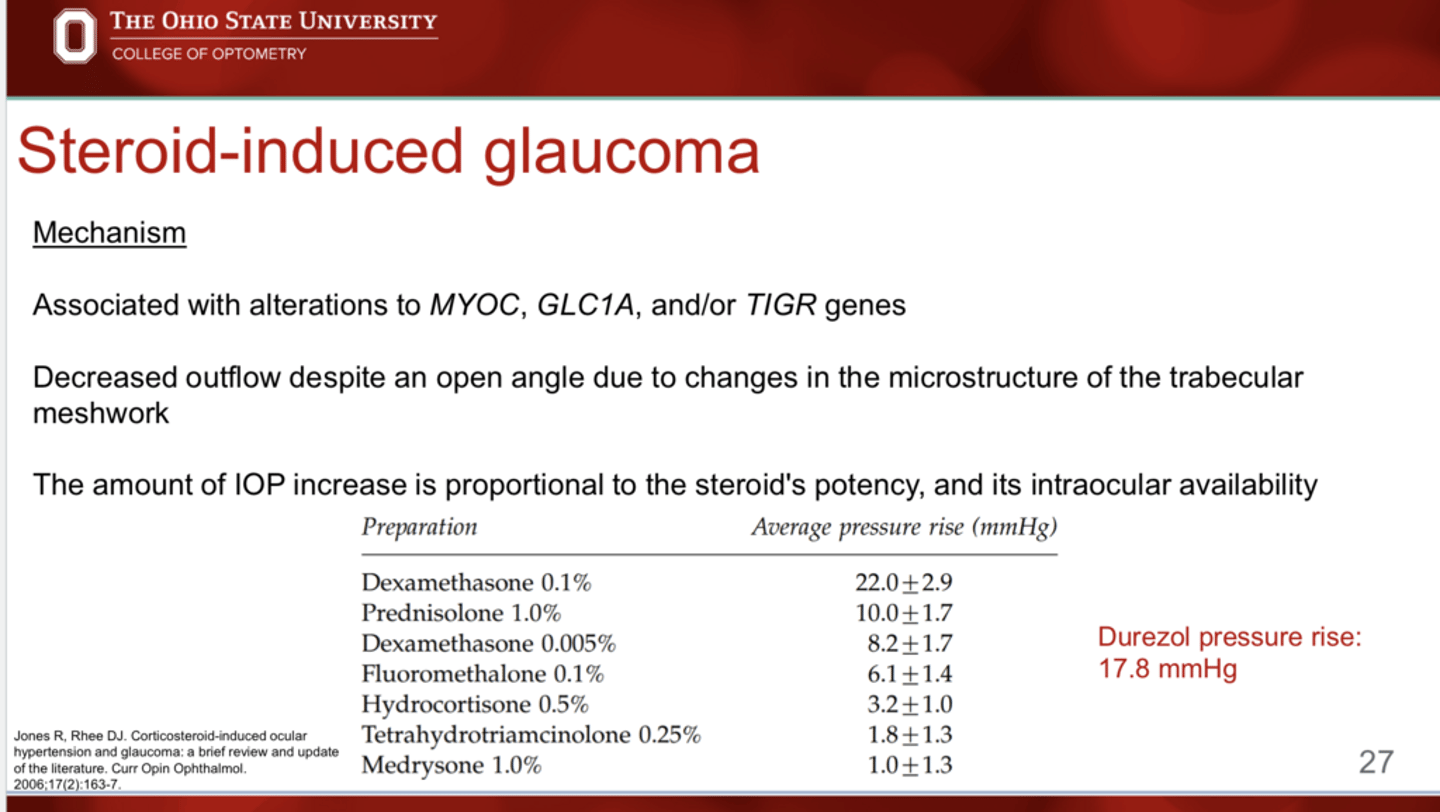
What is steroid-induced glaucoma associated with?
alterations to MYOC, GLC1A, TIGR genes