Section 1.1 DNA Structure and Genome Organization
 Call Kai
 Learn
Learn Practice Test
 Spaced Repetition
 Match
Match Flashcards
 Knowt Play
1/21

There's no tags or description
Looks like no tags are added yet.
Name | Mastery | Learn | Test | Matching | Spaced | Call with Kai | Chat |
|---|
No analytics yet
Send a link to your students to track their progress
22 Terms
Central dogma of molecular biology (FIRST QUESTION OF EXAM 4)
Hypothesis which describes the flow of genetic information in the cell
DNA (replicable) → Transcription → RNA → Translation → Protein
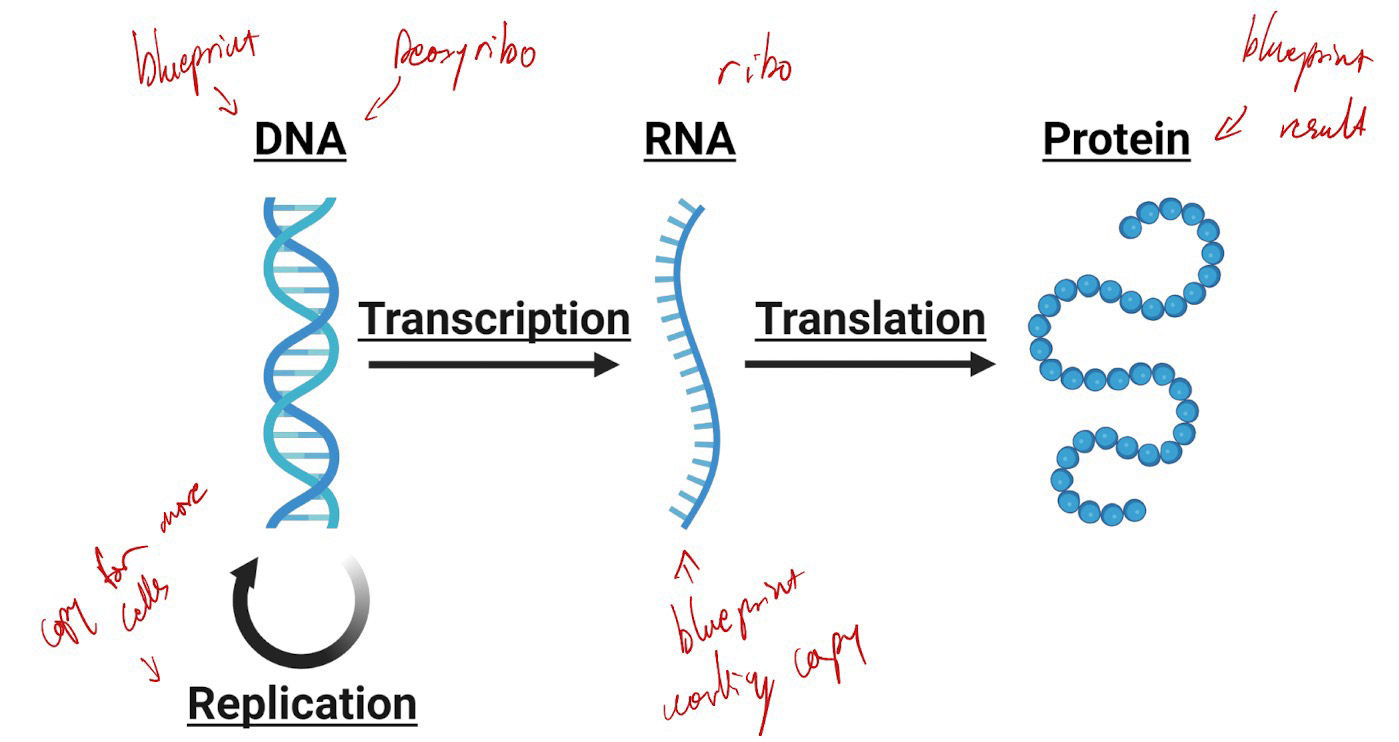
Actual central dogma is much more _____
Complex; Every step can more or less self regulate or regulate a previous step

Where is genetic information stored in prokaryotes? Eukaryotes? Why is this important
Prokaryotes: Cytoplasm (Nucleoid); We typically use E. coli as an example
Eukaryotes: Nucleus; Transcription and RNA processing inside, translation in cytoplasm
This is important because we can utilize the differences in our central dogma to create therapies for diseases

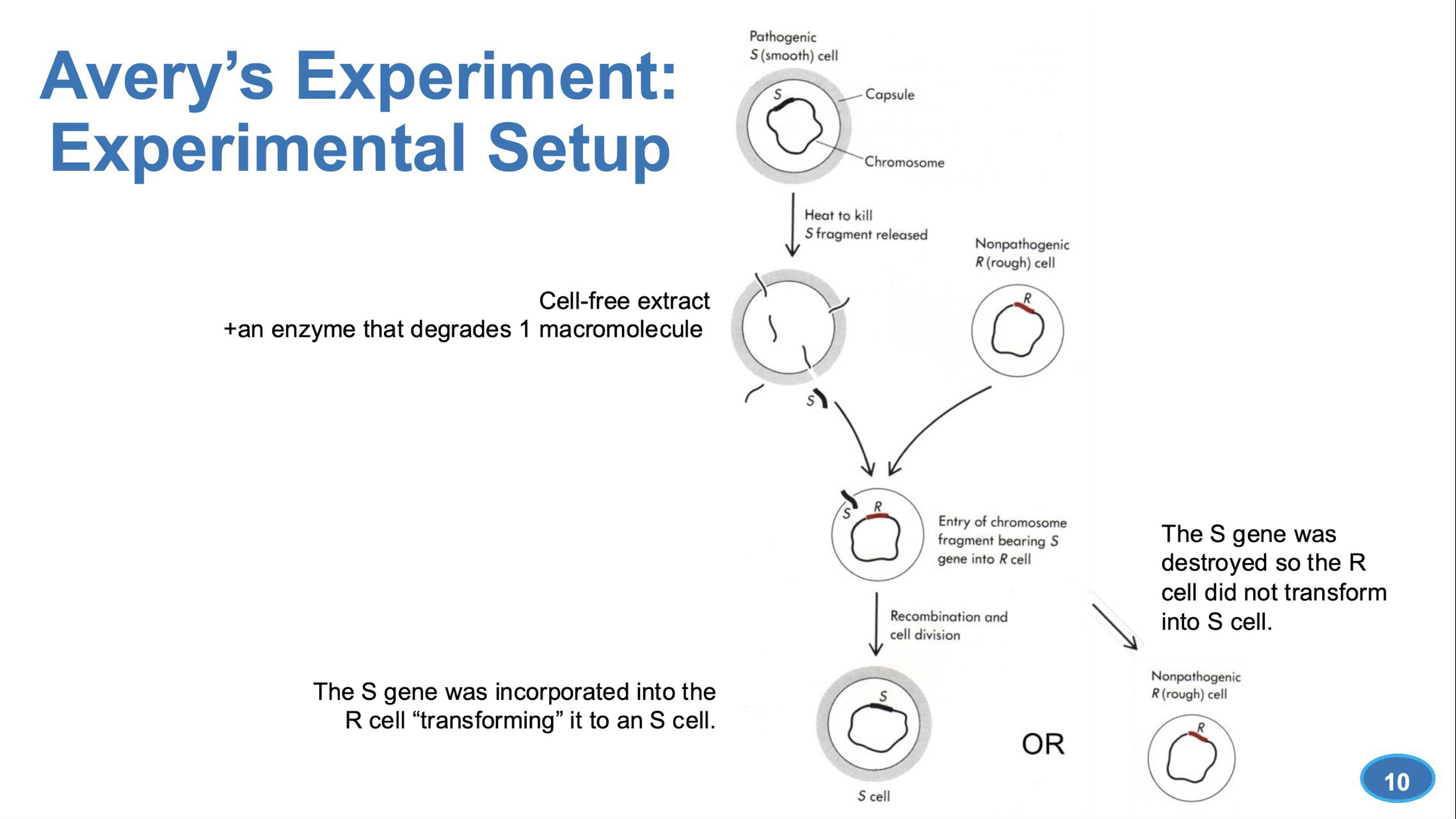
(Oswald) Avery’s Experiment: What bacteria were used? What strains? What phenomenon was utilized? What is a cell-free extract?
Determined what molecule contains genetic information in the cell
Used the bacteria Streptococcus pneumoniae
Used two strains:
Smooth (S) cells: Produced polysaccharide capsule (Pathogenic)
Rough (R) cells: Did not produce a capsule; Meaning it did not contain the genetic information required to make it (Non-Pathogenic)
Bacterial transformation: External DNA is taken up by the bacterial cell and utilized to change its morphology or physiology
Cell-free extract: Everything inside a cell, DNA, RNA, proteins, lipids, carbs, in a solution (The cell is not alive)
Essentially, Avery took the cell-free extract (And modified it to remove one type of macromolecule, e.g., a protease to degrade proteins) from a smooth cell and combined it with rough cells; If recombination and cell division do not result in an S cell, then that macromolecule is what contains genetic information
Proteinase, RNase, and DNase were used one at a time. DNase was the only enzyme that resulted in no transformation
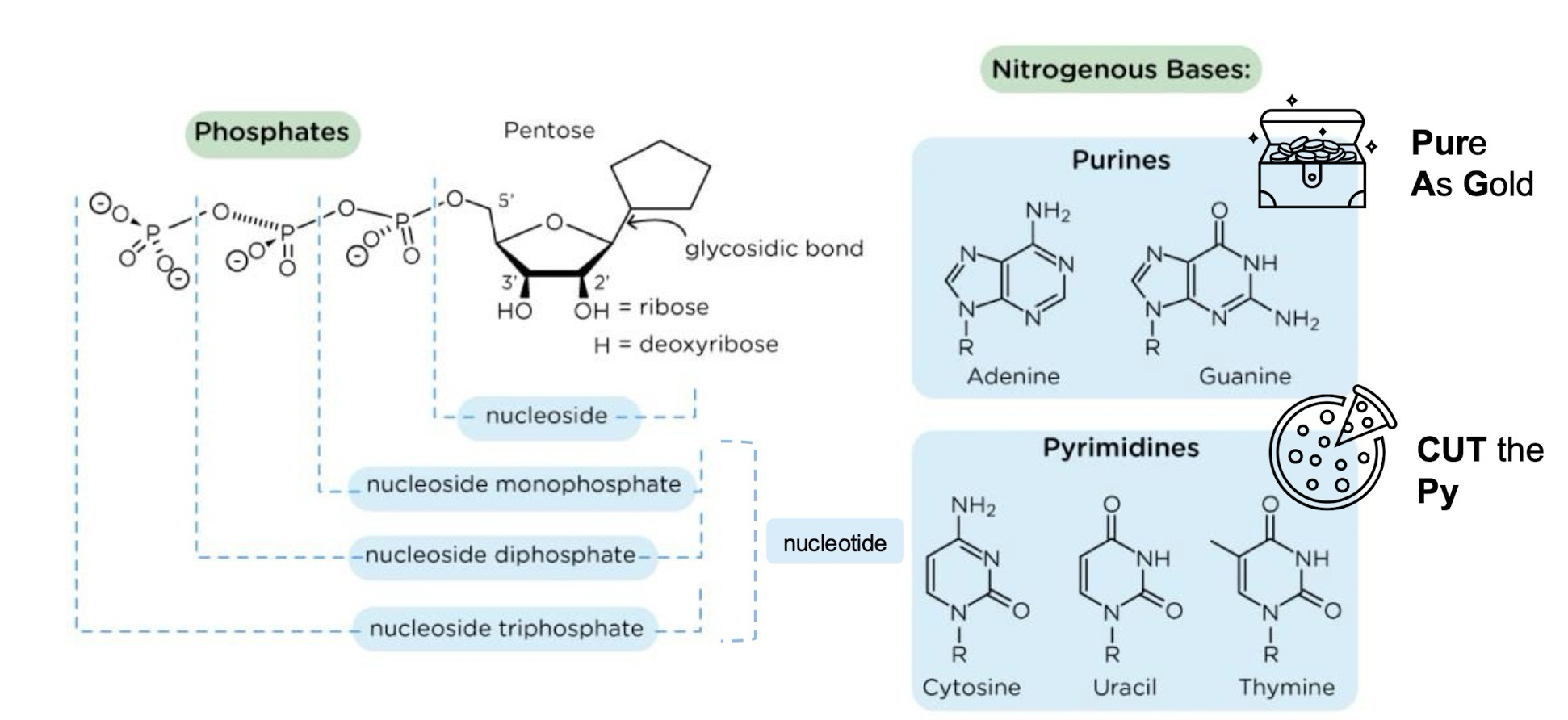
Nucleotides Vs. Nucleosides
Major purine bases
Major pyrimidine bases
Nucleotides have a nitrogenous base, a pentose, and 1+ phosphate; they make up DNA
Nucleosides have everything except a phosphate group
Purines: Adenine and Guanine
Pyrimidines: Thymine, Cytosine, and Uracil
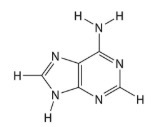
What structure is this? Purine or Pyrimidine?
Adenine; Purine

What structure is this? Purine or Pyrimidine?
Guanine; Purine
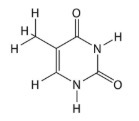
What structure is this? Purine or Pyrimidine?
Thymine: Pyrimidine
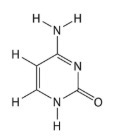
What structure is this? Purine or Pyrimidine?
Cytosine: Pyrimidine
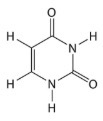
What structure is this? Purine or Pyrimidine?
Uracil: Pyrimidine
Polynucleotide; How is DNA/RNA written
Polymer of many nucleotides (Can be DNA or RNA); DNA and RNA are written via bases (ATGCU) from 5’ → 3’ end (Phospho group to hydroxy group)
Oligonucleotide: Polymer of several nucleotides
Phosphodiester linkage
Connects the 3’ of one base to the 5’ phosphate of another base

(Erwin) Chargaff’s Rules
DNA has a concentration in which A=T and G=C
Base composition percentages varies between species
Base composition is the same in different cells types within an individual organism
Base composition does NOT change with age, nutrition, or environment
Photo 51
X-rays bend/diffract in different directions based on the location of atoms in a macromolecule
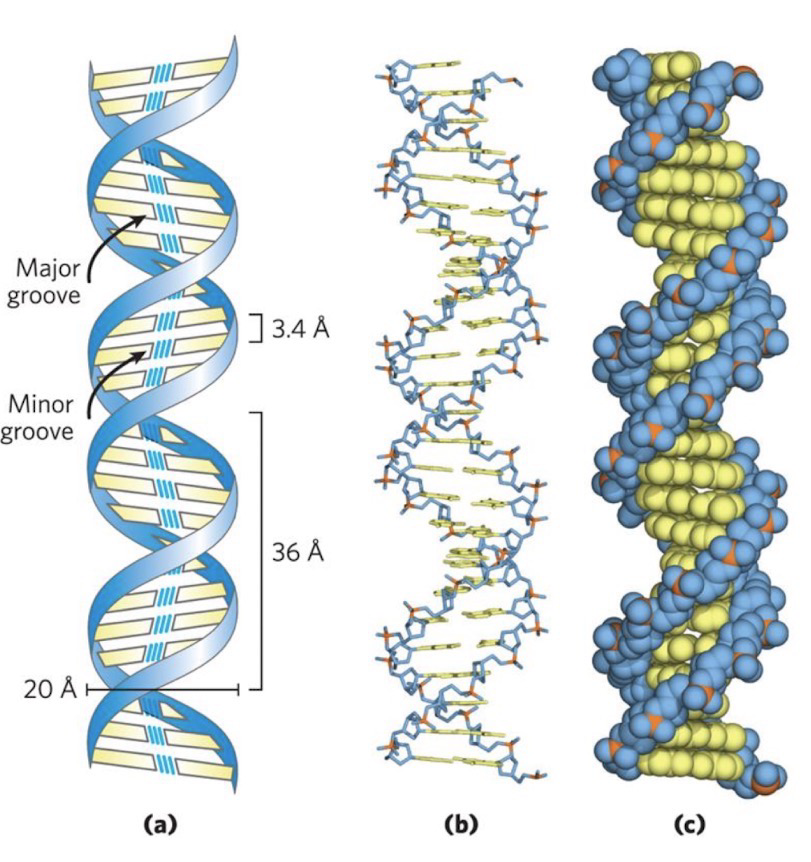
Showed DNA is helical; each turn is 34 Å (3.4nm), 10 bases (Close to actual measurements)
An X-ray diffraction image of hydrated DNA (Dehydrated had been done already, but hydrated was necessary to infer structure because DNA is hydrated in cells)
Rosalind Franklin collected a large portion of the data in Crick and Wilkins DNA structure proposal.

Chemical Structure of DNA
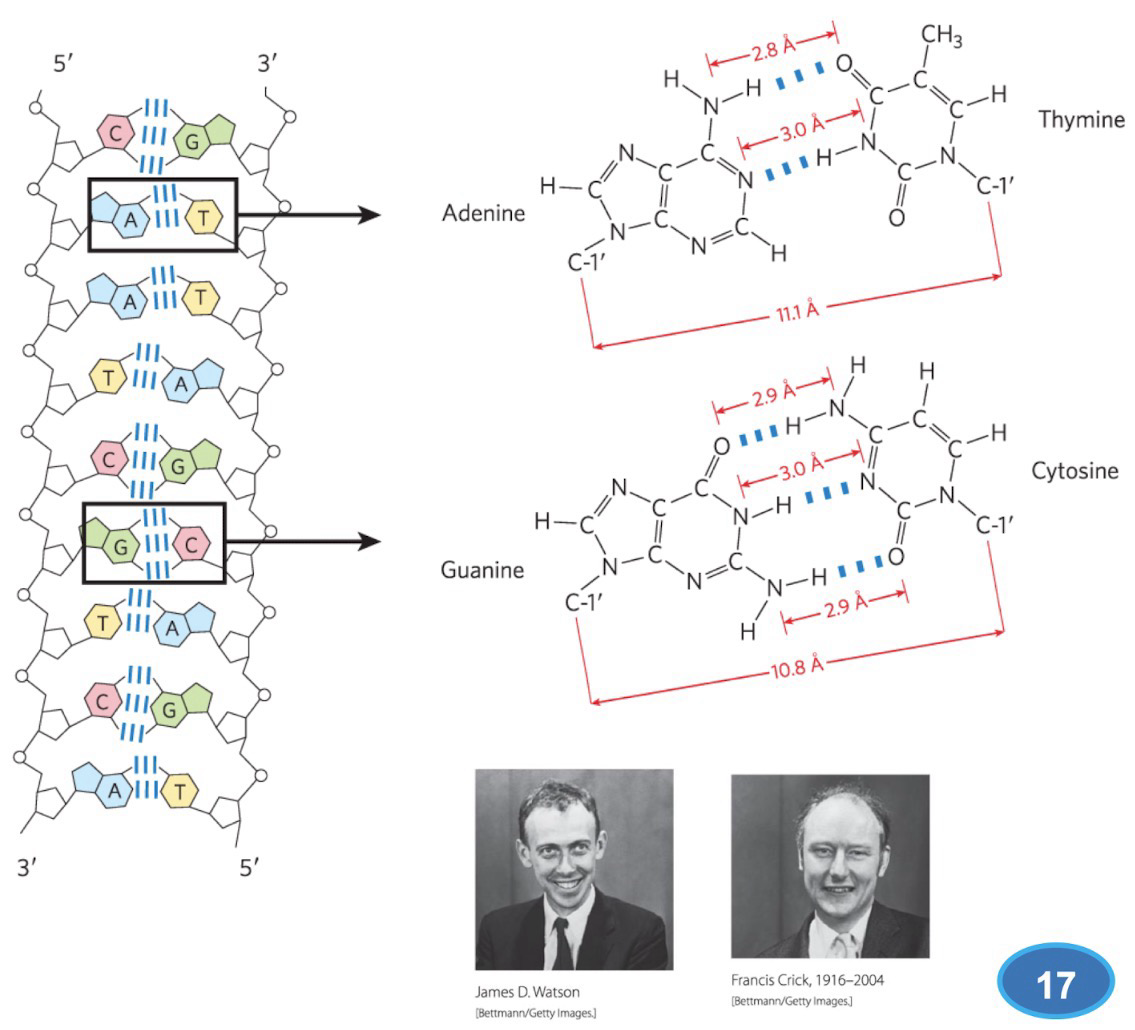
Repeating units of 2’-deoxyribonucleoside 5’-monophosphate (dNMP)
DNA contains two unbranched polynucleotide chains in an antiparallel orientation
The chains interact via H-bonds (Weak interactions allow separation for certain processes)
Based on “Watson-Crick-Franklin” base pairing: AT(U) & GC
Backbone made of the sugar and phosphate portion of nucleotides
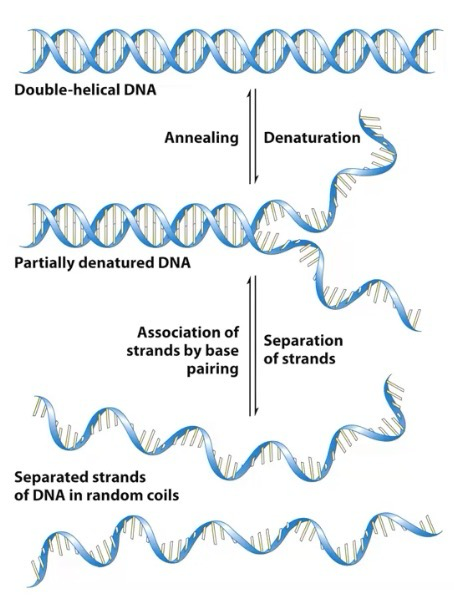
Denaturing/annealing, Tm, how do specific base pairings affect it
This process is called denaturing; 50% denaturation occurs at Tm (melting temperature)
Complementary single strands of DNA anneal to each other via base pairing
GC-rich sequences have higher Tm because they contain 3 H-bonds
AT pairing only has 2 H-bonds
What conformation is DNA typically in
DNA is a long, flexible molecule, typically in the B-DNA conformation
Right-handed helix, 10.5bp per turn, bp is flat and perpendicular to backbone, hydrophobic portion is on the inside (Occurs via hydrophobic and base-stacking interactions)
Bps are exposed in major and minor grooves, where other things can interact with DNA
Alternate DNA conformation
A-DNA: Conformation of dehydrated DNA; Good structural model of double-stranded RNA and RNA-DNA hybrid molecules; Right-handed
Z-DNA: <1% of cellular DNA; Seen in areas of high G-C content; Left-handed
Other forms: Cruciform, triplex, and quadruplex

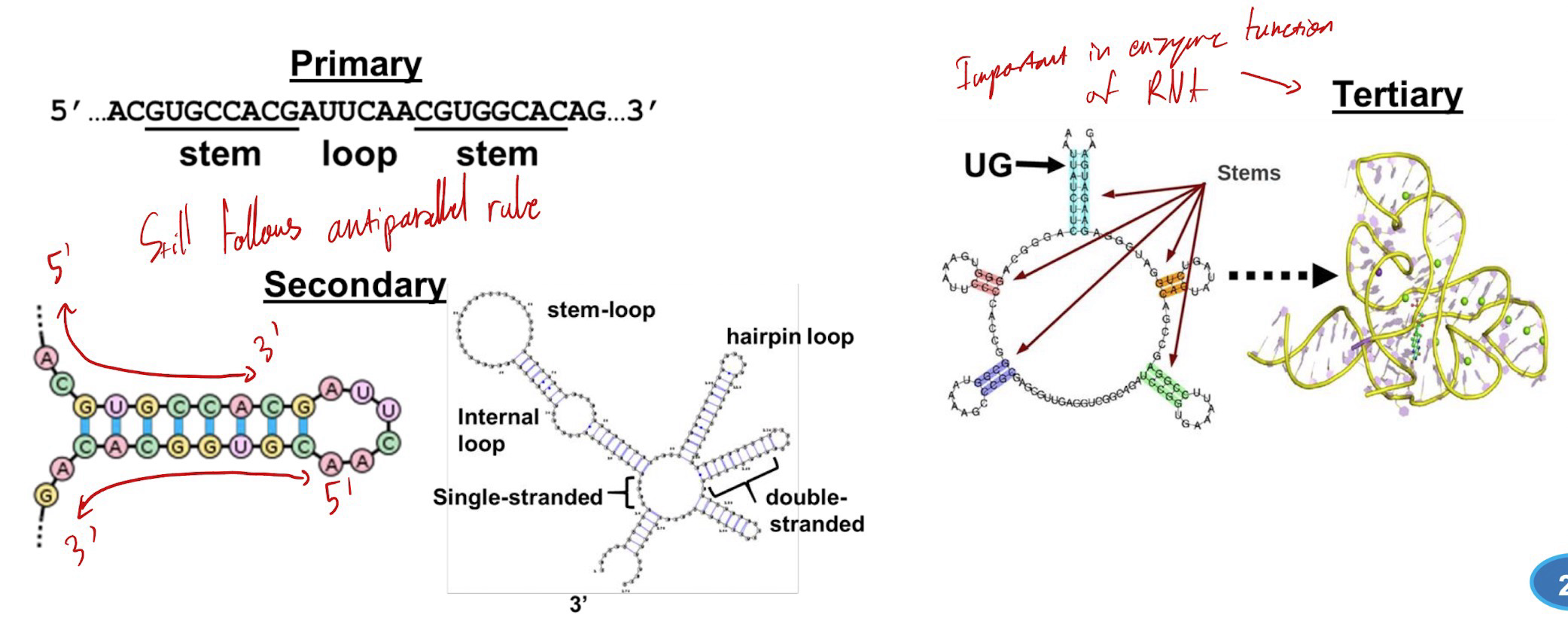
RNA structure
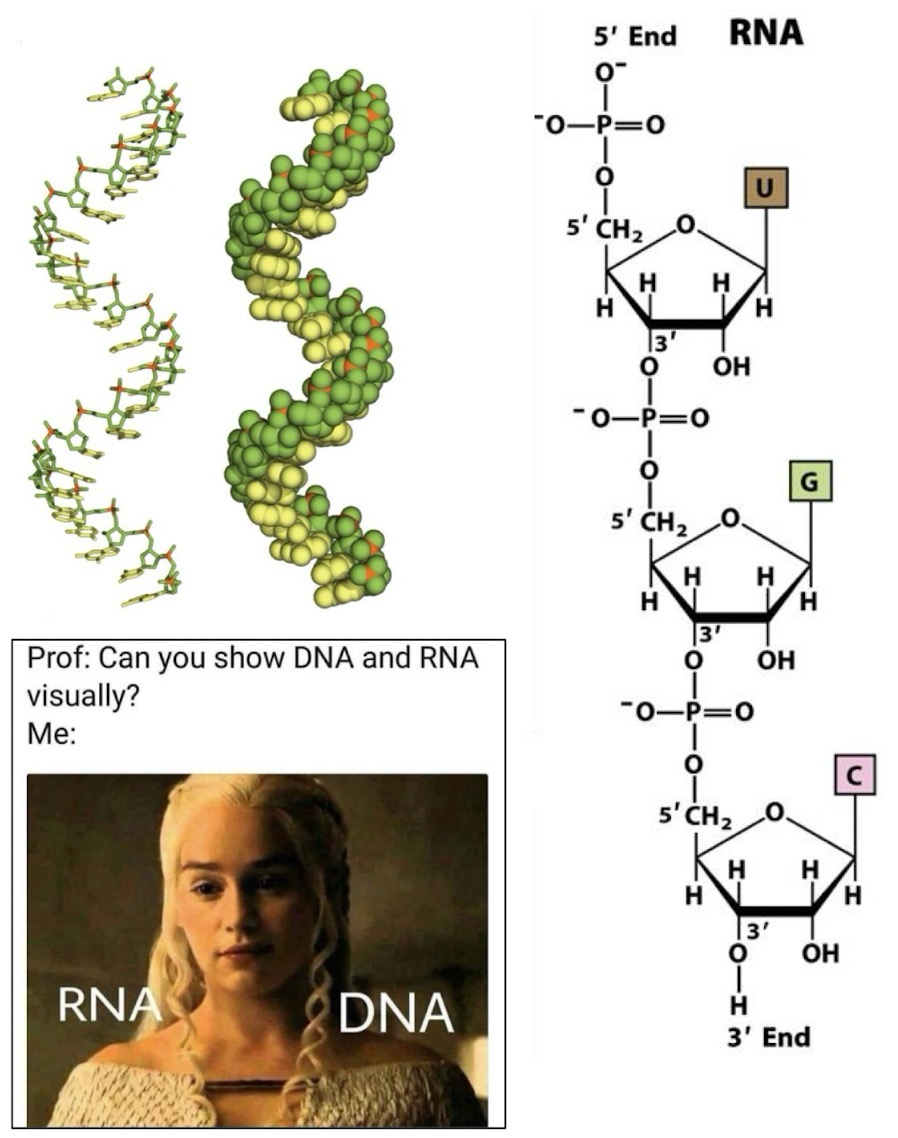
RNA (ribonucleic acid): Usually a linear, single-stranded polynucleotide chain
Contains a ribose sugar-phosphate backbone; uracil (U) instead of thymine (T); still reads 5’ → 3’
Still helical due to base-stacking interactions
RNA can pair with complementary RNA/DNA; resembles A-DNA; still antiparallel; G-U base pairing can occur when RNA base pairs with itself or another RNA molecule
RNA molecules can also form
Secondary and tertiary structures; Similar to how protein is organized
Occurs as a result of internal base pairing
Primary structure is the linear form
Gene vs Genome
Gene: DNA encoding a functional RNA or proteins as well as the regulatory elements controlling its expression
Genome: Complete set of genetic material present in a cell/organism
Ex. E. coli has a singular circular chromosome (DNA molecule that encodes genes)
Gene positions are fixed in a species
The Human Genome
Human cells contain 46 linear chromosomes; Eukaryotes have proteins bound to chromosomal DNA