Plant Taxonomy Lecture Exam 1
 Call Kai
 Learn
Learn Practice Test
 Spaced Repetition
 Match
Match Flashcards
 Knowt Play
1/47

There's no tags or description
Looks like no tags are added yet.
Name | Mastery | Learn | Test | Matching | Spaced | Call with Kai | Chat |
|---|
No analytics yet
Send a link to your students to track their progress
48 Terms
What is Taxonomy is a major part of systematics, what are the 4 components that comprise systematics?
Description
Identification
Nomenclature
Classification
(Taxonomy) Description
The assignment of morphological characteristics to a taxon.
Ex: we can describe the taxon in the image as having compound leaves and purple
flowers.

Features are often referred as what in systematics?
characters
(Taxonomy) Identification
Is the process of associating an organism with a taxon name, or if the organism has not been described, identify it as a new taxon.
Dichotomous keys are typically used for this.
(Taxonomy) Nomenclature
Naming of taxa (plural of taxon) based on a standardized system.
Species names always consist of two parts (binomials)
Genus + specific epithet
i.e. Quercus agrifolia
species name = ? + ?
species name = genus name + specific epithet
ex: Trillium ovatum (Trillium ovatum)
*underlined on exam (italics when typed)
(Taxonomy) Classification
Is the arrangement of taxa in hierarchical order.
Taxon
any group, regardless of rank
1 species = 1 taxon
1 family = 1 taxon
2 species = 2 taxa
2 families = 2 taxa
genera
plural form of genus
why is taxonomy important?
-by grouping organisms as species, scientists can measure and catalog biodiversity
-standardized names provide a pivotal tool for communication between scientists around the world
common names are local geographically
same name could be applied to diff plants
Deficiencies with the current taxonomic system of nomenclature
• It is Eurocentric
• The system is not friendly with the population that doesn’t use the Roman alphabet in their first language
• Local and indigenous names are for the most part ignored, losing valuable Traditional Ecological Knowledge.
There were many indigenous dialects in California before the arrival of the Spanish and subsequently the Anglo colonizers
What is systematics
-Systematics encompasses taxonomy, and its primary goal is to reconstruct the tree of life of all organisms using phylogenetic methods
-Such trees are also known as phylogenies
Why is systematics important?
Phylogenetic trees illustrate evolutionary novelties or apomorphies that show us how organisms evolved through time
Phylogenies and taxonomy
Phylogenetic systematics is the base of modern taxonomy
Introduced taxa
(always relative to geographic location)
Taxa introduced to an area because human interference
• Naturalized
• Exotic
• Escaped
• Invasive: “aggressive”,
example: English ivy
Native taxa
(always relative to geographic location)
Taxa that evolved locally for hundred, thousands, or millions of years = they were
here before humans arrived
ex: seaside buckwheat, native to US, California and Oregon
Endemic taxa
(always relative to geographic location)
• A subset of the native taxa
•taxa restricted to a single place
Ex: seaside buckwheat is endemic to the west coast of the US
California is hotspot of plant diversity
• 4976 CA native species
• Close to 1300 are CA endemic
• California contains most of the California Floristic Province
Carl Linnaeus
Before Carl Linnaeus and the domination of western science, many plants were known by other names to native people
Latin; genus + specific epithet; organized into groups
Linnaeus’ classification
-organizing + naming plants, systematic key based on sex
-before family or orders - organized into groups
ex: monandria - one stamen/male reproductive part
Andros = ‘male’ (Androecium)
Gynous = ‘female’ (Gynoecium)
Artificial vs. natural classifications
All classifications before the theory of evolution were artificial – solely
based in morphological similarities: sexual system
Artificial sexual system - what it got right, what it got wrong
-Gingers and bananas make part of the order Zingiberales, Monocots, this makes sense because it reconstucts ancestry
-Pickleweeds are in the Caryophyllales, and order that includes Cacti and beets in the Eudicots. It does not make sense in terms of Ancestry.
Carl Linnaeus standardized classification
Carl Linnaeus standardized the binomial species name, as well as the fundamental system of classification (phylum, order, family, etc.), which is often still used today.
Classification systems after Linnaeus
-Every author had different ideas about the morphological characters to be used in these systems, or their relative importance
-There were multiple systems, for example:
• Jussie’s
• De Candolle’s
Illustrating classifications
• The field of systematics started as a means to identify and classify organisms
• Visual representations of such classifications appear first in the 1800’s
system of classification > illustrated tree (not yet phyllogenous tree)
An illustration about classification
• These classifications are solely based in morphological similarities
• These trees were not drawn to illustrate relatedness (phylogenies)
• These figures predate the “Origin of species” of Darwin
• Classifications that are not based on evolutionary history are known as artificial
The theory of Evolution
after Darwin biologists proposed that classifications should represent evolutionary history = Natural Classifications
-first phylogeny tree drawn by Darwin (1859)
Theory of Evolution Example (Island A and Island B)
-Initially these populations are identical.
-But because populations of both islands are isolated, they start to evolve independently

Charles Bessey’s classification (1915)
• Done by hand
• Considering “evolutionary theory”
• Untestable at the time
Phylogenetics trees became testable in the 1960’s
Classifications were proposed “by hand” until the field of Phylogenetic Systematics was developed in the 1960’s by Hennig along with computational methods to infer trees from morphology
In the 90’s DNA replaced morphology as the main source of data to infer phylogenetic trees
The influence of theory of the theory of evolution (Darwinism) into classification
• Visual representations of classifications should indicate evolutionary relationships: phylogenies
Phylogenies inform the system of classification

phylogeny terms
branch length
branch
tip
root
internode/internal branch
node/hypothetical ancestor

Polytomy
Polytomy
a node that has more than two immediate descendants (relationships
are unresolved)
Monophyletic group (Clade)
Group consisting of a common ancestor plus all (and only all) descendants of that common ancestor

what type of group?
monophyletic group (clade)
B, C, and D are monophyletic because they are a group of taxa that are all descendants of ancestor G
Paraphyletic (grade)
Group consisting of a common ancestor but not all descendants

what type of group?
paraphyletic (grade)
A, B, and C are paraphyletic because together, they comprise a F and all its descendants, excepting D
Polyphyletic
Group consisting two or more taxa with separate common ancestors
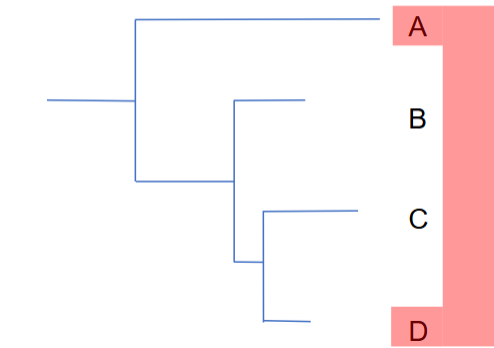
what group?
Polyphyletic
The group comprised of A and D is polyphyletic because they do not share an immediate
common ancestor
Sister taxa
clades and/or taxa that share an immediate common ancestor

what is this called?
sister taxa
Taxon A is sister to the clade 1 (B, C and D)

apomorphy - Derived characteristics

synapomorphy - shared characteristics
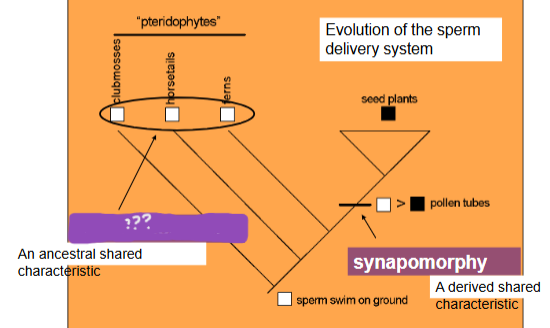
symplesiomorphy
Convergent evolution (homoplasy)
Character state “white” in taxa I and V evolved independently, therefore they represent a homoplasy

Naming of taxa should follow what type of group?
monophyletic
Dicotyledons v. Eudicotyledons
Dicotyledons were thought to be a natural group until the first DNA phylogeny for vascular plants was inferred
• Dicotyledons are polyphyletic (Classification should follow monophyletic groups; the name Dicotyledons = obsolete
• Eudicots and Monocots are monophyletic
• Basal Angiosperms are paraphyletic
• One cotyledon evolved only in Monocots, hence one cotyledon is a synapomorphy for all monocots
• Two cotyledons is a symplesiomorphy shared by Eudicots and the “basal Angiosperm
grade”