last chem test this year!!!
 Call Kai
 Learn
Learn Practice Test
 Spaced Repetition
 Match
Match Flashcards
 Knowt Play
1/70

Earn XP
Description and Tags
god help me
Name | Mastery | Learn | Test | Matching | Spaced | Call with Kai | Chat |
|---|
No analytics yet
Send a link to your students to track their progress
71 Terms
Kinetic Theory of Gases
A theoretical model about the structure and motion of gases used to explain physical and chemical properties and behaviors.
Kinetic Theory Model 1
Gases are composed of particles that are in continuous random motion.
Kinetic Theory Model 2
Attraction and repulsion forces between gas particles are negligible.
Kinetic Theory Model 3
The particles of a gas possess kinetic energy calculated by Ek=21mv2.
Kinetic Theory Model 4
The average kinetic energy of gas particles is directly proportional to absolute temperature and is identical for all gases at the same temperature.
Kinetic Theory Model 5
Collisions between gas particles and container walls are perfectly elastic.
Effect of increasing temperature on Maxwell-Boltzmann distribution curve
The peak of the curve lowers and shifts to the right (flattens), while the total area under the curve remains constant.
Gas property: Take the shape of their container / Low density
Particles show negligible forces of attraction and are in constant random motion
allows them to spread out as far as possible to occupy the container volume.
Gas property: Can be compressed
Gas particles have negligible volume and are widely spaced, providing space for them to be forced into a smaller volume.
Gas property: Readily diffuse through other gases
Particles are widely spaced
move randomly
experience negligible intermolecular forces
allowing for mixing between different gases.
Gas property: Exert pressure
Gas particles move in straight lines and collide with container walls; these collisions exert force per unit area on the walls.
Temp affect on pressure
Increasing gas temperature increases average kinetic energy and particle speed, leading to a higher frequency and greater force of wall collisions, raising pressure.
Amount of gas effect on pressure
Increasing the amount of gas increases the concentration of particles per volume
resulting in a higher frequency of wall collisions and higher pressure.
Volume of the container effect on pressure
Increasing container volume spreads particles further apart
increasing the travel distance before colliding with walls
reduces collision frequency and lowers pressure
Differences between an ideal gas and a real gas
An ideal gas assumes:
zero particle volume
no intermolecular forces,
perfectly elastic collisions;
In reality:
real gas particles occupy finite volume
experience intermolecular attractions/repulsions
non-ideal collisions.
Conditions for real gas ideal behavior: Low Pressure
Gas particles are far apart, making particle volume negligible compared to container volume and minimizing intermolecular interactions such as in a real gas
Conditions for real gas ideal behavior: High Temperature
Gas particles have high kinetic energy and rapid motion
making intermolecular attractive forces insignificant
Conditions for real gas ideal behavior: Small, Non-Polar Molecules
Substances like Helium (He) and Hydrogen (H2) possess extremely weak intermolecular forces, behaving closely to an ideal gas.
Solids
Particles experience strong attractive forces, are tightly packed, and only vibrate in fixed positions, giving them a fixed shape, fixed volume, and incompressibility.
Liquids
Particles experience strong attractive forces keeping them close together, but can slide past each other to flow and fill container bottoms while keeping a fixed volume.
Why physical and chemical changes are accompanied by energy changes
Phase and chemical changes require breaking and forming intermolecular forces or chemical bonds, which involve taking in or releasing energy.
Exothermic physical processes
Deposition, condensation, and freezing. (gas—>solid)
Endothermic physical processes
Evaporation, melting, and sublimation. (moving towards gas
Sublimation
Phase transition directly from solid to gas.
Energy change to transition to solid
Remove heat energy.
Energy change to transition to gas
Add heat energy.
Atomic level events during a phase change
Added heat energy is used to disrupt intermolecular forces between molecules rather than increase kinetic energy, keeping temperature constant while potential energy increases.
Distillation
A separation technique based on differences in the boiling points of liquid mixture components.
Combustion
A rapid exothermic reaction between a fuel and oxygen that releases heat and light energy.
Enthalpy (H)
The total chemical energy stored in a substance, encompassing chemical potential energy in bonds and particle kinetic energy.
Heat of combustion
The enthalpy change occurring when a specified amount of fuel undergoes complete combustion in oxygen.
Energy
The capacity to do work, measured in Joules (J); total energy in an isolated system is conserved.
System (in thermochemistry)
The specific chemical reaction mixture under study.
Surroundings
Everything outside the chemical reaction mixture, including the container, solution, and measuring devices.
Bond breaking and bond forming energy changes
Breaking bonds in reactants requires energy input (endothermic)
forming new bonds in products releases energy (exothermic).
Conservation of energy in reactions
Total energy is conserved; changes in chemical potential energy are offset by opposite changes in heat energy absorbed from or released to the surroundings.
Endothermic reaction definition
A reaction where bond breaking requires more energy than bond forming releases (ΔH>0), absorbing heat from surroundings and lowering temperature.
Exothermic reaction definition
A reaction where bond breaking requires less energy than bond forming releases (ΔH<0), releasing heat to surroundings and raising temperature.
Exothermic reaction enthalpy profile
Reactants have higher enthalpy than products resulting in a negative enthalpy change

Endothermic reaction enthalpy profile
Reactants have lower enthalpy than products (Hreactants<Hproducts), resulting in a positive enthalpy change (ΔH>0).

Formula for enthalpy change (ΔH)
ΔH=Hproducts−Hreactants
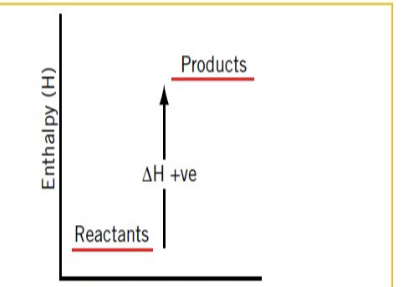
Energy profile diagrams
A graphical representation showing enthalpy or potential energy on the y-axis against the reaction progress/coordinate on the x-axis.
Indicators of an exothermic profile
Negative ΔH, energy step goes downward from reactants to products, releasing heat and increasing surrounding temperature.
Indicators of an endothermic profile
Positive ΔH, energy step goes upward from reactants to products, absorbing heat and decreasing surrounding temperature.
Exothermic process example
Cellular respiration.
Endothermic process example
Photosynthesis.

Collision theory requirements
For a reaction to occur, reactant particles must collide with each other, with sufficient energy (E≥Ea), and with correct molecular orientation.
Activation energy (Ea)
The minimum energy required for colliding reactant particles to break existing bonds and initiate a chemical reaction.
Transition state / Activated complex
An unstable, high-energy arrangement of atoms occurring at the peak of the activation energy barrier where original bonds are breaking and new bonds are forming.
Activation energy representation on an energy profile
The vertical energy difference from the reactant energy level to the top peak of the transition state.
Enthalpy change representation on an energy profile
The vertical energy difference between the reactant level and product level.
Consequence of a large activation energy
Reactant bonds are strong, requiring significant energy input to break; few particles possess sufficient energy, leading to a slow reaction rate.
Consequence of a small activation energy
Reactant bonds are relatively weak
a large proportion of particles possess sufficient energy to react
fast reaction rate.
Reactants with highest collision efficiency / reaction rates
Aqueous ions, because bonds are already broken and electrostatic attraction aids immediate reaction upon collision.
Orientation of colliding particles
Particles must align in a specific geometry during collision to enable reactive centers to interact and form new bonds.
Effect of concentration on reaction rate
Increasing solute concentration increases the number of particles per unit volume, raising the collision frequency and frequency of successful collisions, thus increasing reaction rate.
Effect of pressure on reaction rate
Increasing gas pressure compresses particles into a smaller volume, increasing particle concentration and collision frequency, which raises reaction rate.
Effect of temperature on reaction rate
Increasing temperature increases average particle kinetic energy,
move faster and more likely to collide with other particles
frequency of collisions increases
More importantly:
higher temp increases the proportion of particles is able to overcome the acitatn energy
freuency of collisions, frequency of successful collisions
Effect of surface area on reaction rate
Breaking a solid into smaller pieces increases exposed surface area, exposing more reactant particles for collision and increasing successful collision frequency.
Catalyst mechanism
Substances that increase reaction rate without being consumed
provides an alternative pathway with a lower activation energy (Ea).
Reaction rate behavior over time
Reactions do not proceed at a constant rate; they start fastest and slow down progressively as reactant concentrations deplete.
Why increasing gas volume decreases reaction rate
Increasing volume lowers particle concentration per unit space, decreasing collision frequency and lowering the rate of reaction.
Why small wood pieces burn faster than large logs
Smaller pieces present a larger surface area relative to mass
Exposes more reactant particles for allowing for frequency of collisions with oxygen to increase
Why sulfur burns faster in pure oxygen than air
Pure oxygen provides a higher concentration of reactant molecules than atmospheric air
more particles in the same amount of space
increasing collision frequency and accelerating reaction rate.
Maxwell-Boltzmann distribution curve axes
X-axis represents Kinetic Energy of gas particles; Y-axis represents the proportion/number of particles with that kinetic energy.
Shape of Maxwell-Boltzmann curve
Starts at origin (0,0) because no particles have zero energy, rises steep to a single peak, then decays asymptotically toward zero at high energies.
Area under a Maxwell-Boltzmann curve
Represents the total number of particles present in the gas sample.
Most probable energy on a Maxwell-Boltzmann curve
The kinetic energy value corresponding to the maximum peak of the distribution curve.
Maxwell-Boltzmann curve shape at low temperature
The peak is taller and shifts left towards lower kinetic energy values.
Maxwell-Boltzmann curve shape at high temperature
The peak is lower and shifts right towards higher kinetic energy values.
Effect of molecular mass on particle speed at constant temperature
At equal temperatures, heavier gas molecules possess lower average velocities than lighter gas molecules because kinetic energy (Ek=21mv2) is identical.