ppom 2 block 1
 Call Kai
 Learn
Learn Practice Test
 Spaced Repetition
 Match
Match Flashcards
 Knowt Play
1/2188

There's no tags or description
Looks like no tags are added yet.
Name | Mastery | Learn | Test | Matching | Spaced | Call with Kai | Chat |
|---|
No analytics yet
Send a link to your students to track their progress
2189 Terms
What is blood flow?
Blood flow (Q) is the volume of blood passing a given point per unit time, typically measured in mL/sec or mL/min.
Formula:
Flow = Volume ÷ Time
Which direct vasodilator can cause cyanide toxicity?
Sodium nitroprusside.
Which direct vasodilator can increase intraocular pressure and should be avoided in glaucoma?
Fenoldopam
Which direct vasodilator is typically given with a beta blocker and a diuretic?
Minoxidil
Which alpha-1 blocker is classically associated with first-dose orthostatic hypotension?
Prazosin
Which direct vasodilator opens adenosine triphosphate-sensitive potassium channels in vascular smooth muscle?
Minoxidil
What histologic change causes impaired ventricular relaxation in chronic hypertension?
Increased interstitial collagen/fibrosis → increased stiffness → impaired relaxation.
A histology section from the ventricular conduction system shows cells that are larger and paler than nearby working myocytes.
Which feature best explains their pale appearance?
Abundant glycogen with fewer myofibrils
Which antihypertensive drug class is most likely to cause orthostatic hypotension from venous pooling?
Alpha-1 blockers (prazosin, terazosin, doxazosin).
Which alpha blocker is used for vasopressor extravasation?
Phentolamine
What happens if fast sodium channels recover from inactivation more slowly?
The effective refractory period is prolonged, so premature re-excitation is more difficult.
What happens when delayed rectifier potassium current decreases?
Repolarization slows, Phase 2/3 lasts longer, and ventricular action potential duration increases.
Who is at highest risk for first-dose hypotension from an angiotensin-converting enzyme inhibitor?
Patients with high renin-angiotensin system activity, especially volume depletion or heart failure.
Which antihypertensive drug directly inhibits renin?
Aliskiren
Why are angiotensin-converting enzyme inhibitors and angiotensin receptor blockers used in proteinuric chronic kidney disease?
Efferent arteriole dilation → decreased glomerular pressure → decreased proteinuria.
Which calcium channel blockers most strongly slow atrioventricular nodal conduction?
Verapamil and diltiazem.
What is the most common adverse effect of dihydropyridine calcium channel blockers?
Peripheral edema.
Which calcium channel blockers are first-line therapy for variant angina because they relieve coronary vasospasm?
Calcium channel blockers as a class.
Which calcium channel blockers are most likely to cause bradycardia and atrioventricular block?
Verapamil and diltiazem
Which beta blocker has the shortest half-life and is useful when rapid titration is needed?
Esmolol
Which beta blockers also block alpha-1 receptors and therefore cause additional vasodilation?
Labetalol and carvedilol.
What is the principle of helium dilution?
Helium mixes within a closed gas system and becomes diluted in proportion to lung volume, allowing estimation of functional residual capacity.
What does nitrogen washout measure in the residual-volume section of this lecture?
It is an indirect method used to determine residual volume.
A patient is given 5% glucose in water. After glucose is metabolized, the solution behaves like:
Free water.
What are the 3 major triggers for renin release?
↓ afferent pressure, ↓ macula densa NaCl, ↑ beta-1 sympathetic stimulation.
Why do loop diuretics increase urinary Ca²⁺?
Block NKCC2 in thick ascending limb → ↓ K⁺ back-leak/lumen-positive potential → ↓ paracellular Ca²⁺ reabsorption → ↑ Ca²⁺ excretion.
Where do thiazides act, and what happens to Ca²⁺?
Early distal convoluted tubule; block Na⁺/Cl⁻ cotransporter → ↑ Ca²⁺ reabsorption → ↓ urinary Ca²⁺.
What transporter does angiotensin II stimulate in the PCT?
Na⁺/H⁺ exchanger (NHE3) → ↑ Na⁺ and HCO₃⁻ reabsorption
What does ADH do in the collecting duct?
V2 receptor → ↑ cAMP → ↑ AQP2 insertion → ↑ water reabsorption; also ↑ inner medullary urea permeability.
Why is the thick ascending limb called a diluting segment?
It reabsorbs NaCl but not water → tubular fluid becomes dilute.
Why does aldosterone increase K⁺ secretion?
↑ ENaC-mediated Na⁺ reabsorption → lumen becomes more negative → ↑ K⁺ secretion.
What does PTH do to phosphate in the kidney?
↓ phosphate reabsorption in PCT → ↑ phosphate excretion in urine.
What are PTH’s two major renal effects?
↓ PO₄³⁻ reabsorption in PCT + ↑ Ca²⁺ reabsorption in DCT.
Why can hyperaldosteronism cause metabolic alkalosis?
Aldosterone → ↑ H⁺ secretion by α-intercalated cells → ↑ HCO₃⁻ in blood.
What does low NaCl at the macula densa do?
↑ Renin → ↑ Ang II → ↑ aldosterone → ↑ Na⁺/water retention.
What does angiotensin II do in the PCT?
Stimulates Na⁺/H⁺ exchange → ↑ Na⁺, H₂O, and HCO₃⁻ reabsorption.
What is the basic valve/sound sequence through systole?
Mitral closes → S1 → aortic opens → aortic closes → S2.
ADH at V1 receptors causes what?
↑ intracellular Ca²⁺ → vascular smooth muscle contraction → vasoconstriction → ↑ blood pressure.
A patient is water deprived and has high ADH levels. Which pairing is most accurate?
V1 on vascular smooth muscle → ↑ intracellular Ca²⁺ → vasoconstriction
V2 on collecting-duct cells → ↑ adenylate cyclase → ↑ cyclic adenosine monophosphate → ↑ aquaporin-2 insertion → ↑ water reabsorption
A 44-year-old man with no known lung disease undergoes spirometry. After a maximal inspiration, he is instructed to exhale as much air as possible.
Which quantity is being measured?
Vital capacity
What does Fowler’s nitrogen washout method measure?
Anatomic dead space.
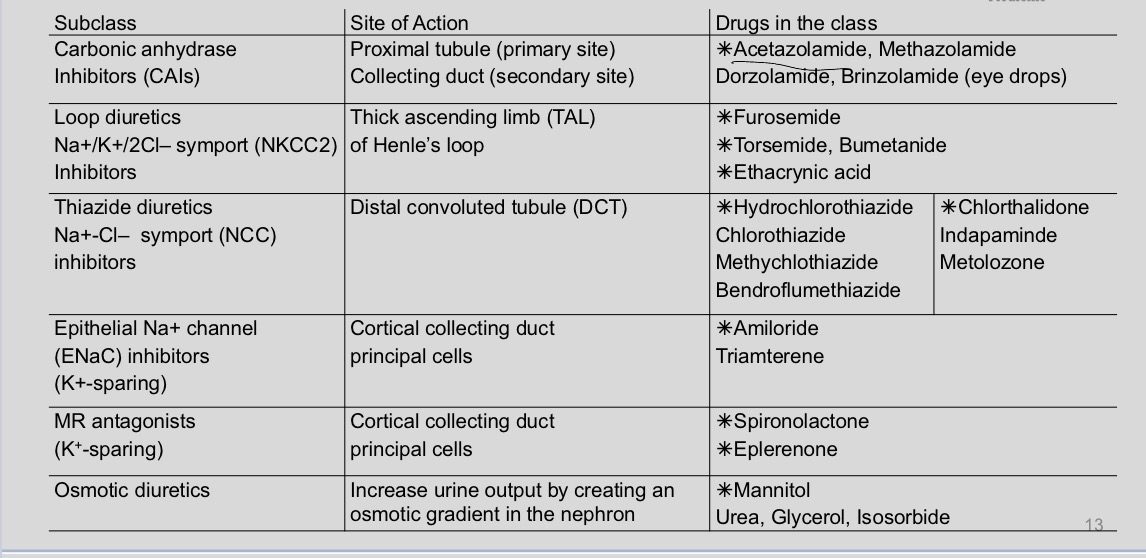
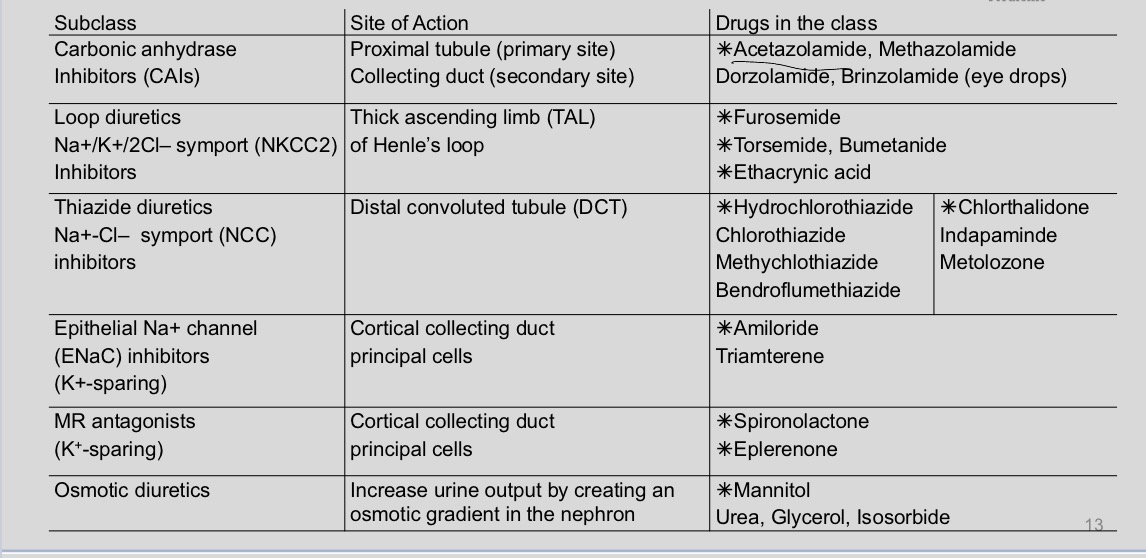
Loop diuretics we must know (Na+/K+/2Cl– symport (NKCC2)
Inhibitors)
Furosemide Torsemide, Bumetanide Ethacrynic acid
Epithelial Na+ channel (ENaC) inhibitors (K+-sparing) Drugs we need to know
Amiloride
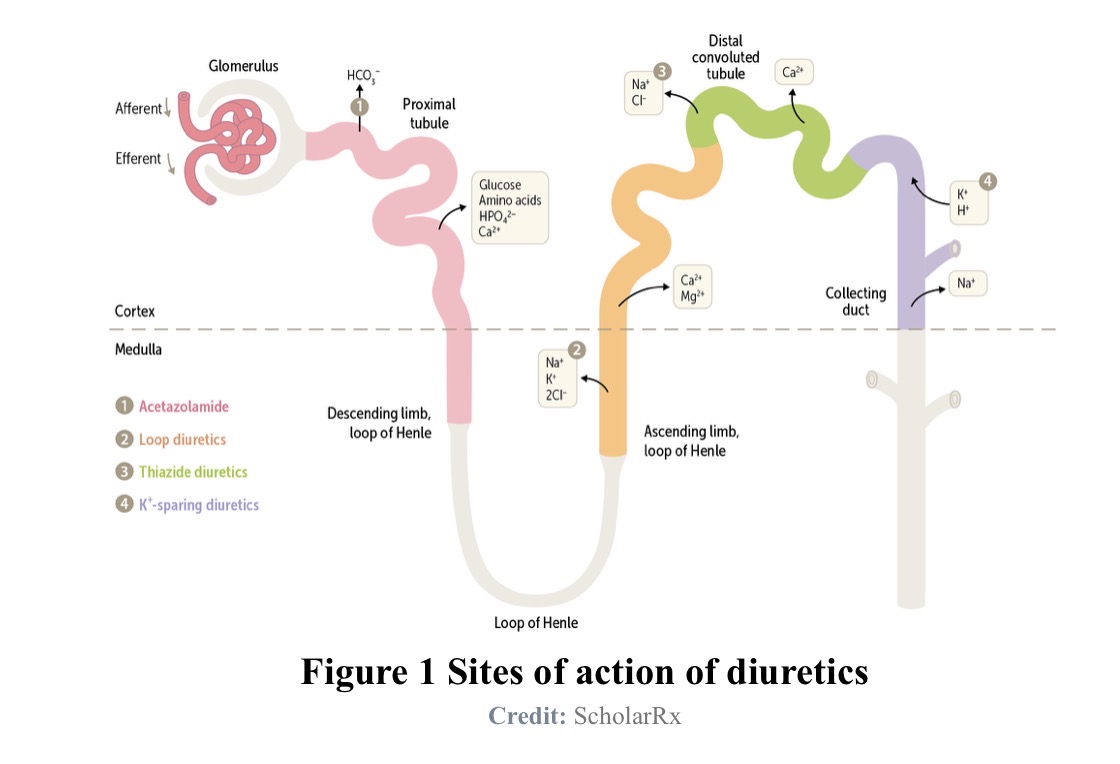
“The formation of carbonic anhydrase is inhibited so bicarbonate can’t be reabsorbed” which drug?
Carbonic anhydrase inhibitors

“NKCC2 inhibited, gradient collapses affecting ROMK so magnesium and calcium are not reabsorbed” which drug
Loop diuretics
Thiazide diuretics (Na+-Cl– symport (NCC)
inhibitors) we need to know
Hydrochlorothiazide Chlorthalidone
What are the key histologic features of SA nodal cells?
Small modified cardiac myocytes with abundant autonomic innervation.
What causes S2?
Aortic + pulmonic valve closure → start of diastole.
Which phase has minimum/most negative dP/dt?
Isovolumetric relaxation → fastest fall in ventricular pressure.
Renin is mainly released when there’s
Low volume
Preferred initial therapy to hypertension
Angiotensin converting
enzyme inhibitors
− Angiotensin II AT
blockers
− Calcium channel blockers
(CCB), long-acting
− Thiazide-type / thiazide-like
diuretics
Captopril And Enalapril are both
Angiotensin converting enzyme inhibitors
The main classes of first-line agents for treating hypertension are
thiazide diuretics, ACE inhibitors or ARBs, and CCBs.
Thiazide diuretics Specifically target which symporter
Na+/Cl– symporter at the distal convoluted tubule (DCT)

Side effects of thiazides
Hypokalemia (lower aldosterone),hyperuricemia which increases risk of gout (thiazide diuretics compete with urate for secretion by the organic anion transporter (OAT) at the proximal convoluted tubule), hyponatremia, and hypercalcemia
Thiazide diuretics contain a sulfa group so they should not be used in patients with
A sulfa allergy
Thiazide diuretics decrease
Lithium clearance
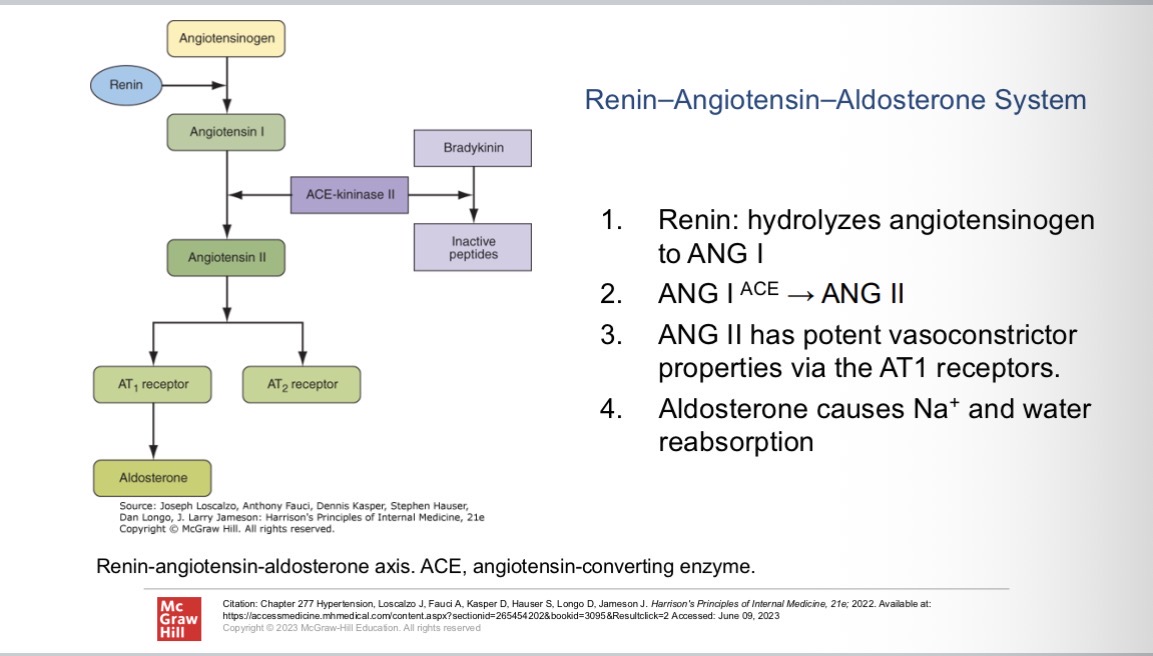
Angiotensin 2 has potent vasoconstriction properties via the __ receptors
AT1
___are a group of diureticdrugs that block the enzyme carbonic anhydrase (CA). CA catalyzes the conversion of carbon dioxide (CO2) and water (H2O) into bicarbonate (HCO3–) and protons (H+) and vice versa.
Carbonic anhydrase inhibitors
Blocking carbonic anhydrase reduces the reabsorption of sodium and
HCO3– so they get excreted out of the body
big adverse affects of carbonic anhydrase inhibitors
Renal stones (causes urine to become alkaline), tinnitus, paresthesias, metabolic acidosis (bicarbonate isn’t reabsorbed and potassium excreted)
Loop diuretics work on the
Loop of henle

More specifically, loop diuretics are ___, which is in the luminal membrane of the thick ascending limb of the loop of Henle which leads to water loss and calcium and magnesium excretion
inhibitors of the Na+/K+/2Cl– cotransporter
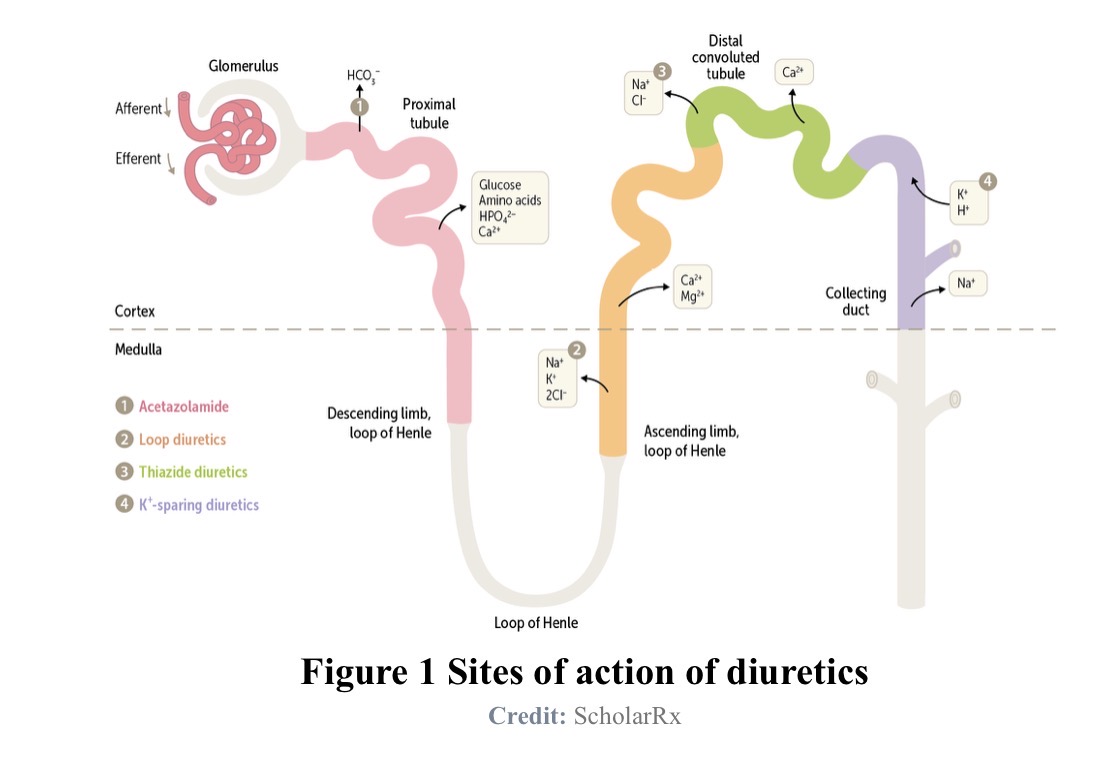
Loop diuretics side effects
Ototoxicity
Which of the following conditions would least benefit from treatment with loop diuretics?
End stage kidney disease (the kidneys must work)
There are two main types of potassium-sparing diuretics. Both types operate in the distal nephron, specifically the principal cells of the
Collecting duct
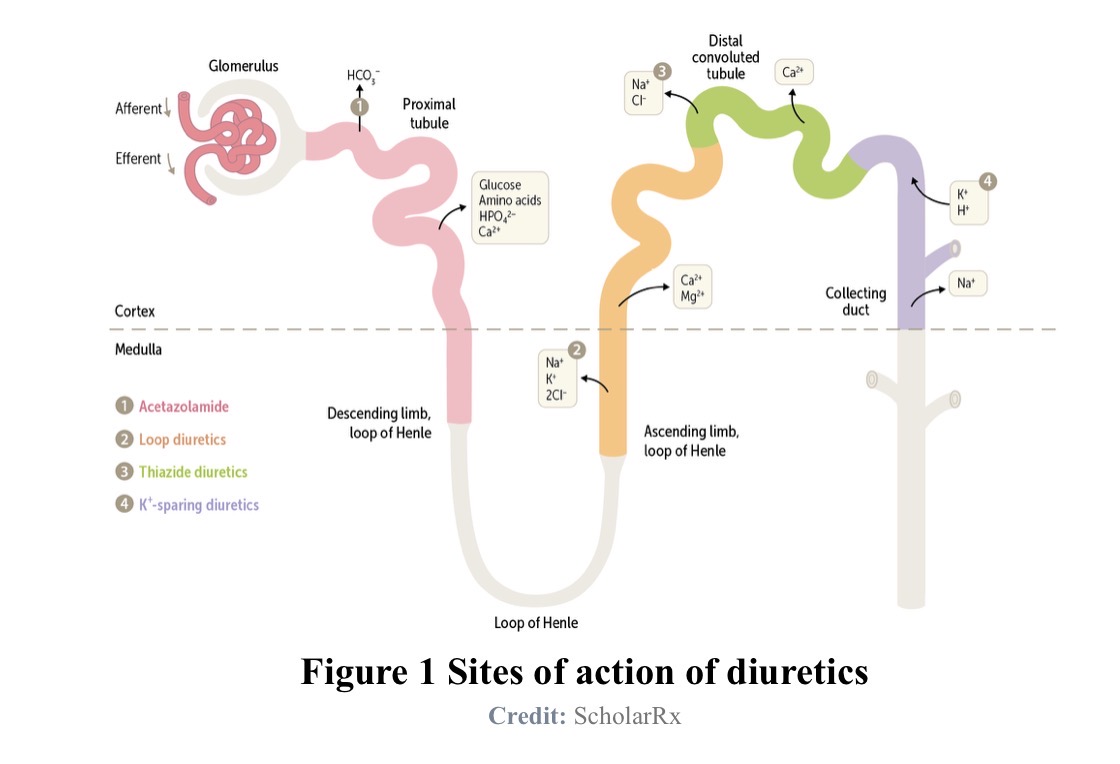
What are the two main categories of potassium-sparing diuretics?
Aldosterone receptor antagonists and epithelial sodium channel (ENaC) blockers are the two main categories of potassium-sparing diuretics
The primary function of ___ is to increase blood volume and blood pressure.
Aldosterone
Aldosterone receptor-blockers inhibit all the effects of aldosterone in the collecting duct,
including sodium reabsorption and potassium secretion
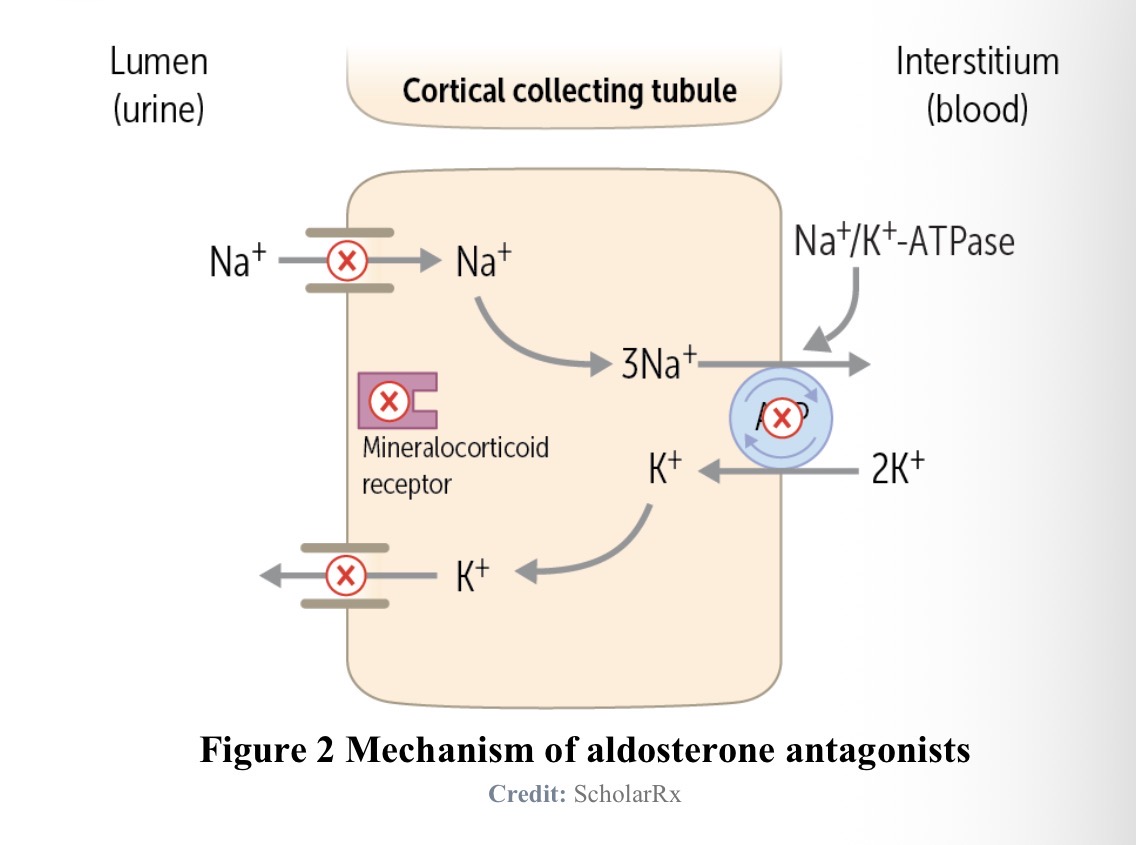
What are the two mechanisms of action by which potassium-sparing diuretics work to block sodium reabsorption?
Potassium-sparing diuretics block intracellular aldosterone receptors and apical ENaCs.
What Are Some Possible Adverse Reactions to Potassium-Sparing Diuretics.
Hyperkalemia, type 4 renal tubular acidosis, anti androgen affects (Aldosterone receptor antagonists)
Thiazide diuretics list
Hydrochlorothiazide and chlorthalidone
All inhibit Na+-Cl– Cotransporter (NCC) Inhibitors
Contraindications for carbonic anhydrase inhibitors
Acidosis
• Severe renal disease
• Cirrhosis or other severe hepatic disease
CA inhibitors may contribute to
hyperammonemia (NH3) by reducing
production of NH4+, a main form of acid
excretion.
• Hypersensitivity to the drug or any component of the formulation
Loop diuretics that we need to know
• Furosemide (sulfonamide)
• Bumetanide (sulfonamide)
• Torsemide (sulfonylurea)
• Ethacrynic acid (phenoxyacetic acid derivative)
Diuresis duration of furosemide
Diuresis duration oral ~6 h, IV ~2 h
Furosemide and torsemide uses
Furosemide-heart failure patients (Diuresis duration oral ~6 h, IV ~2 h)
Torsemide-refractory edema (Diuresis duration oral ~12 h)
Chlorthalidone Takeaway
Very long t½, long duration of
action provides smoother 24-hour blood pressure control.
Higher risk of hypokalemia than with hydrochlorothiazide
Thiazide diuretics are useful for
Primary hypertension
First line treatment for severe
edema/pulmonary edema
In a large vein, which layer is thickest and contains longitudinal smooth muscle?
Tunica adventitia. The tunica media is thinner and mainly circular smooth muscle.
A patient has a normal S1. Which mechanical event occurred immediately before this sound?
Atrioventricular valve closure.
When does S3 occur?
Rapid ventricular filling in early diastole.
What do pericytes do?
Wrap postcapillary venules/capillaries, are contractile, and can become endothelial or smooth muscle cells during vessel growth and wound healing.
Which of the following is the most likely mechanism for how aldosterone increases blood volume?
Insertion of sodium channels
What glomerular filtration barrier layer forms filtration slits?
Visceral epithelial layer → podocytes → foot processes/pedicels form filtration slits.
What features identify a lymphatic capillary?
Blind-ended + very permeable + incomplete basal lamina + takes up protein-rich interstitial fluid.
What are the key histologic features of Purkinje cells?
Large, pale, glycogen-rich cells with fewer myofibrils and few/no T-tubules.
After hemorrhage, GFR and tubular NaCl delivery fall. Which response is most likely?
Increased renin + afferent dilation.
Where do thiazides work, and what transporter do they block?
Distal convoluted tubule → block NCC (Na⁺/Cl⁻ cotransporter). Gitelman syndrome affects the same transporter.
What distinguishes a postcapillary venule from a muscular venule?
Postcapillary venule → no tunica media + pericytes. Muscular venule → 1–2 smooth muscle layers.
How does atrial histology differ from ventricular histology?
Atria have thinner myocardium and relatively thicker endocardium.
What does ANP do to GFR and Na⁺ reabsorption?
ANP → ↑ GFR + ↓ Na⁺ reabsorption → ↑ natriuresis/diuresis.