Chapter 11 of Social Psychology
 Call Kai
 Learn
Learn Practice Test
 Spaced Repetition
 Match
Match Flashcards
 Knowt Play
1/20

There's no tags or description
Looks like no tags are added yet.
Name | Mastery | Learn | Test | Matching | Spaced | Call with Kai |
|---|
No analytics yet
Send a link to your students to track their progress
21 Terms
What is the primary goal of reducing prejudice?
Changing the values and beliefs by which people live.
What psychological functions does prejudice serve for individuals?
Serves specific psychological functions that contribute to psychological security.
What are self-perpetuating schemas in the context of prejudice?
Established prejudiced views and stereotypes that reinforce themselves over time.
What is a significant challenge in reducing prejudice?
Changing laws, customs, and norms that legitimize prejudice.
What landmark case is associated with changing institutional structures to reduce prejudice?
Brown v. Board of Education.
What are the two processes in the dual-process view of prejudice?
Process 1: Automatic recall of stereotypes
Process 2: Reflective regulation of those thoughts.
What factors can impair cognitive control of prejudice when judging others?
Being aroused or upset, pressed for time, cognitively engaged, or distracted.
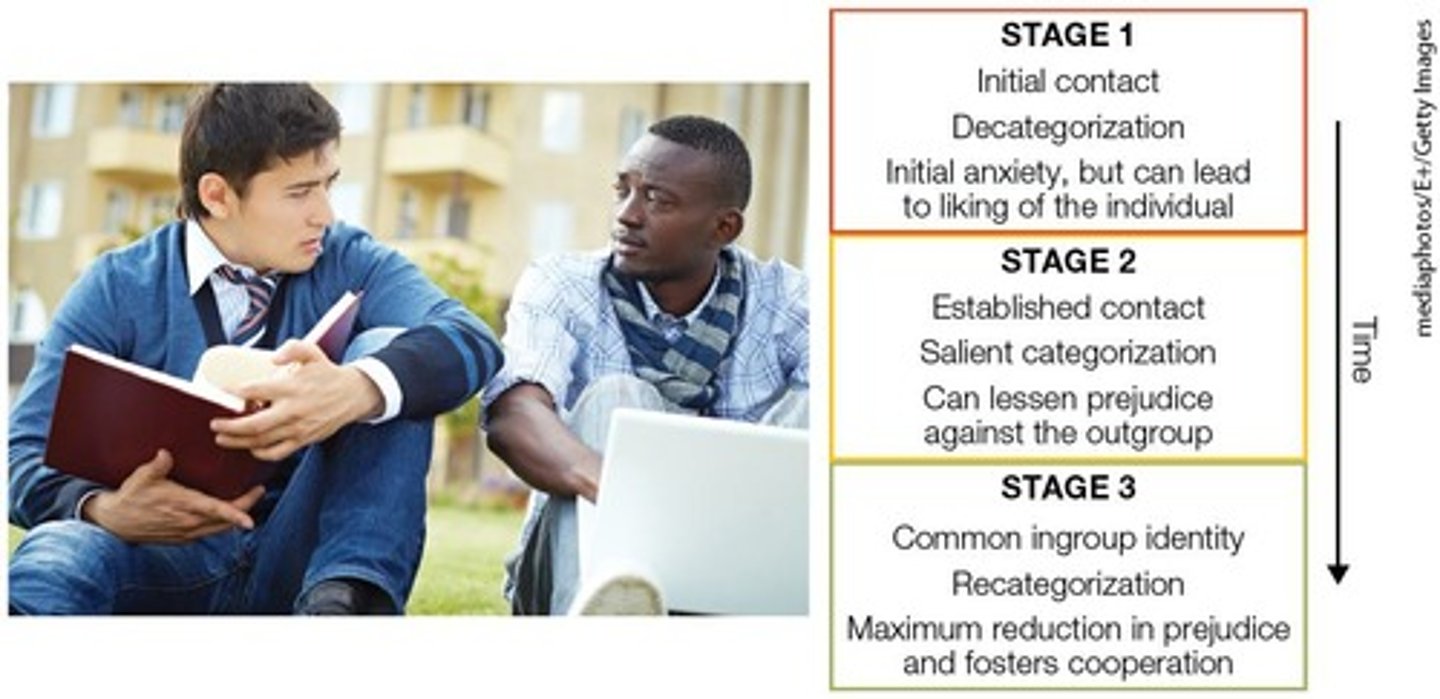
What is the Contact Hypothesis?
A theory stating that positive intergroup contact can reduce prejudice under certain conditions.
What are the 4 ingredients for positive intergroup contact according to Allport?
Equal status, intimate contact, intergroup cooperation to a superordinate goal, and institutional support.
What study is associated with optimal intergroup contact?
Sherif's Robber's Cave study.
How does optimal contact reduce stereotyping?
By decategorizing individuals, reducing anxiety and fostering empathy.
What is the Jigsaw Classroom and why is it effective?
An educational approach that fosters cooperation and equal status among students, enhancing peer liking across groups.
What effect does perspective taking have on prejudice?
It can eliminate implicit bias when individuals imagine the experiences of others.
What is the impact of embracing a multicultural ideology?
It can bolster self-esteem and reduce prejudice compared to a colorblind ideology.
What is the role of empathy in reducing prejudice?
Empathy fosters understanding and can lead to reduced bias in intergroup interactions.
What is the significance of institutional support in reducing prejudice?
It legitimizes intergroup contact and encourages positive interactions.
What does the term 'circadian rhythms' refer to in the context of controlling biases?
Biological processes that can affect cognitive control and judgment at different times of the day.
What is the effect of intimate and varied contact in intergroup settings?
It allows people to get acquainted and fosters cooperation towards a common goal.
How can reducing anxiety contribute to reducing prejudice?
By creating a more comfortable environment for intergroup interactions.
What is the outcome of children participating in the Jigsaw Classroom?
Increased self-esteem, intrinsic motivation for learning, and peer liking across racial and ethnic groups.
What is the importance of generalization of positive change in intergroup contact?
It depends on the stages of intergroup contact that occur over time.