5-B Creative and Performing Arts
 Call Kai
 Learn
Learn Practice Test
 Spaced Repetition
 Match
Match Flashcards
 Knowt Play
1/7

There's no tags or description
Looks like no tags are added yet.
Name | Mastery | Learn | Test | Matching | Spaced | Call with Kai |
|---|
No analytics yet
Send a link to your students to track their progress
8 Terms
Purposes and Functions of the Arts
Artistic activities in the early childhood classroom help children understand all subjects such as reading and math by promoting visual, motor, and social development. Teachers should use art as a mechanism for expression and as a communication tool. Different types of art can reveal children's thoughts, feelings, and interests. Engaging in artistic activities allows children to externalize their feelings.
Music
Listening to and making music help children develop their intellectual, auditory, sensory, speech, and motor skills.
Drawing and Painting
Drawing and painting are beneficial for young students because these activities help develop fine motor skills. Drawing and painting also help to reinforce skills in writing, reading, and creativity. Drawing and painting also help to boost self-esteem because students are able to express themselves.
Theater
Activities in theater encourages children to see themselves in the characters of books. Students learn to identify with characters by living their experiences. Theater helps students comprehend complex stories and helps students empathize with characters. Theater is play, and play is essential in the early childhood classroom.
[Structure and Processes Within the Arts]
Drawing and Painting
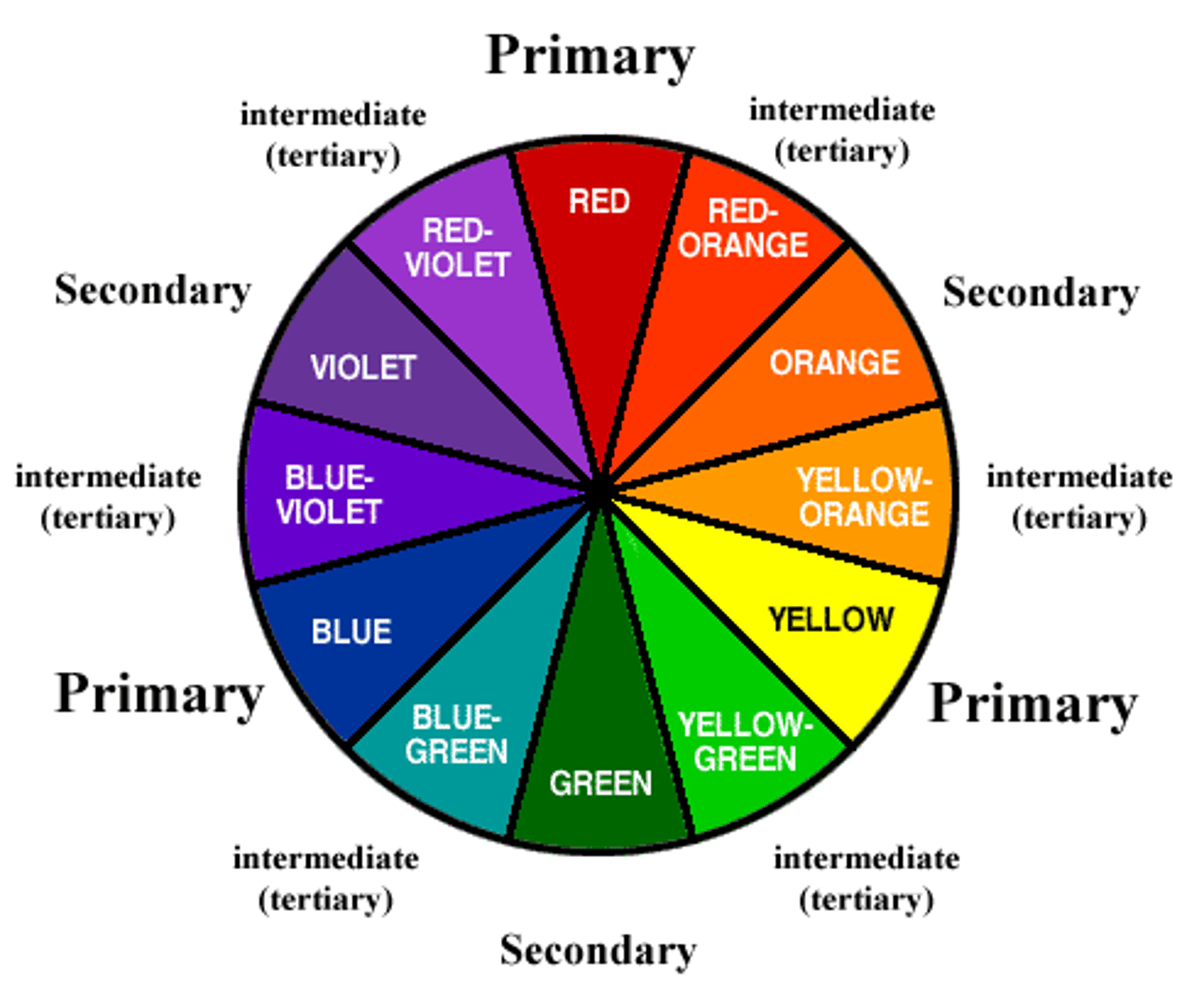
A big part of teaching art is introducing students to color. You will most likely encounter questions about the color wheel on the exam. The color wheel was developed by Sir Isaac Newton, and it is a color spectrum using a circle. If you follow the wheel from the top and then clockwise, the colors are red, orange, yellow, green, blue, indigo, and violet.
The color wheel is made up of three different types of colors - Primary, Secondary, and Tertiary.
• Primary - There are 3 primary colors - red, blue, yellow. They are called primary because no two colors can be mixed to make red, blue, or yellow. All colors on the color wheel are the result of mixing the primary colors.
• Secondary - There are 3 secondary colors - orange, green, purple. They are called secondary because they are a result of mixing the primary colors. For example, orange is a mix of red and yellow. Green is a mix of blue and yellow. Finally, purple is a mix of red and blue.
• Tertiary - There are 6 tertiary colors - red-purple, red-orange, blue-green, yellow-green, blue-purple, and yellow-orange. The proper way to list tertiary colors is primary color-secondary color.
Arts Creation
Line, shape, and texture are also important elements in art. Students use these elements to express themselves in drawing and painting. Line engages the eye and can be short, long, thin, thick, etc. Teachers can also emphasize shape when teaching art. For example, emphasizing geometric shapes incorporates math into art class. Finally, texture can be beneficial in class because it encourages students to use different substances. This aligns to science because rocks have different textures.
Music
Music engages all areas of child development and skills for school readiness, including intellectual, socialemotional, motor, language, and literacy. Exposing children to music during early development helps them learn the sounds and meanings of words. Rhyming music can help students with phonemic awareness. Songs can help students remember complex concepts. Finally, music can accompany stories so students can comprehend meaning.
On the exam, you might encounter questions about the basic concepts of music.
• Harmony - the combination of simultaneously sounded musical notes to produce chords and chord progressions that have a pleasing effect.
For example, when one person sings low and the other high at the same time and the result is pleasing to the ear.
• Melody - a series of notes played in an order that is memorable and recognizable as a separate unit.
For example, the melody of Row, Row Row Your Boat is easily recognizable to most people.
• Rhythm - a strong, regular, repeated pattern of movement or sound. Rhythm can be used to reinforce poetry and is helpful in remembering songs.
• Tempo - the speed at which the music is played. For example, a tempo of 60 beats per minute signifies one beat per second, while a tempo of 120 beats per minute is twice as rapid.
• Pitch - the position of a single sound in the complete range of sound. Pitch is measured by frequency. For example, a high frequency is perceived as a high pitch and a low frequency as a low pitch.
Other Principles of Art Creation
• Contrast - refers to the arrangement of opposite elements and effects. For example, light and dark colors, smooth and rough textures, large and small shapes. Contrast can be used to create variety, visual interest, and drama in an artwork.
• Balance - refers to the use of artistic elements such as line, texture, color, and form in the creation of art in a way that is visually stable. For example, when students draw certain shapes, they will use balance, so the shapes are pleasing to the eye.
• Unity - refers to how different elements of design work together and create a sense of unity. This can be achieved through proximity, simplicity, repetition and continuation.
• Scale - refers to the size of an object in relationship to another object. In art, early childhood students tend to compare the size of objects to the size of their own bodies as a reference.
• Movement - refers to the path the viewer's eye takes through the work of art, tending to move towards focal areas. Movement can be directed along lines, edges, shape, and color.
• Pattern - refers to a design in which lines, shapes, forms or colors are repeated. The part that is repeated is called a motif. Patterns can be regular or irregular. This is helpful when integrating art and math skills in early childhood classrooms.