Psych 261 Final
 Call Kai
 Learn
Learn Practice Test
 Spaced Repetition
 Match
Match Flashcards
 Knowt Play
1/53

There's no tags or description
Looks like no tags are added yet.
Name | Mastery | Learn | Test | Matching | Spaced | Call with Kai | Chat |
|---|
No analytics yet
Send a link to your students to track their progress
54 Terms
Where do axons from retinal ganglion cells generally project?
The CNS
Main target of retinal ganglion cells
LGN of the thalamus (for the geniculostriate pathway)
Where does the LGN of the thalamus send its info?
Primary visual cortex (striate cortex/V1)
What occurs in the PVC
Basic visual processing
Where does visual info go after reaching the PVC
The secondary visual cortex (V2)
How does the secondary visual cortex connect to the PVC
Bidirectional connections (travels ventrally & dorsally)
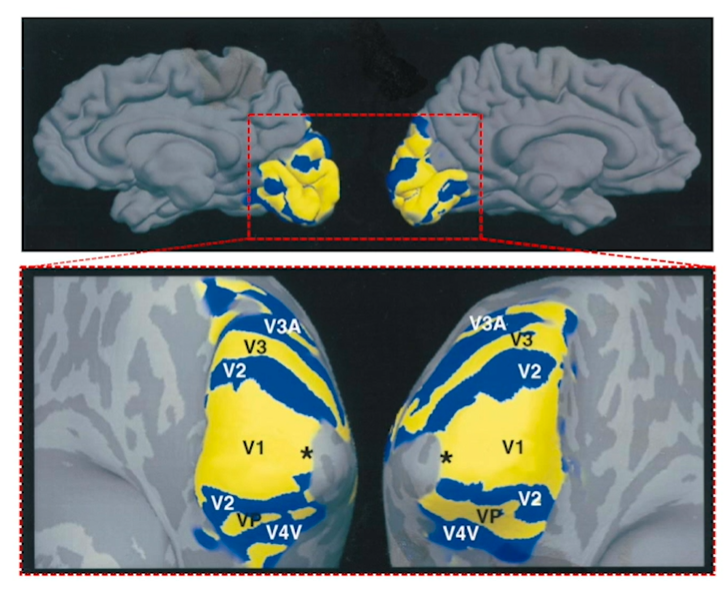
Purpose of V2
Continues basic visual processing
2 general pathways from which information is passed from early processing areas to other cortical areas
Dorsal stream & ventral stream
What is included in the dorsal stream
Superior & middle temporal cortex
What is included in the ventral stream
Inferior temporal cortex
What is the dorsal stream known as
The “where” pathway - Processing object movement & location + visually guided action
What is the ventral stream also known as
The “what pathway” - Processing object form & colour - heavily involved in object recognition
V4 role
Colour perception
Which pathway is the V4 involved in
Ventral (what) - colour/object form + object reco
Dmg to V4 leads to
Cerebral achromatospia
Cerebral achromatospia effect
Impaired colour perception (w/o any dmg to colour processing machinery in the retina)
When dmg extends to regions surrounding V4, it can result a complete loss of colour vision
Cells responsive to specific categories of stimuli include (w/i ventral)
Primarily further down the ventral visual processing stream (esp. the inf temp cortex)
Fusiform face area (particularly responsive to faces)
Parahippocampal place area (primarily responsive to places)
Certain regions also respond to inanimate vs animate
How do receptive fields change throughout the ventral visual stream
Inc in size & complexity as they get closer to the inferior temporal cortex
Difference b/w PVC & Inferior Temporal Cortex - what they respond to
Cells in the inferior temporal cortex respond to objects regardless of their retinal size or their orientation; thus unlike cells in the primary visual cortex, those in the inferior temporal cortex respond to the identify of objects, and not just to basic visual features.
Damages to parts of the ventral stream can lead to
Visual Agnosia
Visual agnosia
A deficit of visual object recognition
can recognize objects by touch or by sight; they’re just unable to recognize objects by vision alone.
Subtype of visual agnosia (1)
Apperceptive agnosia (or visual form agnosia)
Have problems even putting together the basic features of objects, and so they have trouble copying objects.
Subtype of visual agnosia (2)
Associative agnosia, can put the features of objects together, but are unable to link the resulting visual forms with meaning.
These patients can copy objects just fine, but even as they copy them, they cannot identify them.
Prosopagnosia
Problem w/ facial recognition.
Can make out the various features of a face, but they cannot put the features tgth
Damage to the dorsal stream can lead to a condition known as
Optic ataxia
Optic ataxia
a failure to point or reach accurately towards objects presented visually (primarily in the periphery)
can visually identify objects just fine
also don’t have an underlying motor problem; their problem is specific to visually guided reaching movements.
What areas of dorsal pathway are involved in processing visual motion perception
Middle-temporal cortex (MT or V5)
Medial superior temporal cortex (MST)
Both MT/V5 & MST have
Retinotopic maps (MST is less defined)
Size of receptive fields MT vs MST
MT - small receptive fields
MST - large receptive fields
What do the MT receptive fields code for?
MT: Movement direction, speeds for object movement, changes in object speeds, object movements relative to THEIR background (direction, speeds/changes, movements relative)
What do MST receptive fields code for?
Dorsal part - expansion/contraction and rotation of objects
Lateral part - object movement relative to THE background
Damage to motion processing areas can lead to condition known as
Akinetopsia
akinetopsia
characterized by a specific inability to visually perceive object motion.