Hip Joint Mobs / InterventionsCFJ Txn (Indirect) MLPP
 Call Kai
 Learn
Learn Practice Test
 Spaced Repetition
 Match
Match Flashcards
 Knowt Play
1/9

There's no tags or description
Looks like no tags are added yet.
Name | Mastery | Learn | Test | Matching | Spaced | Call with Kai | Chat |
|---|
No analytics yet
Send a link to your students to track their progress
10 Terms
CFJ Txn (Indirect) MLPP
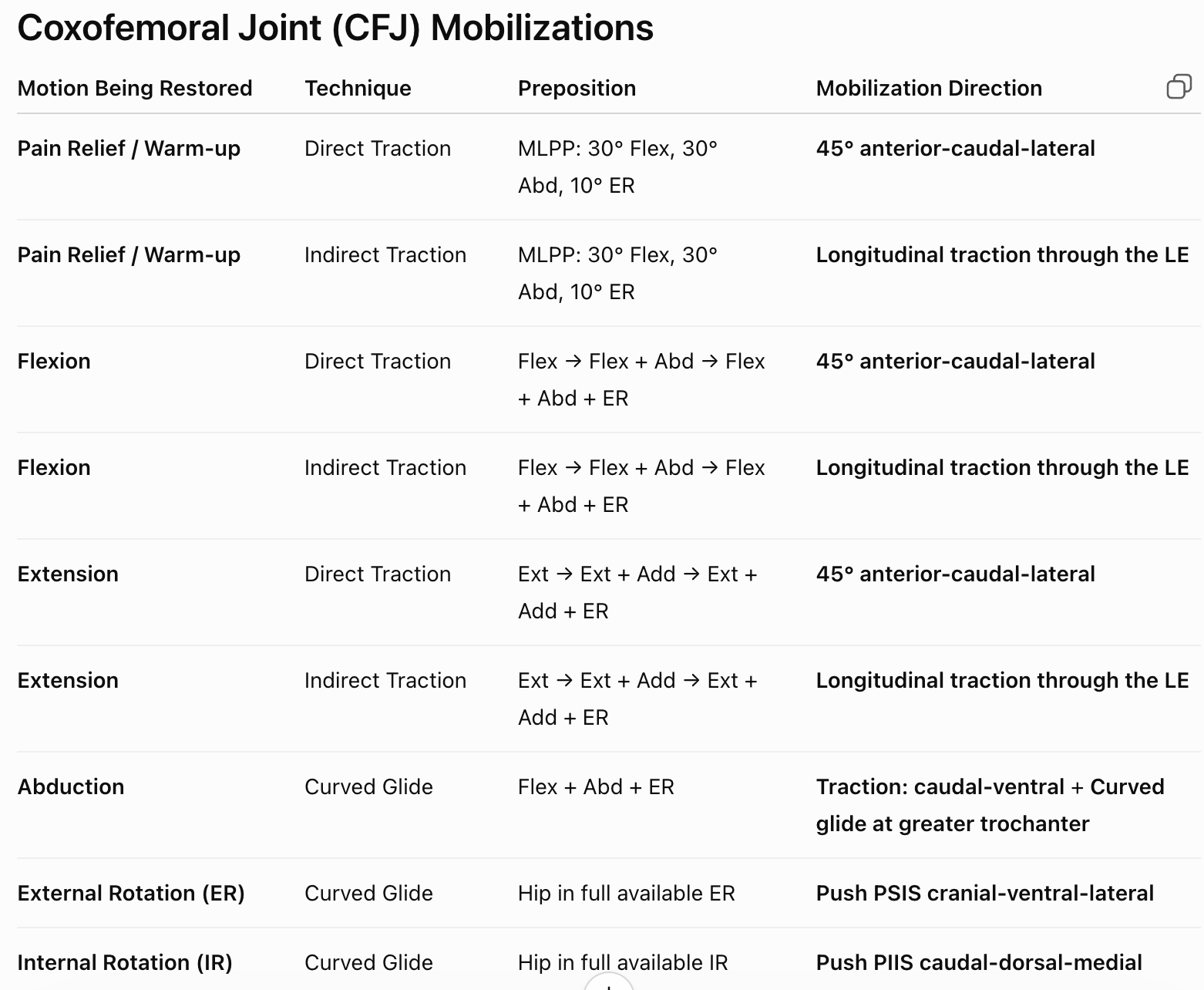
Purpose: Provides pain relief and warms up the hip joint in preparation for other mobilizations.
How: Patient supine with the hip in the MLPP (30° flexion, 30° abduction, 10° external rotation). Apply long-axis traction by pulling at the malleoli.
Indication/Positive: Decreased pain and improved hip mobility with traction, suggesting the hip joint responds well to distraction.
CFJ Traction (Indirect) – Extension (<0°)
Purpose: Restore hip extension.
How: Patient supine. Preposition the hip into extension (may progress to extension + adduction + ER) and apply long-axis traction.
Positive/Indication: Increased hip extension and decreased pain.
CFJ Traction (Indirect) – Extension (>0°)
Purpose: Restore hip extension beyond neutral.
How: Patient prone with the hip positioned past 0° extension, then apply long-axis traction. Finish with an isometric hip extension.
Positive/Indication: Increased hip extension ROM and decreased pain.
CFJ Traction (Direct) – Extension
Purpose: Restore hip extension when indirect traction is not tolerated (e.g., knee pain).
How: Patient prone with the hip supported in extension. Apply a 45° anterior-caudal-lateral traction through the proximal femur.
Positive/Indication: Increased hip extension and decreased pain.
CFJ Traction (Direct) – Resting Position
Purpose: Pain relief and to warm up the hip joint.
How: Patient supine with the hip in 30° flexion, 30° abduction, 10° ER. Apply 45° anterior-caudal-lateral traction through the proximal femur.
Positive/Indication: Decreased pain and improved joint mobility.
CFJ Traction (Direct) – Flexion
Purpose: Restore hip flexion.
How: Position the hip in flexion → flexion + abduction → flexion + abduction + ER, then apply 45° anterior-caudal-lateral traction. Finish with an isometric hip flexion.
Positive/Indication: Increased hip flexion ROM and decreased pain.
CFJ Curved Glide – Restoration of Abduction
Purpose: Restore hip abduction.
How: Patient side-lying. Apply caudal-ventral traction while moving the hip into flexion-abduction-ER, simultaneously providing a curved glide at the greater trochanter.
Positive/Indication: Increased hip abduction ROM and decreased pain
CFJ Curved Glide – Restoration of External Rotation
Purpose: Restore hip external rotation.
How: Patient prone with the knee flexed to 90°. Bring the hip into available ER, then apply a cranial-ventral-lateral curved glide at the PSIS.
Positive/Indication: Increased hip external rotation ROM and decreased pain.
CFJ Curved Glide – Restoration of Internal Rotation
Purpose: Restore hip internal rotation.
How: Patient prone with the knee flexed to 90°. Bring the hip into available IR, then apply a caudal-dorsal-medial curved glide at the PIIS.
Positive/Indication: Increased hip internal rotation ROM and decreased pain