The U.S. Constitution
 Call Kai
 Learn
Learn Practice Test
 Spaced Repetition
 Match
Match Flashcards
 Knowt Play
1/28

There's no tags or description
Looks like no tags are added yet.
Name | Mastery | Learn | Test | Matching | Spaced | Call with Kai | Chat |
|---|
No analytics yet
Send a link to your students to track their progress
29 Terms
Articles of Confederation
America's first national constitution that was in effect from 1781 - 1787. It created a very weak central (or national) government that was incapable of effectively dealing with the problems facing the country.
Constitutional Convention
A meeting that took place between May and September of 1787 in Philadelphia with the original goal of fixing the Articles of Confederation.
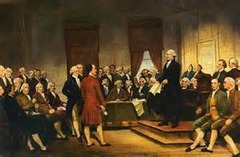
Delegate
An individual sent to represent a state at the Constitutional Convention. Twelve of the 13 states sent representatives to the Convention. In total, 55 were sent to Constitutional Convention in 1787.

Virginia Plan
One of the two main plans proposed at the Constitutional Convention. The plan was written by James Madison and proposed a two-house (bicameral) legislature in which representation was based on population. It was favored by large states.
New Jersey Plan
One of the two main plans proposed at the Constitutional Convention. The plan proposed a single house (unicameral) legislature in which representation was equal. It was favored by small states.
Great Compromise
An agreement struck between the large and small states over the issue of representation. Combining aspects of the Virginia and New Jersey plans, it proposed a two-house legislature. In the lower house, representation would be based on population; in the upper house, representation would be equal.

Three Fifths Compromise
An agreement struck between the free and slave states over whether or not slaves should count as part of the population for the purposes of representation and taxation. According to the compromise, every 5 slaves would count as equal to 3 free persons.

Separation of Powers
The principle that the power of government (the ability to write, interpret, and enforce laws) should be divided between different branches of government to ensure that no one person or group becomes to powerful.

Checks and Balances
The principle that the branch of government (Legislative, Executive, and Judicial) should have some power each other.

U.S. Constitution
The document created during the Constitutional Convention in 1787. It contains the framework, or fundamental laws, governing the United States of America. It is the supreme law of the land in that no other law may contradict it.

Federalism
A key principle of the Constitution that divides power between the national (federal) government and the state governments. As an American citizen, you must obey federal law and the laws of the state in which you live.

Limited Government
A principle of the U.S. Constitution that says the government can only do what the Constitution gives it the power to do.
Popular Sovereignty
The principle that the people are the primary source of power in the United States. This is best seen in the Preamble of the Constitution, which states: "We the people of the United States...do ordain and establish this Constitution for the United States of America."

Ratification
The official approval process of the Constitution. Before going into effect, the Constitution had to be ratified by 9 of the 13 states.

Federalists
The group during the debate over ratification that support the U.S. Constitution. Typically, they were supporters of a strong central government.

Anti-Federalists
The group during the debate over ratification that did not support the U.S. Constitution. They thought the national government it created was too powerful.

Preamble
The opening paragraph of the Constitution. It outlines the purpose/goals of the U.S. Constitution.

Articles
The main body of the Constitution. There are seven in total and they outline the framework (basic rules and structure) for the national government.
Amendments
Changes to the U.S. Constitution. There have been 27 made to the Constitution since its creation in 1787.
Bill of Rights
The first ten amendments to the Constitution; guarantees certain individual rights, like freedom of speech and religion.

Legislative Branch
The branch of government responsible for writing laws. Known as Congress, it is divided into two houses: the House of Representatives and the Senate.

Judicial Branch
The branch of government responsible for interpreting laws. It is made up the federal court system, with the Supreme Court as the highest court in the nation. It has the power to declare laws unconstitutional.

Executive Branch
The branch of government responsible for enforcing laws. It is headed by the President of the United States and made up of several departments (the Department of Defense, Department of Justice) and agencies (the FBI, the CIA) and the U.S. Military.

House of Representatives
Considered the lower house of Congress (the legislative branch of the national government). Together with the Senate, it introduces national laws. With 435 members, representation is based on population (the more people a state has the more representatives it gets)

Senate
Considered the upper house of Congress (the legislative branch of the national government). Together with the House of Representatives, it introduces national laws. Each state has two senators; therefor, states are equal in the Senate regardless of population.

George Washington
The commander-in-chief of the Continental Army during the American Revolution; the president of the Constitutional Convention; and the first president of the United States of America under the U.S. Constitution. Often referred to as the "Father of His Country."

Thomas Jefferson
The primary author of the Declaration of Independence and the third president of the United States.

James Madison
Often considered the "Father of the Constitution," he was the delegate most responsible for the language and ideas in the U.S. Constitution. He became the fourth president of the United States.

Alexander Hamilton
A leading delegate at the Constitutional Convention and leading member of the Federalists during the debate over ratification.
