S1 - Dental Nomenclature
 Call Kai
 Learn
Learn Practice Test
 Spaced Repetition
 Match
Match Flashcards
 Knowt Play
1/156

There's no tags or description
Looks like no tags are added yet.
Name | Mastery | Learn | Test | Matching | Spaced | Call with Kai | Chat |
|---|
No analytics yet
Send a link to your students to track their progress
157 Terms
What are the functions of the teeth?
- Protects the oral cavity.
- Acquiring and chewing food.
-Aiding the digestive system in breaking down food.
- Communication
Crown
Covered with enamel.
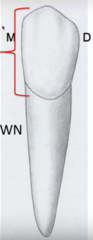
Root
Portion that is covered with dentin.
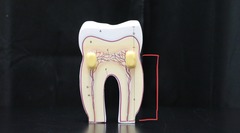
Where are the crown and root joined?
CEJ (Cementoenamel Junction)
What is the line at the CEJ known as?
Cervical Line
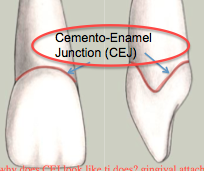
Anatomic Crown
The whole crown of the tooth is covered by enamel, regardless of whether it is erupted.

Clinical Crown
Part seen above the gingiva

Eruption
The movement of a tooth through the surrounding tissues.

Each root has one ___ or terminal end.
Apex
The root is supported in the ___ ___, by the biny porcess of jaw
Dental Arch
Alveolar Process
The portion of the jaw that supports teeth.
Alveolus
The bony socket in which the tooth fits and also is whre the root is anchored.
Maxillary Teeth
Teeth in the upper part of the jaw, anchored in the maxillary bone.
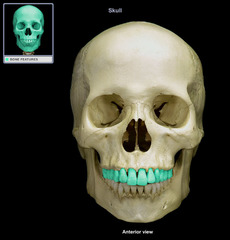
Mandibular Teeth
Teeth in the lower part of the jaw, anchored in the mandible.

Higher root to crown ratio =
More resistance to displacement
What are the four tooth tissues?
Enamel, dentin, cementum, and dental pulp.
Enamel
Forms the outer surface of the crown.
Where is enamel the thickest?
Over the tip of the crown.
Enamel becomes thinner until it ends at the ___ ___.
Cervical line.
Enamels color varies with its ___ and ___.
Thickness and mineralization.
The thicker the enamal the ___ it appears.
Whiter
The thinner the enamel, the ...
The color varies more.
What is the most densely mineralized and hardest tissue in the human body?
Enamel
Chemical composition of enamel is ___ inorganic and ___ organic.
96% inorganic, 4% organic
What gives enamel the ability to resist the wear the crown of a tooth is subjected to?
Dense mineralization
What layer is the main portion of the tooth?
Dentin
What is hard, dense, calcified tissue called?
Dentin
The dentin is ___ in color and ___ in nature.
Yellow, elastic.
T or F - Dentin can regenerate itself.
True
Which layer of dentin forms throughout the pulp chamber after the tooth erupts, and is the normal process of aging?
Secondary dentin.
Which layer of dentin is formed in response to trauma or caries?
Reparative dentin.
What is the bone-like substance that covers the root?
Cementum
What is the main function of the cementum?
To provide a medium for the attachment of the tooth to the alveolar bone.
Is cementum less or more dense than enamel or dentin?
Less dense
What gives the tooth a mechanism of anchorage?
Cementum
Cementum is __ at the cervical line but ___ at the apex.
Thin, thicker.
What are the two types of cementum?
Cellular and aceulluar
Cellular cementum is confined to the ___ third of the root.
Apical (lower)

T or F - Cellular cementum can reproduce itself.
True
Acellular cementum covers the ___ portion of the tooth, and is part of the attatchment system of the tooth.
Cervical (upper)

What is the pulp composed of?
Blood vessels, lymph vessels, connective tissue, nerve tissue, and odontoblasts.
What do the blood vessels in the pulp do?
Bring nourishment to activate and support the formation of the second dentin.
What do the lymph vessels in the pulp do?
Filters the fluids within the tooth.
What does the nerve tissue do in the pulp?
Responds to pain.
Name the types of teeth.
Incisors, canines, premolars, and molars.
What is the function of the incisors?
To cut.

The biting edge of the incisal is called what?
The incisal edge
Why is the lingual surface of an incisor shaped like a shovel?
To aid in guiding the food into the mouth.
What is the function of a canine?
To hold or grasp.

What do the canine teeth protect?
The jaw joint during side jaw movement.
Which teeth are the longest in the human dentition?
Canines
Which teeth are the most stable in the human dentition?
Canines
How many maxillary premolars are in a dentition?
Four
How many mandibular premolars are in a dentition?
Four
How many cusps do premolars have?
2-3 cusps
Which cusps hold the food in a premolar?
Buccal cusps
Which cusps grind the food in a premolar
Lingual cusps
Which tooth is much larger than a premolar?
Molar
How many cusps does a molar have?
4-5 cusps
Molars vary in size, shape, and number of roots based on what?
Location in the mouth.
What is the function of molars?
To chew or grind.

Which teeth are labeled anterior?
Incisors and canines
Anterior teeth have how many surfaces and a ridge?
Four surfaces
Which teeth make up the posterior teeth?
Premolars and molars.
How many surfaces do the posterior teeth have?
Five surfaces
Lingual
Faces the tongue
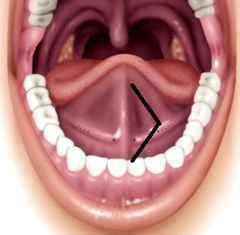
Facial
Faces the lip.
Buccal
Faces the cheek

Proximal
Faces the neighboring tooth in the same arch.
Mesial
Towards the midline
Distal
Away from the midline.
Occlusal
Biting or chewing surface
Lingual and facial surfaces divide into...
Mesial third, middle third, and distal third

Proximal surfaces are divided into..
Facial third, middle third, lingual third.
What are the line angles for anterior teeth?
Labio-incisal
Mesio-lingual
Mesio-labial
Linguo-incisal
Disto-lingual
Disto-labial
What are the line angles for posterior teeth?
Mesio-occlusal
Mesio-lingual
Mesio-buccal
Bucco-occlusal
Linguo-occlusal
Disto-lingual
Disto-buccal
Disto-occlusal
What are the point angles for anterior teeth?
Mesio-labio-incisal
Mesio-linguo-incisal
Disto-labio-incisal
Disto-bucco-occlusal
What are the point angles for posterior teeth?
Mesio-linguo-occlusal
Mesio-bucco-occlusal
Disto-linguo-occlusal
Disto-bucco-occlusal
Crowns form from what?
Fusion of lobes.
Development grooves remain after what?
Fusion
Tubercle
Small elevation of enamel on the crown

Fossa
Depression or concavity
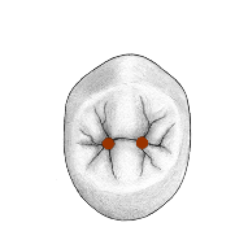
Pit
Pinpoint hole in the fossa or elsewhere on a tooth.
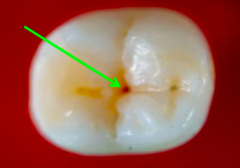
Cusp
Mound on the crown that makes up a major division of the occlusal or incisal surface.

Ridge
Elevated portion of a tooth that runs in a line.
What are the labial development grooves on the anterior teeth?
Two development grooves on their labial surfaces that separate the three lobes that form the labial surface.
Lingual Groove
Separates labial development grooves from the fourth lobe on the lingual surface of the crown.

What are the most obvious landmarks on the posterior teeth?
Cusps
Triangular Ridges
Main ridges on each cusp that run from the tip of the cusp to the central part of the occlusal surface.
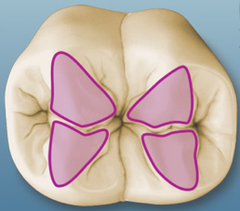
Transverse Ridges
Union of two triangular ridges that cross the occlusal surfaces.
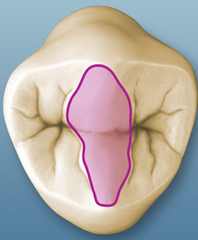
Proximal Contact Areas
-Where proximal surfaces of teeth touch one another, and share the same interproximal bone.
- Located on mesial and distal surfaces of each tooth at the widest portion and the greatest curvature.

What does a proximal contact do?
Prevents food from packing between teeth, offers support and anchorage to teeth, and offers resistance to displacement.
Proximal Contact Area - Bone supports the __ root of one tooth and the ___ root of a second tooth.
Distal, mesial
Contact Area
Flattened portion of the tooth where it touches the tooth next to it in the same dental arch.

Contact Point
Where the occlusal cusp of one tooth touches the occlusal portion of another tooth in the opposing arch.
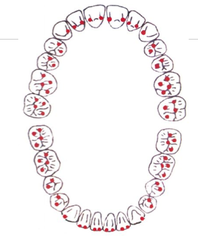
Interproximal Spaces
Triangular-shaped spaces between teeth formed by bone on one side and the proximal surfaces and their contact area on the other side.
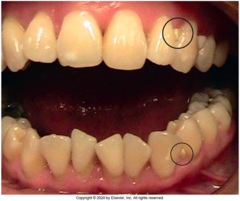
Cervical Embrasure
Occurs when there is gingival recession between teeth, and the interproximal papilla and bone no longer fill the entire interproximal space.
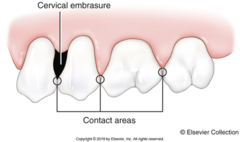
The more papilla is missing, the ___ the cervical embrasure.
Larger

Embrasures (Spillways)
The spaces between teeth that are occlusal to the contact areas.
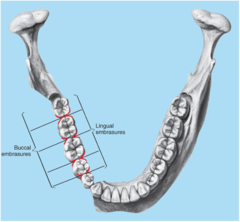
Tor F - Embrasures are named by their location in relation to the contact area.
True