Degree of Unsaturation
 Call Kai
 Learn
Learn Practice Test
 Spaced Repetition
 Match
Match Flashcards
 Knowt Play
1/4

There's no tags or description
Looks like no tags are added yet.
Name | Mastery | Learn | Test | Matching | Spaced | Call with Kai |
|---|
No analytics yet
Send a link to your students to track their progress
5 Terms
Degree of Unsaturation
Once calculated, tells you how many rings and/or multiple bonds must be in the structure. One degree of unsaturation counts as either 1 pi bond or 1 ring.
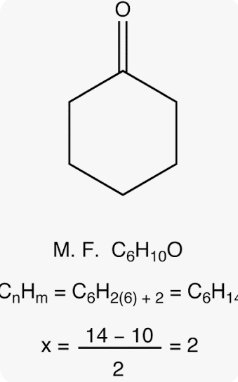
Degree of Unsaturation Formula
CnH2n+2 (n is your number of carbons from your original formula, the chemical formula for this you will then compare with your ORIGINAL chemical formula, i.e, comparing Hydrogens). You will subtract the big number, n, by the smaller one and divide it by 2. This will give you your degree of unsaturation, so the number of pi bonds or rings you can have. (see image)
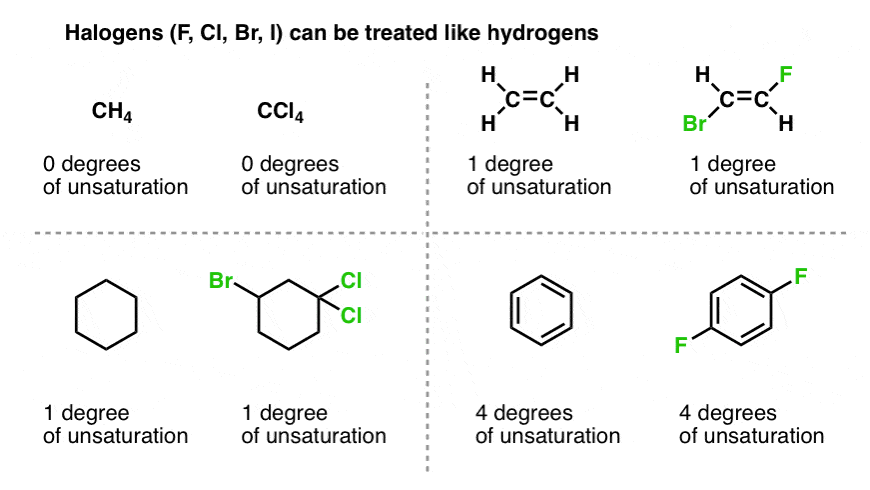
If you have a Halogen
(Group 17) treat it like a Hydrogen, for every Halogen you have, add one Hydrogen to the comparison of the original Molecular formula. (see image)
EX: C5H6Cl2 , but use C5H8 for comparison. Your saturated formula is C5H12 , 12 - 8/2 = 2 degrees of unsaturation.
If you have Oxygen
ignore it when calculating degree of unsaturation, treat as if it’s just Carbon and Hydrogen
If you have a Nitrogen present
Subtract a Hydrogen from original formula for comparison purposes. EX: C3H9N, so use C3H8 to compare with your saturated formula, which will be C3H8 D.O.U = 0