7 - Measuring rate of a reaction
 Call Kai
 Learn
Learn Practice Test
 Spaced Repetition
 Match
Match Flashcards
 Knowt Play
1/8

There's no tags or description
Looks like no tags are added yet.
Name | Mastery | Learn | Test | Matching | Spaced | Call with Kai | Chat |
|---|
No analytics yet
Send a link to your students to track their progress
9 Terms
What is meant by the ‘rate of reaction’ ?
The changes in the concentration of reactants or products over time
How can the rate of reaction be measured?
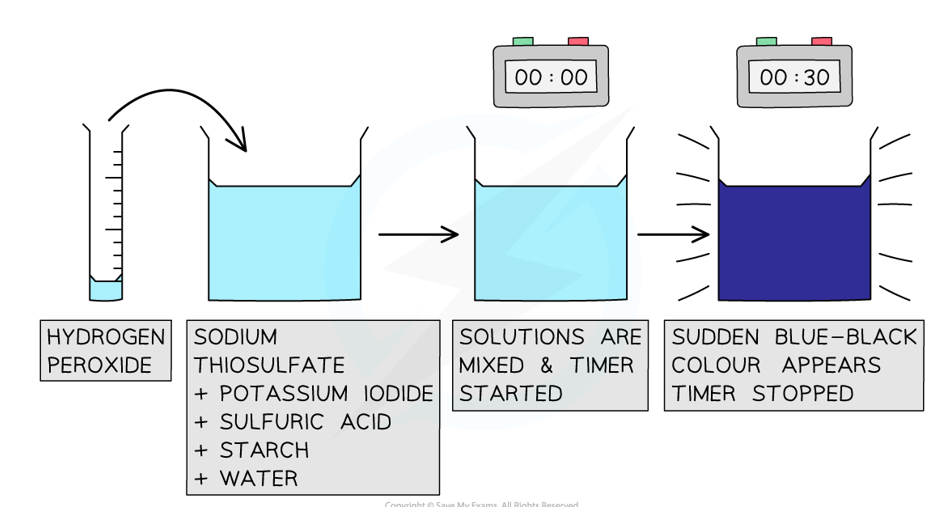
Initial rates method: iodine clock reaction
Continuous monitoring method: measuring the volume of gas produced in a reaction over time
What is an initial rates method?
Involves measuring the initial rate of reaction for multiple different concentrations to observe how rate of reaction varies
In the iodine clock reaction, I- reacts with hydrogen peroxide to form I2. This reacts with HSO3- & forms further iodide ions, until the supply of HSO3- is exhausted. At this stage, I2 forms a blue complex with starch.
You are given solution A (containing iodide ions), solution B (containing hydrogen peroxide) & a starch solution. Describe how you would design a series of experiments to determine the order of reaction with respect to the iodide ions (6 marks)
Perform a series of experiments where only the concentration of solution A varies, meaning the volumes & the concentration of B & the starch remain the same
Control the temperature using a water bath
Add 5cm3 of solution B & 1cm3 of starch to the beaker (add solution A last)
Simultaneously add 5cm3 of solution A & start the timer
Record the time taken for a blue-black colour to appear
Dilute solution A, so the concentration is half of the original
Repeat the experiment & record the time taken for a blue-black colour to appear
Use 1/time taken for a blue-black colour to appear as the surrogate rate
How are the results interpreted from the initial rates (iodine clock reaction) experiment?
If the rate doubles/halves when [A] doubles/halves, the reaction is 1st order with respect to A
If the rate doesn’t change when [A] doubles/halves, the reaction is 0 order with respect to A
If the rate quadruples when [A] doubles/halves, the reaction is 2nd order with respect to A
What are some issues with the iodine clock reaction?
Some low I- concentrations may take too long to react
Delayed stopwatch reactions
Concentrations may not be exact due to measuring apparatus
What is a continuous monitoring method?
Involves measuring the change in concentration of a reactant or product over time (or measuring volume of gas released) as the reaction progresses
A student investigates the following reaction: 2H2O2 (l) → 2H2O (l) + O2 (g)
The reaction is catalysed by manganese (IV) dioxide.
She wishes to determine the partial order with respect to hydrogen peroxide.
Outline the experimental steps & data analysis she should do to achieve this (6 marks)
Use a burette to measure 50cm3 of 0.1moldm-3 of hydrogen peroxide into a conical flask (allows us to close the opening & collect the gas)
Use a high precision balance to measure 1g of manganese (IV) dioxide → significant excess, so concentration is effectively unchanging
Prepare the bung with a delivery tube attached to a gas syringe
Add the catalyst to the flask, insert the bung & start the stopwatch
Record the volume of gas released every 10 seconds until the syringe is full
n (O2) produced = n (H2O2) reacting ÷ 2
Calculate [H2O2] remaining for each point in time
Plot [H2O2] on the y-axis against time on the x-axis
Draw tangents at each time point to establish the rate for each concentration
How are the results interpreted from the continuous monitoring method experiment?
Plot a graph of [H2O2] on the x-axis & the rate on the y-axis
![<p>Plot a graph of [H<sub>2</sub>O<sub>2</sub>] on the x-axis & the rate on the y-axis </p>](https://assets.knowt.com/user-attachments/41b7e68a-b099-4315-8bdb-2264a970677e.png)