Raccoon Roundworm
 Call Kai
 Learn
Learn Practice Test
 Spaced Repetition
 Match
Match Flashcards
 Knowt Play
1/12

There's no tags or description
Looks like no tags are added yet.
Name | Mastery | Learn | Test | Matching | Spaced | Call with Kai | Chat |
|---|
No analytics yet
Send a link to your students to track their progress
13 Terms
Introduction
What is it? -> Intestinal parasite found in the feces of raccoons
Scientific name -> Baylisascaris procyonic
Procyonis comes from procyon lotor, which is the scientific name for raccoon
Why is it important? -> Important pathogen affecting wildlife and domestic animals, causing severe neurologic damage
Now considered common in Texas and can be found in central, eastern, and coastal areas (including Brazos County!)
The Parasite
B. procyonis is a large, tan-colored parasitic nematode
Adult females are 20 to 22 cm long, and males are 9 to 11 cm long
Eggs -> thick-shelled and golden brown
Microscopic
Thick shell is important for protecting the egg from things like temperature, drying out, or other environmental conditions
Typically found in the small intestines or tissues of animals
Migration is what makes the parasite so dangerous because it leaves behind physical damage in tissues and organs (lungs, eyes, brain)
Definitive host -> raccoons
Parasite is able to complete its entire lifecycle within the raccoon
History
1931
First isolated from raccoons in the New York Zoological Park (as Ascaris columnaris)
Later recognized as a distinct species (Ascaris procyonis) in raccoons in Europe
1968
The genus Baylisascaris was defined and included eight recognized and two provisional species previously classified as members of the Ascaris or Toxascaris genus
1984
First confirmed cases in humans
2 young boys experienced neurologic symptoms after being exposed to the parasite
First time scientists realized that is was more than just a disease that affects wildlife, has major global health implications
Hosts and Reservoirs
Primary hosts -> raccoons
Parasite can complete its life cycle and breed within a raccoon host
Other hosts -> domestic dogs, rodents, rabbits, primates, and birds (over 150 species)
Not common in livestock
It is zoonotic, yet rare
35 confirmed cases in humans since 1984
Raccoons are well-adapted hosts for B. procyonis;
They exhibit a high susceptibility to infection, and they release a significant number of eggs into the environment each day, typically at latrines
Latrines become contaminated with the parasite
How Infection Works
Two types of life cycles for B. procyonis, direct and indirect
Type of life cycle depends on the host
Direct (monoxenous): only raccoons
Indirect (heteroxenous): paratenic hosts (birds and mammals)
Intermediate host
Both allow the parasite to survive and persist in its environment
How Infection Works (Direct)
Adult worms live in the small intestine
Eggs laid by the female worms are passed in feces and reach the ground
Not immediately infectious
Takes a minimum of about 2 weeks for larvae to develop from first stage to third stage
Once ingested by raccoon, larvae invade intestinal wall to complete development
Male and female worms, mate, and start oviposition 50 to 76 days after infection
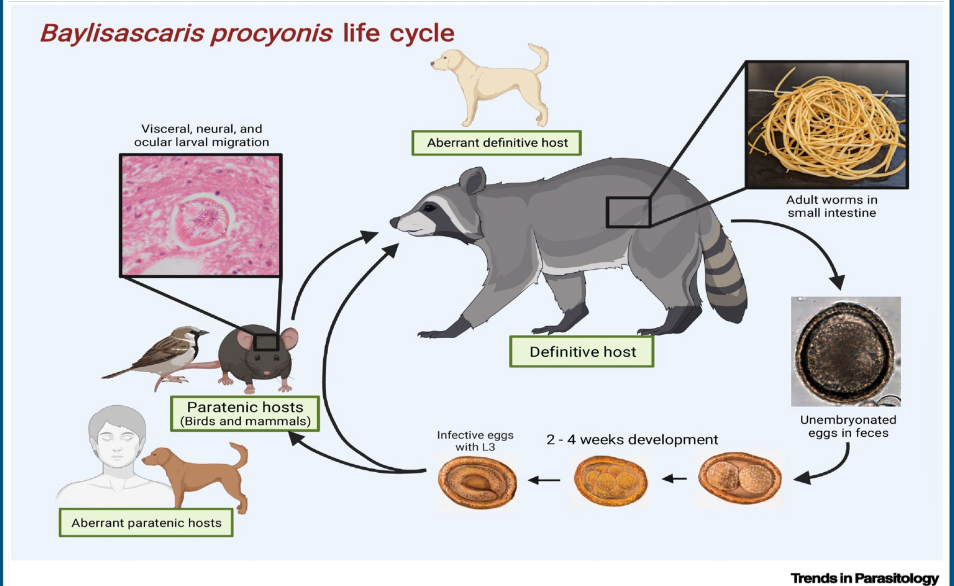
How Infection Works (Indirect)
Eggs are passed in feces and ingested by paratenic hosts
Larvae penetrate the intestinal wall and migrate through the bloodstream to reach other organs and tissues
Two to four weeks after infection, the larvae grow in their third stage of development
Become encapsulated by granulomas in various organs and tissues
Remain dormant in granulomas in paratenic hosts until ingestion by predatory raccoons, then continue into adulthood
Transmission
Infected raccoons can shed millions of raccoon roundworm eggs per day in their feces
Average 20,000 to 26,000 eggs per gram of feces
Optimal conditions:
75 F
100% Humidity
Eggs persist extremely well in their environment
92% of eggs were still alive and able to infect a host after 2 years
True regardless of soil type, amount of moisture, and amount of shade
Infant raccoons are directly infected within the first few months
Ingest eggs from mother’s contaminated teats or fur, contaminated den, or from nearby raccoon latrine sites
Older raccoons may become infected indirectly by killing or scavenging infected prey
100% of raccoons that consumed an infected rodent became infected themselves
Clinical Signs
Raccoons -> often asymptomatic, causing no clinical signs
Unless the parasite load is large enough to cause intestinal obstruction
Other Hosts -> lethargy, depression, unkempt coat, seizures, blindness, or death
Can invade CNS and eyes, causing neurologic and ocular signs
Because of the physical damage left behind by these migrating larvae, many times if the neurologic signs do start to show, it likely signals that the animal will die or be left with permanent neurologic damage
Population Effects
Highly common
Infecting 40-60% of adult raccoons and up to 90-95% of juveniles in certain areas
80% of raccoons acting as carriers in Texas
Creates significant environmental contamination
Rarely causes high mortality in raccoons
Mortality rate is high for those who develop severe symptoms (other hosts)
Population-limiting factor for these prey species
Diagnosis
Definitive Hosts (and dogs) -> Fecal Floatation
Process of mixing stool with high density solution to make parasite eggs float
Analyze eggs with microscope
Can also use PCR to confirm presence
Other Hosts -> clinical signs of neurologic impairment
Diagnosis is challenging
Worms in these cycles never mature into adults and can’t produce eggs
Fecal flotation would be ineffective because there are no eggs in the feces
No eggs in feces for floatation
Also confirmed post-mortem via histopathology
Diagnosis relies on identifying characteristic neurologic and ocular signs
Prevention
Prevention is the most important strategy for managing raccoon roundworm
Raccoons and other definitive hosts can be treated with common antiparasitic drugs used in domestic dogs and cats
How to avoid infection/spread:
Avoid direct contact with raccoons and raccoon latrines
Avoid using pet doors
Do not use self-feeders for outside pets
On a community level, identification and evaluation of contaminated areas
Best Method -> combination of treatment and removal of contaminated raccoon latrines
Key Takeaways
Cause -> intestinal parasite, Baylisascaris procyonis
Location -> in small intestines or tissues of host, eggs excreted via feces, larvae is ingested
Hosts -> Raccoons (definitive) and domestic dogs, rodents, rabbits, primates and birds
Clinical signs -> lethargy, depression, unkempt hair coat, blindness, or death (raccoons asymptomatic)
Treatment -> common antiparasitic drugs
Dewormers