practical 1
 Call Kai
 Learn
Learn Practice Test
 Spaced Repetition
 Match
Match Flashcards
 Knowt Play
1/146

There's no tags or description
Looks like no tags are added yet.
Name | Mastery | Learn | Test | Matching | Spaced | Call with Kai | Chat |
|---|
No analytics yet
Send a link to your students to track their progress
147 Terms
Surface Anatomy
Study of the body’s external features and landmarks.
Axial Part of the Body
The central part of the body, including the head, neck, and trunk.
Appendicular Part of the Body
The limbs and the structures that attach the limbs to the axial body.
Anatomical Position
Standing upright, facing forward, feet slightly separated, arms at the sides, and palms facing forward.
Supine
Lying face upward.
Prone
Lying face downward.
Sagittal Plane
Divides the body into left and right portions.
Median Plane
A sagittal plane that runs directly down the body’s midline.
Frontal (Coronal) Plane
Divides the body into anterior and posterior sections.
Transverse (Horizontal/Cross) Plane
Divides the body into superior and inferior sections.
Oblique Plane
A cut made at an angle other than a right angle.
Longitudinal Section
A cut made along the length of an organ.
Transverse (Cross) Section of an Organ
A cut made at a right angle to the length of an organ.
Directional Terms
Words used to describe where one body structure is located compared with another.
Superior
A structure located above another structure; closer to the head.
Inferior
A structure located below another structure; farther from the head.
Cephalic
Closer to the head than another structure; usually means the same thing as superior.
Caudal
Closer to the tail/lower end of the body than another structure; usually means the same thing as inferior.
Anterior
Toward the front of the body.
Posterior
Toward the back of the body.
Ventral
Toward the belly/front of the body; synonymous with anterior.
Dorsal
Toward the back of the body; synonymous with posterior.
Medial
Toward the body’s midline.
Lateral
Away from the body’s midline.
Intermediate
Located between a medial and a lateral structure.
Proximal
Closer to the point where a structure attaches to the body.
Distal
Farther from the point where a structure attaches to the body.
Superficial
Toward or on the body’s surface.
Deep
Away from the body’s surface; more internal.
Ipsilateral
On the same side of the body.
Contralateral
On the opposite side of the body.
Visceral
Describes the inner layer associated with an organ.
Parietal
Describes the outer layer associated with a body cavity.
Afferent
Moving toward the brain/CNS.
Efferent
Moving away from the brain/CNS.
Right
Toward the right side of the body.
Left
Toward the left side of the body.
Dorsal Body Cavity
The body cavity that contains the brain and spinal cord.
Cranial Cavity
The part of the dorsal body cavity that contains the brain; protected by the skull.
Vertebral Cavity
The part of the dorsal body cavity that contains the spinal cord; protected by the spine.
Ventral Body Cavity
The body cavity containing most of the body’s viscera/organs.
Thoracic Cavity
The ventral cavity in the chest; protected by the ribcage.
Mediastinum
The midline region of the thoracic cavity containing the heart, some major blood vessels, thymus, trachea, and esophagus.
Pleural Cavities
The two cavities that each surround a lung; located on the sides of the mediastinum.
Pericardial Cavity
The cavity surrounding the heart; located inside the mediastinum.
Abdominopelvic Cavity
The ventral cavity below the diaphragm; divided into abdominal and pelvic cavities.
Abdominal Cavity
Contains many digestive organs, including the stomach, small intestine, beginning of the large intestine, liver, gallbladder, pancreas, spleen, and kidneys; has little bony protection.
Pelvic Cavity
Contains the urinary bladder, urethra, sigmoid colon, rectum, and reproductive organs; located inside the bony pelvis.
Body Cavities
Internal spaces in the body that contain and protect organs.
Serous Membranes (Serosa)
Double-layered membranes that cover organs and line closed ventral body cavities.
Visceral Layer
The inner layer of a serous membrane that directly covers an organ.
Parietal Layer
The outer layer of a serous membrane that lines the cavity wall.
Serous Cavity
The space between the visceral and parietal layers that contains lubricating serous fluid.
Serous Fluid
Lubricating fluid between the visceral and parietal layers of a serous membrane.
Pleura
The serous membrane that surrounds the lungs and lines the thoracic cavity; contains pleural fluid.
Pericardium
The serous membrane surrounding the heart.
Peritoneum
The serous membrane surrounding many abdominal organs and lining the abdominopelvic cavity.
Mesentery
A double-folded part of the visceral peritoneum attached to parts of the posterior abdominopelvic wall.
Function of the Mesentery
Provides a pathway for nerves and blood vessels to reach digestive organs.
Retroperitoneal
Located behind the peritoneum; includes the kidneys, ureters, adrenal glands, part of the pancreas, parts of the large intestine, and urinary bladder.
Abdominal Quadrants
Four sections used to describe locations within the abdomen: right upper, left upper, right lower, and left lower quadrants.
Right Upper Quadrant (RUQ)
The upper-right section of the abdomen.
Left Upper Quadrant (LUQ)
The upper-left section of the abdomen.
Right Lower Quadrant (RLQ)
The lower-right section of the abdomen.
Left Lower Quadrant (LLQ)
The lower-left section of the abdomen.
Abdominal Regions
Nine sections used to describe more specific locations within the abdomen.
Body Systems
Groups of organs that work together to perform specific functions in the body.
Integumentary System
Includes the skin, hair, nails, and sweat glands; protects the body, regulates temperature, prevents water loss, and helps produce vitamin D.
Skeletal System
Includes bones, cartilage, ligaments, and joints; supports and protects the body, allows movement, produces blood cells, and stores minerals and fat.
Muscular System
Includes muscles attached to the skeleton by tendons; produces movement, maintains posture, and produces body heat.
Nervous System
Includes the brain, spinal cord, nerves, and sensory receptors; detects sensations and controls movement, physiological processes, and intellectual functions.
Endocrine System
Includes hormone-secreting glands such as the pituitary; regulates metabolism, growth, reproduction, and other body functions.
Lymphatic System
Removes foreign substances, helps fight disease, maintains tissue-fluid balance, and absorbs fats from the digestive tract.
Respiratory System
Exchanges oxygen and carbon dioxide between the blood and air and helps regulate blood pH; includes the lungs and respiratory passages.
Digestive System
Breaks down food mechanically and chemically, absorbs nutrients, and eliminates solid wastes.
Urinary System
Removes waste from the blood and regulates blood pH, ion balance, and water balance.
Female Reproductive System
Produces oocytes, is the site of fertilization and fetal development, produces milk, and produces hormones involved in sexual functions and behaviors.
Male Reproductive System
Produces and transfers sperm to the female and produces hormones involved in sexual functions and behaviors.
Cardiovascular System
Transports nutrients, wastes, gases, and hormones; helps with immune responses and temperature regulation.
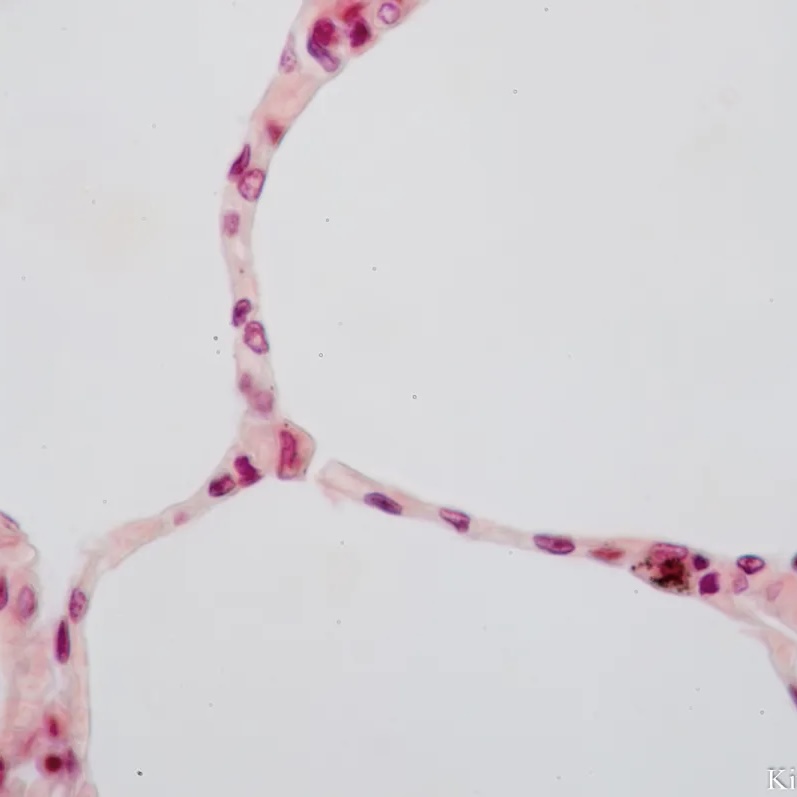
Simple Squamous Epithelium — Identification
Very thin, flat, irregularly shaped cells; forms the thinnest possible tissue sheet.

Simple Squamous Epithelium — Function
Works mainly as a filter or exchange membrane.

Simple Squamous Epithelium — Location
Found in capillary walls and larger blood vessels, kidney glomeruli, pericardial/pleural/peritoneal membranes, and lung alveoli.
Endothelium
Simple squamous epithelium lining capillary walls and larger blood vessels.
Mesothelium
Simple squamous epithelium found in the pericardial, pleural, and peritoneal membranes.

Simple Cuboidal Epithelium — Function
Secretion.

Simple Cuboidal Epithelium — Location
Most glands and kidney tubules.

Simple Columnar Epithelium — Function
Complex absorption or secretion.

Simple Columnar Epithelium — Location
Lining of the stomach, small intestine, and Fallopian tubes.
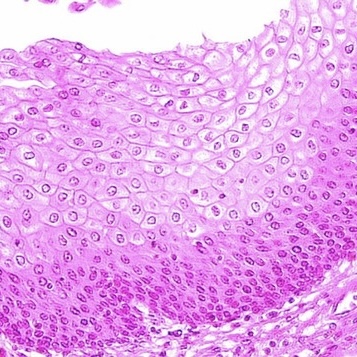
Stratified Squamous Epithelium — Identification
Multiple layers with thin, flat squamous cells at the surface and thicker, more cuboidal cells in the lower layers.

Stratified Squamous Epithelium — Function
Protects against abrasion.

Stratified Squamous Epithelium — Location
Surface of the skin, lining of the oral cavity and esophagus, and lining of the vagina.

Transitional Epithelium — Identification
Multiple layers with plump, rounded, dome-shaped surface cells when relaxed; the surface cells flatten when the tissue is stretched.

Ciliated Pseudostratified Columnar Epithelium — Identification
Actually one layer because every cell touches the basement membrane, but it looks like multiple layers because the cells are different sizes; has nuclei at different heights, cilia, and goblet cells.
Apical Surface
The exposed/free surface of epithelial tissue.
Avascular
Without blood vessels; epithelial tissue gets materials by diffusion from the underlying connective tissue.
Basal Surface
The anchored surface of epithelial tissue that rests on the basement membrane.
Basement Membrane
A layer that connects the basal layer of epithelial cells to the underlying tissue; blood vessels do not penetrate it.
Cilia
Tiny hair-like structures that beat to move substances/secretions across a cell surface.
Goblet Cells
Cells that produce and secrete mucus.
Mitosis
Cell division used to make new cells; epithelial tissue uses mitosis to replace damaged cells.