Integumentary System: Structure, Functions, and Skin Appendages
 Call Kai
 Learn
Learn Practice Test
 Spaced Repetition
 Match
Match Flashcards
 Knowt Play
1/53

There's no tags or description
Looks like no tags are added yet.
Name | Mastery | Learn | Test | Matching | Spaced | Call with Kai | Chat |
|---|
No analytics yet
Send a link to your students to track their progress
54 Terms
What are the two major parts of the integument?
Cutaneous membrane (skin) and accessory/appendage structures.

What percentage of total body weight does the skin account for?
~16% of total body weight.
What are the two major regions of the skin?
Epidermis (superficial region) and dermis (middle region).

What is the hypodermis?
The deepest region of the skin, also known as superficial fascia, mostly composed of adipose tissue.
What are the three types of barriers provided by the integumentary system?
Chemical, physical/mechanical, and biological barriers.
What is the function of the acid mantle in the skin?
It slows bacterial activity through low pH secretions.
How does the integumentary system regulate body temperature?
Through insensible perspiration and dilation of dermal vessels at elevated temperatures.
What are the general senses provided by the integumentary system?
Temperature, touch, and pain.
What metabolic functions does the integumentary system perform?
Synthesis of vitamin D precursor and collagenase, and chemical conversion of carcinogens and hormones.
How much of the body's blood volume can the skin act as a reservoir?
Up to 5% of the body's blood volume.
What are the nitrogenous wastes excreted by the skin?
Ammonia, urea, uric acid, and salt in sweat.
What type of epithelium is the epidermis composed of?
Keratinized, stratified, squamous epithelium.
What are keratinocytes?
Epithelial cells that produce the fibrous protein keratin.
What is the role of melanocytes in the skin?
They produce the pigment melanin.
What are the four to five layers of the epidermis?
Stratum corneum, stratum lucidum (thick skin only), stratum granulosum, stratum spinosum, and stratum basale.
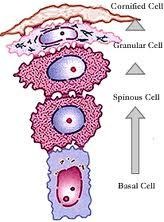
What is the stratum basale known for?
It is the deepest layer of the epidermis, where cells undergo rapid division.
What are dermal papillae?
Finger-like projections that enhance the connection between the dermis and epidermis.

What are the characteristics of the stratum spinosum?
It is 8-10 layers thick with a web-like system of intermediate pre-keratin filaments.
What happens in the stratum granulosum?
Keratinocytes flatten and produce keratin and keratohyalin, leading to cell dehydration and death.
What is the stratum lucidum?
A thin, transparent layer found only in thick skin, consisting of flat, dead keratinocytes.
What is the function of the stratum corneum?
It protects from abrasion and penetration and is water-resistant.
What is the dermis composed of?
Strong, flexible connective tissue with collagen and elastic fibers.

What are the two layers of the dermis?
Papillary layer and reticular layer.
What are tension lines (cleavage lines)?
Lines produced by parallel bundles of collagen and elastic fibers in the dermis that resist forces applied to the skin.

What is the role of eccrine sweat glands?
They help regulate body temperature through sweat production.

What pigments contribute to skin color?
Melanin, carotene, and hemoglobin.
What is the function of melanin in the skin?
It provides pigment and protects against UV radiation by forming 'pigment shields' for nuclei.
What is melanin?
A pigment responsible for dark skin colors, produced in melanocytes.
How long does it take for melanin production to ramp up?
10 days.
What are the two forms of melanin?
Eumelanin (brown/black) and Pheomelanin (red/yellow).
What is carotene?
A yellow to orange pigment that can be converted to Vitamin A and accumulates in fatty tissue.
What is the role of hemoglobin in skin color?
It is responsible for the pinkish hue of the skin.
What does flushed skin indicate?
Fever, embarrassment, or hypertension.
What does cyanotic skin indicate?
Low oxygen levels, resulting in a blue color (lips and nail beds).
What does jaundiced skin indicate?
Liver issues, resulting in a yellowish tinge.
What is the primary function of Vitamin D3?
It is needed for calcium and phosphorus absorption.
What are the two main types of sweat glands?
Eccrine (merocrine secretion) and Apocrine (merocrine secretion) sweat glands.

Where are eccrine sweat glands most abundant?
On the palms, soles, and forehead.
What is sebum?
An oily holocrine secretion produced by sebaceous glands that softens hair and skin.
What is the function of hair?
To alert the body to the presence of insects, guard against trauma, heat loss, and sunlight.
What are the two types of hair?
Vellus hair (fine body hair) and Terminal hair (coarse, long hair).
What is the structure of a hair follicle?
It has a two-layered wall made of dermis and epidermis.

What is the ABCD rule for skin cancer detection?
A: Asymmetry, B: Border indentations, C: Color variation, D: Diameter larger than 6 mm.

What is a first-degree burn?
Epidermal damage only, characterized by localized redness, edema, and pain.
What is a third-degree burn?
Involves the entire thickness of skin, may appear gray-white, cherry red, or blackened, and is not painful.
What is the rule of nines used for?
To estimate the volume of fluid loss due to burns.
What is basal cell carcinoma?
The least malignant and most common type of skin cancer, cured by surgical excision in 99% of cases.
What is melanoma?
The most dangerous type of skin cancer, highly metastatic and resistant to chemotherapy.

What causes gray or white hair?
Decreased melanin production and increased air bubbles in the hair shaft.
What are the characteristics of apocrine sweat glands?
Confined to axillary and pubic areas, secrete sweat mixed with triglycerides and proteins.
What is the function of the arrector pili muscle?
It causes goosebumps by contracting and pulling hair follicles.
What is the nail matrix?
The actively dividing area from which nails grow.
What is the main threat from burns?
Dehydration and electrolyte imbalance, which can lead to renal shutdown and circulatory shock.
What is the average hair growth rate?
2.25 mm per week.