Dental Anatomy - Maxillary Second Premolars
 Call Kai
 Learn
Learn Practice Test
 Spaced Repetition
 Match
Match Flashcards
 Knowt Play
1/28

There's no tags or description
Looks like no tags are added yet.
Name | Mastery | Learn | Test | Matching | Spaced | Call with Kai | Chat |
|---|
No analytics yet
Send a link to your students to track their progress
29 Terms
Evidence of calcification of Maxillary Second Premolars
2 years
Enamel completion of Maxillary Second Premolars
6-7 years
Eruption of Maxillary Second Premolars
11-12 years
Root completion of Maxillary Second Premolars
12-14 years
General Characteristics of Maxillary Second Premolars
- crown is slightly smaller in all dimensions than the first premolar
- exhibits more rounded crown form
- buccal and lingual cusps are of nearly equal height (wear can trick you)
- normally no mesial concavity or marginal groove on the crown
- normally single rooted
- more variations from normal are observed with these
On the buccal aspect of maxillary second premolars, the buccal cusp (is/is not) as long or pointed as the first premolar with a mesial offset
is not
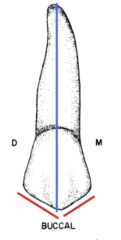
On the buccal aspect of maxillary second premolars, the mesial cusp ridge is (shorter/longer) than the distal cusp ridge
shorter
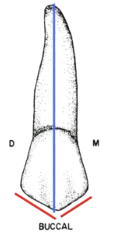
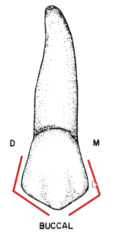
on the buccal aspect of maxillary second premolars, the mesioocclusal and distoocclusal line angles are (more/less) prominent, with a straight mesial surface
less
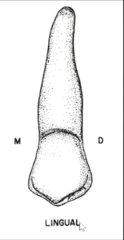
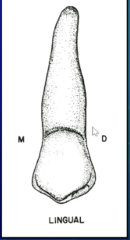
on the lingual aspect of maxillary second premolars, the lingual cusp is (longer/shorter) occlusocervically than the first premolar
longer
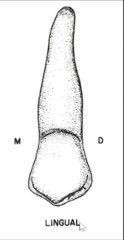
on the lingual aspect of maxillary second premolars, the occlusal surface is (more/less) visible and (more/less) mesial offset
less, less
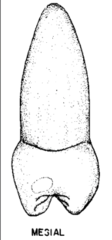
on the mesial aspect of maxillary second premolars, the buccal and lingual cusps (are/are not) nearly the same length
are
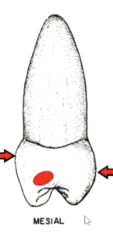
on the mesial aspect of maxillary second premolars, there (is/is not) a mesial concavity or mesial marginal groove
is not
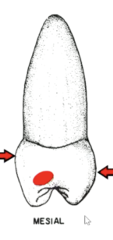
on the mesial aspect of maxillary second premolars, the buccal outline has a HOC in the _______ 1/3
cervical
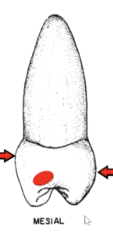
on the mesial aspect of maxillary second premolars, the lingual outline has a HOC in the _______ 1/3
middle
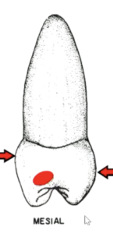
on the mesial aspect of maxillary second premolars, the contact area is at the junction of the _________ and _________ 1/3
occlusal, middle
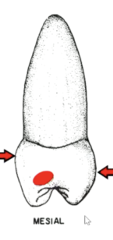
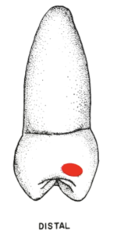
on the distal aspect of the maxillary second premolars, there is an even (larger/smaller) contact area with the first molar
larger
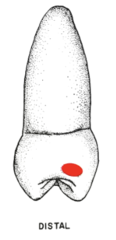
on the distal aspect of maxillary second premolars, the contact area is (more/less) cervical than the first premolar
more
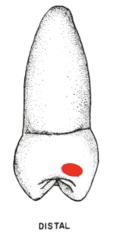
on the distal aspect of maxillary second premolars, the contact area is at the junction of the ________ and ________ 1/3
occlusal, middle
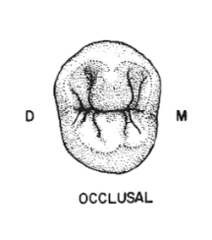
from the occlusal aspect of maxillary second premolars, the line angles are (more/less) rounded
more
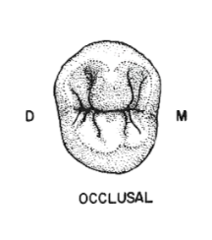
from the occlusal aspect of maxillary second premolars, the crown is (more/less) angular
less
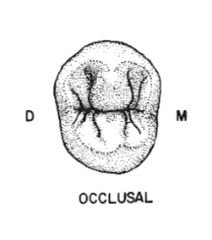
from the occlusal aspect of maxillary second premolars, there is a (longer/shorter) central groove
shorter
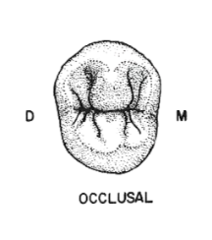
The central groove on the occlusal aspect of maxillary second premolars sometimes displays
multiple supplemental grooves
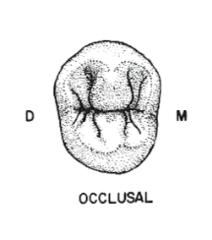
the mesial and distal pits on the occlusal aspect of maxillary second premolars are (further away/closer) to each other
closer
root structure of maxillary second premolars
- single, straight root
- blunt apex
- root length as long or slightly longer than first premolar
- wider buccolingually than mesiodistally
- faciolingual taper
the buccal and lingual surfaces of the root structure of maxillary second premolars are
convex
the mesial and distal surfaces on the root structure of maxillary second premolars are either _______ or ______
convex, flat
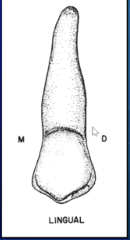
the root of maxillary second premolars deflects to the ______ in the apical portion
distal
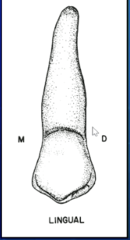
root structure cross section of maxillary second premolars
ovoid
variations and anomalies of maxillary second premolars
- crown form varies more than first premolar
- wrinkled occlusal surface (accessory grooves and ridges)
- central pit replaces the central groove
- root variations (distal deflections, two roots, extension into the antrum)