Calc 3 Chapter 12
 Call Kai
 Learn
Learn Practice Test
 Spaced Repetition
 Match
Match Flashcards
 Knowt Play
1/23

There's no tags or description
Looks like no tags are added yet.
Name | Mastery | Learn | Test | Matching | Spaced | Call with Kai | Chat |
|---|
No analytics yet
Send a link to your students to track their progress
24 Terms
how to represent x,y coordinates on a circle with radius R using cos and sin?
(Rcos(t), Rsin(t)) = Rcos(t)i + Rsin(t)J
circle centered at 0,0 using x and y formula
x2 + y2 = r2
center shifts w/ cos and sin
2 + cost would be if the center is at x=2
cost - 2 would be if the center is at x=-2
r(t) = *as a coordinate
(x(t), y(t), z(t))
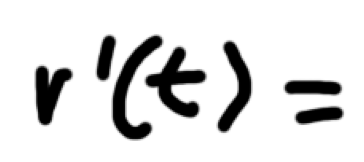

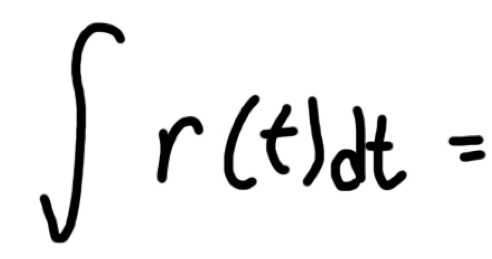
don’t forget the constant of integration (which is a vector meaning that it adds a constant c1 c2 and c3 to the ijk respectively. the constants can be different so you need to solve for them!)

what is a zero vector
all the values for (x,y,z) are (0,0,0)

speed =
magnitude of velocity aka take derivative of the position function then take norm of that

what does the vector r’(t) represent if r(t) is continuous and differentiable
r’(t) is a vector tangent to the motion of the curve traced by r(t)
A curve is closed if it…
A curve is closed if it has all of the following:
a parameterization r→(t)
a ≤ t ≤ b
r→(a) = r→(b)

A curve is smooth if…
A curve if smooth if for SOME parameterization r(t) along [a,b]
r’(t) is continuous & exists for all t in the interval [a,b]
r’(t) ≠ 0→ for all t in the interval [a,b] aka r’(t) isn’t a zero vector for all t in [a,b]
e.g. a circle
piecewise smooth defn
Piecewise smooth means that the curve can be divided into a finite number of sub intervals like [a,b] [b,c] [c,d] etc where each sub interval is smooth
e.g. a square has 4 corners making it not differentiable in those spots, but the square can be broken up into pieces where each piece is a line that is smooth within its subinterval
how to obtain new parameterizations (e.g. r(t) = (t, t2)
you can do t = t2 and get a new parameterization, q(t) which = (t2, t4)… essentially you can plug in different values
arclength formula + what types of curves does it work for?
aka integrate speed aka integrate the magnitude of velocity
works for smooth and piecewise smooth curves
only works if r(t) traces the curve only once within [a,b]
![<p>aka integrate speed aka integrate the magnitude of velocity </p><ul><li><p>works for smooth and piecewise smooth curves</p></li><li><p><strong>only works if r(t) traces the curve only once within [a,b]</strong></p></li></ul><p></p>](https://assets.knowt.com/user-attachments/c2f32caf-8102-4dff-ae99-e6ea70fe7253.png)
Unit tangent vector (formula)
normalize velocity

What is a principal normal vector?
The principal normal vector is a vector of length one that is perpendicular to a curve and points toward the inside of the curvature
Note that the principal normal vector isn’t defined at inflection points bc there is no curvature so pointing “inwards” doesn’t exist
Straight lines have no curvature and therefore the principal normal vector is undefined

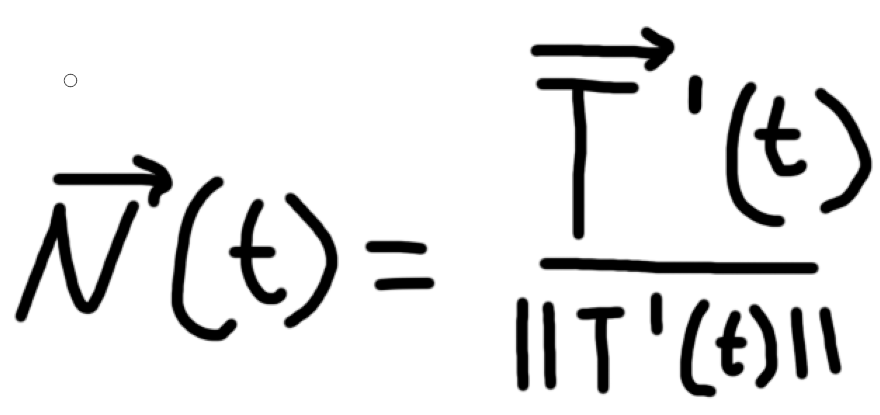
principal normal vector formula
normalize the derivative of the unit tangent vector
what does the tangential component of acceleration control? what does the normal component of acceleration control?
aTT→ changes a particle’s speed
aNN→ changes a particle’s direction
aN is ____ to 0 because ____
the normal component of acceleration is always greater than or equal to 0 because the direction can’t be negative
tangential component of acceleration formula
[velocity dotted with acceleration] all over the magnitude of velocity
![<p>[velocity dotted with acceleration] all over the magnitude of velocity</p>](https://assets.knowt.com/user-attachments/510cc6e8-1215-4174-9ee5-94ca9de8c1bf.png)
normal component of acceleration formula
the magnitude of the [velocity crossed with acceleration] all over the magnitude of velocity
![<p>the magnitude of the [velocity crossed with acceleration] all over the magnitude of velocity </p>](https://assets.knowt.com/user-attachments/99fa22b3-470e-4f31-96ec-c622bd890629.png)
a→(t) =
where:
aT and aN get evaluated as the tangential and normal components, respectively, of acceleration
the symbols T→ and N→ stay as they are written as if were variables such as x and y

How to use Pythagorean theorem to get the tangential or normal component of acceleration easier (FORMULA)

how to find where a plane and some parameterization r(t) written in ijk form intersect
plug in the different components from r(t) into x,y, and z in the plane equation
e.g.
r(t) = 5t²i - (t+1)j + (t2+1)k
8x+7y+0z = 5
8(5t2) + 7( -(t+1) ) + 0(t2 + 1) = 5 now solve for t