24 Digestive System Infections
 Call Kai
 Learn
Learn Practice Test
 Spaced Repetition
 Match
Match Flashcards
 Knowt Play
1/28

There's no tags or description
Looks like no tags are added yet.
Name | Mastery | Learn | Test | Matching | Spaced | Call with Kai | Chat |
|---|
No analytics yet
Send a link to your students to track their progress
29 Terms
Digestive tract
Our digestive system has two general components:
» [__]: Hollow tube from mouth to anus
→ GI tract is used when referring to only the stomach and intestines
» Accessory organs: produce enzymes and substances to break down food
eg. salivary glands, pancreas, liver
Function of Digestive System:
break down food into smaller components so that our body can use them. Absorbed into intestine
![<p><u>Our digestive system has two general components</u>:</p><p><mark data-color="yellow" style="background-color: yellow; color: inherit;">» </mark><strong><mark data-color="yellow" style="background-color: yellow; color: inherit;">[__]</mark></strong>: Hollow tube from mouth to anus</p><p>→ <strong><mark data-color="#f4eeee" style="background-color: rgb(244, 238, 238); color: inherit;">GI tract</mark></strong> is used when referring to <mark data-color="#f4eeee" style="background-color: rgb(244, 238, 238); color: inherit;">only the stomach and intestines</mark></p><p><mark data-color="yellow" style="background-color: yellow; color: inherit;"> » </mark><strong><mark data-color="yellow" style="background-color: yellow; color: inherit;">Accessory organs</mark></strong>: produce enzymes and substances to break down food</p><p><u>eg.</u> <mark data-color="blue" style="background-color: blue; color: inherit;">salivary glands, pancreas, liver</mark></p><p></p><p><strong><u><mark data-color="#f4eeee" style="background-color: rgb(244, 238, 238); color: inherit;">Function of Digestive System:</mark></u><mark data-color="#f4eeee" style="background-color: rgb(244, 238, 238); color: inherit;"> </mark></strong></p><p><mark data-color="yellow" style="background-color: yellow; color: inherit;">break down food into smaller components so that our body can use them. </mark>Absorbed into intestine</p>](https://assets.knowt.com/user-attachments/85893ceb-0b51-4f1a-9beb-1033d8069464.png)
Streptococcal
Few species present, but most common organism of mouth microbiota are [__] species
eg. Streptococcus mutans
Protection to prevent overgrowth of microbiota exist in our:
Mouth » saliva has enzymes and lysozyme and IgA
Stomach » lysozyme, IgA, and HCl (stomach acid)
» completely sterile due to acid (w/ exceptions like H. pylori)
» bile is also antimicrobial (released from gallbladder to stomach to break down fats)
» peristalsis prevents colonization (moves bacteria along to intestine)
Intestine » contains microbiota
» small intestine has very few retaining here as they are smaller diameter and propels movement much faster here
» large intestine has greatest amount of microbiota (1011 bacteria/g of feces… 100 billion bacteria)
→ bacteria makes up bulk of feces
eg. Escherichia coli, Bacteriodes (most common in people), Enterobacter faecalis, Klebsiella pneumoniae
→ common cause of urinary tract infections
Cavities
Mouth disease
[__]/dental caries (tooth decay). Lead to erosion of teeth
Causative agent: Streptococcus mutans
» lactic acid bacterium with thick capsule to attach to (eg.) our enamel
» come together to form biofilm for further attachment → creates plaque
» sugar metabolism of bacteria releases lactic acid, which wears down the teeth in [__]
Treatment: drill out [__], replace them with filling, and restore teeth
![<p><mark data-color="blue" style="background-color: blue; color: inherit;">Mouth disease</mark></p><p><strong><mark data-color="yellow" style="background-color: yellow; color: inherit;">[</mark><mark data-color="purple" style="background-color: purple; color: inherit;">__]/dental caries</mark></strong> (tooth decay).<mark data-color="yellow" style="background-color: yellow; color: inherit;"> Lead to erosion of teeth</mark></p><p><u>Causative agent</u>: <em><mark data-color="purple" style="background-color: purple; color: inherit;">Streptococcus mutans</mark></em></p><p><mark data-color="yellow" style="background-color: yellow; color: inherit;">» lactic acid bacterium with thick capsule to attach to (</mark><u><mark data-color="yellow" style="background-color: yellow; color: inherit;">eg.</mark></u><mark data-color="yellow" style="background-color: yellow; color: inherit;">) our enamel</mark></p><p>» come together to form biofilm for further attachment → creates <strong>plaque</strong></p><p>» sugar metabolism of bacteria <mark data-color="yellow" style="background-color: yellow; color: inherit;">releases lactic acid, which wears down the teeth in [__]</mark></p><p></p><p><u><mark data-color="blue" style="background-color: blue; color: inherit;">Treatment</mark></u>: drill out [__], replace them with filling, and restore teeth</p>](https://assets.knowt.com/user-attachments/8647aa64-34f7-429f-93e9-74046dc31f56.png)
Periodontal Disease
Mouth disease
[__]: diseases of tissues that support and anchor teeth
Causative agent: Gram-negative anaerobic bacteria in our mouth
» participate in dental plaque build up between gum and teeth that causes [__], such as gingivitis: inflammation of gums
Trench Mouth
Mouth disease
[__]: extreme gingivitis (gum inflammation). Extreme case of Periodontal disease
» extreme damage of gum → extreme bleeding
Causative agent: an oral spirochaete belonging to genus Treponema
» another strain that causes syphilis is from this genus (Treponema pallidum)
![<p><mark data-color="blue" style="background-color: blue; color: inherit;">Mouth disease</mark></p><p><strong><mark data-color="purple" style="background-color: purple; color: inherit;">[__]</mark></strong><mark data-color="purple" style="background-color: purple; color: inherit;">:</mark> <mark data-color="yellow" style="background-color: yellow; color: inherit;">extreme </mark><strong><mark data-color="yellow" style="background-color: yellow; color: inherit;">gingivitis </mark></strong><mark data-color="yellow" style="background-color: yellow; color: inherit;">(gum inflammation)</mark>. Extreme case of Periodontal disease</p><p><mark data-color="yellow" style="background-color: yellow; color: inherit;">» extreme damage of gum → extreme bleeding</mark></p><p><u>Causative agent</u>: <mark data-color="#f4eeee" style="background-color: rgb(244, 238, 238); color: inherit;">an </mark><mark data-color="purple" style="background-color: purple; color: inherit;">oral spirochaete</mark><mark data-color="#f4eeee" style="background-color: rgb(244, 238, 238); color: inherit;"> belonging to genus </mark><em><mark data-color="purple" style="background-color: purple; color: inherit;">Treponema</mark></em></p><p><span style="color: rgb(145, 143, 143);">» another strain that causes syphilis is from this genus (<em>Treponema pallidum</em>)</span></p>](https://assets.knowt.com/user-attachments/91c47b03-b3f9-4a77-b946-f114ab86ab25.png)
Fluoridation
Prevention of Mouth Diseases:
» restrict dietary sucrose (sugary foods)
» [__]: placing fluoride in water, reduced dental caries by 60% in US
→ not prevalent in all areas; some add chloride instead
» brushing and flossing; plaque removal with regular dental appointments
→ tartar: calcified, hardened plaque. can no longer be brushed away like normal soft plaque (must be scraped off)
» sealant, which can prevent dental caries
Helicobacter pylori
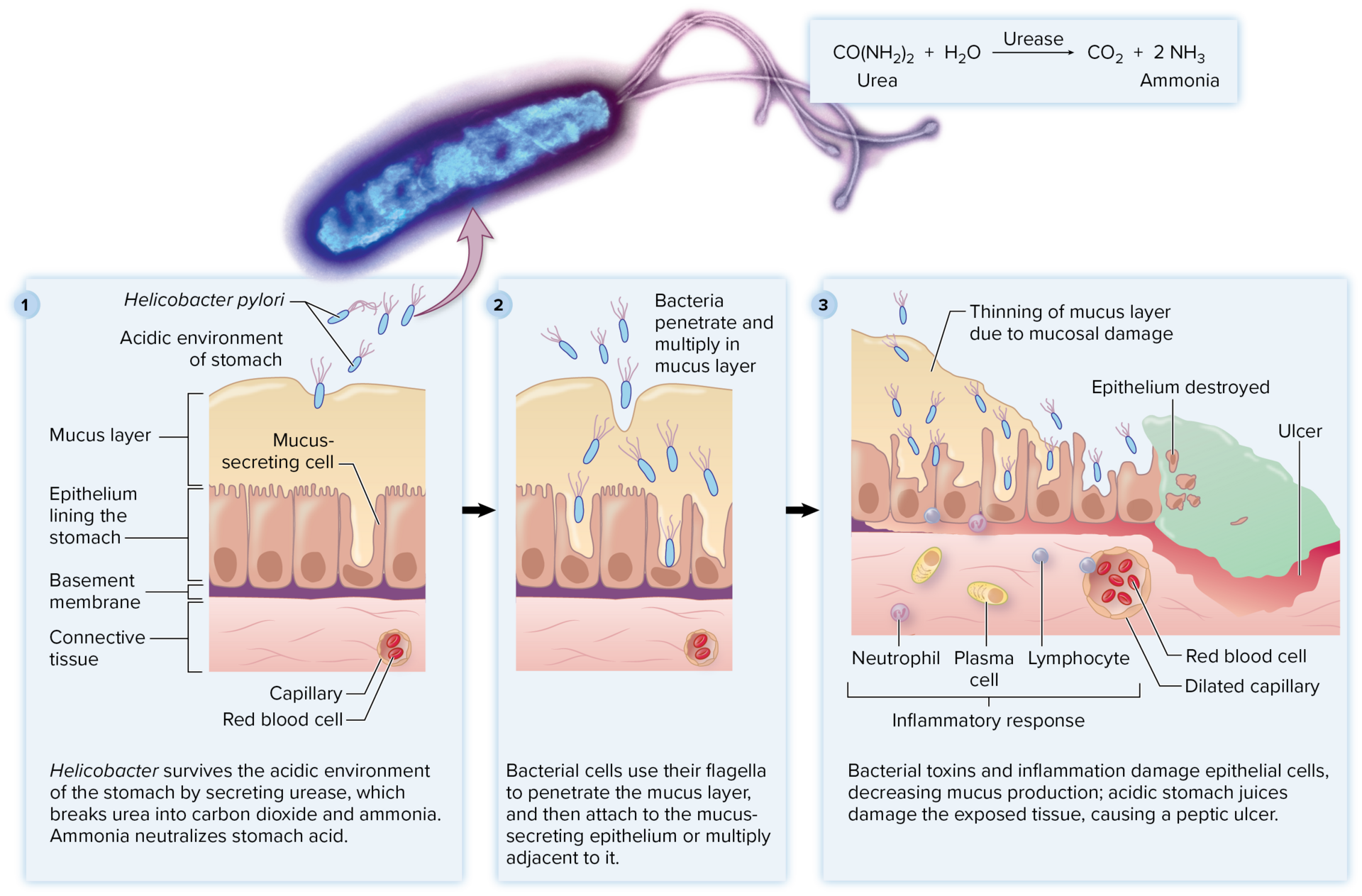
[__] Gastritis, Peptic Ulcer Disease, and Gastric carcinoma
Causative agent [__]: flagellated, Gram-negative spiral
» survives by neutralizing acidic environment via urease production
→ breaks down urea to produce ammonia, which shields it from acidity
» only bacteria known to date to cause a cancer (Gastric carcinoma)
Pathogenesis: after [__] produces urease to neutralize stomach acid,
» bacterium use flagella to swim through mucous layer of stomach cells and infect epithelial cells → causes damage and kills mucous producing cells
» mucous no longer effectively produced, stomach cells are exposed to acid and gets destroyed → peptic ulcers and bleeding
![<p><strong>[__] Gastritis</strong>, <strong>Peptic Ulcer Disease,</strong> and <strong>Gastric carcinoma</strong></p><p>Causative agent <strong><mark data-color="purple" style="background-color: purple; color: inherit;">[__]</mark></strong>: <mark data-color="yellow" style="background-color: yellow; color: inherit;">flagellated, Gram-negative spiral</mark></p><p><mark data-color="yellow" style="background-color: yellow; color: inherit;">» survives by neutralizing acidic environment via </mark><strong><mark data-color="yellow" style="background-color: yellow; color: inherit;">urease</mark></strong><mark data-color="yellow" style="background-color: yellow; color: inherit;"> production</mark></p><p>→ breaks down urea to produce ammonia, which shields it from acidity</p><p><span style="color: purple;">» only bacteria known to date to cause a cancer </span><span style="color: rgb(145, 143, 143);">(Gastric carcinoma)</span></p><p></p><p><u><mark data-color="blue" style="background-color: blue; color: inherit;">Pathogenesis</mark></u><mark data-color="blue" style="background-color: blue; color: inherit;">:</mark> after [__] produces urease to neutralize stomach acid,</p><p>» bacterium use flagella to swim through mucous layer of stomach cells and <mark data-color="#f4eeee" style="background-color: rgb(244, 238, 238); color: inherit;">infect epithelial cells → causes damage and kills mucous producing cells</mark></p><p><mark data-color="#f4eeee" style="background-color: rgb(244, 238, 238); color: inherit;">» mucous no longer effectively produced, stomach cells are exposed to acid and gets destroyed </mark>→ <strong>peptic ulcers </strong>and bleeding</p><img src="https://assets.knowt.com/user-attachments/847063bf-d4a2-4be4-9ac5-434d9070bdcf.png" data-width="75%" data-align="center"><p></p>](https://assets.knowt.com/user-attachments/7a05ed6b-8b5c-436c-92ad-25f3bb4f6b02.png)
H. pylori Gastritis
Stomach disease (very rare)
[__]: inflammation of the stomach lining
» abdominal pain and tenderness of the stomach
» bleeding in stool
» can lead to peptic ulcer disease: characterized by lesions in lining of stomach or duodenum
» repeated infection can lead to gastric carcinoma: stomach cancer
Spread: fecal-oral route (GI tract)
» causative agent found in well waters
» flies that may have been in contact with pathogen in feces act as vectors of disease
» about 50% of world population is infected; chances inc. as we age, and rates higher in lower socioeconomic groups
Diagnosis:
» urea breath test: patients drink urea-containing drink and breath into a breathalyzer that detects for production of ammonia (bacteria releases it!)
» endoscopy: stomach biopsy
» antibody test. can establish time frame of infection by relative amounts of:
IgM = recent infection; IgG = past infection
Prevention: none, as H. pylori is ubiquitous
Treatment: antibiotic and acid reducer
→ increases risk of infection by reducing stomach’s inbuilt antimicrobial defenses
Infectious Intestinal Infections
[__]: infections of the digestive tract that namely impact the intestines. Results in diarrhea
eg. Gastroenteritis, “stomach flu”
» pathogens are contracted by fecal-oral route
→ fingers of unsanitary food handlers
→ flying or crawling insects (eg. cockroaches)
→ contaminated food or water
→ sexual practices with oral-anal contact
» usually no treatment other than rehydration and electrolytes
due to self-limiting responses naturally done by our body to eradicate pathogens
eg. diarrhea, vomiting
Control measures: sewage treatment, handwashing, chlorination of drinking water
» also have PulseNet: DNA subtyping resource that tracks illnesses caused by specific intestinal pathogens → helps determine outbreaks and their sources
Diarrheal diseases caused by [__] are hard to diagnose as they exhibit similar symptoms
information that can help with diagnosis:
» patient travel history and food
» macroscopic and microscopic examination of feces
» lab tests → important in outbreak cases
Diarrhea
Type of Gastrointestinal tract infection
[__]: rapid release of fluid from cells into gut lumen; results from pathogen altering cells in gut to lose water in the form of stools
» loose, watery stools. classified as [__] when it occurs >3x a day
» means by host to forcibly expel pathogen; also aids in dissemination of pathogen
Gastroenteritis
Type of Gastrointestinal tract infection
[__]: watery diarrhea with nausea and cramps
» may involve enterotoxins: toxin that causes diarrhea and vomiting
→ cause water and electrolytes to flow from intestinal cells
→ exotoxins specifically targeting intestine
→ entero = “intestine”
Dysentery
Type of Gastrointestinal tract infection
[__]: bloody diarrhea
» blood and pus show in up feces
» caused by colonization and destruction of epithelial cells in colon/large intestine → can be done by cytotoxins: toxin that causes cell death
Cholera
infectious intestinal disease
[__]: severe diarrhea » 20 L fluid lost daily
» Vomiting and muscle cramps common due to severe dehydration → fatal as severe dehydration can cause damage to vital organs
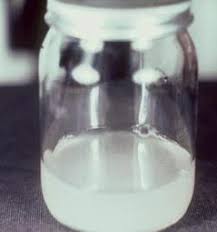
» “Rice water stool” from extreme loss of water and absence of solid in stool
Spread: fecal-oral route, specifically through fecal-contaminated water
» can drink water, or wash vegetables in contaminated water
» eat contaminated foods like crab and oysters
Epidemiology: Very common disease worldwide, but not in the US
» most US cases involve international travel
Treatment: rapid replacement of fluids and electrolytes (via IV or by drinking)
→ can decrease mortality rate from 30% to 1%
Prevention: have clean water and effective wastewater treatment
» live attenuated oral vaccine against serotype 01 (FDA-approved 2016) for travellers going to areas that are endemic with [__]
![<p><mark data-color="blue" style="background-color: blue; color: inherit;">infectious intestinal disease</mark></p><p><strong>[__]</strong>: <mark data-color="yellow" style="background-color: yellow; color: inherit;">severe diarrhea » 20 L fluid lost daily</mark></p><p><mark data-color="yellow" style="background-color: yellow; color: inherit;">» Vomiting and muscle cramps common due to severe dehydration</mark> → fatal as severe dehydration can cause damage to vital organs</p><p><mark data-color="yellow" style="background-color: yellow; color: inherit;">» “Rice water stool”</mark> from extreme loss of water and absence of solid in stool</p><img src="https://assets.knowt.com/user-attachments/b86d84a2-7d44-4648-a52c-6e8e7c2ce61e.jpg" data-width="50%" data-align="center"><p><u>Spread</u>:<strong> fecal-oral route</strong>, specifically through <mark data-color="purple" style="background-color: purple; color: inherit;">fecal-contaminated water</mark></p><p>» can <mark data-color="#f4eeee" style="background-color: rgb(244, 238, 238); color: inherit;">drink water</mark>, or <mark data-color="#f4eeee" style="background-color: rgb(244, 238, 238); color: inherit;">wash vegetables in contaminated water</mark></p><p>» eat contaminated foods like <mark data-color="#f4eeee" style="background-color: rgb(244, 238, 238); color: inherit;">crab </mark>and <mark data-color="#f4eeee" style="background-color: rgb(244, 238, 238); color: inherit;">oysters</mark></p><p></p><p><u><mark data-color="blue" style="background-color: blue; color: inherit;">Epidemiology</mark></u>: Very common disease worldwide, but not in the US</p><p>» most US cases involve international travel</p><p></p><p><u><mark data-color="blue" style="background-color: blue; color: inherit;">Treatment</mark></u>: rapid replacement of fluids and electrolytes (via IV or by drinking)</p><p>→ can decrease mortality rate from 30% to 1%</p><p></p><p><u><mark data-color="blue" style="background-color: blue; color: inherit;">Prevention</mark></u>: have <mark data-color="#f4eeee" style="background-color: rgb(244, 238, 238); color: inherit;">clean water and effective wastewater treatment</mark></p><p><mark data-color="#f4eeee" style="background-color: rgb(244, 238, 238); color: inherit;">» live attenuated oral vaccine against </mark><strong><mark data-color="#f4eeee" style="background-color: rgb(244, 238, 238); color: inherit;">serotype 01</mark></strong> (FDA-approved 2016) for travellers going to areas that are endemic with [__]</p>](https://assets.knowt.com/user-attachments/28fd29d7-3a9f-4e7c-9664-24b6947f46f7.png)
Vibrio cholerae
Cholera
Causative agent [__]: gram-negative, curved rod
» 1 million bacteria/mL expelled in feces of Cholera diarrhea
» produces cholera toxin » stimulates intestinal cells to lose electrolytes and water → causes symptoms of diarrhea
![<p><strong>Cholera</strong></p><p>Causative agent <strong><mark data-color="purple" style="background-color: purple; color: inherit;">[__]</mark></strong><mark data-color="purple" style="background-color: purple; color: inherit;">:</mark> <mark data-color="yellow" style="background-color: yellow; color: inherit;">gram-negative, curved rod</mark></p><p>» 1 million bacteria/mL expelled in feces of Cholera diarrhea</p><p>» produces <strong><mark data-color="purple" style="background-color: purple; color: inherit;">cholera toxin</mark></strong><mark data-color="yellow" style="background-color: yellow; color: inherit;"> » stimulates intestinal cells to lose electrolytes and water</mark> → causes symptoms of diarrhea</p>](https://assets.knowt.com/user-attachments/4620cf59-f0c0-436b-8a47-385e92dd5ba8.png)
Escherichia coli Gastroenteritis
Infectious intestinal disease
[__]: traveler’s diarrhea
Symptoms vary according to virulence of infecting strain
» all lead to vomiting and loose stools → profuse watery diarrhea
» can lead to severe cramps and bloody diarrhea
Can recover within 10 days
Causative agent: E.coli = main cause of traveler’s diarrhea
» E.coli infects travellers that haven’t been exposed to that specific strain of E.coli before → why locals are unaffected
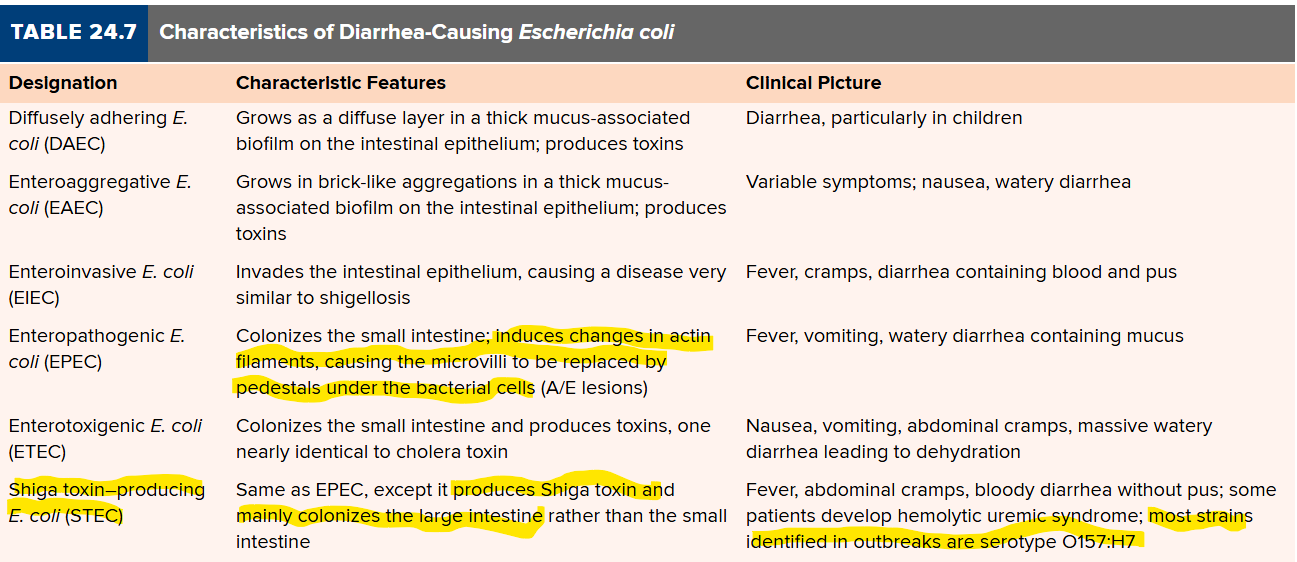
Shiga-toxin producing E.coli
STEC. Most pathogenic strain of E.coli
» foodborne-pathogen. Prototype strain/primary example: E.coli O157:H7
» produces shiga toxin → destroys colon cells
→ can travel to the kidney and cause hemolytic uremic syndrome which leads to kidney failure
→ survivors may require a dialysis later in life
Salmonellosis
Infectious intestinal disease
[__]: results in diarrhea (bloody), abdominal pain, nausea, and vomiting
Spread: fecal-oral route. primarily by foods contaminated by animal feces
» outbreaks primarily caused this way
» commonly contaminated poultry (chicken) and eggs; not as common, but also by tomatoes and alfalfa sprouts
» transmission through pet reptiles (turtle)
» asymptomatic cases of carriers, like “Typhoid Mary”
Prevention and Treatment: Sanitary handling of food and cooking to 165F = kills bacterium
» vaccine for Typhoid fever: severe type of disease caused by S. enterica (50-75% effective)
» surgical removal of gallbladder → eliminates carrier state
Salmonella enterica
Salmonellosis
Causative agent [__]: motile, Gram-negative rods
high infectious dose due to its high sensitivity to stomach acid
![<p><strong>Salmonellosis</strong></p><p>Causative agent <strong><mark data-color="purple" style="background-color: purple; color: inherit;">[__]</mark></strong>: <mark data-color="yellow" style="background-color: yellow; color: inherit;">motile, Gram-negative rods</mark></p><p><mark data-color="#f4eeee" style="background-color: rgb(244, 238, 238); color: inherit;">high infectious dose</mark> due to its high sensitivity to stomach acid</p>](https://assets.knowt.com/user-attachments/7dc14616-9cdb-4680-b9a6-8ec91fa6b816.png)
Clostridioides difficile Associated-Disease
Infectious intestinal disease
[__]: antibiotic-associated diarrhea (from individuals broad spectrum antibiotics over a long period of time)
Signs and symptoms vary widely:
» mild diarrhea with fever, pain
» colitis or pseudomembranous colitis → inflammation of the intestines that forms pseudomembranes of blood and pus as bacterium grows on intestine
Pathogenesis: infection occurs when C. difficile colonizes the gut due to dysbiosis: disruption of normal microbiota
Prevention and Treatment: oral vancomycin or fidaxomicin may be used (counterintuitive as antibiotics typically cause this disease)
» stop antibiotic treatment
» fecal microbiota transplant (FMT) → replace microbiome of affected individual from a healthy person. repairs dysbiosis and flushes out C. difficile; very effective
![<p><mark data-color="blue" style="background-color: blue; color: inherit;">Infectious intestinal disease</mark></p><p><strong><mark data-color="purple" style="background-color: purple; color: inherit;">[__]</mark></strong>: <mark data-color="yellow" style="background-color: yellow; color: inherit;">antibiotic-associated diarrhea</mark> (from individuals broad spectrum antibiotics over a long period of time)</p><p><u>Signs and symptoms vary widely:</u></p><p><mark data-color="yellow" style="background-color: yellow; color: inherit;">» mild diarrhea with fever, pain</mark></p><p>» <strong>colitis</strong> or <strong><mark data-color="yellow" style="background-color: yellow; color: inherit;">pseudomembranous colitis</mark></strong><mark data-color="yellow" style="background-color: yellow; color: inherit;"> → inflammation of the intestines that forms pseudomembranes of blood and pus as bacterium grows on intestine</mark></p><p></p><p><u><mark data-color="blue" style="background-color: blue; color: inherit;">Pathogenesis</mark></u>: infection occurs when <em>C. difficile</em> colonizes the gut due to <strong><mark data-color="purple" style="background-color: purple; color: inherit;">dysbiosis</mark></strong>: <mark data-color="yellow" style="background-color: yellow; color: inherit;">disruption of normal microbiota</mark></p><p></p><p><u><mark data-color="blue" style="background-color: blue; color: inherit;">Prevention and Treatment</mark></u><mark data-color="blue" style="background-color: blue; color: inherit;">:</mark> <mark data-color="#f4eeee" style="background-color: rgb(244, 238, 238); color: inherit;">oral vancomycin</mark> or <mark data-color="#f4eeee" style="background-color: rgb(244, 238, 238); color: inherit;">fidaxomicin </mark>may be used (counterintuitive as antibiotics typically cause this disease)</p><p><mark data-color="#f4eeee" style="background-color: rgb(244, 238, 238); color: inherit;">» stop antibiotic treatment</mark></p><p><mark data-color="#f4eeee" style="background-color: rgb(244, 238, 238); color: inherit;">» </mark><strong><mark data-color="#f4eeee" style="background-color: rgb(244, 238, 238); color: inherit;">fecal microbiota transplant (FMT)</mark></strong> → replace microbiome of affected individual from a healthy person. repairs dysbiosis and flushes out <em>C. difficile;</em> <mark data-color="yellow" style="background-color: yellow; color: inherit;">very effective</mark></p>](https://assets.knowt.com/user-attachments/971f4ad6-d99d-4531-9b60-2dc0260501f0.png)
Clostridioides difficile
C. difficile Associated Disease
Causative agent [__]: Gram-positive, endospore-forming, obligate anaerobic rod
» formerly belonged to the Clostridium genus (has its own genus now)
» produces one or more cytotoxins (A and B) that are lethal to intestinal epithelium
» colonizes surface of intestine when normal microbiota not present
Norovirus Gastroenteritis
Infectious intestinal disease (Viral)
[__]: abrupt onset of nausea, vomiting, and diarrhea. Short (subsides in 12-60 hours) but awful
Spread: fecal-oral route but also via aerosols and contaminated surfaces
» highly contagious
» millions of cases in the US annually
Epidemiology: causes >50% of foodborne illnesses and common overall on cruise ships and dormitories
Treatment and Prevention: handwashing and disinfectants
» no proven anti-noroviral medications
» no vaccine
![<p><mark data-color="blue" style="background-color: blue; color: inherit;">Infectious intestinal disease (</mark><strong><mark data-color="blue" style="background-color: blue; color: inherit;">Viral</mark></strong><mark data-color="blue" style="background-color: blue; color: inherit;">)</mark></p><p><strong><mark data-color="purple" style="background-color: purple; color: inherit;">[__]</mark></strong>: <mark data-color="yellow" style="background-color: yellow; color: inherit;">abrupt onset of nausea, vomiting, and diarrhea. Short (subsides in 12-60 hours) but awful</mark></p><p></p><p><u>Spread</u>: <strong>fecal-oral route</strong> but also via <mark data-color="#f4eeee" style="background-color: rgb(244, 238, 238); color: inherit;">aerosols</mark> and <mark data-color="#f4eeee" style="background-color: rgb(244, 238, 238); color: inherit;">contaminated surfaces</mark></p><p><mark data-color="yellow" style="background-color: yellow; color: inherit;">» highly contagious</mark></p><p><mark data-color="yellow" style="background-color: yellow; color: inherit;">» millions of cases in the US annually</mark></p><p></p><p><u><mark data-color="blue" style="background-color: blue; color: inherit;">Epidemiology</mark></u>: <strong>causes<mark data-color="yellow" style="background-color: yellow; color: inherit;"> >50% of foodborne illnesses</mark></strong> and common overall on cruise ships and dormitories </p><p></p><p><u><mark data-color="blue" style="background-color: blue; color: inherit;">Treatment and Prevention</mark></u>: handwashing and disinfectants</p><p>» no proven anti-noroviral medications</p><p>» no vaccine</p>](https://assets.knowt.com/user-attachments/cd36ec6e-4ddb-4c03-89aa-a1a3278ce82c.png)
Norovirus
Norovirus Gastroenteritis
Causative agent [__]: non-enveloped virus that infects intestinal cells
» shed in feces
» highly contagious → infectious dose of <20 virions
» designated Class B bioterrorism agent due to easy spread (fecal-oral route, air and fomites)
Hepatitis
Disease that results from infection and inflammation of liver
» 3 types: [__] A, [__] B, and [__] C
» most noticeable sign is jaundice: yellowing of skin and whites of eyes
Hepatitis A
Viral Disease in Kidneys
[__]: “infectious hepatitis”
» acute illness that results in: jaundice, fever, fatique, clay-colored feces, and vomiting (in older children and adults). no known chronic form or carrier state!
» asymptomatic (for most young children <6y/o and those 6-14 y/o)
Spread: fecal-oral route or vehicle-born (fecal-contaminated food or water)
» raw shellfish from fecal polluted seawater
» many outbreaks occur at restaurants (eg. McDonalds [__] Outbreak)
Pathogenesis:
» following ingestion, [__] virus goes to liver to replicate
» virus gets released to bile, which gets released into the stomach → shed in feces
Prevention and Treatment: inactivated HAV vaccine for 1-2 y/o and adults
Hepatitis A virus
Hepatitis A
Causative agent [__]: HAV
non-enveloped single stranded RNA virus belonging to Picornaviridae family
» Highly infectious
Hepatitis B
Viral Disease in Kidneys
[__]: hepatitis with an incubation period is 2-5 months (“silent killer/disease”), depending on dose → ninth leading cause of death globally
» acute disease that is asymptomatic to severe
» seldom fatal and clears within weeks or months
» can be chronic disease (happens to 1/5 patients)
→ cirrhosis: scarring of liver, liver failure, liver cancer, etc.
Spread: body fluids (saliva, blood, blood products, semen)
→ sharing of needles, toothbrushes, razors, unsterile tattooing or ear-piercing instruments
→ sexual intercourse makes up 50% of cases in US
Treatment and Prevention: Hep B vaccine → first vaccines given to newborns
» education in high-risk groups on proper use of condoms
» regular screening of adults for HBV
Hepatitis B
Hepatitis B
Causative agent [__]: HBV
Enveloped, dsDNA (double-stranded DNA) genome, member of Hepadnaviridae family
![<p><strong>Hepatitis B</strong></p><p>Causative agent <strong><mark data-color="purple" style="background-color: purple; color: inherit;">[__]</mark></strong>: <mark data-color="yellow" style="background-color: yellow; color: inherit;">HBV</mark></p><p><mark data-color="yellow" style="background-color: yellow; color: inherit;">Enveloped, dsDNA (double-stranded DNA) genome, member of Hepadnaviridae family</mark></p>](https://assets.knowt.com/user-attachments/a820d26d-b346-4cc9-ab5d-110ea8315739.png)
Hepatitis C
Viral Disease in Kidneys
[__]: exhibits similar symptoms to Hepatitis A and B but generally milder
» mild symptoms lead to 80% of infected to develop chronic infection over time
→ cirrhosis, liver cancer
Spread: infected blood
» blood transfusion, tattoos and body piercing with unsterile instruments, needle sharing, toothbrushes, razors, towels, and sexual intercourse
» most common chronic blood-born infection in the US from needle sharing
Treatment and Prevention: no vaccine
» interferon injections and ribavirin
» new group of anti-HCV medications available (95% cure rate)
→ direct acting antivirals (DAAs) interfere with HCV-encoded proteins required for replication of viral genome; a costly and intense treatment wherein a specific strain of HCV was templated for the cure
→ combinations taken orally; variations related to differences in HCV genotypes.
Hepatitis C
Hepatitis C
Causative Agent [__]: enveloped, single-stranded RNA virus belonging to Flaviviridae