Learn: 20 Amino Acids
 Call Kai
 Learn
Learn Practice Test
 Spaced Repetition
 Match
Match Flashcards
 Knowt Play
1/19

There's no tags or description
Looks like no tags are added yet.
Name | Mastery | Learn | Test | Matching | Spaced | Call with Kai | Chat |
|---|
No analytics yet
Send a link to your students to track their progress
20 Terms

Glycine (Gly, G)
Nonpolar, aliphatic
Smallest AA, achiral

Alanine (Ala, A)
nonpolar, aliphatic

Valine (Val, V)
nonpolar, aliphatic

Leucine (Leu, L)
Nonpolar, Aliphatic

Isoleucine (Ile, I)
Nonpolar, aliphatic
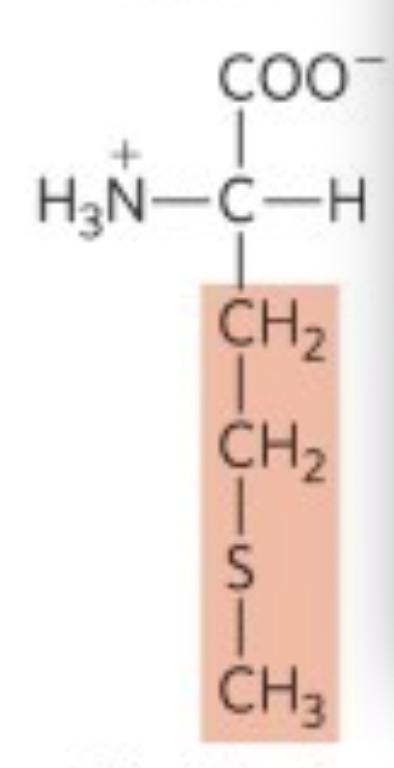
Methionine (Met, M)
Nonpolar, aliphatic
One of two AAs that contains a sulfur atom in the side chain; because S has a methyl group attached, it's considered to be relatively nonpolar

Proline (Pro, P)
Nonpolar, aliphatic
Cyclic amino acid; introduces kinks in the Alpha helix (rarely found in a-helices except those that cross the cell membrane) and turns in Beta-pleated sheets

Tryptophan (Trp, W)
Nonpolar, aromatic

Phenylalanine (Phe, F)
Aromatic, Nonpolar

Tyrosine (Tyr, Y)
Aromatic, Relatively polar (bc of -OH)

Serine (Ser, S)
Polar, uncharged
-OH group makes this highly polar due to Hydrogen bonding capabilities

Threonine (Thr, T)
Polar, uncharged
-OH group makes this highly polar due to Hydrogen bonding capabilities

Asparagine (Asn, N)
Polar, uncharged
Amide side chain whose N doesn't gain or lose hydrogen, does not become charged

Glutamine (Gln, Q)
Polar, uncharged
Amide side chain whose N doesn't gain or lose Hydrogen, does not become charged

Cysteine (Cys, C)
Polar, uncharged
Has (-SH)/thiol group, prone to oxidation because sulfur is larger and less electronegative than O-H bond (SH bond weaker than OH bond).
2 Cysteine molecules can oxidize to form cystine (disulfide bond), creating loops in the protein chain

Aspartate (Asp, D)
Negatively charged, Acidic side chain
Aspartic acid is the protonated form

Glutamate (Glu, E)
Negatively charged, Acidic side chain
Glutamic acid is the protonated form

Arginine Arg, R
Positively charged, Basic side chain
3N - positive charge delocalized over all three

Lysine (Lys, K)
Positively charged, Basic side chain
Terminal primary amino group

Histidine (His, H)
Positively charged, basic side chain
Imidazole-aromatic ring with 2N atoms