Module 3.1 - Datalink Layer - Making Connection Efficient
 Call Kai
 Learn
Learn Practice Test
 Spaced Repetition
 Match
Match Flashcards
 Knowt Play
1/18

Earn XP
Description and Tags
Midterm topic
Name | Mastery | Learn | Test | Matching | Spaced | Call with Kai | Chat |
|---|
No analytics yet
Send a link to your students to track their progress
19 Terms
TRUE
Under simplest conditions, a medium can carry only one signal at any moment in time
TRUE
For multiple signals to share a medium, the medium must somehow be divided, giving each signal a portion of the total bandwidth
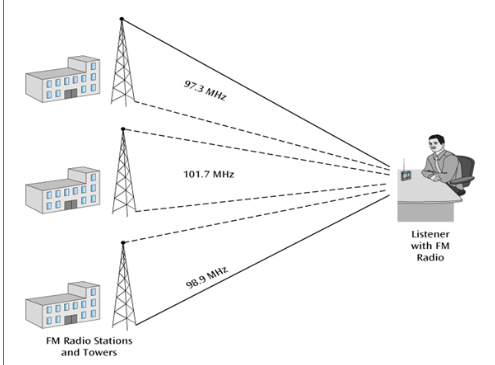
Frequency Division Multiplexing
Assignment of non-overlapping frequency ranges to each “user” or signal on a medium. Thus, all signals are transmitted at the same time, each using different frequencies
A multiplexor takes multiple input signals, assigns each a distinct set of frequencies, and combines them onto one transmission line at the same time. A receiver (demultiplexor) splits the combined frequencies back into their original, separate signals.
Oldest multiplexing technique, Uses standard or discrete analog signaling, making it inherently susceptible to noise and interference.
Broadcast radio and television, Cable TV systems, etc.
Time Division Multiplexing
Sharing of the signal is accomplished by dividing available transmission time on a medium among users
Digital signaling is used exclusively in this
This comes in 2 basic forms: Synchronous and Statistical
Synchronous Time Division Multiplexing
(Type of Time Division Multiplexing)
The original time-division multiplexing
The multiplexor accepts input from attached devices in a round-robin fashion and transmits the data in a never-ending pattern
shares a single line by giving connected devices continuous, strictly timed turns to transmit data over the full connection. Because these turns repeat in a fixed, predictable order, the receiver always knows which device sent the data based on the clock alone.
T-1 and SONET telephone systems are examples of this

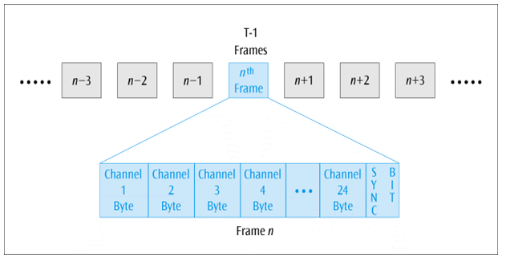
T-1 Multiplexing
A type of Synchronous time division multiplexing
This multiplexor stream is a continuous series of frames
It combines 24 separate voice or data lines into a single high-speed connection. It works by rapidly taking strictly timed turns collecting data from each line, merging them into one continuous 1.544 Mbps stream. Telecommunications companies and businesses used this system to efficiently transmit dozens of simultaneous phone calls or data streams through a single cable.
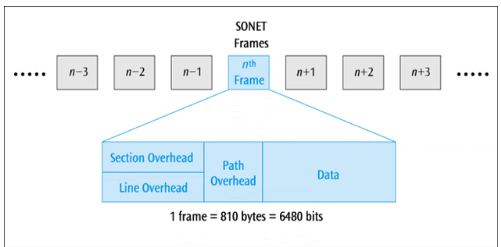
SONET/SDH Multiplexing
A type of Synchronous time division multiplexing
Similar to T-1, This multiplexor stream is a continuous series of frames and is used for high-speed data transmission
Telephone companies have traditionally used a lot of this but it may be giving way to other high-speed transmission services
Statistical Time Division Multiplexing
(Type of Time Division Multiplexing)
This multiplexor transmits the data from active workstations only
If a workstation is not active, no space is wasted in the multiplexed stream
The process: the multiplexor accepts the incoming data streams and creates a frame containing the data to be transmitted. To identify each piece of data, an address is included. If the data is of variable size, a length is also included. More precisely, the transmitted frame contains a collection of data groups

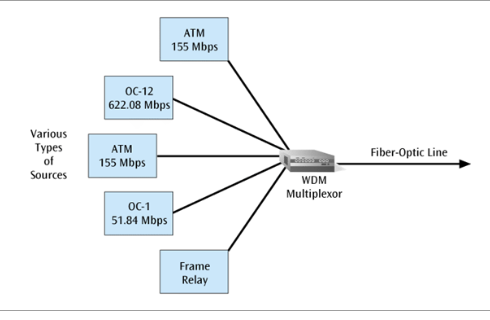
Wavelength Division Multiplexing
This technique multiplexes multiple data streams onto a single fiber-optics line
Different wavelength lasers (called lambdas) transmit the multiple signals
Each signal carried on the fiber can be transmitted at a different rate from the other signals
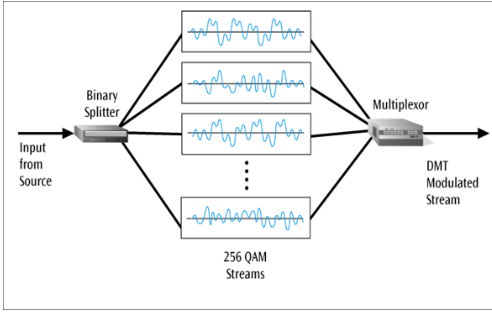
Discrete Multitone (DMT) Multiplexing
This is a multiplexing technique commonly found in digital subscriber line (DSL) systems
This combines hundreds of different signals, or subchannels, into one stream
All of these subchannels belong to a single user, unlike previous multiplexing techniques
Each subchannel is quadrature amplitude modulated
Theoretically, 256 subchannels, each transmitting 60 kbps, yields 1536 Mbps
There is noise, so the subchannels back down to slower speeds
Code Division Multiplexing
An advanced multiplexing technique that allows multiple devices to transmit on the same frequencies at the same time
Also known as code division multiple access
Each mobile device is assigned a unique 64-bit code
To send a binary 1, a mobile device transmits the unique code
To send a binary 0, a mobile device transmits the inverse of the code
To send nothing, a mobile device transmits zeros
The receiver gets summed signal, multiplies it by receiver code, adds up the resulting values
(Interprets as a binary 1 if the sum is near +64)
(Interprets as binary 0 if the sum is near -64)
Compression
This is a technique used to squeeze more data over a communications line or into a storage space
Ex: If you can make a data file down to one half of its original size, the file will obviously transfer in less time
Lossless Compression
When data is uncompressed, all original data returns
This is used for important data because it preserves every single bit of the original file without losing any information.
Replaces runs of 0s with a count of how many 0s
Lossy Compression
When data is uncompressed, you do not have the original data
This is often used to compress videos, images, audio files, etc.
MPEG, JPEG, MP3, etc.
Audio and video files do not compress well using lossless techniques
Audio Compression
A lot of audio nowadays is now compressed - MP3 players found in cellphones and iPod-like devices store and play compressed music
This is tricky and hard to describe. For example, a louder sound may mask a softer sound when both played together (so drop the softer sound)
Some people don’t like compressed audio and prefer to store their music in an uncompressed form (like FLAC) but this takes more storage
Video Compression
Still Images and videos do not compress well using run-length encoding
The difference between video frames is usually very small
So what if we just sent the difference between frames?
MPEG (Motion Picture Experts Group)
Is a group of people that have created a set of standards that can use these small differences between frames to compress a moving video(and audio) to a fraction of its original size
Image Compression
A color image can be defined by red/green/blue, or luminance/chrominance, which are based on RGB values
If you have 3 color values and each is 8 bits, you have 24 bits total (or 224 colors!)
JPEG (Joint Photographic Experts Group)
A lossy compression type for still images
This consists of 3 phases: Discrete cosine transformations (DCT), Quantization, Run-Length encoding