ECNS 201 - Unit 1
 Call Kai
 Learn
Learn Practice Test
 Spaced Repetition
 Match
Match Flashcards
 Knowt Play
1/19

There's no tags or description
Looks like no tags are added yet.
Name | Mastery | Learn | Test | Matching | Spaced | Call with Kai | Chat |
|---|
No analytics yet
Send a link to your students to track their progress
20 Terms
allocative efficiency
when the mix of goods being produced represents the mix that society most desires.
budget constraint
all possible consumption combinations of goods that someone can afford, given the prices of goods, when all income is spent; the boundary of the opportunity.
comparative advantage
when a country can produce a good at a lower cost in term of other goods, or, when a country has a lower opportunity cost of production.
invisible hand
idea that self-interested behavior by individuals can lead to positive social outcomes.
law of diminishing marginal utility
as we consume good of a good or service, the utility we get from additional units of the good or service tend to become smaller than what we received from earlier units.
law of diminishing returns
as additional increments of resources are added to producing a good or service, the marginal benefit from those additional increments will decline.
marginal analysis
examination of decisions on the margin, meaning a little more or a little less from the status quo.
normative statement
statement which describes how the world should be.
opportunity cost
measures cost by what is given up in exchange; measures the value of the forgone alternative.
opportunity set
all possible combination of a consumption that someone can afford given the prices of goods and the individual’s income.
positive statement
statement which describes the world as it is.
production possibilities frontier (PPF)
a diagram that shows the productively efficient combination of two products that an economy can produce given the resources it has available.
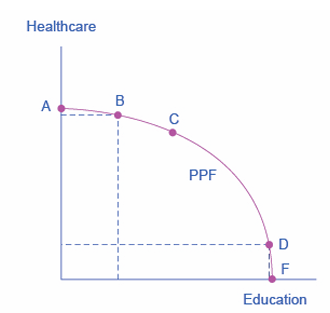
production possibilities frontier (PPF) slope
gives the opportunity cost of producing one more unit of the good in the x-axis in terms of the other good (in the y-axis).
how much of the y-axis second good must be given up to produce an additional unit of the x-axis first good.
productive efficiency
when it is impossible to produce more of one good (or service) without decreasing the quantity produced of another good (or service).
sunk costs
costs that are made in the past and cannot be recovered.
utility
satisfaction, usefulness, or value one obtains from consuming goods and services.
absolute advantage
when one country can use fewer resource to produce a good compared to another country. meaning when a county is more productive compared to another.
gain from trade
a country that can consume more than it can produce as a result of a specialization and trade.
specialization
processing more of one good in which a country has a comparative advantage. leads to an increase in total world production. allows countries to focus on their strengths, improving efficiency and output.
marginal analysis
examination of the associated costs and potential benefits of specific business activities or financial decisions. does the increase in income from the change outweigh the increase in cost to make the change. observed as the cost of producing an individual unit rather than output as a whole.