juris 1
 Call Kai
 Learn
Learn Practice Test
 Spaced Repetition
 Match
Match Flashcards
 Knowt Play
1/104

There's no tags or description
Looks like no tags are added yet.
Name | Mastery | Learn | Test | Matching | Spaced | Call with Kai | Chat |
|---|
No analytics yet
Send a link to your students to track their progress
105 Terms
Statutory Law
Laws passed by legislative bodies, such as the Senate and the House of Representatives, dictating the activities of persons subject to the law and providing penalties for non-compliance.
Regulatory Law
Law enacted by government agencies to enforce and understand statutes, including rule-making and adjudication for proper implementation.
Common Law
Common law encompasses those areas of law that have evolved over a hundred years of judicial decisions.
Stare Decisis
The policy of courts to stand by precedent, where rulings and interpretations are based on previous decisions.
Accredited Professional Organization (APO)
Refers to the duly integrated and accredited professional organization of registered and licensed pharmacists.
Continuing Professional Development (CPD)
Refers to the inculcation of advanced knowledge, skills, and ethical values in a post-licensure specialized or in an inter- or multidisciplinary field of study for assimilation into professional practice, self-directed research, and/or lifelong learning.
Philippine Practice Standards for Pharmacists
Refer to the established national framework for quality standards and guidelines of the practice of pharmacy that respond to the needs of the people who require the pharmacists’ services to provide optimal, evidence-based care.
Pharmacist-only OTC medicines
Refers to over-the-counter medicines classified by appropriate government agencies to be obtained only from a licensed pharmacist, with mandatory pharmacist’s advice on their selection and proper use.
Nontraditional outlets
Refer to entities licensed by appropriate government agencies to dispense over-the-counter medicines based on an approved list.
Institutional pharmacies
Refer to pharmacies of institutions, organizations, and/or corporations that provide a range of pharmaceutical services, given exclusively to the employees and/or their qualified dependents.
Telepharmacy services
Refer to pharmaceutical services of a duly licensed pharmaceutical outlet done through the use of telephone, teleconferencing, or facsimile.
Pharmacy aides
Refer to persons who assist the pharmacists in the different aspects of pharmacy operation based on established standard operating procedures and processes, with very minimal degree of independence or decision making and without direct interaction with patients.
Pharmacy assistants
Refer to persons who assist the pharmacists in different aspects of pharmacy operation based on established standard operating procedures and processes, with a minimum degree of independence or decision making and may have supervised interaction with patients.
Pharmacy technicians
Refer to persons who assist in compounding and dispensing of medicines in community, hospital, institutional and industrial settings or engaged in other activities under the supervision of the pharmacist.
Term of Office
Chairman and members shall hold office for 3 years.
Reappointment
They can be reappointed for another 3 years but cannot serve continuously for more than 6 years.
Certificate of Registration (COR)
Bears the registration number, date of issuance, signatures of the PRC and BOP, and the official seals of the PRC and the BOP. Must be displayed in establishments, and a duplicate is allowed in Category B establishments. Remains in full force and effect unless revoked or suspended. A revoked COR may be reissued after 2 years.
Professional Identification Card (PIC)
Bears the registration number, date of issuance and expiry, and signature of the PRC Chairperson. Renewed every 3 years with requirements of Certificate of Good Standing (COGS) from PPhA and CPD Requirements.
Category A Drug Establishments
Requires the direct and immediate control and supervision of a registered pharmacist (RPh). Includes wholesale and retail sale of drugs, manufacture, importation, exportation, distribution, pharmaceutical laboratories, and government units in 1st to 3rd Class municipalities.
Category B Drug Establishments
Requires the supervision and oversight of a registered pharmacist (RPh). Includes retail of over-the-counter (OTC) and household remedies, satellite pharmacies, government units in 4th to 6th Class municipalities, telepharmacy services, and nontraditional outlets. The RPh must be present for 2 hours/week in a maximum of 15 establishments with none farther than 25 km.
Medical Representative
One who represents authorized manufacturers, dealers, distributors, or wholesalers of drugs and pharmaceuticals, primarily to introduce or reacquaint a product to physicians, dentists, pharmacists, etc.
Cipher
Method of secret writing that substitutes other letters or characters for the letter intended.
Codes
System of words or other systems arbitrarily used to present words.
Secret Keys
Characteristics style or symbols kept from the knowledge of others or disclosed confidentially to one or few.
Prescription Switching
No pharmacist shall substitute drugs in a prescription without prior consultation with the prescriber.
Records Books for Prescriptions
All prescriptions dispensed must be recorded, indicating the name of the manufacturer, original stock, lot and control numbers, and must be kept for at least 2 years after the last entry.
Violent poisons
Any sale shall be recorded in a separate book indicating the date of each sale, name and address of the purchaser, name and quantity of the poison sold, and purpose of the purchase. If amount is dangerous, consult with prescriber first. A red label must be affixed containing the word 'Poison' and a vignette of skulls and bones.
Restrictions on the sale of Violent poisons
Should not be sold to individuals under 18 years old, those who are mentally deranged, or those under the influence of liquor or substance of abuse.
Duration for records of Violent poisons
The book will be kept for at least 5 years after the last entry.
Abortion-related drugs
No drug capable of provoking abortion shall be delivered or sold without a prescription. A record book must contain the number and date of prescription, name and address of physician, name, quantity and manufacturer of the drug, name and address of purchaser, date of filling the prescription, and signature of the registered pharmacist filling the prescription.
July 17, 2016
When was RA 10918 signed
Penalty for Minor Violations
Fine of 100,000 to 200,000 PESOS AND/OR imprisonment of NLT 30 days & NMT 1 year.
Grounds for Minor Violations
Includes affixing 'RPh' with no license, practicing without COR, PIC, or STP, noncompliance with requirements for filling, sale or alteration of labels of physician samples, use of cipher, code, or secret keys, noncompliance with labeling requirements, and refusal to undergo necessary training.
Penalty for Major Violations
Fine of 250,000 to 500,000 PESOS AND/OR imprisonment of NLT 1 year and 1 day & NMT 6 years.
Grounds for Major Violations
Includes violation of Sec. 30 (sale of drugs) & Sec. 31 (Pharmacist Requirements), operating without a licensed pharmacist, dispensing drugs in unlicensed places, forcing RPh to dispense contrary to the law, and involvement in fraudulent drug manufacture.
Republic Act No. 3720
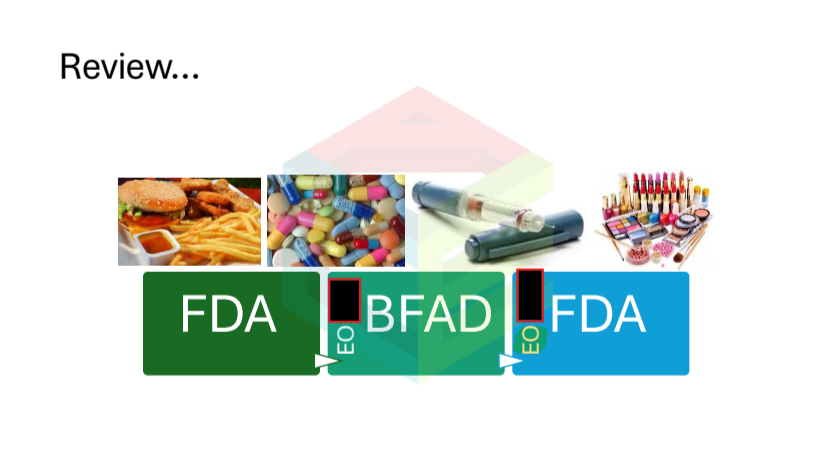
The Foods, Drugs, Devices and Cosmetics Act, amended by EO 175, ensures the safety and purity of foods, drugs, and cosmetics.
Food and Drug Administration (FDA)
An agency within the Department of Health responsible for the regulation and supervision of food, drugs, and cosmetics.
Executive Order 119
An order focused on reorganizing the Bureau of Food and Drugs.
851
119
Adulterated Drug or Device
If it consists in whole or in part of any filthy, putrid, or decomposed substance which may affect its safety, efficacy, or good quality. If it has been manufactured, prepared, or held under unsanitary conditions.
Misbranding
False or misleading label or container. Missing label or information. Contains narcotic or hypnotic substances, not using the official compendium name, liable to deterioration, imitation, sold under another name, or an antibiotic without batch certification.
June 22 1963
When was RA 3720 signed
Essential Drugs List
A list of drugs prepared and periodically updated by the Department of Health based on health conditions in the Philippines and internationally accepted criteria. It shall consist of a core list and a complementary list.
The Generics Act of 1988 (Republic Act No. 6675)
Legislation aimed at promoting and ensuring the availability of generic drugs in the Philippine market.
AP 62
AO 63
What AO
Prescribing requirements
Dispensing requirements
Sept 13 1988
When was RA 6675 signed
1972
April 4 1972
Prohibited drug (RA 6425)
Includes opium and its active components and derivatives, such as heroin and morphine; coca leaf and its derivatives; hallucinogenic drugs; Indian hemp and its derivatives; and other drugs producing similar effects.
Regulated drug (RA 6425)
Includes self-inducing sedatives, such as secobarbital and phenobarbital, and any drug which produces physiological action similar to amphetamines, along with hypnotic drugs, such as methaqualone.
Narcotic drug (RA 6425)
Refers to any drug which produces insensibility, stupor, melancholy or dullness of mind with delusions, including opium and its derivatives.
Comprehensive Dangerous Drugs Act of 2002 (RA 9165)
Legislation that establishes regulations and penalties regarding prohibited and regulated drugs.
Clandestine Laboratory
Any facility used for the illegal manufacture of any dangerous drug and/or controlled precursor and essential chemical.
Controlled Delivery
The investigative technique of allowing an unlawful or suspect consignment of any dangerous drug and/or controlled precursor and essential chemical, equipment or paraphernalia, or property believed to be derived directly or indirectly from any offense, to pass into, through or out of the country under the supervision of an authorized office.
Den, Dive or Resort
A place where any dangerous drug and/or controlled precursor and essential chemical is administered, delivered, stored for illegal purposes, distributed, sold or used in any form.
Cannabis
Embraces every kind, class, genus, or species of the plant Cannabis sativa L., including, but not limited to, Cannabis americana, hashish, bhang, guaza, churros and ganjab.
Financier
Any person who pays for, raises or supplies money for, or underwrites any of the illegal activities prescribed under this Act.
Illegal Trafficking
The illegal cultivation, culture, delivery, administration, dispensation, manufacture, sale, trading, transportation, distribution, importation, exportation and possession of any dangerous drug and/or controlled precursor and essential chemical.
Opium Poppy
Refers to any part of the plant of the species Papaver somniferum L., Papaver setigerum DC, Papaver orientale, Papaver bracteatum and Papaver rhoeas, which includes the seeds, straws, branches, leaves or any part thereof, or substances derived therefrom, even for floral, decorative and culinary purposes.
Planting of Evidence
The willful act by any person of maliciously and surreptitiously inserting, placing, adding or attaching directly or indirectly.
Protector/Coddler
Any person who knowingly and willfully consents to the unlawful acts provided for in this Act and uses his/her influence, power or position in shielding, harboring, screening or facilitating the escape of any person he/she knows, or has reasonable grounds to believe on or suspects, has violated the provisions of this Act in order to prevent the arrest, prosecution and conviction of the violator.
Pusher
Any person who sells, trades, administers, dispenses, delivers or gives away to another, on any terms whatsoever, or distributes, dispatches in transit or transports dangerous drugs or who acts as a broker in any of such transactions, in violation of this Act.
3 permanent members
12 ex official
2 regular members
Member category of DDB
S-Licenses
Licenses related to the preparation and distribution of drug preparations containing controlled chemicals.
Exempt DD preparation (S-1)
Retail of drug preparations containing controlled chemicals.
Prescribers (S-2)
Individuals who are authorized to prescribe controlled drugs.
Retailers of DD preparation (S-3)
Retailers of drug preparations in any form and DD preparations containing controlled chemicals.
Wholesaler (S-4)
Entities that sell controlled chemicals in bulk.
Importer (S-5-I)
Entities or individuals authorized to import controlled chemicals.
Compounder (S-5-C)
Entities or individuals authorized to compound controlled drugs.
Exporter (S-5-E)
Entities or individuals authorized to export controlled drugs.
Bulk Depot/Storage (S-5-D)
Facilities that store controlled chemicals in bulk.
Research (S-6)
Entities or individuals engaged in research involving controlled chemicals.
Importer AND compounder (S-7)
Those who import and compound controlled drugs.
Special prescription info
Special prescriptions retained by the pharmacist for 1 year, with a maximum of 10 booklets.
Triplicate copy
Records the pharmacist, patient, and doctor, with respective colors — White for Pharmacist, Pink for Patient, and Yellow for Doctor.
Confiscated or seized chemicals
Shall be submitted to PDEA within 24 hours.
Republic Act 8203
An act of prohibiting counterfeit drugs, providing penalties for violations and appropriating funds. This act shall be known as the 'Special Law on Counterfeit Drugs.'
Counterfeit drugs
Counterfeit drug/medicine refers to medicinal products with the correct ingredients but not in the amounts as provided hereunder, wrong ingredients, without active ingredients, with insufficient quantity of active ingredient, which results in the reduction of the drug’s safety, efficacy, quality, strength, or purity.
September 4 1996
When was RA 8203 signed
February 15 2010
When was RA 9994 signed
R.A. 7432
Senior Citizen Act that outlines the rights and privileges of senior citizens.
R.A. 9257
Expanded Senior Citizen Act of 2003, enhancing benefits and privileges for senior citizens.
R.A. 9994
Expanded Senior Citizen Act of 2010 that provides additional benefits and privileges.
Privileges for Senior Citizens
Includes a twenty percent (20%) discount and exemption from value-added tax (VAT) on specific goods and services.
Eligibility for Discounts
Covers professional fees for attending physicians in private hospitals, medical facilities, outpatient clinics, and home health care services.
Identification for Availment
Required documents include an identification card issued by the Office of the Senior Citizen Affairs (OSCA), a passport, and other proof of age.
Office for Senior Citizens Affairs (OSCA)
Headed by a senior citizen appointed by the mayor for a term of three years without reappointment. Entitled to an honorarium equivalent to Salary Grade 10.
National Drug Policy
Established under President Corazon Aquino to ensure safe, efficacious, and affordable essential drugs are accessible to all Filipinos. Promotes rational drug use including Quality Assurance, Rational Use by Health Professionals, National Self-sufficiency, and DOH’s Procurement Program.
Price Act (Republic Act No. 7581)
An act providing protection to consumers by stabilizing prices of basic necessities and prime commodities and prescribing measures against undue price increases during emergency situations.
Hoarding
Undue accumulation of basic necessities or prime commodities by individuals beyond normal inventory levels, including unreasonable limitations on the distribution of these commodities.
Hoarding
There shall be prima facie evidence of hoarding when a person has stocks of any basic necessity or prime commodity fifty percent (50%) higher than his usual inventory and unreasonably limits, refuses or fails to sell the same to the general public at the time of discovery of the stocks.
Profiteering
There shall be prima facie evidence of profiteering whenever a basic necessity or prime commodity being sold: has no price tag, is misrepresented as to its weight or measurement, is adulterated or diluted, or whenever a person raises the price of any basic necessity or prime commodity he sells or offers for sale to the general public by more than ten percent (10%) of its price in the immediately preceding month.
Cartel
Any combination of or agreement between two (2) or more persons engaged in the production, manufacture, processing, storage, supply, distribution, marketing, sale, or disposition of any basic necessity or prime commodity designed to artificially and unreasonably increase or manipulate its price.
Automatic Price Control
Unless otherwise declared by the President, prices of basic necessities in an area shall automatically be frozen at their prevailing prices or placed under automatic price control whenever: that area is proclaimed or declared a disaster area or under a state of calamity; that area is declared under an emergency; the privilege of the writ of habeas corpus is suspended in that area; that area is placed under martial law; that area is declared to be in a state of rebellion; or a state of war is declared in that area.
AO 55 s. 1988
Regulates the principal display panel of a label, requiring it to be clear and examined under retail conditions. The brand name must use a specific typeface, Helvetica Medium, and the Rx symbol must be printed at a specified height. Also outlines how alcohol content and expiration dates should be displayed.
Minimum Mandatory Info on Labelling Materials
Includes the product's name, dosage form, strength, pharmacologic category, Rx symbol, indications, contraindications, directions for use, storage conditions, and a warning regarding prescription requirements.
AO 56 s. 1989 (Licensing Requirements)
Outlines requirements for drugstores, including the need for a signboard, well-ventilated areas for compounding and storage, and a cabinet for dangerous drugs.
License-to-Operate
Details the validity of LTO, including initial registration and renewal processes. Major and minor variations that require approval or notification are also outlined.
AO 56 s. 1989 (Licensing Requirements)
Outlines the licensing requirements for drugstores, administrative sanctions including temporary closure for absence of a registered pharmacist (RPh), suspension and revocation of License to Operate (LTO) for various violations.
AO 67 – Registration of Pharmaceutical Products
Covers the registration categories for pharmaceutical products, including Drugs for General Use, Drugs for Restricted Use, Tried and Tested Drugs, New Drugs, Investigational New Drugs, and Established Drugs.