A100 Final IU
 Call Kai
 Learn
Learn Practice Test
 Spaced Repetition
 Match
Match Flashcards
 Knowt Play
1/63

There's no tags or description
Looks like no tags are added yet.
Name | Mastery | Learn | Test | Matching | Spaced | Call with Kai | Chat |
|---|
No analytics yet
Send a link to your students to track their progress
64 Terms
Financial Accounting Report
Periodic financial statements and related disclosures
Managerial Accounting Report
Detailed plans and continuous performance reports
External Decision Makers
Evaluate the Company (creditors, investors)
Internal Decision Makers
Run the company (managers)
Accounting
The recording of business transactions, the preparation of reports summarizing these transactions, and the analysis of financial information
Capital Markets
All investors and creditors that provide funds to the business to operate and grow
Accounting Equation
Assets= Liabilities(outsider claim to assets) + Stockholders' Equity(insider claim to assets)
Business Activities Categories
Operating, Investing, Financing
Operating Activities
Everyday business transactions (including interest expense, dividend revenue)
Investing Activities
Transactions involving long term assets and investments
Financing Activities
Transactions involving long-term liabilities, stock, and dividend payments
Equity Investors
Contributions from Owners (for a corporation = stockholders) Earnings retained from profitable business operations (Retained Earnings).
Debt Investors
Creditors of the business, such as a bank, bondholders, leasing companies
Reported as current "liabilities" or "long-term liabilities" on the financial statements
Financial Leverage
Using borrowed money (debt) to increase the potential return on an investment.
By borrowing money, you can invest more than you could with just your own funds. If the investment does well, you earn more profit than you would have without borrowing
Legal Rights of Stockholders
Those contributing funds to the company are awarded share of ownership (shareholders).
Shareholders have voting rights on significant corporate matters.
Shareholders share in the company's profits and losses.
Risks to Stockholders
Stockholders face the risk of not receiving a satisfactory return on their investment.
Sometimes investors can lose some or all of the investment if the business fails.
Stockholders may expect dividend payments that are taxable income.
Benefits to Stockholders
Stockholders may enjoy increases in market value of their shares.
Stockholders may enjoy dividends if awarded by the Board of Directors
Benefits to the Company of Equity Financing
No obligation to repay.
The company doesn't have to pay dividends unless the BOD declares them.
More investors share in the risk of the project
Risks to Company of Equity Financing
Owners give up portions of their company to shareholders (who probably have opinions)
Company's may feel pressure to share profits through dividend payments instead of reinvesting in the company
Dividends are NOT tax deductible and are NOT expenses on the Income Statement
Legal Rights of Debt Investors
Both interest (tax deductible) and principal must be paid to the investor.
If the company does not make payments, the debt investor has legal recourse to "call" the loan and demand payment.
Creditors have a higher claim on the company's assets in bankruptcy over stockholder's.
Risks to Debt Investors
Payments will not be made on time.
Sometimes companies have to liquidate assets to make payments.
Liquidating assets may cause the company to file for bankruptcy.
Interest rate risk (if interest rates rise the value of existing fixed rate loans decrease on the creditor's Balance Sheet.)
Benefits to Debt Investors
Creditors receive regular interest payments (taxable revenue).
Creditors often secure loans with collateral in the even of non-payment.
Creditors can enforce loan covenants (restrictions to limit the company's financial activities and manage risk).
Benefits to the Company of Debt Financing
The owners retain full ownership.
Once the loan in paid in full, the relationship is over.
The company can budget exactly how much payments (principal and interest) will be.
Potential for higher rate of return (goal is to earn a higher return than that of the borrowed funds- net is retained by the company
Risks to the Company of Debt Financing
A company has to bay it back....plus interest! Even if the investment fails.
These payments could put a company in a cash flow crunch..
A company may need to sell their assets to make loan payments.
Financial Reporting Objectives
Provide specific information about economic resources, claims to those resources, and changes to resources and claims
Provide information useful in understanding a company's cash flows. This includes assessing the amount, timing of cash flows, and uncertainty of future cash flows.
Provide general information to help make investment and credit decisions
Securities & Exchange Commission (SEC)
Established in 1934
Only applies to public companies
Requires public companies to file reports of company activity
SEC required reports
Form 10-K (annually)
Form 10-Q (quarterly)
Annual financial statements audited by an "independent auditor"
Generally Accepted Accounting Principles (GAAP)
The accounting standards that companies based in the United States are required to use.
Standards give the statements credibility and allow reports of different companies to be compared
Financial Accounting Standards Board (FASB)
The organization that determines the GAAP
Independent Auditor
Also called an "external auditor", is an accounting firm that specializes in "public accounting"
Public Accounting
The company is in business to provide accounting services to
other companies. The external auditors performing the audit must be independent of the company they are auditing
Financial Statements
Balance Sheet
Income Statement
Statement of Retained Earnings/Stockholder's Equity
Statement of Cash Flows
Notes to the Financial Statements
Can be prepared anytime.
Are the responsibility of the company's management
Income Statement
Revenue
- Cost of goods sold
= Gross profit
- Operating expenses
= Net income from operations
+/- Gain or loss on sale of other assets
= Net income (Net Loss)
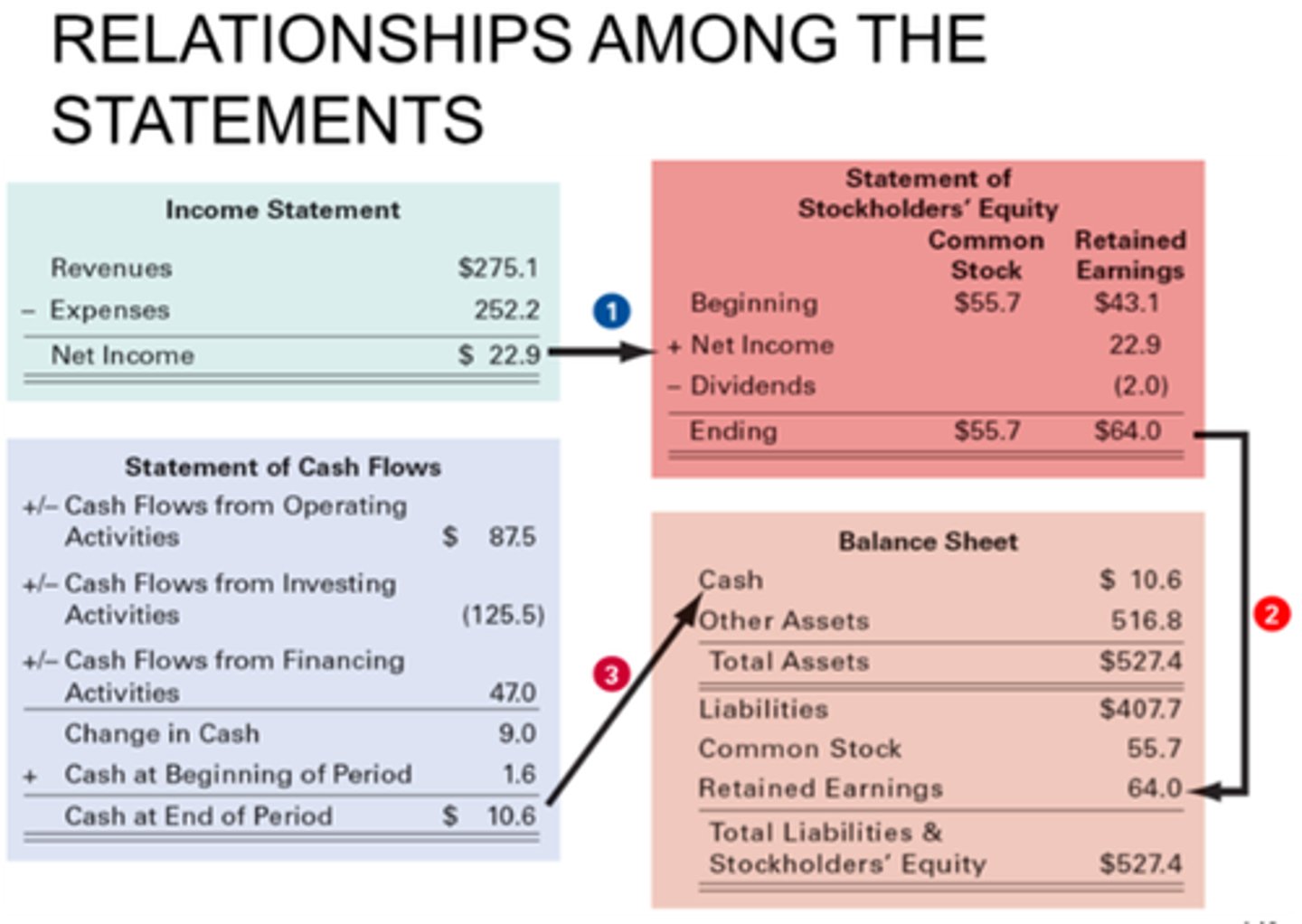
Statement of Retained Earnings
Beginning retained earnings
+ Net income (or - Net Loss)
- Dividends paid
Ending retained earnings
Balance Sheet
Assets = Liabilities + Stockholder's Equity
Statement of Cash Flows
Beginning cash
+/- Cash flows from operations
+/- Cash flows from investing
+/- Cash flows from financing
= Ending cash
Relationship between the financial statements
Accrual Basis (GAAP)
Records transactions in the period in which the events occurred, not when cash changes hands.
Cash Basis (Not GAAP)
Records transactions in the period in which cash changes hands, not when they occurred.
Matching Principle
Expenses are matched in the same period in which they contribute to the revenue earned
Accounts Payable (Liability)
If goods or services are provided before cash changes hands, then the company has expenses (on income statement) increase
Accounts Receivable (Asset)
If goods are services are provided before cash changes hands, then the company has an increase in revenue (on income statement)
Unearned Revenue (Liability on balance sheet)
When cash is received and before goods are services are provided, cash increases, but there is no revenue until the transaction occurs
Prepaid Expenses (Asset on balance sheet)
When cash is paid before goods are services are provided. Cash decreases, but the expense is not recorded until the transaction occurs.
Revenue Recognition
Record revenue when EARNED (when service is performed, when product is delivered), not when cash is received
Expense Recognition
Record expense when INCURRED (USED), not when cash is paid
Audit
An independent professional service that improves the quality of information for decision makers
Auditors
They objectively collect and evaluate evidence.
They have to be independent (unbiased/objective).
Make sure the F.S. are prepared in accordance with GAAP = with no material misstatements
Provide their opinion in an audit report to users (investors)
Principal-Agent Relationship
There is a conflict in priorities between the owner of an asset and the person to whom control of the asset has been delegated
Audit Opinion
Provides reasonable assurance about whether the financial statements are fairly stated in accordance with GAAP in all material respects
Audit Risk
The risk the auditor gives a clean opinion on financial statements that are materially misstated
Clean Audit Opinion
Indicates that all matters have been satisfactorily addressed
Tax Reporting
Cash-based with more advisory / consulting / planning
Major Sources of Tax Revenue
Local Tax, State Tax, Federal Tax
Local Tax
County, city, real estate (property) Ex: Education
Property Tax
Real Estate - Based on assessed (by the government) value of Real Estate
State Tax
Sales tax, income tax, C Corp. Business Income Tax. Ex: State parks
C Corp. business income tax
Only a small amount of tax collected; not a major source of taxes
Federal Tax
Individual Income Tax, C Corp. Business income tax, Federal Payroll Tax, Self-employment tax. Ex: Social Security and Medicare
Individual Income Tax
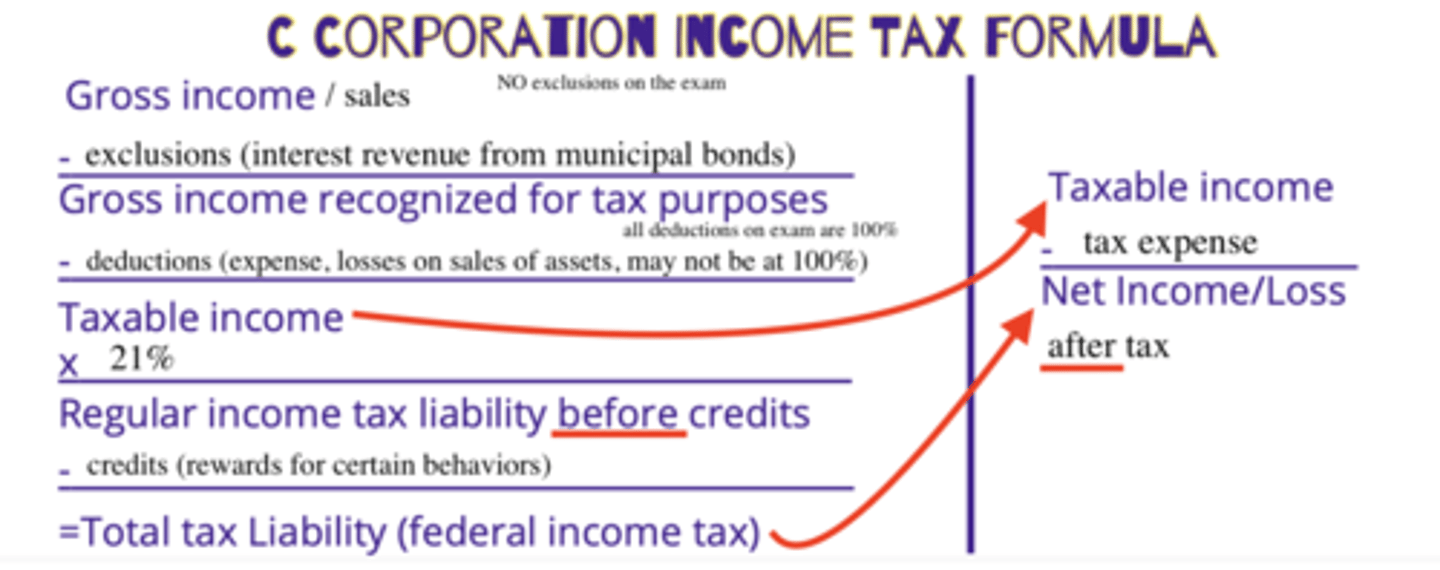
Income - Deductions = Taxable Income
Passthrough Entities
Does NOT file its own Federal Income Tax Return. Ex: Limited Liability Company (LLC), Partnership,
C Corporation Income Tax Formula
Limited Liability Company (LLC)
Earnings "passthrough" to each "members" individaul 1040 Federal Income Tax Return (Schedule C)
Partnership
Earnings "passthrough" to each "partners" individaul 1040 Federal Income Tax Return (Schedule K-1)