Saliva part 2
 Call Kai
 Learn
Learn Practice Test
 Spaced Repetition
 Match
Match Flashcards
 Knowt Play
1/88

There's no tags or description
Looks like no tags are added yet.
Name | Mastery | Learn | Test | Matching | Spaced | Call with Kai | Chat |
|---|
No analytics yet
Send a link to your students to track their progress
89 Terms
What is the Saliva Buffering Capacity responsible for?
Maintaining a constant pH in the oral cavity
What three buffer systems are seen in saliva?
- Bicarbonate
- Phosphate
- Protein
What minerals are part of saliva's buffering capacity?
Bicarbonate, calcium, non-specific buffers

What does Bicarbonate do in the saliva?
Helps to stabilize the pH and resist fluctuation
What is the buffering capacity measuring?
The buffering capacity is a measurement of the bicarbonate concentration
________ (High or Low) Buffering capacity resist pH changes and keeps the mouth stable
High
What does the buffering capacity indicate?
Indicates how well the saliva can moderate changes to the pH
What is the natural pH range of saliva in healthy individuals?
5.6 - 7.6
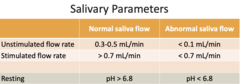
What is the normal and abnormal unstimulated salivary flow rate?
Normal: 0.3-0.5 mL/min
Abnormal:

What is the normal and abnormal stimulated flow rate?
Normal: >0.7 mL/min
Abnormal:

What is the normal and abnormal resting pH?
Normal: >6.8
Abnormal:
What is the normal and abnormal stimulated pH?
Normal: >7
Abnormal:

What is the normal and abnormal buffering capacity pH?
Normal: >10
Abnormal:

What type of environment (acidic or basic) is good protection against caries?
A basic environment
What can happen if you have a basic oral environment, but don't have good oral hygiene?
Precipitation of ions and calcification of plaque can occur.
Mouths with high levels of ________ tend to have high salivary pH
Calculus
Patients with __________ ____________ tend to develop more calculus
renal failure
Why do renal failure patients develop more calculus?
High content of urea in their saliva
The _________ found in saliva are essential in beginning the process of digestion of dietary _______ and _________.
- enzymes
- starches
- fats
What other role do the digestive enzymes have?
Break down food particles entrapped within dental crevices, protecting teeth from bacterial decay.
What does saliva's lubricating function do?
Wets food, permits the initiation of swallowing, and protects the mucosal surfaces of the oral cavity from desiccation.
What are the salivary digestive enzymes?
Amylase and Lipase
What type of foods begin digestion in the oral cavity due to amylase?
Rice, wheat, corn, potatoes, beans, and nuts
What does amylase do?
Breaks down large, insoluble starch molecules into smaller, soluble starches.
What molecule is produced after amylase breaks down large starches?
Maltose
What does lipase help digest?
Fats
What secretes lipase in the oral cavity?
von Ebner's glands of tongue
What else does von Ebner's glands secrete?
Serous saliva
Lipase catalyzes initial __________ digestion
triglyceride
Why is lipase important for newborns?
Digests milk fat
What is the protective function of lipase?
Prevents bacteria build-up on the teeth and washing away adhered food particles
What minerals are involved in enamel maitenance?
Proline-rich proteins, calcium, phosphates.

What mineral is lost during meal time?
Calcium
What is a biofilm?
Food/small particles combined with bacteria
What occurs on your teeth directly after mealtime?
Cariogenic bacteria in the biofilm metabolize dietary sugars via glycolysis
What type of environment is left in the mouth after meal time?
Acidic
What does the acidic environment cause?
Tooth demineralization
What happens to the pH of the mouth between meals?
Saliva raises pH to safe levels (pH above 5.5) allowing calcium ions to return to the tooth
How long does it take for pH to return to normal levels?
20 minutes to an hour
If there is not enough time for sufficient remineralization, what can happen?
Persistent calcium loss can lead to cavitation.

What is the critical pH of saliva?
5.5
What is demineralization?
- When saliva or plaque pH is < 5.5, tooth mineral (Ca2+, PO4) leached out
- This unsaturation causes tooth enamel to begin dissolving (demineralization).
What is remineralization?
- When the pH is > 5.5, saliva and plaque become supersaturated with tooth material.
- In this supersaturated state, Ca2+ and PO4 in saliva start to repair damaged mineral crystals in enamel (remineralization).

What should patients be informed about in terms of dietary prevention?
- Certain foods can cause demineralization and lead to caries.
- Saliva needs time between food intakes to restore calcium lost due to sugar-containing foods and beverages.
Why is always snacking or sipping on a soft drink bad for your mouth?
Causes mouth to be consistently acidic
Foods rich in _________ stimulate saliva flow
calcium
What are some examples of beneficial foods?
- Yogurt
- Cheese
- Milk
- Sugar-free chewing gum (with Xylitol)
What do French people give at the end of their meals?
Cheese
Why is xylitol better than regular sugar?
Xylitol can prevent caries
What is whole saliva?
A composite exocrine secretion from the major and minor salivary glands of the mouth.
How much saliva is produced during the day?
640 to 1200 mL
How much saliva is produced at night?
10 mL
Why should you brush your teeth before bed?
The nocturnal reduction of saliva flow takes away the oral cavity's protection and allows bacteria to "have a party"
What is stimulated whole saliva?
- Secretions of saliva produced by thinking of certain foods, tasting, and chewing.
- Complex process involving numerous neurological pathways
- One mode of stimulation can be gustatory
What does stimulated whole saliva do?
- Thought to aid in digestion and taste
- Protect, buffer, and confer immune response and maintain tooth integrity
How much can the parotid gland contribute during stimulated whole saliva?
As much as 50%
What is Unstimulated Whole Saliva?
- Saliva produced while sleeping, reading, bathing, etc.
- Always present in the mouth
- Very protective of the dentition and its supporting structures.
What does Unstimulated Whole Saliva do?
Plays a role in protection, buffering, antimicrobial action, and tooth integrity
What is the flow rates throughout the day of Unstimulated Whole Saliva?
Constant slow flow throughout the day, peaking during afternoon and lowest at 4:00 AM.
~ 0.3 - 0.5 mL per minute secretion rate
How much does each major salivary gland contribute to Unstimulated Whole Saliva?
Parotid - 25%
Submandibular - 60%
Sublingual - 7-8%
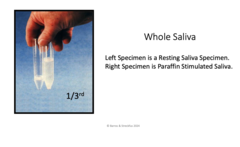
Resting saliva is only ______(fraction) of Parrafin Stimulated Saliva
1/3rd
What instrument is used to collect saliva?
Sialometer
How do you collect saliva?
- Collect unstimulated whole saliva, and stimulated whole saliva.
- Tell the patient to spit into a sialometer for a certain time
- Measure saliva flow rate by mL / minute
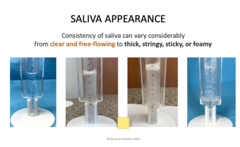
What are the different salivary appearances?
Clear and free flowing to thick, stringy, sticky, or foamy
What are the possible causes of sticky saliva?
Dehydration, dry mouth

What are the possible causes of frothy and bubbly saliva?
GERD, excessive mouth breathing
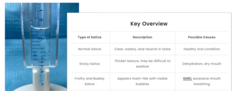
What are the possible causes of stringy saliva?
Allergies, dry mouth

What is an indication of Sjögren's Syndrome?
Foamy saliva
What are two diseases that affect saliva?
- Systemic Lupus Erythematosus
- Sjögren's Syndrome

What are possible causes of salivary hypofunction?
- Damage to acinar units (radiation, Sjogren's)
- Medications (blocking agents)
- Mechanical obstruction (sialoliths)
- Dehydration (diuretics)
- Chronic alcoholism
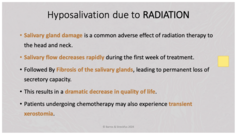
Hyposalivation due to head and neck radiation therapy
- Radiation therapy kills all cells
- Salivary flow decreases rapidly during first week of treatment
- Followed by fibrosis of the salivary glands, leading to permanent loss
- Results in dramatic decrease in quality of life
- Patients undergoing chemotherapy may experience transient xerostomia.
Hyposalivation due to Sjogren's syndrome
- First described by Henrich Sjögren in 1933
- Autoimmune condition affecting the salivary and lacrimal glands
- Female: male is 10:1
- Dry eyes (Keratoconjunctivitis sicca)
- Dry mouth (xerostomia)
- Bilateral parotid enlargement
- Often associated with connective tissue disorders

Hyposalivation due to medication
- Over 500 drugs are known to cause oral dryness
- Most medications do not damage the salivary gland
- The likelihood of decreased salivary flow rates increases with numerous diseases and medications
- Patients on multiple xerostomic medications tend to have more severe dry-mouth symptoms
- Effects of xerostomic medications can be highly variable among patients
- These medications directly inhibit salivary flow and are often associated with dry-mouth symptoms

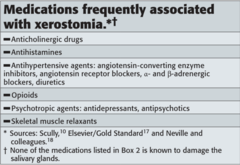
What medications are frequently associated with xerostomia?
- Anticholinergic drugs
- Antihistamines
- Antihypertensive agents: angiotensin-converting enzyme inhibitors, angiotensin receptor blockers, alpha and beta andrenergic blockers, diuretics
- Opiods
- Phsychotropic agents: anti-depressants, antipsychotics
- Skeletal muscle relaxants
What is Sialolithiasis?
Benign condition involving the formation of stones within the ducts of the major salivary glands
How often is Sialolithiasis present in each major salivary gland?
- 80% occur in the submandibular gland
- 10% occur in the parotid gland
- 7% occur in the sublingual gland
80% of submandibular stones are ________
radiopaque
Most parotid stones are _______
radiolucent
Classic presentation of complete obstruction of submandibular stone is _____ and ____________ prior to or during meal
pain and swelling
When partial obstruction occurs, __________ may be mild with chronic painful ___________ of the gland
swelling
enlargement
What are Ranulas
- Large retention cysts in the ducts of submandibular, sublingual, or mucous glands of the floor of the mouth
- Lesions are large, blue-purple-pink with pronounced vascularity
- Treatment is by excision or marsupialization

What is a Mucocele (Mucocyst)
- Retention cysts of the minory salivary glands of the labial mucosa
- Most frequently on the mandibular labial mucosa
- Less frequent on the palate and the floor of the mouth
- Lesions are large, ovoid swellings often bluish in appearance
- Treatment is by excision or marsupialization

How can dehydration cause hyposalivation?
- Dehydration may cause decreased parotid flow rates, independent of age in healthy adults
- Many studies have demonstrated decreased salivary secretion in heavy drinkers

Why should you never recommend listerine with alcohol?
The alcohol can dry up the mucosa
What can cause salivary gland enlargement?

What medical conditions are associated with xerostomia?

Sjogren's Syndrome (again)
- Systemic Autoimmune disorder
- Common symptoms dry mouth and eyes
- Due to inflammation of salivary and lacrimal glands
- It is related to rheumatological disease
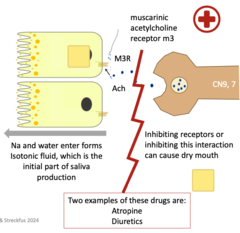
How do medical drugs cause dry mouth?
- CN 9 or 7 releases NTs to acinus cells
- Drugs inhibit receptors on cells, resulting in no release of saliva

What are two examples of drugs that cause dry mouth?
Atropine and Diuretics