AP MacroEconomics UNIT 1
 Call Kai
 Learn
Learn Practice Test
 Spaced Repetition
 Match
Match Flashcards
 Knowt Play
1/41

There's no tags or description
Looks like no tags are added yet.
Name | Mastery | Learn | Test | Matching | Spaced | Call with Kai | Chat |
|---|
No analytics yet
Send a link to your students to track their progress
42 Terms
Scarcity
Limited nature of society's resources. Example: OIL
Choice
Human behavior to choose how to spend/use the world's scarce resources.

Trade Offs
1st Principle of Economics-the fact that people's choice results in losing one quality or aspect of something in exchange for a quality or aspect of another
Private Property
Goods or Services owned by a person for exclusive use
Opportunity Cost
Whatever must be given up to obtain a good or service
There's no such thing as a free lunch!
Milton Friedman famous quote explaining that even in a free lunch, you are still paying opportunity cost (gas to get somewhere, time it takes, etc)
Efficiency
Society getting the most out of its scarce resources
Equality
The property of distributing economic prosperity uniformly among the members of society
Incentive
4th principle of economics. Something that induces a person to act a certain way (cigarette tax increase in the hopes to stop smoking)

Marginal Change
Small incremental changes to a plan of action (why buying in bulk is sometimes a better deal)
Circular Flow Model
The illustration representing the flow of goods and services between firms and households

Production Possibilities Frontier/ Production Possibility Curve
a graph that shows the combinations of output that an economy can possibly produce given the available factors of production and the available production technology
Imports
Goods produced abroad and sold domestically
Exports
Goods produced domestically and sold abroad
Absolute Advantage
One nation produces a good at a lower resource cost than another nation
Comparative Advantage
One nation produces a good a lower opportunity cost than another nation
Market
A group of buyers and sellers of a particular good or service

Quantity Demanded
The amount of a good that buyers are willing and able to purchase (change results in a movement along demand curve)
Demand
The amount of a good that buyers want to purchase based on underlying conditions (change results in shift in demand curve)
Quantity Supplied
The amount of a good that sellers are willing and able to sell (change results in movement along supply curve)
Supply
The amount of a good that sellers are willing and able to sell based on underlying conditions (change results in shift in supply curve)
Factors that affect demand
Income, Preferences, Price of Related Goods, Number of Buyers, Expectations
Factors that affect supply
Resource Prices, Technology, Taxes, Subsidies, Quotas, Number of sellers in market, Weather, Government Regulations
Substitute Goods
Two goods for which an increase in the price of one leads to an increase in the demand for the other

Complementary Goods
Two goods for which an increase in the price of one leads to a decrease in the demand for the other

Income effect
The change in consumption that results when a price change moves the consumer to a higher or lower indifference curve. More simply: when someone makes less, they will spend less.
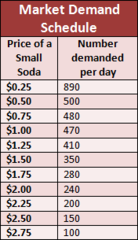
Demand Schedule
A table that shows the relationship between the price of a good and the quantity demanded
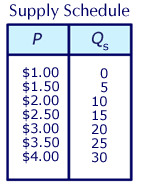
Supply Schedule
A table that shows the relationship between the price of a good and the quantity supplied
Normal Good
A good in which an increase in income will result in an increase in demand (ex. TVs)
Inferior Good
A good in which an increase in income will result in a decrease in demand (ex. McDonalds)
Neutral Good
A good in which an increase in income will not result in a change in demand (ex. Toilet Paper)
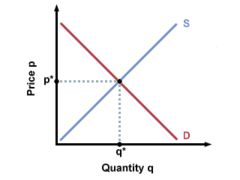
Equilibrium
A situation in which the market price has reached the level at which quantity supplied equals quantity demanded
Law of Diminishing Marginal Utility
Maximum amount of money he or she is willing to pay for one more unit of the good or service

Elasticity of Demand
A measure of how much the quantity demanded changes with a change in price
Elasticity of Supply
A measure of how much the quantity supplied changes with change in price
Total Revenue Test
An decrease in price and decrease in total revenue means inelastic. A decrease in price and an increase in total revenue means elastic. (remember the ACDC video)
Law of Supply
Price and Quantity supplied have a direct relationship. As price rises, so does quantity supplied
Ceteris Paribus
All other things are the same. When you compare two things, you keep in mind that all other things stay the same.

Economics
How society manages its resources
Margin
Each additional unit
Implicit
Unintended consequence
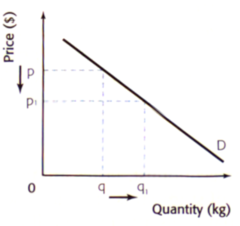
Law of Demand
As the price of goods increases, the quantity demanded decreases. Price and Quantity demanded have an inverse relationship