BMS2042 - W4: Genetic engineering
 Call Kai
 Learn
Learn Practice Test
 Spaced Repetition
 Match
Match Flashcards
 Knowt Play
1/6

There's no tags or description
Looks like no tags are added yet.
Name | Mastery | Learn | Test | Matching | Spaced | Call with Kai | Chat |
|---|
No analytics yet
Send a link to your students to track their progress
7 Terms
Forwards and reverse genetics
Forward genetic - phenotype → genotype
first identify mutant phenotype → identify gene sequence → analyse molecular function (how is it promoting wildtype phenotype, why does mutation cause mutant phenotype)
unbiased (not looking for a specific mutant, it just appears)
Reverse genetics - gene of interest/ genotype → phenotype
find a gene of interest → generate mutant allele → identify mutant phenotype
basically, you have a gene of interest and you alter that gene so you can see changes in phenotype which help with understanding function of that gene
General approach to forwards genetics:
mutagenise (introduce a mutant) germline of the organism
chemical mutagen (leads to chemical modification→ repaired → can cause changes in base pair → usually point mutations, nonsense mutations or splice site destructions → usually loss of function)
radiation (blast the germline with radiation agents → usually large scale rearrangements - deletions, inversions, translocations → usually loss of function, but can be gain of function)
insertional (pieces of DNA added into cell and insert themselves in a gene → usually loss of function)
insertional mutagenesis via transposons: selective marker (e.g. drug resistance) placed on a transposons (so you can see it is present) → transposase randomly inserts the transposon into a recognition site → take individual mutants and screen them.
self fertilise or undertake crosses to produce homozygotes for mutation
find offspring with mutant phenotype → screen for phenotypic changes of interest
some mutants only appear under certain conditions (e.g. temperature), so phenotypic screening design is important
map/ sequence to find impacted gene (find which gene is mutated)
use experiments to determine molecular role of the gene (why is it happening?)
General approach to reverse genetics:
What is gene manipulations?
mutate the gene to alter its function
modify expression of the gene
introduce the gene to another cell/ organism
General approach:
alter gene expression or structure (introduction of nucleic acids to cells)
transient - short lived, exist for a limited number of generations (usually not passed on to offspring)
permanent - integration with the cell’s DNA via recombination (transgene) → passes on mutant to offspring
How can we introduce nucleic acids to cells?
viral method (viruses deliver DNA from cell to cell)
physical methods (shooting the DNA into cells by force - injections)
chemical (change chemical nature of cell membrane → DNA can pass through
physicochemical (package DNA into lipid packages → phagocytosis or endocytosis into cell)
Gene knockdowns:
rather than target the mutate/ change the DNA sequence, we go after the gene product in the form of the RNA transcript
uses the RNAi (RNA interference) pathway which is usually used for defense from viruses (by recognising double stranded RNA) and gene regulation
inject a double stranded RNA or a virus carrying the double stranded RNA → RNAi pathways leads to knockdown of the level of expression of that RNA product → decrease expression
can also be done permanently by introducing a double stranded RNA gene as a transgene (knockdown)
Strengths:
provides good control on how you administer it - at exact time you want if you are adding it transiently
can target all genes in the genome (not non-coding regions though)
works on many eukaryotes
variable knockdown efficiency (might not want to knockout completely - as it may be an essential gene)
Weaknesses:
variable knockdown efficiency (can be a weakness bc sometimes you want to get rid of the entirety of the gene transcript but cannot)
not applicable to some eukaryotes that lack the RNAi system or when RNAi systems are not that useful (alternative is through morpholinos)
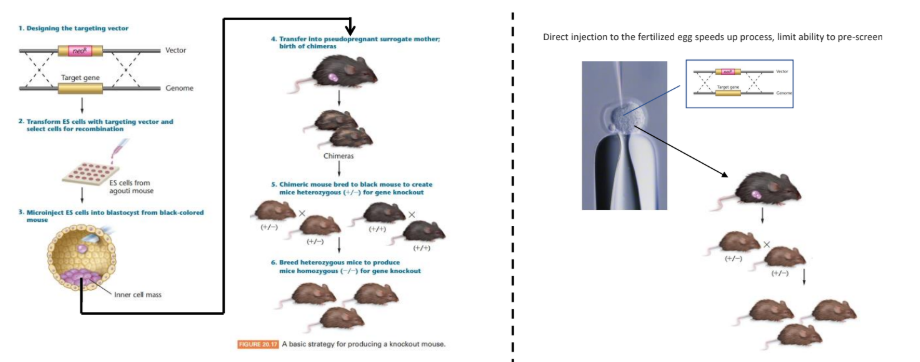
Gene knockouts via homologous recombination
abolish the gene function entirely (unlike gene knockdown) so no functional copies can be made
homologous recombination - swap a predesigned nonfunctional gene with a functional copy in the cell → creates knockout organism
design a targeting vector that allows for homologous recombination swap out
make a version that has a large portion or entirety removed = no longer function
should also contain a resistance marker or selectable marker
the edges/ side of the target gene should be the same as the knockout gene → so homologous recombination can occur
introduce the vector to the embryonic stem cells (dominant phenotype)
allows us to culture them and look for which ones have undergone recombination by looking at the selectable marker
cells are inserted into the blastocyst of another mouse (surrogate mother)
offspring will be chimeric → have original cells and knockout cells
when chimeras are crossed with black mice, should produce heterozygotes → breed the homozygotes to produce homozygotes for the knockout gene
Direct injection - speeds up the process but removes ability to pre screen
more useful if you’re looking to introduce some form of transgene that would show an obvious phenotype
less useful if you’re looking for a mutant phenotype
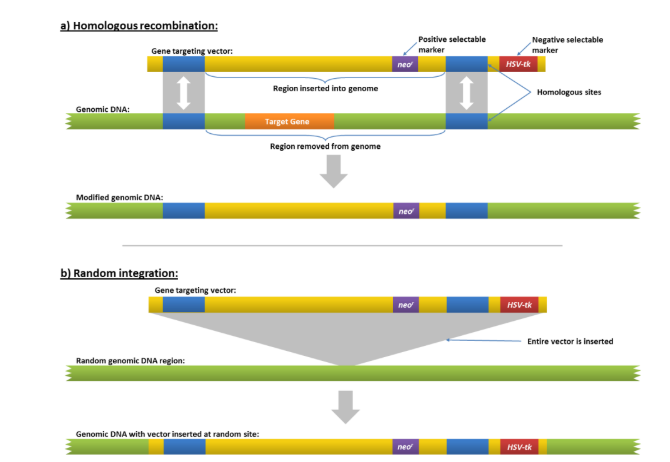
How can we avoid random integration of the selectable marker (and what does this mean)
The selectable marker could have integrated into a random genomic DNA region rather the region we want it inserted into via homologous recombination
these cells would also have the selectable marker
We can avoid this by using positive and negative selection
positive marker we want to select from located within the region we want to insert (between gene targeting region which is supposed to undergo homologous recombination)
negative selectable marker is added outside the homologous recombination region → after homologous recombination, negative selective marker should not be added
expose the DNA to something which will make it die if it contains the negative selectable marker
Knock-in - homologous recombination
Can show you what a gene ‘can do’
put in an entirely new gene in an organism
take a novel component (e.g. regulatory element) and add it to an existing gene
change one or more nucleotides (nucleotide variants)
CRISPR-Cas
Clustered Regularly Interspaced Short Palindromic Repeats (CRISPR) regions
these spacer sequences had homology to bacteriophages or plasmids
the repeat sequences get transcribed → makes precursor → processed into crRNAs → made up of the repeat region + spacer sequence (which has complementarity to a DNA sequence from a virus or plasmid/ external DNA). Downstream of the repeat sequence is the CAS operon which encodes for proteins. TracrRNA-crRNA-Cas complex is formed.
if invading phage/ plasmid that matches the sequence of the spacer sequence RNA, Cas protein cleave the double stranded RNA → DNA breaks up, phage/ plasmid can no longer replicate in the cell