Ch. 2 - The Things That People Need & Want
 Call Kai
 Learn
Learn Practice Test
 Spaced Repetition
 Match
Match Flashcards
 Knowt Play
1/34

There's no tags or description
Looks like no tags are added yet.
Name | Mastery | Learn | Test | Matching | Spaced | Call with Kai | Chat |
|---|
No analytics yet
Send a link to your students to track their progress
35 Terms
What is the general definition of a product?
A product is whatever a purchaser hopes to get, or believes they are getting, whenever they make a purchase from another individual or organization.
What is the difference between the Public Sector and the Private Sector? Include Canadian statistics.
Public Sector: Organizations owned or funded by government-raised taxes to provide complex, expensive public needs (e.g., policing, hospitals, national security). Employs 20% of working Canadians.
Private Sector: Part of the economy run by private individuals, usually with the goal of making a profit. Employs 80% of working Canadians.
What is the primary physical difference between goods and services?
Goods: Tangible products that can be seen and touched (e.g., books, clothing, cereal boxes).
Services: Intangible products that are experienced and provide benefits, but cannot be physically seen or touched (e.g., physiotherapy, language lessons, accounting).
Explain the concept of immediacy regarding services.
Goods can be manufactured far in advance and stored for months before purchase. Services cannot be made in advance; they have immediacy, meaning they are performed and consumed right there and then, making scheduling more complex.
What is the difference between high-contact and low-contact services?
High-Contact Services: Require the physical presence and personal interaction of the customer (e.g., getting a haircut, taking a taxi ride).
Low-Contact Services: Do not require direct customer interaction to perform (e.g., an engine tune-up, snow removal, lawn mowing).
Why does customer involvement make providing services more complex than manufacturing goods?
Services often require strong interpersonal skills. A factory operator making books can do their job while grumpy, but a high-contact service worker (like a waitress) must manage customers with humor and tact regardless of mood.
What is customisation in services versus standardization in goods?
Goods are typically standardized (identical sizes, shapes, colors, weights) so they can be built in long, machine-driven production runs.
Services are customized because it is rare for two customers to want the exact same service delivered the exact same way (e.g., specific preferences during a haircut).
Can services be stored or bought in bulk? Explain why or why not.
No. Services (like housecleaning or landscaping) cannot be produced ahead of time, stored on a shelf, or bought in bulk because they are actions performed in real-time, meaning there is no way to physically hold inventory.
True or False: In Canada, more businesses provide goods than services.
False. Canada is a wealthy, developed economy where 70% of all Canadian products are services.
What are the three elements every purchaser wants a product to deliver?
Functions
Features
Benefits
Define a product's Function versus its Features. Give an example.
Function: Basic purpose of a product. (e.g., a car provides transportation; a hotel provides a bed for the night).
Features: Additional attributes that improve usefulness, versatility, or the overall experience (e.g., a car having air conditioning; a service having longer hours or trained staff).
What is a product Benefit, and why is it difficult to measure?
A benefit is an advantage derived from purchasing a product. It is hard to measure because it occurs inside the customer's mind—it is the unique sum of thoughts, feelings, comfort, convenience, and status (e.g., the feeling of generosity when giving a friend a lift in your car).
What is a Value Package?
It is the total bundle of functions, features, and benefits that a business offers to a buyer. This combination determines the "value" (financial worth and regard) that buyers place on the product.
What is the difference between a Consumer Product and an Industrial Product?
Consumer Products: Purchased for personal use by the end user (e.g., a box of cereal). They often need bright, colorful packaging to stand out to shoppers.
Business —> ConsumerIndustrial Products: Parts, ingredients, or supplies bought by one business from another to build consumer goods (e.g., the cardboard, glue, and ink bought to assemble cereal boxes). Sold to fewer buyers and do not need flash packaging.
Business —→ Business
What are Convenience Products? What is the key to marketing them?
Inexpensive, frequently purchased items that require very little time or mental effort to buy. They are consumed quickly and regularly.
Examples: Newspapers, disposable razors, coffee.
Marketing Key: Must be cheap, easy to find, and perform their function reliably.
What are Shopping Products? What is the key to marketing them?
Higher-priced items bought less frequently. Consumers spend time comparing alternatives based on price, style, performance, and color.
Examples: Cars, laptops, life insurance, kitchen remodeling.
Marketing Key: Must offer good, competitive value regarding their features.
What are Specialty Products? What is the key to marketing them?
Highly important items (often bought only once) where consumers will spend massive amounts of time and emotional effort to find exactly what they want. Price is usually secondary.
Examples: A wedding gown, wedding reception catering.
Marketing Key: Maximize the customer's perception of the elite benefits they will receive.
What is Research & Development (R&D)?
The deliberate effort businesses make to find innovations and new ideas to create the next generation of products, safeguarding the company's future.
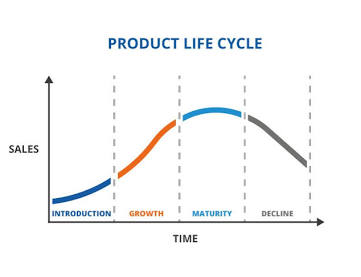
What is the Product Life Cycle? What are its four stages?
The model that visualizes what happens to an industry or product's growth (measured in units sold/produced) over time.
The four stages are:
Introduction
Growth
Maturity
Decline
Why do products in the Introduction Stage usually fail to make a profit? Give one real-world failure example.
Because the technology is new and unfamiliar, meaning sales are low and prices are high. Meanwhile, development and customer education costs are incredibly high.
Examples: New Coke (1985) abandoned after a few weeks, or Samsung Galaxy Note 7 (2016) which was recalled due to overheating/catching fire.
What happens during the Growth Stage of a product? Define economies of scale.
Demand expands rapidly as the product becomes well known. Profits begin because production costs drop due to economies of scale (the decrease in per-unit production costs as the total volume of production increases). This allows businesses to drop prices and expand distribution.
What characterizes the Maturity Stage of the Product Life Cycle? What does market saturation mean?
Sales peak, growth slows, and products are at their most profitable. However, the market experiences saturation, meaning it cannot absorb any more new units because most consumers already own it (e.g., a family with 3 TVs). Most purchases are now just replacements.
Why does an industry enter the Decline Stage? How do profits react?
Sales drop because the market is saturated, tastes change, or a newer, faster, cheaper technology replaces it (e.g., social attitudes causing a decline in smoking). To maintain demand, prices are cut, which causes profits and the number of competitors to drop sharply.
What is Life Cycle Extension? Give an example.
Any creative effort by a business to update, repackage, or relaunch a mature, well-known product to delay its decline.
Examples: Upgrading TVs over 50 years (color, portability, smart features) or Coca-Cola releasing new flavors and variations to generate new excitement.
Invariability - Goods
No customization
Easy to standardize / make, since it’s the exact same specifications
Subject to quality checks to ensure consistency
Separability / Non-Perishability - Goods
No immediacy
Can be stored in inventory, and can be consumed at a later time
Production
Products are manufactured / produced
Tangibility
Products that can physically be seen, touched, stored, and owned.
Variability - Services
Customization
It can be harder to standardize unlike goods due to services being more complex
Inseparability / Perishability - Services
Immediacy
Cannot be stored (unlike goods) due to services being performed on the spot.
Customer Involvement
Requires some degree of the customer being involved.
Either at a high or low contact
Immediacy
The quality of making something important or relevant due to it happening right there or then.
High-Contact Services
The customer involvement is very high
These are services that require personal interaction with the customers
Ex: Hotels, Restaurants, Haircuts, Nursing Homes
Low-Contact Services
Customer involvement isn’t that high
Service operations don’t need to have the customer involved to be performed
Ex: Fast Food, Internet Banking, Insurance, Cable TV
Variability
The characteristic of a service that means no two customers want the same thing delivered in the same way.