7. Diagnosis of nonstrabismic BV disorders
 Call Kai
 Learn
Learn Practice Test
 Spaced Repetition
 Match
Match Flashcards
 Knowt Play
1/89

There's no tags or description
Looks like no tags are added yet.
Name | Mastery | Learn | Test | Matching | Spaced | Call with Kai | Chat |
|---|
No analytics yet
Send a link to your students to track their progress
90 Terms
What are the three classic diagnostic signs of convergence insufficiency (CI)?
Greater exophoria at near than at distance
Receded near point of convergence (NPC)
Insufficient positive fusional vergence (PFV) at near
What pattern of symptoms is typical of convergence insufficiency?
Symptoms occur predominantly during near work and are usually chronic.
They:
Become worse with prolonged work or fatigue
Often worsen throughout the day
May occur at distance if significant distance exophoria is also present
May be absent if the patient avoids demanding near tasks
Approximately 75% to 85% of patients with CI are symptomatic
What symptoms should raise suspicion for convergence insufficiency in a child with near-work difficulties?
Eyestrain, sore eyes, or headaches
Blurred or double vision
Words appearing to move or jump
Losing place
Frequent rereading
Slow reading
Reduced concentration
Difficulty remembering what was read
Sleepiness during near work
The most frequently reported complaints may be performance-related, such as losing place, rereading, and poor concentration.
What observable behaviors may indicate a binocular vision disorder such as convergence insufficiency?
Watch for:
Closing or covering one eye while reading
An unusual head posture
Avoidance of prolonged near work
Reduced reading endurance
These behaviors may be attempts to eliminate diplopia or visual discomfort.
How is the Convergence Insufficiency Symptom Survey (CISS) used in CI?
The CISS is a subjective symptom survey that can help distinguish symptomatic CI from normal binocular vision and may increase with the number of CI signs.
However, it is not diagnostic by itself because symptoms may also come from:
Dry eye
Allergies
Other ocular conditions
The child’s interpretation of “reading” or “close work”
Increased electronic-device use
What phoria finding supports a diagnosis of convergence insufficiency?
An exo deviation at near that is greater than the exo deviation at distance.
Recent clinical-trial criteria commonly require:
At least 4Δ more exophoria at near than at distance
Exophoria can still be present at distance, but the near deviation must be meaningfully greater.
What PFV findings support a diagnosis of convergence insufficiency?
Reduced positive fusional vergence at near, meaning that the patient has inadequate base-out vergence to compensate for the near exophoria.
PFV is considered insufficient when:
It falls below normative base-out values
It fails Sheard’s criterion
The base-out blur or break is below a trial-specific minimum
Examples from clinical trials include:
CITT: BO break ≤15Δ
PEDIG CITS: BO blur <20Δ
What is Sheard’s criterion, and why is it relevant in convergence insufficiency?
Sheard’s criterion states that the fusional reserve should be at least twice the magnitude of the phoria.
For near exophoria, the compensating reserve is positive fusional vergence, measured with base-out prism.
Failure indicates that the patient may not have enough convergence reserve to compensate comfortably for the near exophoria.
What NPC finding supports a diagnosis of convergence insufficiency?
A receded NPC, commonly defined in clinical trials as a break of ≥ 6 cm
A receded NPC is common but is not present in every patient with CI, so it must be interpreted with near phoria and PFV
How does the NPC target affect the measured result?
An accommodative target generally produces a closer NPC than a penlight viewed with red-green glasses. This is because an accommodative target stimulates accommodative convergence, helping the patient converge farther inward
Why should the NPC be repeated when evaluating convergence insufficiency?
Repeated NPC testing can reveal convergence fatigue that may not appear on the first trial.
After approximately 10 repetitions, the NPC may recede by about 4 cm.
What is the classic clinical-trial definition of symptomatic convergence insufficiency?
The patient typically has:
≥4Δ more exophoria at near than at distance
Receded NPC, generally ≥6 cm
Insufficient PFV at near, based on:
Failure of Sheard’s criterion, or
PFV below the required normative or clinical-trial value
Symptoms consistent with near visual stress
What additional clinical findings may occur in convergence insufficiency?
Reduced accommodative ability
Difficulty with binocular accommodative facility, particularly plus lenses
Low NRA
Intermittent or absent suppression at near
Good stereopsis
Exo fixation disparity
Low AC/A ratio
How does convergence deficit differ from classic convergence insufficiency?
Classic CI: Exophoria is meaningfully greater at near than at distance, with reduced PFV and/or a receded NPC.
Convergence deficit: The patient has reduced convergence ability, such as decreased PFV or a receded NPC, but may be orthophoric or have only a small near phoria.
What is pseudoconvergence insufficiency?
Pseudoconvergence insufficiency is a CI-like pattern caused primarily by accommodative dysfunction.
Reduced accommodation produces less accommodative convergence, resulting in:
A secondary increase in near exophoria
Greater demand on PFV
Apparently inadequate PFV at near
Treating the accommodative disorder may improve the apparent CI findings.
What findings suggest pseudoconvergence insufficiency due to accommodative dysfunction?
Reduced amplitude of accommodation
Difficulty with minus lenses on monocular and binocular accommodative facility
Reduced PRA
High accommodative lag
Secondary near exophoria and reduced PFV
Key clue: The problem is present during monocular accommodative testing, not only during binocular testing
How is pseudoconvergence insufficiency managed?
Treat the underlying accommodative dysfunction with:
Appropriate lenses
Accommodative therapy
Combined accommodative and vergence therapy when indicated
As accommodation improves, accommodative convergence increases and the secondary CI-like findings may resolve
What functional binocular disorders should be differentiated from convergence insufficiency?
Basic exophoria: Similar exophoria at distance and near
Divergence excess: Greater exophoria at distance than at near
Convergence insufficiency: Greater exophoria at near than at distance
Convergence deficit: Reduced convergence without substantial near exophoria
What underlying pathology should be considered when CI-like findings are sudden or atypical?
Convergence paralysis from ischemic infarction
Demyelinating disease
Viral infection
Parkinson disease
Parinaud syndrome
Medial rectus weakness from multiple sclerosis
Myasthenia gravis
Previous strabismus surgery
What is the first step in managing convergence insufficiency?
Correct the patient’s refractive error.
Then consider:
Base-in prismHome-based exercises
Office-based vergence/accommodative therapy
Combined office therapy with home reinforcement
What passive and active treatments are available for convergence insufficiency?
Passive treatment
Base-in prism, which reduces the convergence demand
Active treatment
Orthoptics
Vision therapy
Vergence/accommodative therapy
Home- or office-based therapy
Is base-in prism an effective treatment for symptomatic convergence insufficiency in children?
Evidence from the BICITT did not show a significant advantage of base-in prism glasses over placebo glasses in children.
Both groups reported decreased symptoms, but there was no significant between-group difference in:
Symptoms
Ability to converge
Conclusion: Base-in prism is generally not considered an effective primary treatment for childhood CI
What four treatments were compared in the major Convergence Insufficiency Treatment Trial (CITT)?
HBPP: Home-based pencil push-ups
HBCVAT+: Home-based computer vergence/accommodative therapy plus pencil push-ups
OBVAT: Office-based vergence/accommodative therapy with home reinforcement
OBPT: Office-based placebo therapy
Which treatment was most effective for symptomatic convergence insufficiency in children in the CITT?
Office-based vergence/accommodative therapy with home reinforcement, or OBVAT.
Compared with pencil push-ups, home computer therapy, and placebo, OBVAT produced greater improvement in:
NPC
PFV
Symptoms in the original CITT
Composite treatment-success outcomes
How did office-based therapy compare with home-based treatments in the CITT?
OBVAT produced the greatest improvement in NPC and PFV.
Home-based treatments produced some improvement in NPC.
Home computer therapy plus pencil push-ups improved PFV more than pencil push-ups alone.
Neither home-based approach matched the overall effectiveness of OBVAT.
Pencil push-ups often performed similarly to placebo on important outcomes.
Approximately how many children improve after 12 weeks of office-based vergence/accommodative therapy?
Approximately 75% achieve normalization or meaningful improvement in symptoms and/or clinical convergence measures after 12 weeks.
Therefore, OBVAT is considered the preferred first-line treatment for symptomatic CI in children when it is accessible
What treatment may be considered when office-based therapy is not available?
Home-based computer vergence/accommodative therapy, often with structured reinforcement, may be considered.
However:
Expected success is lower than with office-based therapy.
Pencil push-ups alone have limited evidence of effectiveness.
The patient and family should be educated about the differences in treatment success and required time
In what order do clinical findings and symptoms improve during CI therapy?
Objective clinical signs generally improve before subjective symptoms.
Expected pattern:
NPC and PFV may improve by approximately 4 weeks
Symptoms may take longer to improve
Treatment should not be judged solely by early symptom reports
How quickly can coexisting accommodative dysfunction improve during CI therapy?
In patients who also have accommodative dysfunction:
Amplitude of accommodation
Accommodative facility
may improve by approximately 4 weeks.
The presence of coexisting accommodative dysfunction did not significantly reduce the overall response to therapy
Are the benefits of successful CI therapy maintained after treatment ends?
They are generally stable.
In the CITT:
Patients who became asymptomatic performed maintenance therapy for approximately 15 minutes per week
87.5% of the OBVAT group remained successful or improved at one year
Is vision therapy for convergence insufficiency associated only with clinical test changes?
No. Therapy has been associated with:
Improved NPC and PFV
Eye-tracking changes
Changes in cortical activity measured with functional MRI
These findings support measurable neurophysiologic changes, although clinical management should still be guided by symptoms and binocular vision findings
What did CITT-ART find regarding the effect of OBVAT on objective convergence measures?
OBVAT produced substantially better objective convergence outcomes than placebo.
A normal NPC and PFV composite outcome occurred in approximately:
78% with OBVAT
29% with placebo
The composite required:
NPC <6 cm
PFV meeting Sheard’s criterion and exceeding 15Δ
What unexpected symptom result was found in CITT-ART?
Although OBVAT significantly improved NPC and PFV compared with placebo, the difference in CISS symptom scores was not statistically significant.
Interpretation: Improvement in objective convergence measures does not always correspond directly with changes in self-reported CISS symptoms
Why may the CISS inadequately measure treatment-related symptom changes?
The CISS is subjective and may capture symptoms from:
Dry eye or allergies
Normal ocular discomfort
Homework and reading demands
Video games and smart devices
Conditions unrelated to binocular function
The meaning of “reading” and “close work” has also changed since the CISS was originally validated
What reading-related complaints may occur in a patient with convergence insufficiency?
Loss of place
Frequent rereading
Reading slowly
Reduced concentration
Difficulty remembering what was read
Visual discomfort, diplopia, tired eyes, or headaches
These complaints indicate that CI may create a visual obstacle during reading, but they do not prove a primary reading disorder
Does office-based vergence/accommodative therapy improve standardized reading performance in children with CI?
Not more than placebo therapy.
In CITT-ART, 16 weeks of OBVAT did not produce significantly greater improvement in:
Reading comprehension
Word reading
Pseudoword decoding
Oral reading fluency
Silent reading fluency
Listening comprehension
Both groups improved, demonstrating why a control group is essential when evaluating treatment effectiveness
Does successful treatment of the clinical signs of CI necessarily improve reading performance?
No. Even among participants classified as successfully treated:
OBVAT produced much higher clinical success than placebo
There were still no significant between-group differences in standardized reading outcomes
Key distinction: Treating CI improves convergence function, but it is not a stand-alone treatment for a reading disorder
Does office-based vergence/accommodative therapy improve attention more than placebo therapy?
No significant advantage was found for:
Parent- or teacher-rated inattention
Hyperactivity or impulsivity
Objective attention-test performance
Concentration performance
Thus, OBVAT improves convergence function but should not be presented as a primary treatment for attention disorders
What is the most appropriate counseling regarding CI, reading, and school performance?
Treating CI can:
Reduce a visual obstacle
Improve convergence function
Make near work more visually comfortable
However, therapy has not been shown to improve standardized reading or attention outcomes more than placebo.
A child with persistent academic difficulty may still require:
Educational evaluation
Evidence-based reading instruction
Tutoring or other appropriate services
A child has headaches during reading, 10Δ exophoria at near, 2Δ exophoria at distance, an NPC break of 12 cm, and reduced BO vergence at near. What is the most likely diagnosis?
Convergence insufficiency.
Supporting findings:
Near exophoria is 8Δ greater than distance exophoria
NPC is receded
PFV is reduced
Symptoms are provoked by near work
A patient has a receded NPC and reduced PFV but is nearly orthophoric at near. What diagnosis is more appropriate than classic CI?
Convergence deficit.
The patient has impaired convergence, but classic CI requires meaningful near exophoria, generally greater than the distance phoria
A patient has near exophoria, reduced PFV, reduced accommodative amplitude, high accommodative lag, and difficulty clearing minus monocularly. What should be suspected?
Pseudoconvergence insufficiency secondary to accommodative dysfunction.
Monocular accommodative findings indicate that reduced accommodation may be causing:
Reduced accommodative convergence
Secondary near exophoria
Increased demand on PFV
A child completes several weeks of CI therapy. NPC and PFV improve, but the CISS changes only slightly. Does this mean therapy failed?
Not necessarily.
Objective signs can improve before symptoms, and CISS scores do not always correspond closely with NPC and PFV changes.
A parent asks whether CI vision therapy will improve the child’s reading comprehension and attention. What is the evidence-based response?
Therapy can improve convergence ability and visual comfort, but controlled trials have not shown that it improves standardized reading or attention outcomes more than placebo.
CI therapy should treat the binocular vision disorder, while reading or attention problems should receive their own appropriate evaluation and intervention
What is the high-yield diagnosis and management summary for convergence insufficiency?
Diagnosis
≥4Δ more exophoria at near than distance
Receded NPC, commonly ≥6 cm
Insufficient PFV at near or failure of Sheard’s criterion
Near-work symptoms
Differentials
Basic exophoria
Divergence excess
Convergence deficit
Pseudoconvergence insufficiency from accommodative dysfunction
Neurologic or extraocular muscle pathology
Management
Correct refractive error
OBVAT is the most effective treatment in children
Pencil push-ups and home computer therapy are less effective
BI prism is not effective as primary treatment in children
Objective signs generally improve before symptoms
Benefits are usually maintained
Therapy improves convergence but not standardized reading or attention performance beyond placebo
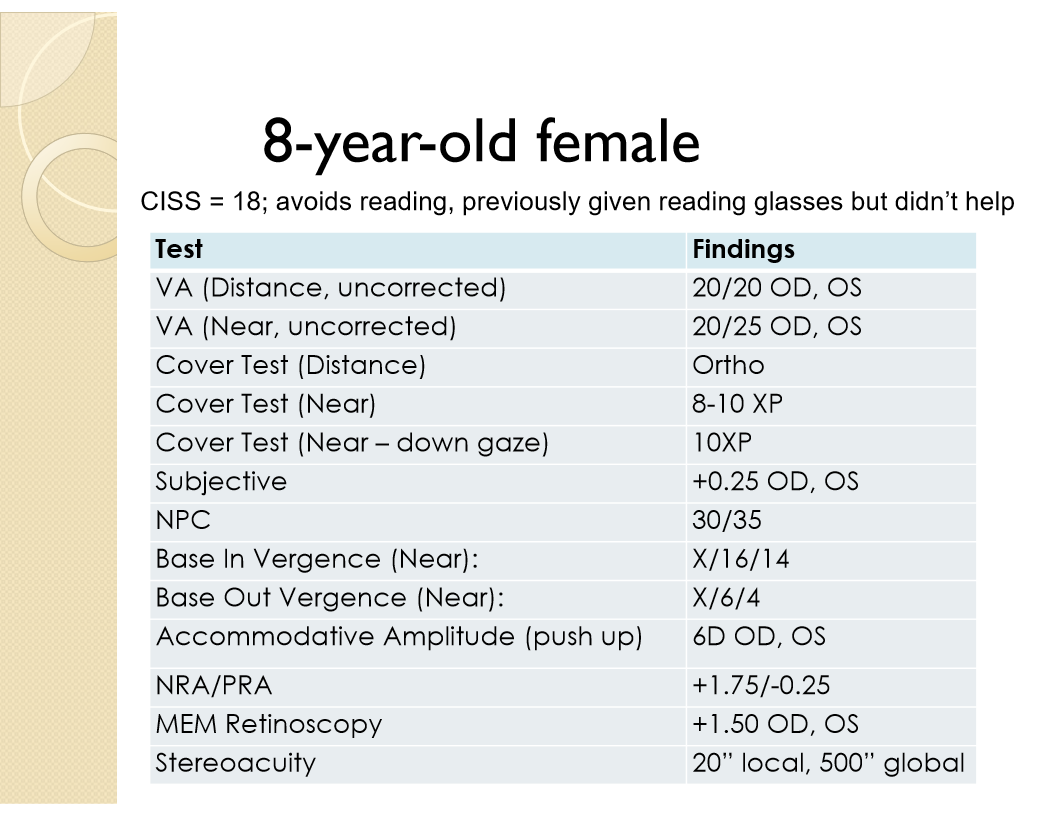
An 8-year-old avoids reading and has 8–10Δ near exophoria, orthophoria at distance, NPC 30/35 cm, and near BO vergence of X/6/4. What binocular vision disorder is present?
Convergence insufficiency.
Supporting findings:
Exophoria is greater at near than distance
NPC is markedly receded
Positive fusional vergence, measured with BO prism, is reduced
Symptoms occur during near work
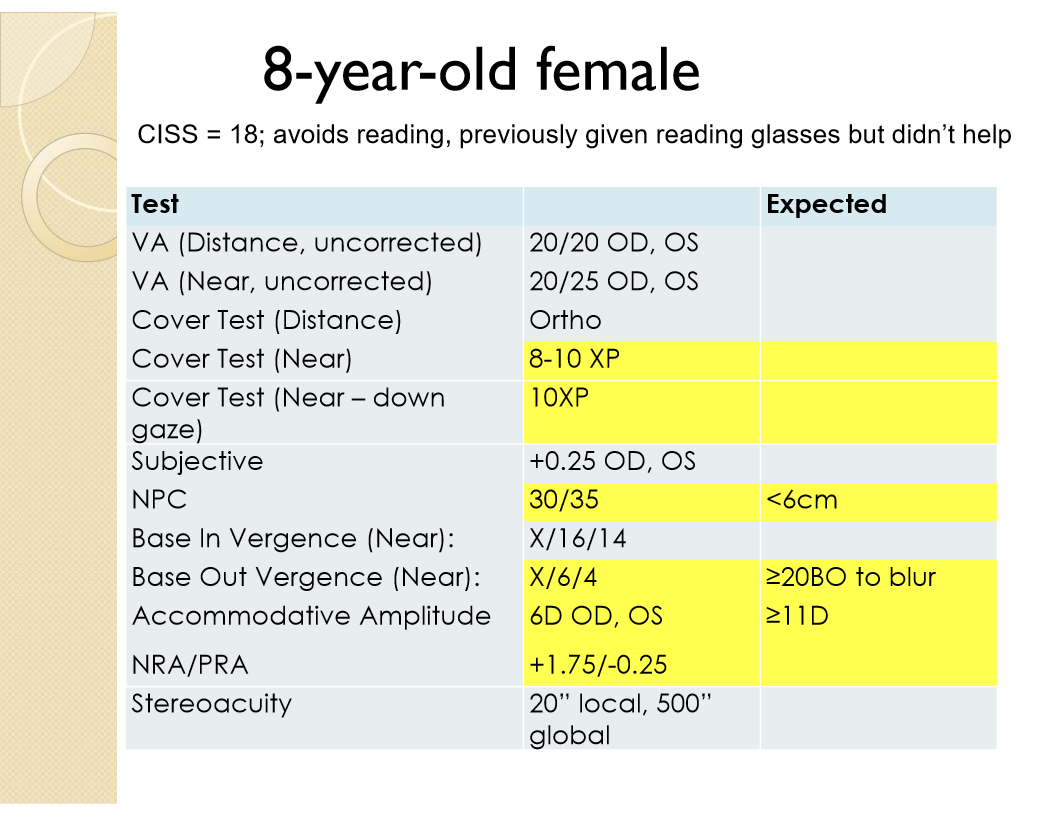
What additional disorder is suggested by an 8-year-old with 6 D accommodative amplitude, PRA of −0.25 D, and MEM of +1.50 D?
Accommodative insufficiency.
Supporting findings:
Expected accommodative amplitude is at least approximately 11 D
Measured amplitude is only 6 D
High MEM indicates excessive accommodative lag
Reduced PRA indicates difficulty stimulating accommodation
Overall diagnosis: Convergence insufficiency with coexisting accommodative insufficiency.
Why might previously prescribed reading glasses have failed to resolve the 8-year-old’s symptoms?
Plus lenses may reduce the accommodative demand, but they can also reduce accommodative convergence, potentially increasing the near exophoria and convergence demand.
Because the patient has both accommodative and convergence dysfunction, treatment must address the complete binocular and accommodative pattern rather than accommodation alone.

A 60-year-old reports losing place and intermittent diplopia while reading. Testing shows 2Δ exophoria at distance, 10Δ intermittent exotropia at near, BI vergence X/4/2, BO vergence X/6/4, and crossed diplopia. What is the likely diagnosis?
Near intermittent exotropia associated with convergence insufficiency.
Supporting findings:
Exodeviation is substantially greater at near
The near deviation intermittently becomes a tropia
Positive fusional vergence is inadequate
Crossed diplopia is consistent with an exodeviation

What type of diplopia is expected with an exodeviation versus an esodeviation?
Exodeviation: Crossed diplopia
Esodeviation: Uncrossed diplopia
This relationship can help confirm the direction of a manifest deviation during sensory testing such as Worth 4 Dot.
What is the defining phoria pattern in divergence insufficiency?
Greater esophoria at distance than at near.
The patient has inadequate divergence ability at distance, resulting in:
More frequent eso deviation at distance
Reduced negative fusional vergence at distance
Possible esophoric fixation disparity at distance
What symptoms are characteristic of divergence insufficiency?
Symptoms occur primarily during distance viewing and may include:
Intermittent distance diplopia
Distance blur or asthenopia
Difficulty driving or watching television
Headaches, nausea, or dizziness
Difficulty changing focus from far to near
Light sensitivity or motion sickness
Symptoms are often longstanding and may worsen with fatigue or later in the day.
What clinical signs support functional divergence insufficiency?
Greater esophoria at distance than near
Reduced distance negative fusional vergence, measured with BI prism
Esophoric fixation disparity at distance
Comitant deviation
Usually no significant refractive error
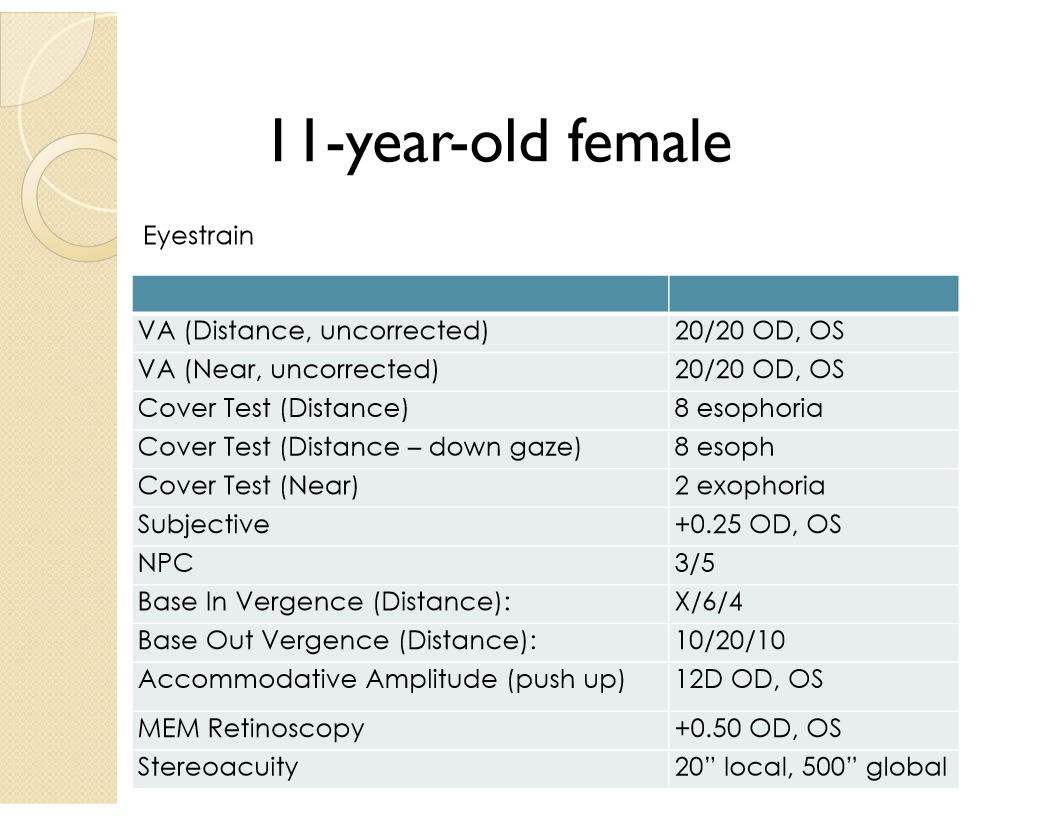
An 11-year-old has 8Δ esophoria at distance, 2Δ exophoria at near, and distance BI vergence of X/6/4. What is the most likely diagnosis?
Divergence insufficiency.
Supporting findings:
Eso deviation is greater at distance
Negative fusional vergence at distance is reduced
The deviation is comitant between primary gaze and downgaze
Accommodative findings and NPC are relatively normal

What functional disorders and refractive condition must be differentiated from divergence insufficiency?
Basic esophoria: Approximately equal eso at distance and near
Convergence excess: Greater eso at near than distance
Uncorrected hyperopia: Accommodative convergence may create an eso pattern
A cycloplegic refraction may be necessary to exclude latent hyperopia
How can sixth nerve palsy be distinguished from functional divergence insufficiency?
Sixth nerve palsy is more likely to show:
Acute onset
Noncomitant deviation
Abduction weakness
Possible endpoint nystagmus
No predictable worsening with ordinary visual fatigue
Functional divergence insufficiency is typically longstanding, comitant, and worsens with fatigue.
What findings suggest divergence paralysis rather than functional divergence insufficiency?
Divergence paralysis may present with:
Acute-onset distance diplopia and headaches
Comitant distance esodeviation
Little change with fatigue
Possible A-pattern deviation
Associated neurologic symptoms
Possible causes include multiple sclerosis, encephalitis, head trauma, cerebral hemorrhage, elevated intracranial pressure, brain tumor, and brainstem vascular lesions.
What associated findings make a distance esodeviation concerning for neurologic disease?
Papilledema
Vomiting
Lethargy or irritability
Dizziness
Gait disturbance
Distal paresthesia
Acute headache
Sudden-onset diplopia
How is functional divergence insufficiency managed?
Correct any hyperopia
Prescribe base-out prism when appropriate
Consider therapy to improve distance negative fusional vergence
Improve near positive fusional vergence if needed to tolerate full-time BO prism
Reserve surgery for unusual cases because it is generally not indicated
BO prism is most useful when the required amount is approximately 15Δ or less.
Why is base-out prism prescribed for divergence insufficiency?
BO prism shifts the image in a direction that reduces the divergence demand required to maintain single vision.
High-yield association:
Eso deviation → BO prism
Exo deviation → BI prism
What defines a basic exodeviation?
Approximately equal amounts of exophoria or exotropia at distance and near, usually within about 5Δ.
Unlike convergence insufficiency or divergence excess, neither viewing distance produces a substantially larger exodeviation.
What symptoms are typical of basic exodeviation?
Symptoms may occur at both distance and near:
Intermittent crossed diplopia
Eyestrain
Headaches
Difficulty concentrating
Intermittent blur
Reading difficulties
Fatigue
Awareness that an eye turns outward
Photophobia
Symptoms frequently worsen throughout the day, although approximately 10% of patients may be asymptomatic
What clinical findings may accompany basic exodeviation?
Similar exodeviation at distance and near
PFV that may be numerically near normal but is inadequate for the phoria
Receded NPC
Reduced binocular accommodative facility, especially with plus
Low NRA
Plano or lead accommodative response
Usually normal monocular accommodative function
Exo fixation disparity at distance and near
Possible intermittent exotropia
Why can apparently normal PFV still be inadequate in basic exodeviation?
Fusional reserves must be interpreted relative to the magnitude of the phoria.
A patient with a large exophoria may have PFV values within the general normative range but still lack enough convergence reserve to satisfy Sheard’s criterion or maintain comfortable fusion.
What fixation disparity curve is associated with basic exodeviation?
A Type III fixation disparity curve.
Additional findings may include:
Exo fixation disparity at distance and near
Intermittent exotropia
A coexisting vertical deviation, which is relatively common
What disorders should be differentiated from basic exodeviation?
Functional differentials
Convergence insufficiency: greater exo at near
Divergence excess: greater exo at distance
Pathologic differentials
Convergence paralysis
Medial rectus weakness
Multiple sclerosis
Myasthenia gravis
Effects of previous strabismus surgery
Acute onset, neurologic symptoms, or associated medical problems should raise concern for pathology
How is refractive error managed in basic exodeviation?
Correct clinically significant:
Myopia
Astigmatism
Anisometropia
Hyperopia requires individualized management because correcting plus reduces accommodative demand and accommodative convergence, potentially increasing the exodeviation. The effect is especially important with hyperopia greater than approximately +1.50 D
What is the primary treatment for symptomatic basic exodeviation?
Vergence therapy is the primary treatment.
Goals include:
Increasing positive fusional vergence
Improving control of the exodeviation
Treating associated suppression or amblyopia
Improving binocular facility and stamina
The slides report a high total or partial treatment success rate for basic exodeviation
What roles do prism and surgery have in basic exodeviation management?
Horizontal prism is generally unnecessary and is less effective for exo than eso deviations.
Prism may help if symptoms remain after therapy.
Vertical prism may be useful for a significant coexisting vertical deviation.
Surgery is rarely required and is considered mainly for deviations greater than approximately 30Δ after unsuccessful nonsurgical treatment

A 14-year-old has 14Δ exophoria at distance and 16Δ at near, with eyestrain at both distances. What is the most likely diagnosis?
Basic exophoria.
The distance and near deviations differ by only 2Δ, so they are approximately equal.
Additional supportive findings include:
Symptoms at both distance and near
PFV that is insufficient relative to the large exophoria
Reduced binocular accommodative facility with normal monocular facility

What defines a basic esodeviation?
Approximately equal amounts of esophoria or esotropia at distance and near, generally within approximately 5Δ.
It is also called an equal esodeviation
What symptoms occur with basic esodeviation?
Symptoms may occur during both distance and near visual tasks:
Asthenopia
Headaches
Difficulty concentrating at near
Intermittent blur
Intermittent uncrossed diplopia
Worsening symptoms throughout the day
What clinical findings support basic esodeviation?
Similar eso deviation at distance and near
Normal-to-low negative fusional vergence at both distances
Low PRA
Reduced binocular accommodative facility, especially with minus
Usually normal accommodative amplitude
Eso fixation disparity at distance and near
Possible hyperopia
Intermittent suppression, good stereopsis, or diplopia
Why can a high accommodative lag conceal part of an esodeviation during cover testing?
A high lag means the patient accommodates less than required. This reduces accommodative convergence and may make the measured esodeviation appear smaller.
Use a detailed target and verify accurate accommodation during the cover test to avoid underestimating the eso deviation.
What fixation disparity curve is associated with basic esodeviation?
A Type II fixation disparity curve.
The patient generally shows eso fixation disparity at both distance and near
What disorders should be differentiated from basic esodeviation?
Functional differentials
Divergence insufficiency: more eso at distance
Convergence excess: more eso at near
Pathologic differentials
Sixth nerve palsy
Divergence paralysis
Acute onset, noncomitancy, neurologic symptoms, or endpoint nystagmus increases concern for pathology
What is the initial refractive treatment for basic esodeviation associated with hyperopia?
Prescribe the full plus correction.
Plus lenses:
Correct hyperopia
Reduce accommodative demand
Reduce accommodative convergence
Decrease the eso deviation
The slides indicate that more than 90% of patients can achieve normal binocular function with appropriate management
What additional treatments may be used for basic esodeviation?
Base-out horizontal prism
Vertical prism for a coexisting vertical deviation
Vergence therapy to improve negative fusional vergence
Occasional added lenses
Surgery only for a large deviation that fails nonsurgical treatment
Therapy may be used alone or in combination with prism
What is the defining clinical pattern of fusional vergence dysfunction?
The patient has relatively normal ocular alignment but has difficulty rapidly and sustainably changing vergence.
Typical findings:
Orthophoria or only a small phoria
Reduced vergence facility
Reduced positive and/or negative fusional vergence
Symptoms during near work
What symptoms are typical of fusional vergence dysfunction?
Eyestrain
Headaches
Ocular burning or tearing
Intermittent blur
Reduced concentration and endurance
Sleepiness while reading
Slow reading
Decreasing comprehension over time
Symptoms usually worsen later in the day or with sustained near work. Some patients avoid symptoms by avoiding near tasks or covering one eye
What test findings support fusional vergence dysfunction?
Orthophoria or small phoria at distance and near
Reduced vergence facility
Possible reduction of both BI and BO fusional vergence
Low NRA and PRA
Reduced binocular accommodative facility with both plus and minus
Normal monocular accommodative facility
Why is binocular accommodative facility reduced while monocular facility remains normal in fusional vergence dysfunction?
The accommodative system itself is functioning normally, but changing lens power during binocular testing also changes accommodative convergence.
The patient struggles to compensate with fusional vergence:
Plus lenses: Reduce accommodative convergence, requiring additional convergence
Minus lenses: Increase accommodative convergence, requiring additional divergence
Therefore, both plus and minus may be difficult binocularly, while monocular facility remains normal
How can fusional vergence dysfunction be differentiated from accommodative infacility?
Fusional vergence dysfunction: Binocular accommodative facility is reduced, but monocular facility is normal.
Accommodative infacility: Both monocular and binocular accommodative facility are reduced.
This distinction identifies whether the primary limitation is vergence or accommodation
What conditions should be excluded before diagnosing fusional vergence dysfunction?
Accommodative infacility
Latent hyperopia
Vertical or cyclodeviation
Fixation disparity
Aniseikonia
Systemic disease causing debilitation
Medication effects
How is fusional vergence dysfunction managed?
Vergence therapy is the primary treatment.
Goals include:
Improving positive and negative fusional ranges
Normalizing vergence facility
Increasing binocular stamina
Improving the ability to sustain near work
Approximately 12 to 24 sessions may be required. Prism and surgery are generally not the primary treatments
A 16-year-old has near eyestrain, orthophoria at distance, 2Δ exophoria at near, reduced BI and BO vergence, vergence facility of 8 cpm, reduced binocular facility, and normal monocular facility. What is the diagnosis?
Fusional vergence dysfunction.
The key diagnostic pattern is:
Minimal phoria
Decreased ability to perform both convergence and divergence
Reduced vergence facility
Binocular difficulty with both plus and minus
Normal monocular accommodative facility
How can the major horizontal vergence disorders be distinguished using distance and near phoria?
Convergence insufficiency: Exo greater at near
Divergence excess: Exo greater at distance
Basic exodeviation: Approximately equal exo at distance and near
Convergence excess: Eso greater at near
Divergence insufficiency: Eso greater at distance
Basic esodeviation: Approximately equal eso at distance and near
Fusional vergence dysfunction: Orthophoria or small phoria with reduced vergence ability
Mnemonic logic: The name identifies the function that is deficient and the viewing distance where the abnormal deviation becomes most apparent.
Which fusional vergence reserve compensates for an exophoria versus an esophoria?
Exophoria: Compensated by PFV, tested with BO prism
Esophoria: Compensated by NFV, tested with BI prism
What lens difficulty is expected with exo and eso deviations during binocular accommodative facility testing?
Exo pattern: More difficulty with plus, because plus reduces accommodative convergence and increases the convergence demand
Eso pattern: More difficulty with minus, because minus stimulates accommodation and accommodative convergence
Fusional vergence dysfunction: Difficulty with both plus and minus
Accommodative infacility: Difficulty binocularly and monocularly
What is the high-yield diagnostic and management summary for the disorders in this deck?
Divergence insufficiency
Greater eso at distance
Reduced distance NFV
Treat hyperopia and consider BO prism
Exclude sixth nerve palsy or neurologic divergence paralysis
Basic exodeviation
Similar exo at distance and near
PFV inadequate for the phoria
Vergence therapy is primary
Basic esodeviation
Similar eso at distance and near
Low NFV
Correct full hyperopia; consider BO prism and therapy
Fusional vergence dysfunction
Small phoria but reduced convergence and divergence facility
Binocular facility reduced with both plus and minus
Monocular facility normal
Vergence therapy is primary