Math
 Call Kai
 Learn
Learn Practice Test
 Spaced Repetition
 Match
Match Flashcards
 Knowt Play
1/151

There's no tags or description
Looks like no tags are added yet.
152 Terms
Sequence
A list of numbers with a pattern.
Series
The sum of numbers in a sequence. Take that list of numbers separated by commas and replace it with a +.
Infinite Sequence
Sequences that have infinite terms
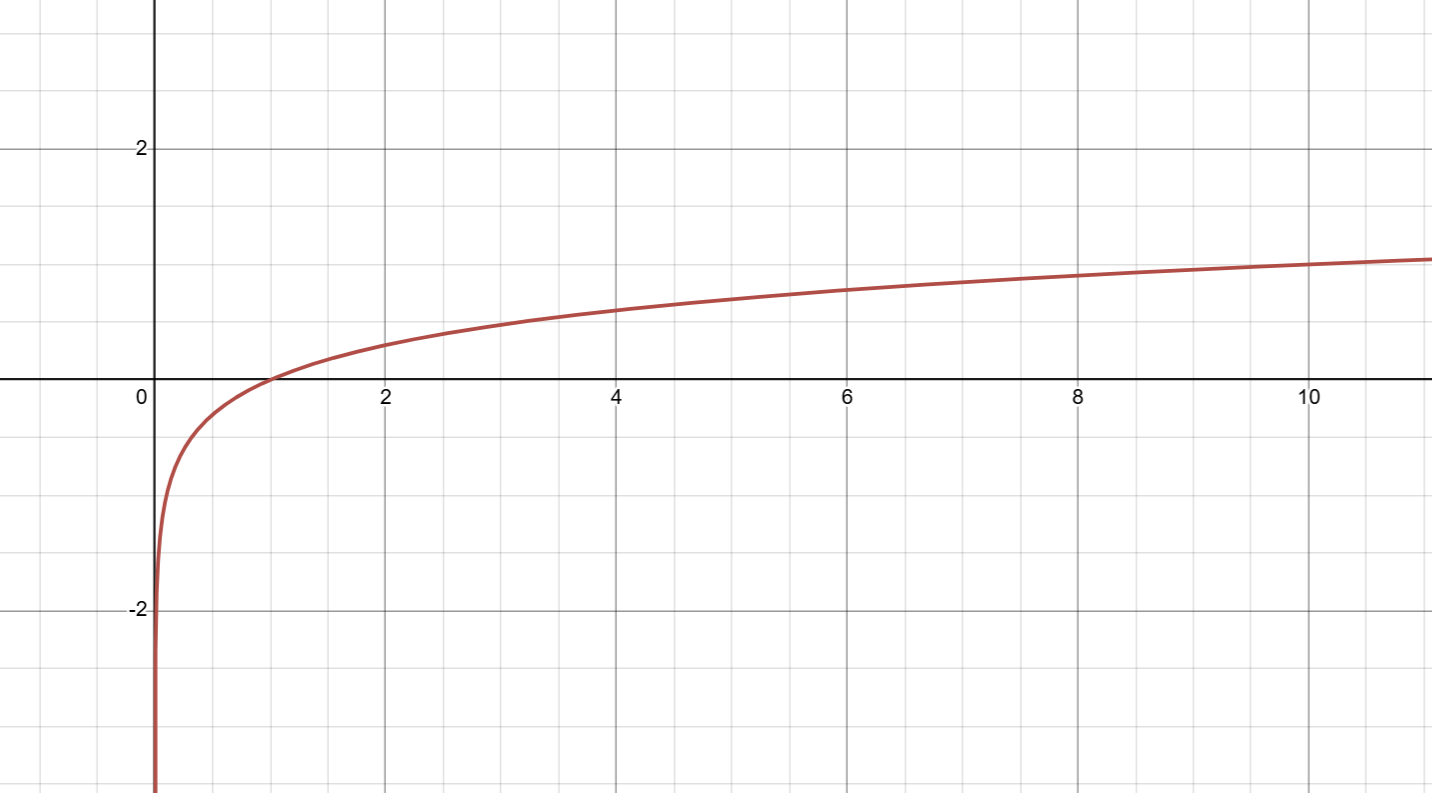
Common Log
y=log₁₀x
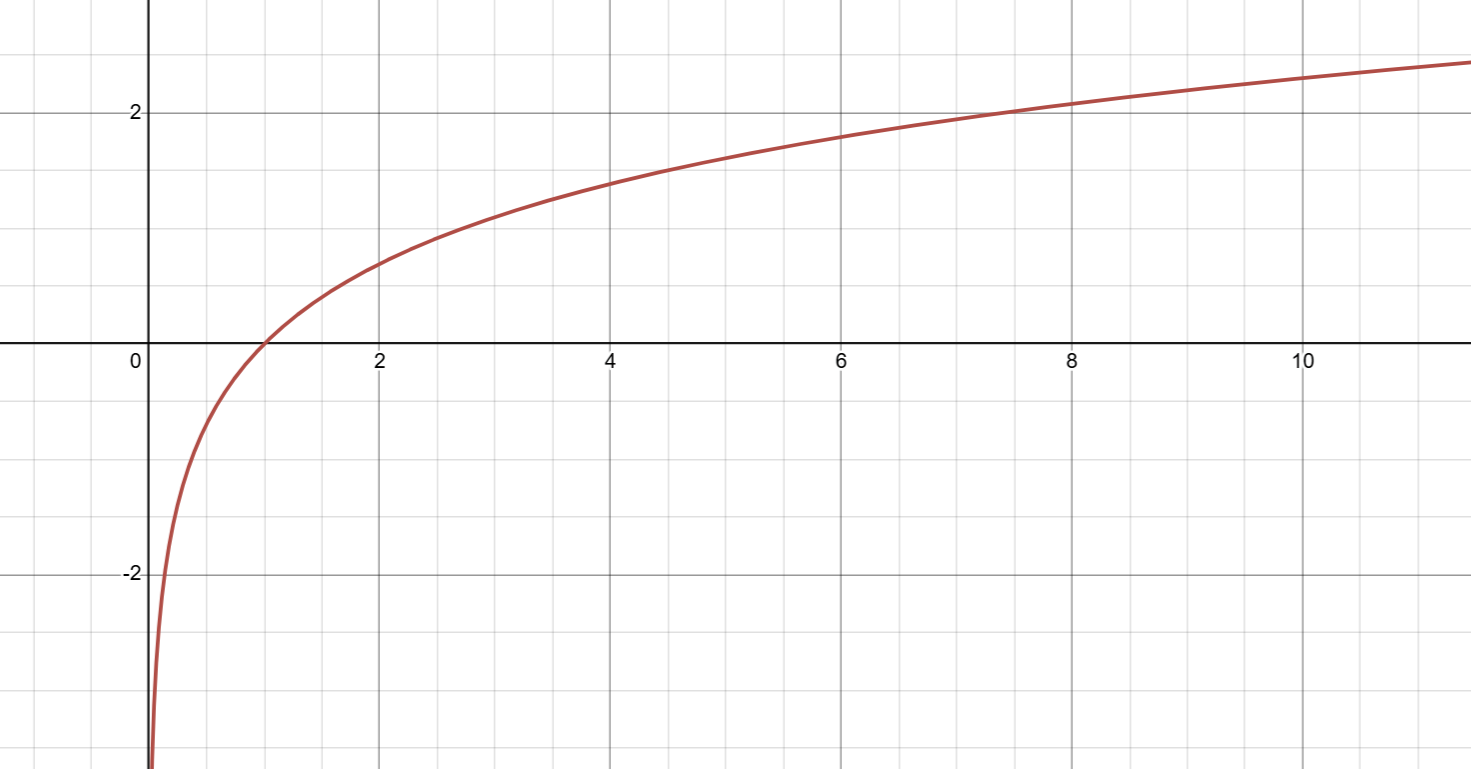
Natural Log
y=lnx OR y=logₑx
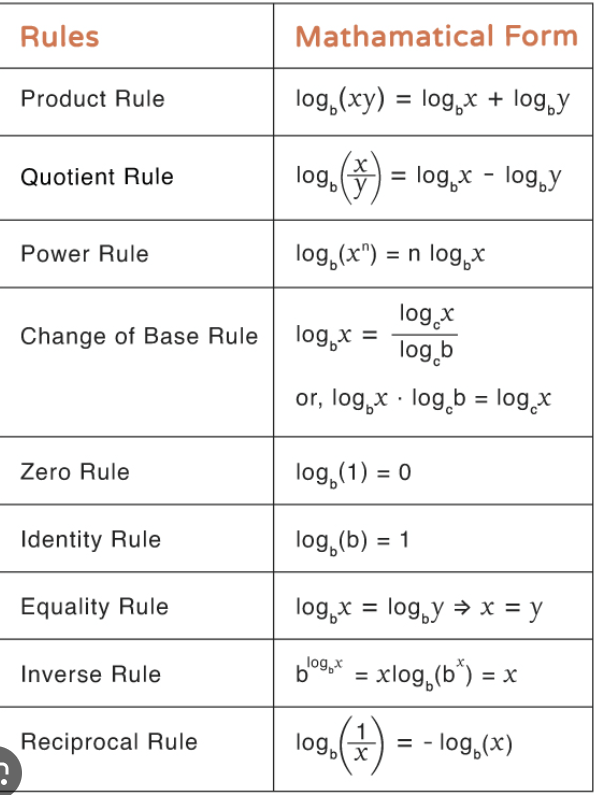
Property of Logarithm
Partial Fractions
Check the degree (highest exponent): The degree of the numerator must be strictly less than the degree of the denominator. If it isn't (e.g., \(x^{3}\) on bottom and \(x^{2}\) on top), you must use polynomial long division first to simplify it.
Factor the denominator: Break the denominator down into its simplest multiplied components (factors).
Set up the fraction template: Assign unknown constants (usually \(A, B, C\), etc.) for the numerators over each factor.
Solve for the constants: Multiply the entire equation by the common denominator to eliminate the fractions, then equate the coefficients or plug in smart values for \(x\) to solve for A,B, and \(C\).
Repeated Linear Factors: If a factor repeats, like \((x-a)^2\), you must account for each power: \(\frac{A}{x-a} + \frac{B}{(x-a)^2}\).
For each irreducible quadratic factor 𝑎𝑥2+𝑏𝑥+𝑐 that 𝑄(𝑥) contains, the decomposition must include
𝐴𝑥+𝐵𝑎𝑥2+𝑏𝑥+𝑐.
For each repeated irreducible quadratic factor (𝑎𝑥2+𝑏𝑥+𝑐)𝑛, the decomposition must include
𝐴1𝑥+𝐵1𝑎𝑥2+𝑏𝑥+𝑐+𝐴2𝑥+𝐵2(𝑎𝑥2+𝑏𝑥+𝑐)2+⋯+𝐴𝑛𝑥+𝐵𝑛(𝑎𝑥2+𝑏𝑥+𝑐)𝑛.
Ex: ∫x²+3x+1/(x+2)(x-3)²(x²+4)² → A/x+2 + B/(x-3)^1 + C/(x-3)² + Dx+E/(x²+4)^1 + Fx+G/(x²+4)²
Double angle identity for sin2x
2sinxcosx
Double angle identity for cos2x
cos²x-sin²x, 2cos²x-1, 1-2sin²x
Double angle identity for tan2x
2tanx/1-tan²x
Power Reduction for sin²x
1-cos2x/2
Power Reduction for cos²x
1+cos2x/2
Power Reduction for tan²x
1-cos2x/1+cos2x
Power Reduction for csc²x
2/1-cos2x
Power Reduction for sec²x
2/1+cos2x
Power Reduction for cot²x
1+cos2x/1-cos2x
Product to Sum Formula for sinAcosB
(1/2) [sin(A+B) + sin(A-B)]
Product to Sum Formula for cosAsinB
(1/2) [sin(A+B) - sin(A-B)]
Product to Sum Formula for cosAcosB
(1/2) [cos(A+B) + cos(A-B)]
Product to Sum Formula for sinAsinB
(1/2) [cos(A-B) - cos(A+B)]
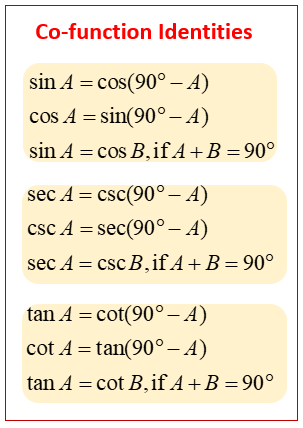
Cofunction identities
When you integrate a product of cosine and sin, where the exponent for one of the functions is 1, and the other is >1
let u=the trig function with the higher power
If you have the integral of cos²x sin³x dx
Take the one with the odd exponent and split it up, and then use pythag identity on what you just split up
-cosx + C
∫sinx dx
sinx + C
∫cosx dx
tanx + C
∫sec²x dx
-cotx + C
∫csc²x dx
secx + C
∫secx tanx dx
-cscx + C
∫cscx cotx dx
ln|secx + tanx| +C
∫secx dx
ln|secx| +C
∫tanx dx
Derivatives of Inverse Trig Functions

PSST Rule
Sec → Sec ← Tan
Derivative of secx = secxtanx
Integral of secxtanx = secx
Derivative of tanx = sec²x
Integral of sec²x = tanx
CCC Rule
Csc → -Csc ← Cot
Derivative of cscx = -cscxcotx
Integral of -cscxcotx = cscx
Derivative of cotx = -csc²x
Integral of -csc²x = cotx
Derivate of ln|x|
= 1/x
Integral of ln(x)
xln(x) - x + C
Product Rule for Log
logₙ(xy)=logₙx+logₙy
Quotient Rule for Log
logₙ(x/y) = logₙx-logₙy
Power Rule for Log
logₙ(x^b) = b logₙx
Change of Base Rule for Log
logₙx = log(sub c) x / log (sub x)b
Zero Rule for Log
logₙb(1) = 0
Pythagorean Identities
csc²x + sec²x = 1
sin²x + cos²x = 1
tan²x + 1 = sec²x
Arithmetic Sequences
add a d(difference) to each term
formula: a₁+(n-1)d
find d: a(sub)n+1 - a(sub)n
Geometric Sequence
multiply a common ratio
find r: r=a(sub)n+1/an
Alternating Sequences
goes from positive term to negative, pos, neg, pos, neg, …
Recursive Formula
formula: an=asub(n-1) +d
Explicit Formula for all Geometric
an=a1(r^n-1)
Recursive Formula for Geometric
an=a(sub)n-1 * r
Convergent Sequence
Given a sequence {an} if the terms an becomes artbitrarily close to a finite number L, as n becomes sufficiently lathe, we say {an} is a convergent sequence and L is the lmit of the sequence, In this case we write the lim as n goes to inifnity of an = L.
if the sequence is not convergent we say it is divergent
L’Hopital Rule
Used to evaluate limit of a function is indeterminate (0/0 or oo/oo or any combination), then you can use this rule to find the derivative of the numerator by itself, and the derivative of the denominator by itself. do not use quotient rule!!!
Finding horizontal asymptope of px^a/qx^b
if a>b, no HA
if b>a, HA @ 0
if a=b, HA @ p/q
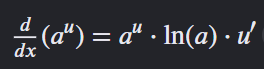
Derivative of exponential function
Squeeze Theorem for Sequences
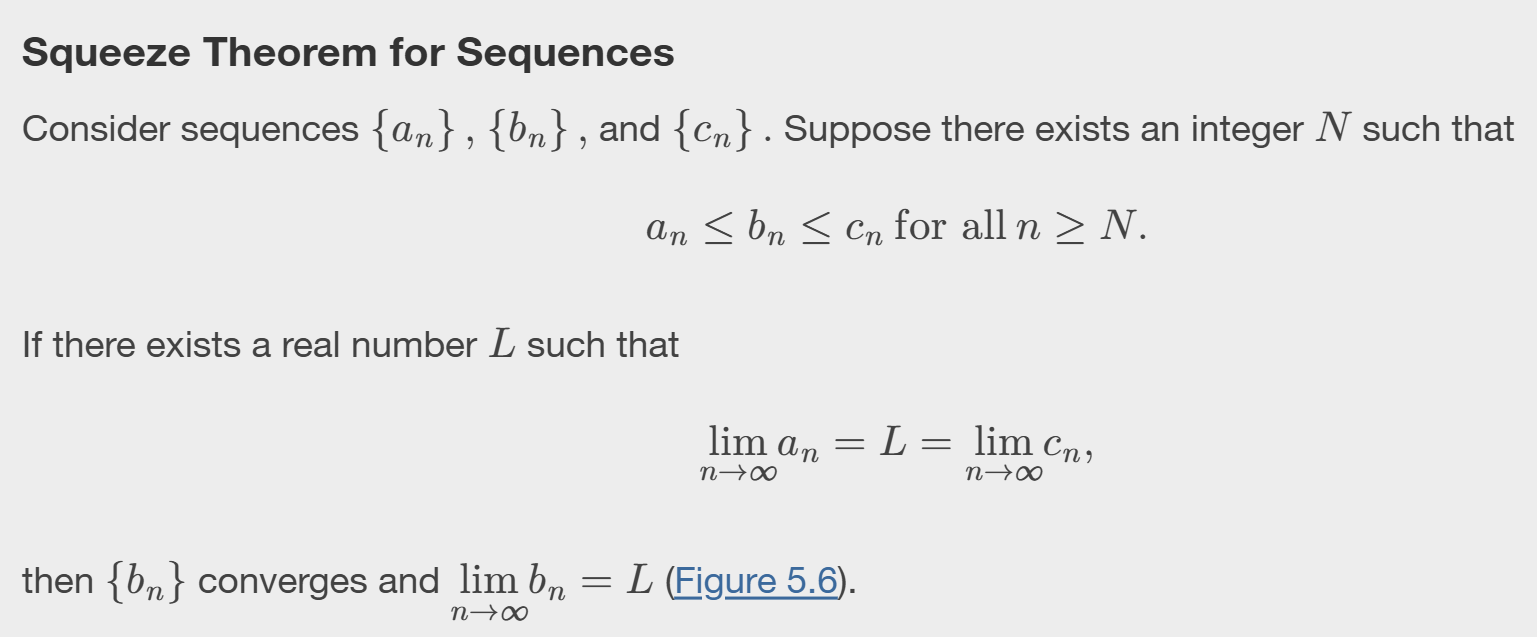
put sequence b in between sequence a and c to determine where sequence b converges or diverges
Bounded Above
if it is bounded above by a M, then M = y if your ceiling, and M is your horizontal aymptope
the shape of the sequence dots can only be horizontal or concave down
Bounded Below
if it is bounded below by a M, then M = y if your floor, and M is your horizontal aymptope
the shape of the sequence dots can only be horizontal or concave up
Bounded Sequence
the sequence has both a ceiling and a floor
boundary for {1/n}?
it is bounded above because 1/1 is 1 which 1 ≤ 1. we are looking at sequences
Relationship between boundaries and sequences
if a sequence converges, then it is bounded
if a sequence is bounded, it doesnt have to converge
Monotonic
an ≤ an+1
meaning that a number in a sequence has to be greater than or equal to the previous term
ex: {1, 2, 3, 4, 5, …} monotonic
ex: {1, 1, 2, 3, 4, …} monotonic
ex: {1, 0, -1, -2, …} monotonic
ex: {1, 2, 3, 2, 1, ….} not monotonic
Factorial
factorial is the number times all the following terms
ex: 5! = 5×4×3×2×1
ex: (2n+3)! = 2n!(2n+1)(2n+2)(2n+3)
n! = n (n-1) (n-2) (n-3) … * 1
Partial Sums
The sum of some of the terms in your sequence, not all of the terms
Infinite Series
A series that has an infinite number of terms
Finite Series
The sum of a finite number of terms
x^0
any number to a power of 0 is 0
Convergent Series
A series that adds up to a finite number or a sum that equals to a finite number
Divergent Series
The sum goes to infinity
1/n(n+1)
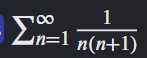
goes to 1
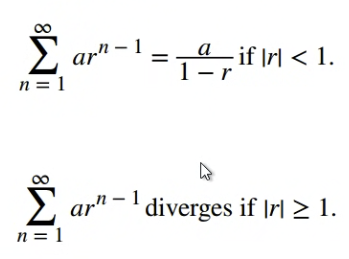
Geometric Series
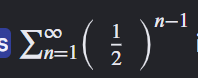
goes to 2
if |r| < 1 then the series converges
if |r| ≥ 1 then the series diverges
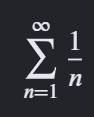
Harmonic Series
diverges
Partial Sums Formula
works only on geometric series

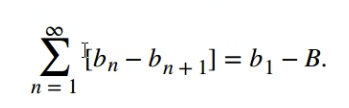
Telescoping Series
first term - last term OR first half term - last half term
ex: {1 - 2} + {2 - 3} + … + {9 - 10}
1-10 = 9
Divergence Test (or nth term test)
If we have a series that converges then an must = 0 or a(infinity) = 0. it doesnt tell you if the series converges

Integral Test

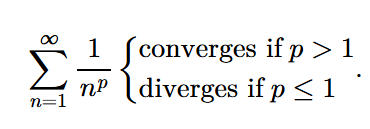
P-Series
1. if it looks like a p-series
2. what is p?
Estimating the Remainder
make sure it satisfies the conditions
find the integral of f(x) from N to oo to find RN

Comparison Test
Compare one function we don’t know how to do with another function we know how to do
for any series an, we want to find a bn, such that bn is always less than an and greater than 0
0≤an≤bn OR an≥bn≥0

Limit Comparison Test
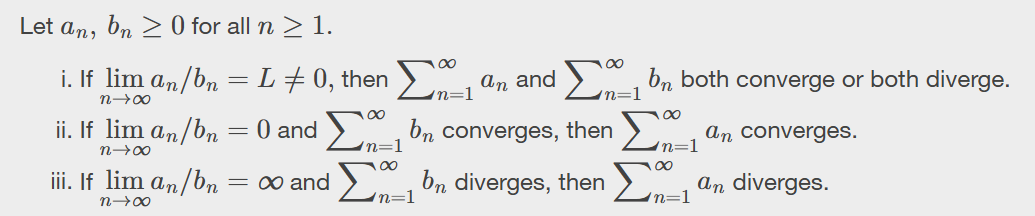
take an and divide it by bn, then apply the limit, if it
≠ 0 then both converge or diverge
= 0 then bn converges, then an converges
then bn diverges, then an is inconclusive
= ∞ then bn diverges, then an diverges
then bn converges, then an is inconclusive
Alternating Series
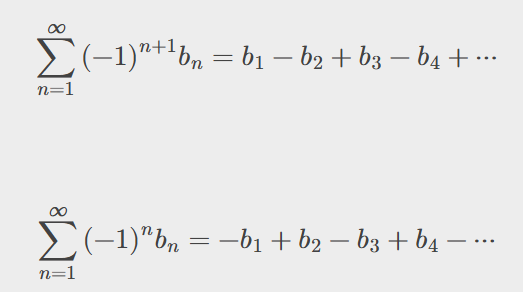
the terms alternate signs, from negative to positive and vice versa
(-1)^n/n to start with negative
(-1)^n+1/n to start with positive
three conditions
i. alternating series
ii. series is non-increasing
iii. lim of series bn = 0 (the last term is 0)
Sequence of odd numbers
ex: 1, 3, 5, 7, 9, = 2n+1
ex: 2, 4, 6, 8, 10 = 2n
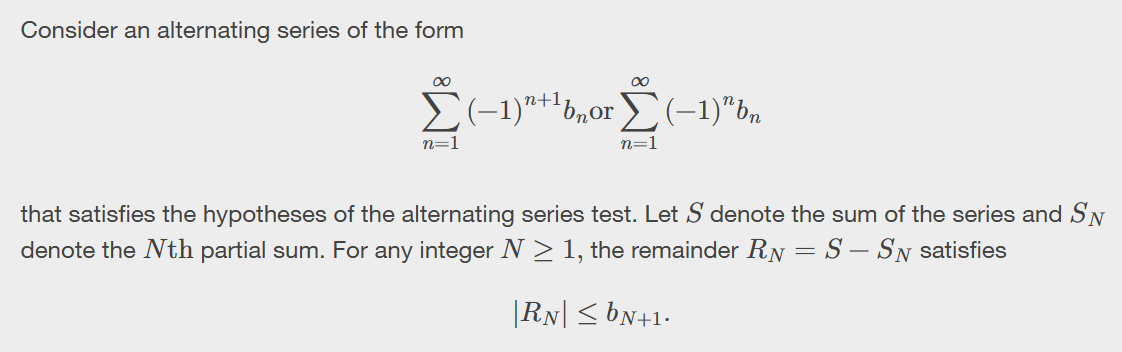
Find Remainder in Alt. Series
do |RN| ≤ b(sub)N+1
plug in bN and plug in N
Absolute convergence
exhibits absolute convergence when if the series converges with |an|

Conditional convergence
exhibits conditional convergence if the series diverges with |an|

Alternating harmonic series
it is conditionally convergent

Ratio Test
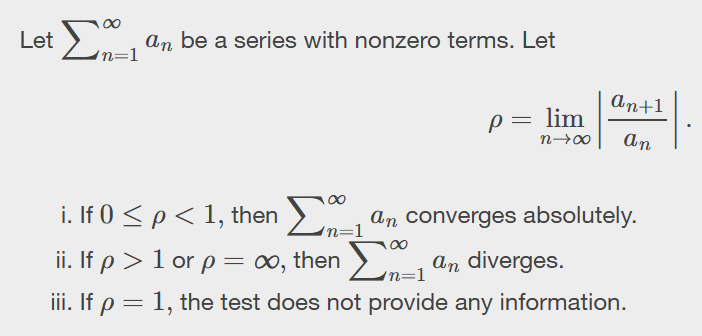
take the series and do n+1 to every n, then divide the series by the original series
Root Test
Definition of e
lim as n goes to oo of (1 + 1/n)^n

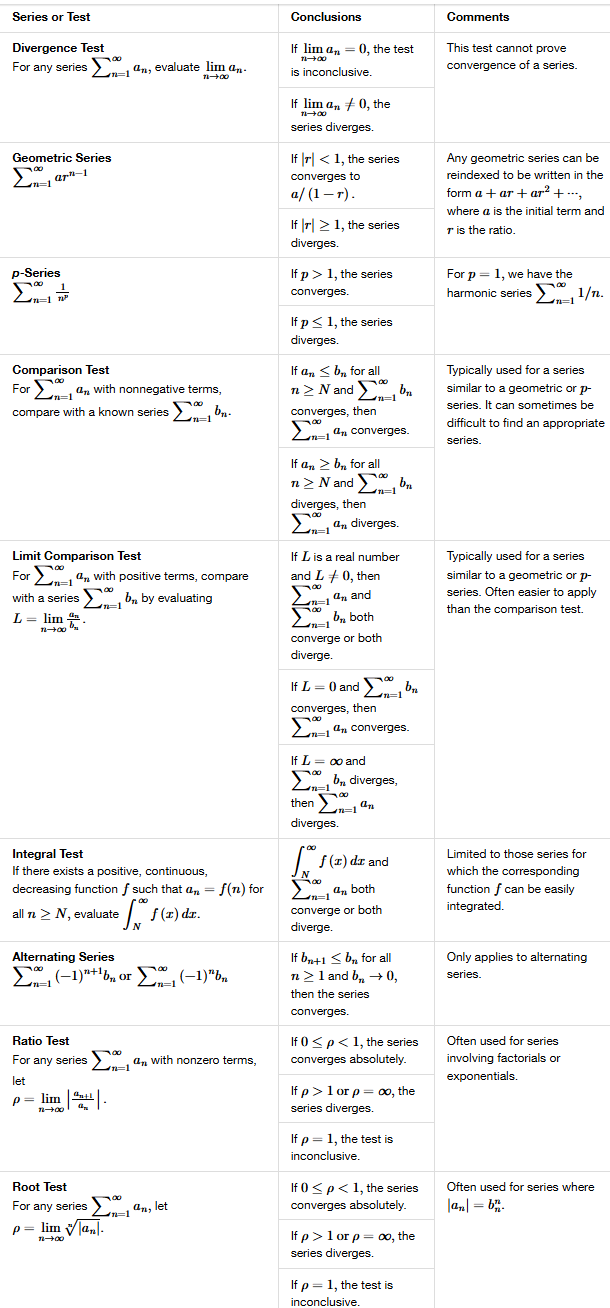
Choosing a Convergence Test

Series Tests
a telescoping series is one in which most of the terms cancel in each of the partial sums
Power Series
Used to represent functions and define new functions. A function with a coefficient times a variable, where the variable has an exponent.
Can be thought of as an infinite polynomial (therefore always an infinite series) and also geometric series where r = x
∑n=0 to ∞ of c(sub)nx^n = c0X^0 + c1X^1 + c2X^2 + c3X^3 + …
∑n=0 to ∞ of c(sub)n (x-a)^n = c0(x-a)^0 + c1(x-a)^1 + c2(x-a)² + c3(x-a)³ + …
|x| ∠ 1 it converges
|x| ≥ 1 it diverges
Center location is the center of the power series graph
x-a; a is the center
Convergence of Power Series
Converges at x=a, diverges when x doesnt equal a
Converges for all real numbers it converges
Converges between a-R to a+R, outside of that it diverges and have to test the endpoints using the ratio test
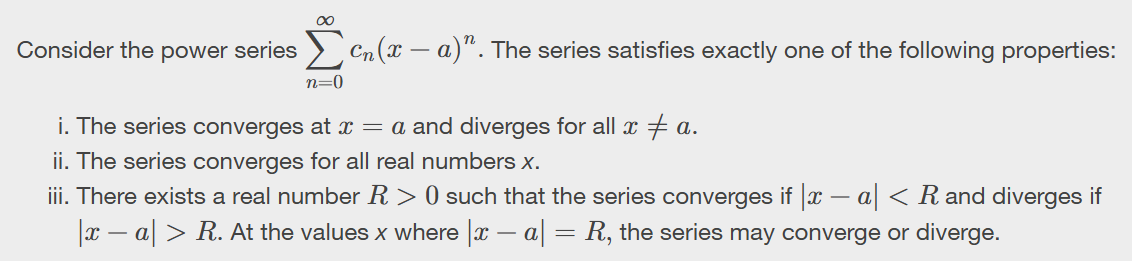
Find radius of convergence
How to find radius:
Find interval of convergence
How to find interval of convergence: test both endpoints using the ratio test, put a-R into power series and use ratio test to see if the series converges or diverges. Repeat the process for a+R
if it converges, then change parenthesis to brackets
if it diverges, then keep the parenthesis
Conditions of power series
i. radius: 0. interval: [0,0]
ii. radius: ∞. interval: (-∞,∞)
iii. radius = a. interval (a-R, a+R) or [a-R, a+R]
![<p>i. radius: 0. interval: [0,0]<br>ii. radius: ∞. interval: (-∞,∞)<br>iii. radius = a. interval (a-R, a+R) or [a-R, a+R]</p>](https://assets.knowt.com/user-attachments/e25e5b69-cc2f-441e-b0ca-7cf8b86a706d.png)
Representing a Function using Power Series
If the function f(x) = 1/1-x then we can use the summation of n=0 to oo of x^n
Indicate the radius or interval of convergence
Your function is exactly like the infinite sum of a geometric series where the r=x and a=1. I can use a geometric series to represent it, since it is the sum of a geometric series formula (S∞ = a/1-r) → 1/1-r

Representing a function that can’t use geometric or power series directly
f(x) and identify a g(x) such that g’(x) = f(x). Then the power series representing of this f(x) is the derivative of the power series that represents g(x)
EX: g(x)=1/(1-x)² we don’t know how to represent this, so we identify f(x)=1/1-x we find that f’(x)=g(x)
1/1-x the power series is ∑n=0 to ∞ of x^n. derivative of this power series is ∑n=0 to ∞ of nx^(n-1) OR ∑n=0 to ∞ of (n+1)x^n
could be done using integral — we have h(x) = ∫k(x)dx
i
imaginary numbers
√(-1) even root of negative # = i
odd root of positive # = a certain #
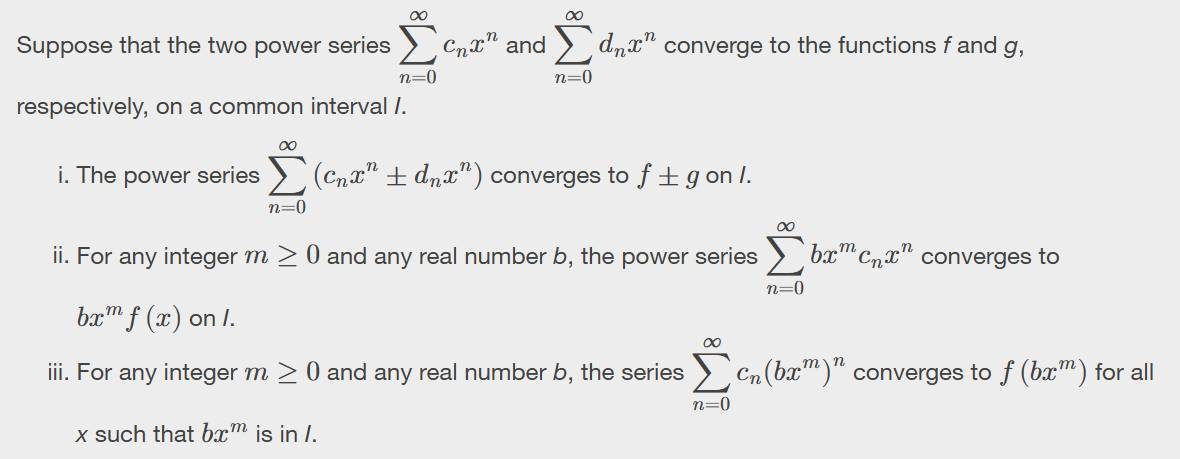
Combining Power Series
when you combine two series with different intervals, use the smaller interval
Taylor Series Formula

Taylor Polynomial
A finite Taylor Series
0th Taylor poly. or 0th partial sum = f(a)
3rd taylor poly. or 3rd partial sum = psub3(x) = 4 terms