matrixes
 Call Kai
 Learn
Learn Practice Test
 Spaced Repetition
 Match
Match Flashcards
 Knowt Play
1/31

There's no tags or description
Looks like no tags are added yet.
Name | Mastery | Learn | Test | Matching | Spaced | Call with Kai | Chat |
|---|
No analytics yet
Send a link to your students to track their progress
32 Terms
when restoring a tooth, why is it important to maintain contact and contours?
it reestablishes the proper form of the interproximal space
maintain the function of the teeth
prevent the impaction of food
maintains the health of the gingiva
what are some consequences of poor anatomic restorative form due to no use of matrix bands or wedges?
flat contact and amalgam gingival excess
amalgam gingival excess and absence of contact
amalgam overhang
poor occlusal margins
gingival overhang with absence of proper contacts and contours
open contacts, gingival inflammation, loss of papilla and excess amalgam
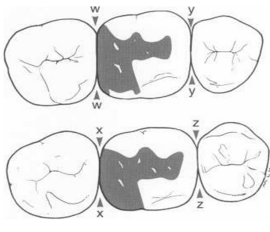
w shows what kind of embrasure form?
improper embrasure form caused by over contouring of restoration, resulting in unhealthy gingiva from a lack of stimulation
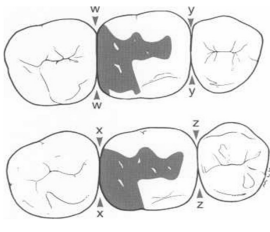
x shows what kind of embrasure form?
good embrasure form
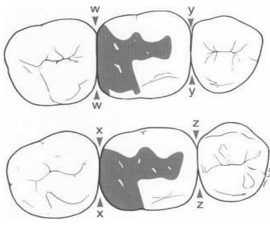
y shows what kind of embrasure form?
frictional wear of contact area has resulted in decrease of embrasure dimension
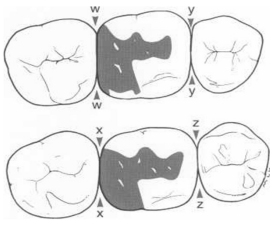
z shows what kind of embrasure form?
when embrasure form is good, supporting tissues receive adequate stimulation from foods during mastication
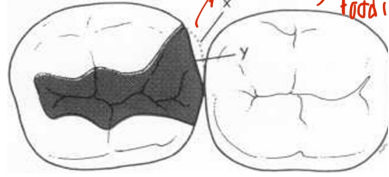
x shows what kind of embrasure form?
the portion of the tooth that offers protection to underlying supporting tissues during mastication
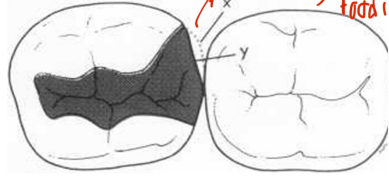
y shows what kind of embrasure form?
since the portion that protects the tooth is missing, restoration fails to establish adequate contour for good embrasure form, which leads to food impaction and gingival trauma
what are matrix bands?
the procedure of creating a temporary wall to replacing the missing walls that are opposite to the axial wall to pack the restorative material until setting
what is required for a proper restoration?
to retain physio anatomical features of teeth with a restorative material, tooth movement and matrixing must be accompanied or precede restoration procedures. there are two components involved in establishing contacts and contours, which are matrixing and tooth separation (by wedges)
what does a matrix consist of?
band
retainer
do all teeth need contoured bands?
no it varies tooth to tooth
what is the band?
a piece of metal that is either of celluloid or polymeric material used to support and give form to the restorative material during its introduction and hardening
what is the retainer?
a device by which the band can be retained in its designated position and shape. it can be a mechanical device, a wire, dental floss or a compound
what are the functions of matrixes?
it serves as a temporary wall or walls of resistance during condensation or packing of plastic restorative materials. necessary force of condensation can be applied safely against walls to produce adaptation
gives shape and contour (proximal — Buccal/Lingual) to the restoration and prevents marginal overhangs
maintains restoration form until it hardens
it keeps the gingival tissues and rubber dam away from the cavity margins during restoration
what are the ideal requirements of matrix?
easy to insert and remove
complete encirclement of tooth surfaces
enables checking occlusion
thin to enable positive contact (0.0016-0.0020 inches in thickness)
rigid to permit forceful condensation
smooth to produce smooth restoration
compatible with restorative (does not react, stick or discoloration)
stabilized firmly, either by wedge or compound
properly extended (1mm above occlusally and 1 mm below cervical margins of preparations)
conforms to large occlusal and narrow cervical diameters to prevent overhangs
how are matrixes classified based on mode of retentions?
mechanically retained matrixes
self-retained matrixes
how are matrixes classified based on transparency?
non transparent matrixes
transparent matrixes
how are matrixes classified based on material?
metallic, can be unilateral (section or ivory No.1). circumferential (ivory No.8, tofflemire and siqveland)
nonmetallic
what are some types of matrix bands for amalgam restorations?
prefabricated, or ready made, which are composed of a matrix holder (retainer) and a matrix band. some examples are:
ivory no.1
ivory no.8
tofflemire
siqveland
fabricated matrixes
wedged matrix
compound wedged matrix
soldered matrix, copper band
tied band
blacks matrix (modified tied band)
which matrix band is the most commonly used in amalgam?
tofflemire
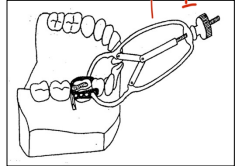
which matrix band is this?
ivory No.1
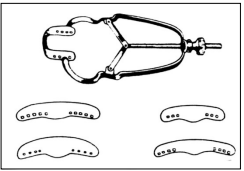
which matrix band is this?
ivory No.1
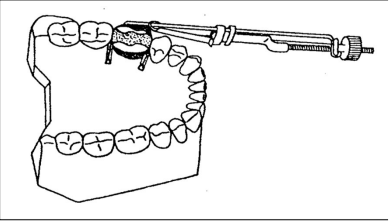
which matrix band is this?
Siqveland matrix band
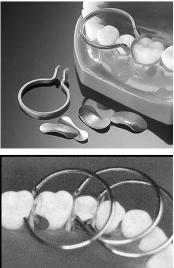
which matrix band is this?
sectional matrix
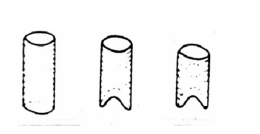
which matrix band is this?
copper band
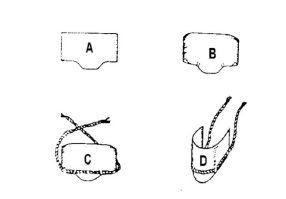
which matrix band is this?
tied band & blacks modification
how is the Tofflemire retainer used?
turn the vice moving nut until the slotted vice about an inch from the inner end of the retainer band. hold the vice moving nut and turn the vice screw nut a number of turns in the opposite direction till the pint of the spindle clears the diagonal slot channel for reception of the free ends of the band. insert the occlusal edge of the band selected upon the diagonal slit. the preshaped loop is thus formed. tighten the vice screw to lock the band in the vice. guide the looped end of the band gently over the tooth. the slotted end of the vice should face gingivally to facilitate the easy occlusal removal of the retainer. the size of the loop may be increased or decreased by turning the vice moving knob
how is the positioning band done in Tofflemire retainer?
Explorer pointing to locking vise. View is showing gingival side of vise.
Pointed spindle is released from locking vise by turning small knurlednut counterclockwise.
Fold band to form loop andposition in retainer (occlusal edgeof band first).
Tighten spindle against band in locking vise.