Speech Disorders QUIZ 1
 Call Kai
 Learn
Learn Practice Test
 Spaced Repetition
 Match
Match Flashcards
 Knowt Play
1/126

There's no tags or description
Looks like no tags are added yet.
Name | Mastery | Learn | Test | Matching | Spaced | Call with Kai | Chat |
|---|
No analytics yet
Send a link to your students to track their progress
127 Terms
Anatomy
study of structures of the body and relationship of the structures
Physiology
study of the functions of organisms and bodily structures
Subsystems of Speech (commonly 3 or 5)
Respiratory System
Laryngeal/Phonatory System
Articulatory/Resonatory
(Prosody also commonly listed, but not in book)
Respiratory System
driving force for speech via positive air pressure beneath vocal folds
Larygneal System
vocal folds vibrate at high speeds
Articulatory/Resonatroy
acoustic filter that allows certain frequencies to pass while blocking others
Respiratory System’s primary biological functions
breathing
ventilation
speech production

What are the organs and structures responsible for breathing called?
pulmonary apparatus
pulmonary apparatus
lungs - pair of air filled sacs elastic that change size and shape to allow us to breathe
trachea - air moves into lungs via trachea and branches
pulmonary airways
Chest wall (thorax)
Rib cage
Abdominal wall
Abdominal content
Diaphragm
Lungs
pair of air filled sacs elastic that change size and shape to allow us to breath
Trachea
air moves into lungs via trachea and branches
Chest Wall (Thorax) Components
Rib cage
Abdominal wall
Abdominal content
Diaphragm
Muscles of Respiratory System
Inspiratory Muscles
Expiratory Muscles
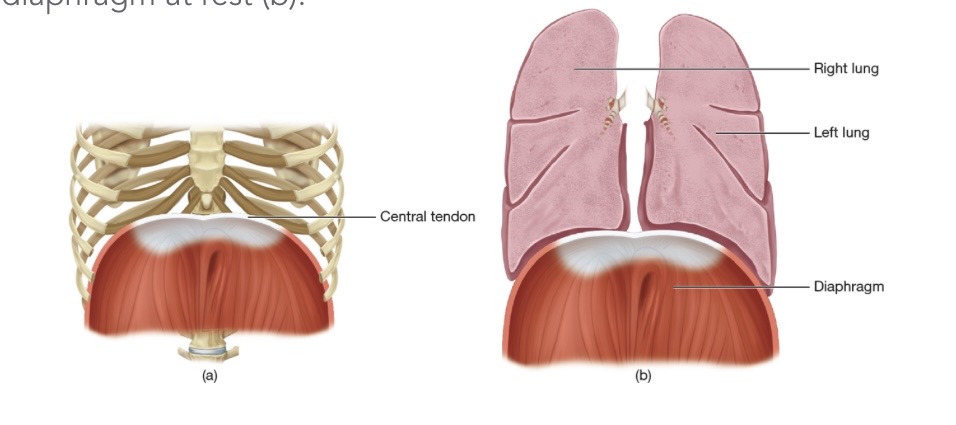
Inspiratory Muscles
Diaphragm
many Thoracic and Neck muscles
Expiratory Muscles
Most important muscles: located anterior and lateral to the the abdomen
Assist diaphragm’s movement back to its relaxed, dome-shape
Other muscles may be used depending on body position, pathological state, and environmental conditions
Resting Tidal Breathing
duration of inspiration and expiration is relatively equal
the normal, quiet breathing when you are at rest
Resting Tidal Inspiration (what happens?)
diaphragm contracts
rib cage and lungs expand
lung volume increases
alveolar pressure drops
Causes air to rush in and equalize with atmospheric pressure
Resting Tidal Expiration (what happens?)
decreases size of rib cage wall
compression of lungs
increase in pressure in lungs
air rushes out to achieve equilibrium w/ atmospheric pressure
Does not require active muscle contraction
A respiratory cycle is…
one inhalation and one exhalation
Speech Breathing
Contraction of diaphragm leads to rapid, forceful inspiration
Inspirations are much shorter than expiration
inspired air is greater than during resting tidal
Inspiratory and expiratory muscles are both activated during speech
Thoracic Muscles (anterior view)
sternocleidomastoid
scalenes
pectoralis major
pectoralis minor
serratus anterior muscle
External oblique
internal oblique
transversus abdominus
abdominal aponeurosis
rectus abdominis

Laryngeal system primary bio function
Prevent foreign objects from entering the trachea and lungs
can impound air for forceful expulsion of foreign objects threatening lower airways (coughing)
Structures of Laryngeal System
Larynx
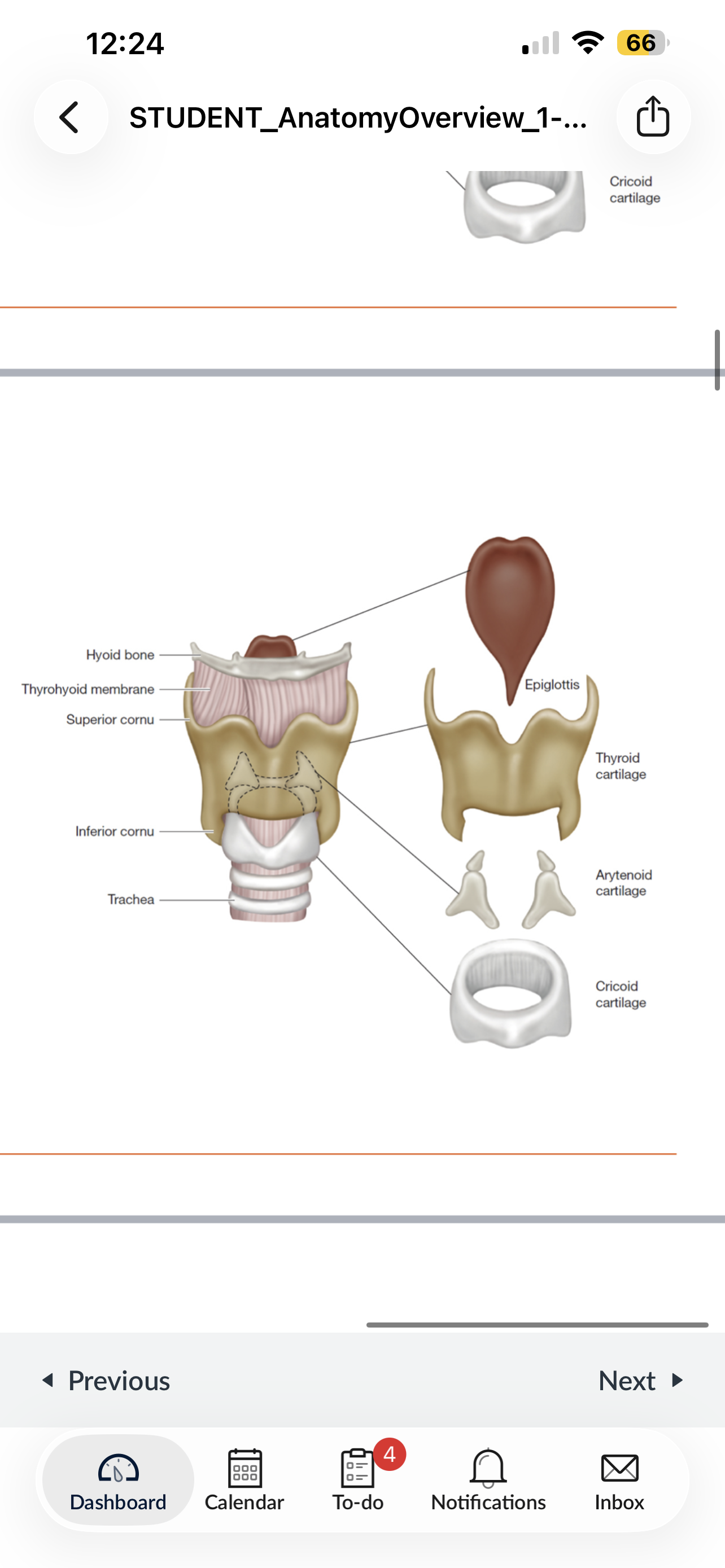
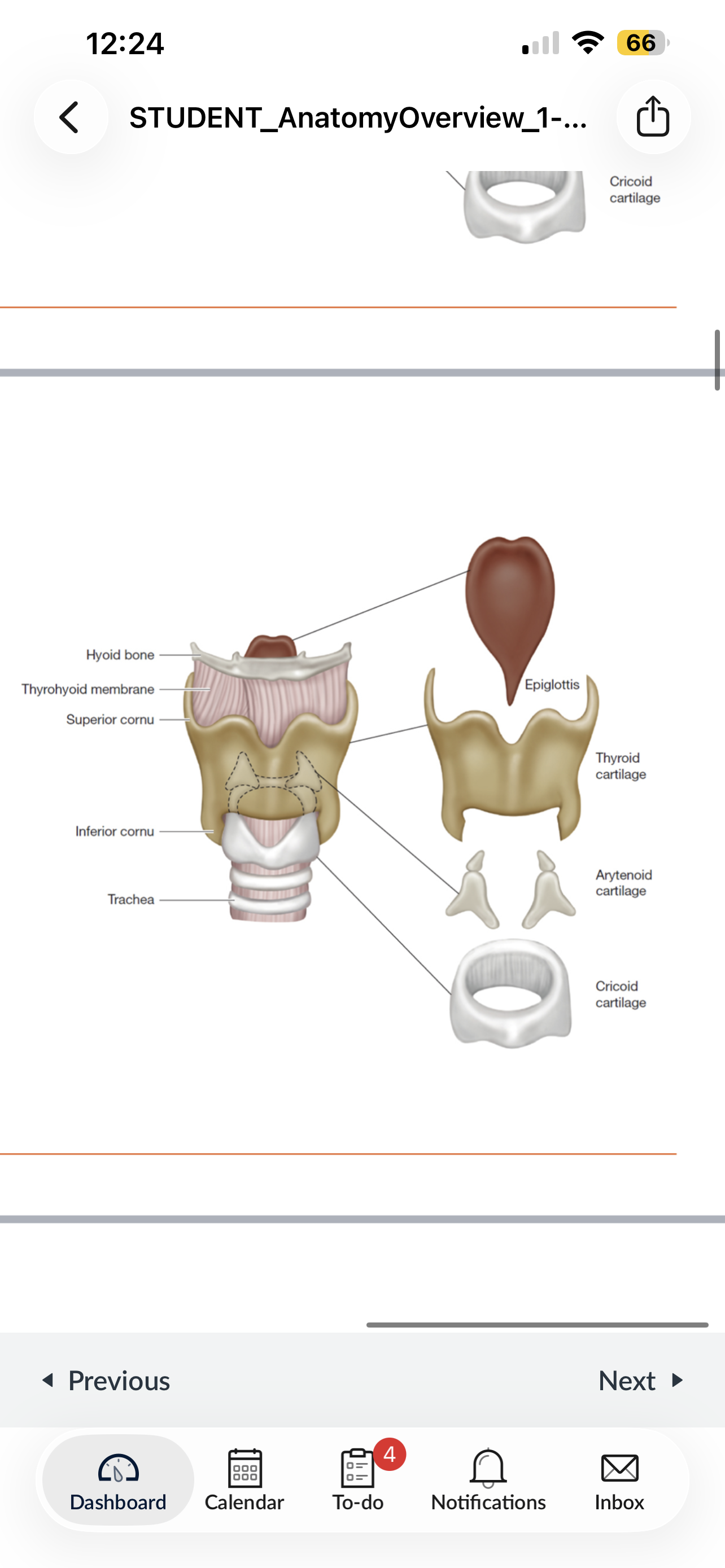
Thyroid Cartilage
Thyroid Prominence
Vocal Folds
Glottis
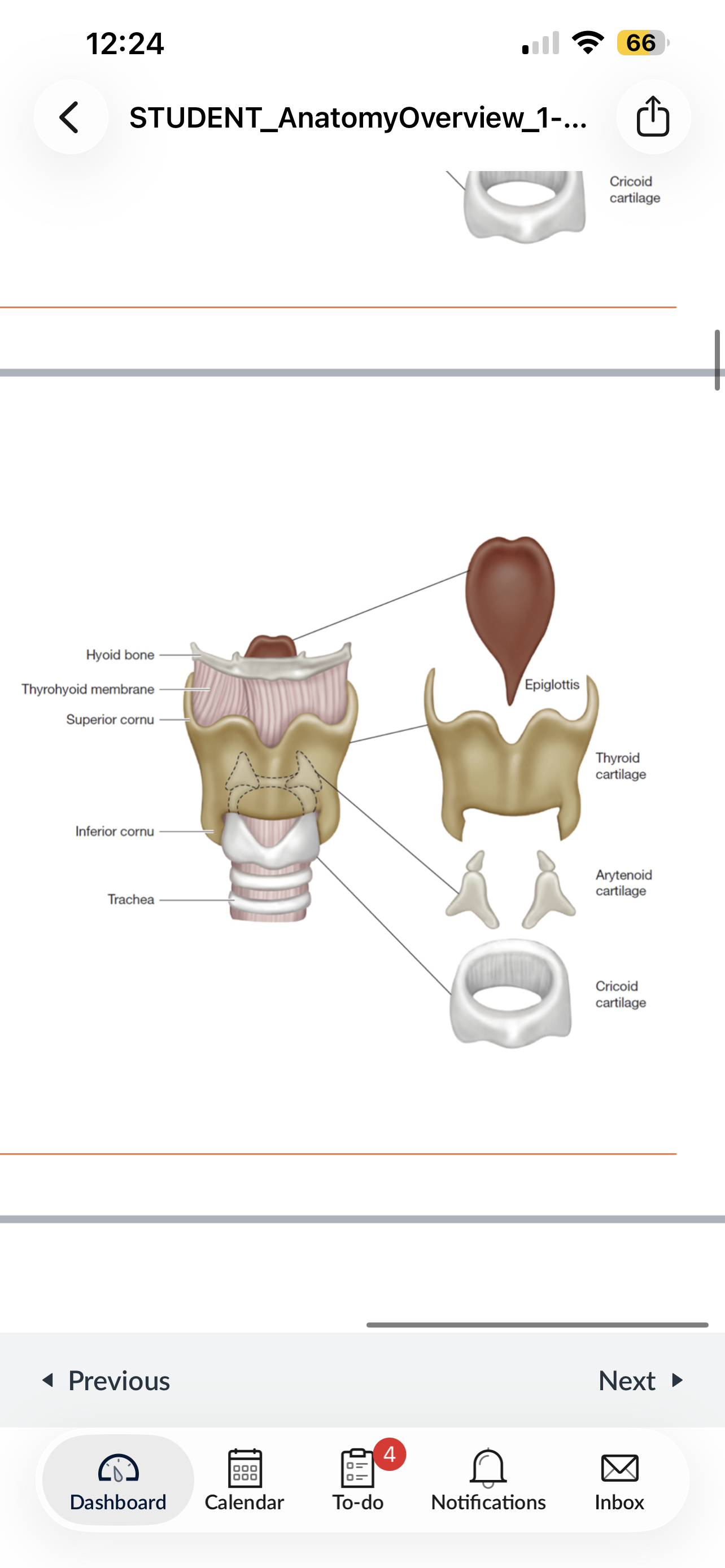
Larynx
Air valve composed of cartilages, muscles, and other tissue
Main sound generator for speech
Sits on top of the trachea and opens into the pharynx
suspended from the hyoid bone (hyoid = point of attachment for laryngeal/tongue muscles)
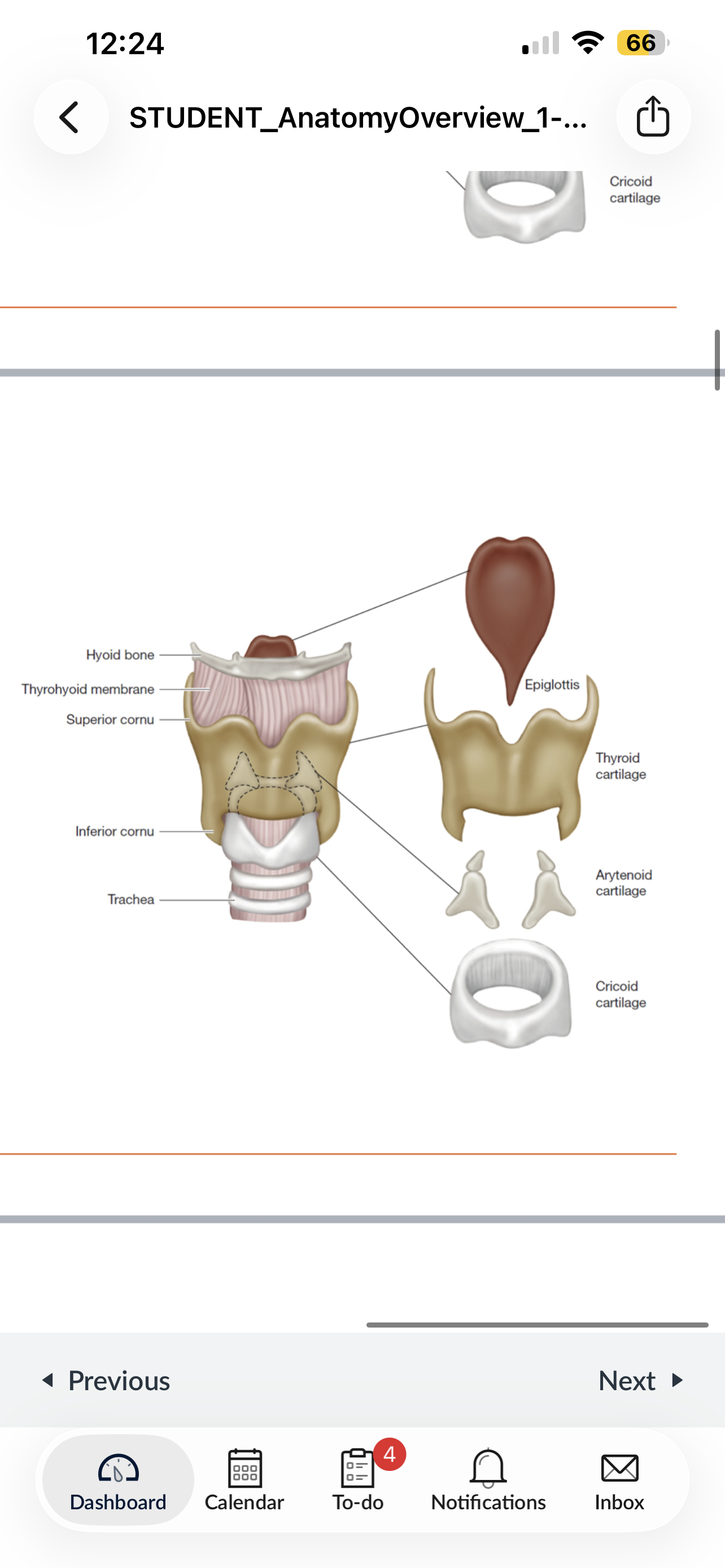
Thyroid Cartilage
Largest laryngeal cartilage
Forms front and sides of laryngeal skeleton and protects inner components of larynx

Thyroid Prominence
“Adam’s apple”; just below the thyroid notch
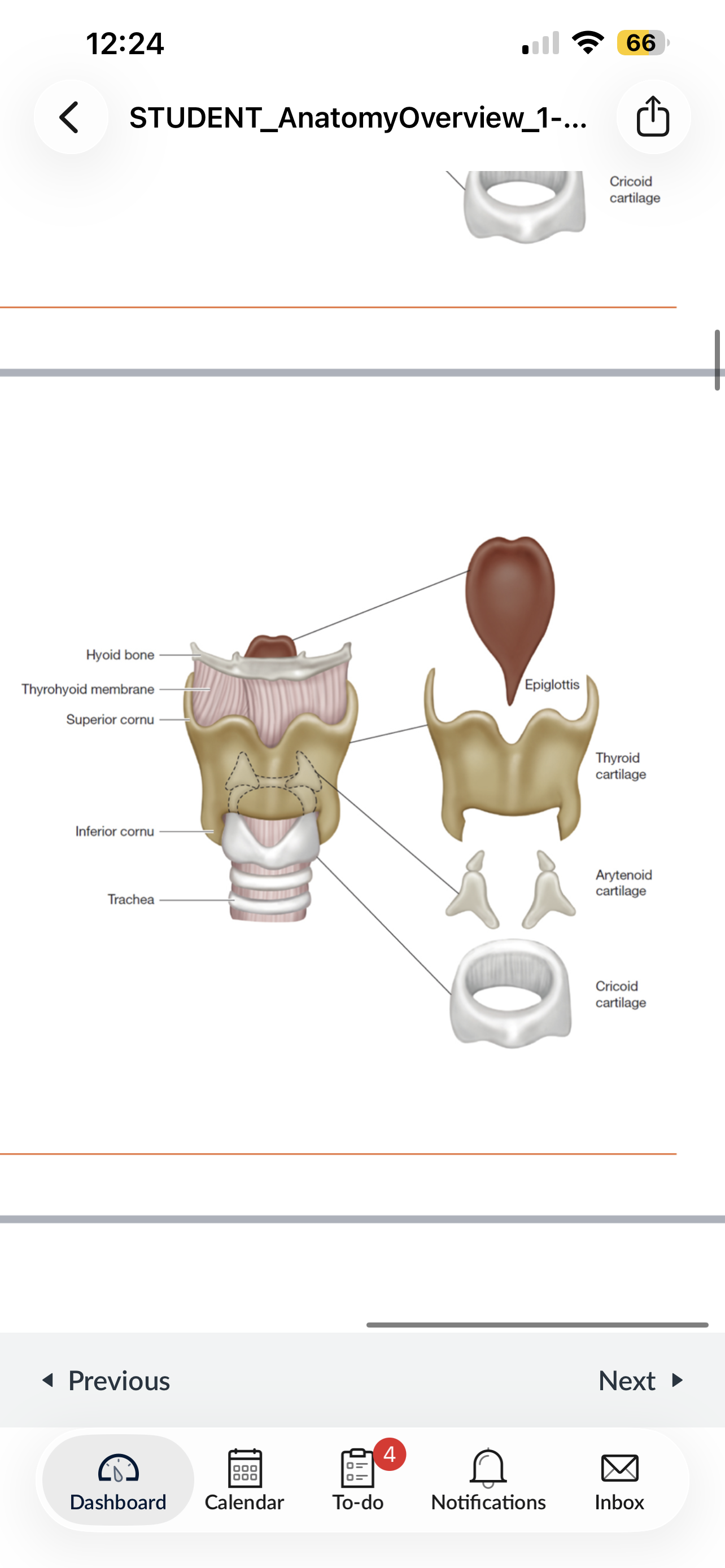
Vocal Folds
Attached in front to the middle of the thyroid cartilage and in back to the arytenoid cartilages through the vocal ligament
Abduct = respiration
adduct = phonation
Glottis
space between vocal folds
Muscles of Larynx
Thyroarytenoid muscle
Cricoarytenoid muscle
Lateral cricoarytenoid and arytenoid muscles
Posterior cricoarytenoid muscle

Thyroarytenoid muscle
Bulk of each vocal fold
Contraction shortens and thickens the vocal folds

Cricoarytenoid muscle
Stiffens and lengthens the vocal folds, increases pitch

Lateral cricoarytenoid and arytenoid muscles
Contraction results in vocal fold adduction (bringing vocal folds together)

Posterior cricoarytenoid muscle
Primary muscle of vocal fold abduction

Larynx is _____ in neck of newborns, and reaches final position between _____ years of age
small and high
10-20 years
Laryngeal Issues of Laryngeal System
Cartilage: Gets larger and less flexible
Vocal folds: Get longer; changes differ between males and females
Female cartilage: Does not fully harden/ossify
Vocal folds with age: Atrophy and lose elasticity
Men: Pitch tends to increase
Women: Pitch tends to decrease, partly due to hormonal changes
Articulatory/Resonance System
Vocal tract is a resonant acoustic tube
Shapes sound energy produced by respiratory and laryngeal systems into speech sounds
articulatory-resonance system is composed of:
nasal cavity
oral cavity
pharyngeal cavity
The oral, nasal, and pharyngeal cavities form the…
vocal tract
Articulatory System Structures
facial and crianial bones
mandible
teeth
tongue
Nasal Cavity Parts
maxilla
Eustachian tube
velum
Oral Cavity Parts
maxilla
lips
velum
mandible
tongue
Epiglottis (not technically in oral cavity, but key for protecting airway during swallowing)
Pharyngeal Cavity Parts
Eustachian tube (shows boundary between nasal and pharyngeal)
epiglottis
vocal folds, larynx
esophagus
pharyngeal wall (posterior of pharyngeal cavity)
how many bones in the facial skeleton and cranium?
22
8 cranial, 14 facial
The mandible articulates with…
the temporal bone by the temporomandibular joint
Maxilla (Hard Palate) Parts
Incisive foramen
longitudinal fissure
bony hard palate
posterior nasal spine
(don’t need to know teeth!)
Teeth
Adults have 32 teeth in alveolar processes of the mandible and maxilla
Hard palate is composed of the horizontal bones of the maxilla
Tongue
Muscular hydrostat
Structural support through contraction of muscles and has a soft skeleton of connective tissue
Skull bones/parts
coronal suture
frontal bone
parietal bone
temporal bone
occipital bone
greater wing of sphenoid
zygomatic arch
zygomatic bone
condylar process
maxilla
mastoid
temporomandiubular joint
mandible
styloid process
alveolar process
Parts of tongue
tip
blade
dorsum
body
root
the tongue is a…
muscular hydrostat
muscular hydrostat (def)
no cartilage or bone
has a soft skeleton of connective tissue
structural support comes from muscle contraction
Velum
Also called the soft palate
Located in the pharynx
Uvula: Termination of the velum
Velopharyngeal closure
VP Closure
Contact of the velum with the lateral and posterior pharyngeal walls
good VP closure = keeps liquid out of nose
Velar Elevation
prevents air or food escaping through the nose
builds up air pressure for production of pressure sounds
Air that escapes through the nose during speech = nasal quality
Soft Palate/Uvula view
hard palate
velum
anterior faucial pillar (important for swallowing stage 2)
back wall of oropharynx
tongue
Bones of the skull reach adult size by ____
age 8
Newborns have ___ separate skull bones that fuse into ___ at adulthood
45; 22
Lower facial bones reach adult size at about ___ years
18
Dentition emerges at about ____ and is complete around____
6 months; 3 years
Secondary dentition is complete around ___
18 years
A newborn’s tongue occupies…
most of the oral cavity
Tongue reaches adult size by about
16 years
By ___, infants can inconsistently close the ____ for syllable productions
2 months; veloppharynx
VP closure becomes consistent between
6 months and 3 yrs
Aging has _____ on velopharyngeal function for speech
minimal impact
Length and volume of oral cavity increases
Influences the overall resonant characteristics
Lowers the frequencies at which the vocal tract naturally resonates
Speech production process begins with ____
phonation
Speech Production Process in order
phonation
Air pressure builds up below the closed vocal folds.
Air pushes the vocal folds apart starting at the lower edges.
The upper edges then move apart.
The vocal folds’ elasticity pulls them back together, causing them to collide
Pressure → Folds open → Folds close/collide → Sound
Fundamental Frequency
Number of cycles of vocal fold vibration per second (lowest sound prodcued)
Harmonics
Whole number multiples of the fundamental frequency
Movement of the tongue, lips, and larynx change the shape of the vocal tract and modify sound
Speech Production process pictures
arrows = air pressure
Speech frequency charts (read over)
increase by 200
top chart = tongue and pitch (tongue height, how far forward tongue is)
bottom chart = voice alone
Central Nervous System (CNS)
brain and spinal chord
encased in bone
descending motor tracts send EFFERENT info (from brain to body)
Peripheral Nervous System (PNS)
nerve tract that connect the rest of the body to CNS
encased in soft tissue
ascending sensory tracts send AFFERENT info (from body to brain)
3 Gross divisions of brain
Cerebrum
Cerebellum
Brainstem (midbrain, pons, medulla)
Cerebrum
made of ridges and valleys
rests on top of brainstem/cerebellum
originating our highest/most complex cognitive functions
cerebral cortex
CENTRAL SULCUS
PRECENTRAL GYRUS
Precentral Gyrus
motor function
Postcentral Gyrus
sensory/tactile info
lateral sulcus/fissure
Cerebral Meninges
DAP
dura, arachnoid, pia
dura mater
dense protective tissue layer
arachnoid mater
contains vascular supply to surface of brain
looks like spiderweb/ceran wrap
Pia mater
most delicate innermost meningeal layer
cerebral spinal fluid travels here to nourish the brain (glial cells come out and clean brain)
Cerebrospinal fluid system
is nutrive
helps suspend brain (like a freshwater lake and brain is boat, makes less heavy)
helps protect brain from trauma
Cerebrospinal fluid
housed in ventricles in the brain
delivers nutrients, removes waste
produced in choroid plexus
Grey Matter
unmyelinated neurons
“houses”
processes and regulates info in the CNS
found in the cortex, cerebellum, thalamus, basal ganglia, and spinal chord
White Matter
HEAVILY MYELINATED
“cable” (connects you to TV)
axons of neurons covered in a white sheath of a protein and fatty substance called myelin
Connects different areas/structures of the nervous system to one another and allows them to communicate
Association fibers
Connects different structures/areas
same hemisphere
“small”
Commissural fibers
Connects analogous areas (similar structures btwn 2 hemispheres)
“medium”
Projection fibers
connects brain to spinal chord
Project from
Transmit motor movements from
transmit sensory signals from
“large”
Longitudinal Fissure
divides brain into left and right halves
runs from front to back along brain
Corpus Callosum
connects the right and left hemispheres through white matter
located at the base of the cerebral hemispheres
Each hemisphere is responsible for different _____ functions
cognitive and motor functions (but both are interconnected)
Frontal Lobe Functions
Expressive language - Broca’s
Personality and memory = prefrontal cortex
Motor Movement = primary motor cortex (motor strip)
left primary motor cortex issues
damage near base of motor strip often creates apraxia of speech
Motor Homunculus (Frontal Lobe)
Representation of the amount of surface area within the motor strip dedicated to the control of each body part
More surface area is dedicated to parts with fine motor movement than gross motor movement
Parietal
sensory in nature
Primary sensory cortex
Primary Sensory Cortex (sensory strip)
First gyrus of parietal lobes
Receives tactile/proprioceptive information
• Left sensory cortex receives sensory info from
• Right sensory cortex receives sensory info from
Sensory Humunculus
Representation of amount of cortical surface area within primary sensory cortex dedicated to each body part
more surface area is dedicated to body parts that have more sensory receptors than others with fewer sensory receptors
Temporal Lobe