AIS Chapter 14
 Call Kai
 Learn
Learn Practice Test
 Spaced Repetition
 Match
Match Flashcards
 Knowt Play
1/12

There's no tags or description
Looks like no tags are added yet.
Name | Mastery | Learn | Test | Matching | Spaced | Call with Kai |
|---|
No analytics yet
Send a link to your students to track their progress
13 Terms
Data Warehouse
collection of information gathered from an assortment of external and operational (that is, internal) databases to facilitate reporting for decision making and business analysis
Model of Data Warehouse
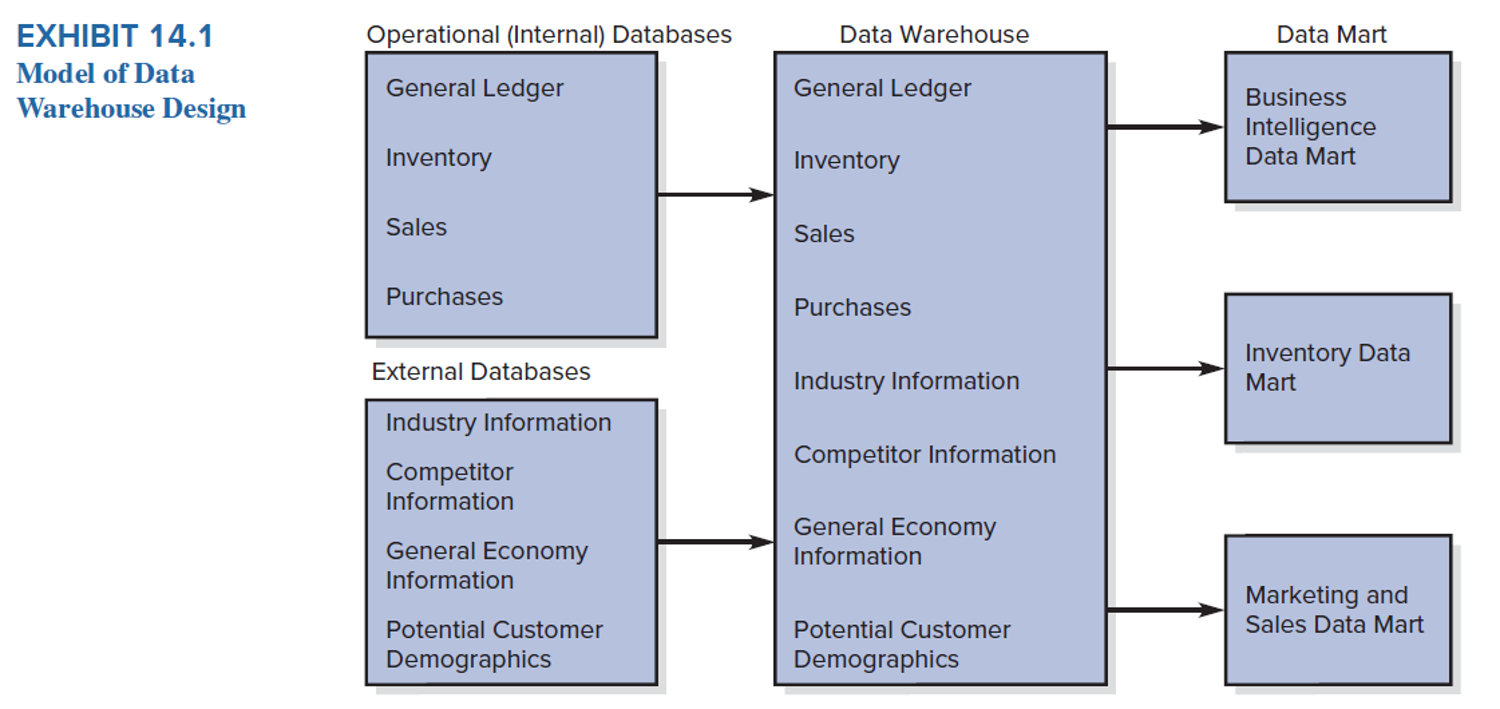
Business Intelligence
computer-based technique for accumulating and analyzing data from databases and data warehouses to support managerial decision making
Process of Business Intelligence
Gather information (either internal information, external information or both) from a variety of sources.
Analyze the data to discern patterns and trends from that information to gain understanding and meaning.
Make decisions, hopefully better-informed ones, based on the information gained
Data Mining
process using sophisticated statistical techniques to extract and analyze data from large databases to discern patterns and trends that were not previously known
will only find statistical relationships and some of them represent spurious correlations
Digital Dashboards
designed to track the firm process or performance indicators or metrics to monitor critical performance
Extensible Business Reporting Language (XBRL)
XML language, a standard for Internet communication between businesses
XRBL Database
available for various uses, including reporting on the firm’s web site, filing to regulators (SEC, IRS, etc.) and providing information to other interested parties such as financial analysts, loan officers and investors
XBRL taxonomy
defines and describes each key data element (for example, total assets, accounts, payable, net income, etc.
XRBL instance documents
Contain the actual dollar amounts or the details of each of the elements within the firm’s X B R L database
XBRL style sheets
take the instance documents and add presentation elements to make them readable by humans
What to include in XBRL audit?
The most current, standardized XBRL taxonomy is used,
The underlying financial and nonfinancial data that is used in XBRL tagging is reliable,
The XBRL tagging is accurate and complete, and,
The reports generated using XBRL are complete and received on a timely basis.
XBRL Global Ledger Taxonomy
allows the representation of anything that is found in a chart of accounts, journal entries or historical transactions, financial and non-financial