TEST 3 Chapter 23: Substitution Reactions of Carbonyl Compounds at the α-Carbon
 Call Kai
 Learn
Learn Practice Test
 Spaced Repetition
 Match
Match Flashcards
 Knowt Play
1/42

There's no tags or description
Looks like no tags are added yet.
Name | Mastery | Learn | Test | Matching | Spaced | Call with Kai | Chat |
|---|
No analytics yet
Send a link to your students to track their progress
43 Terms
B
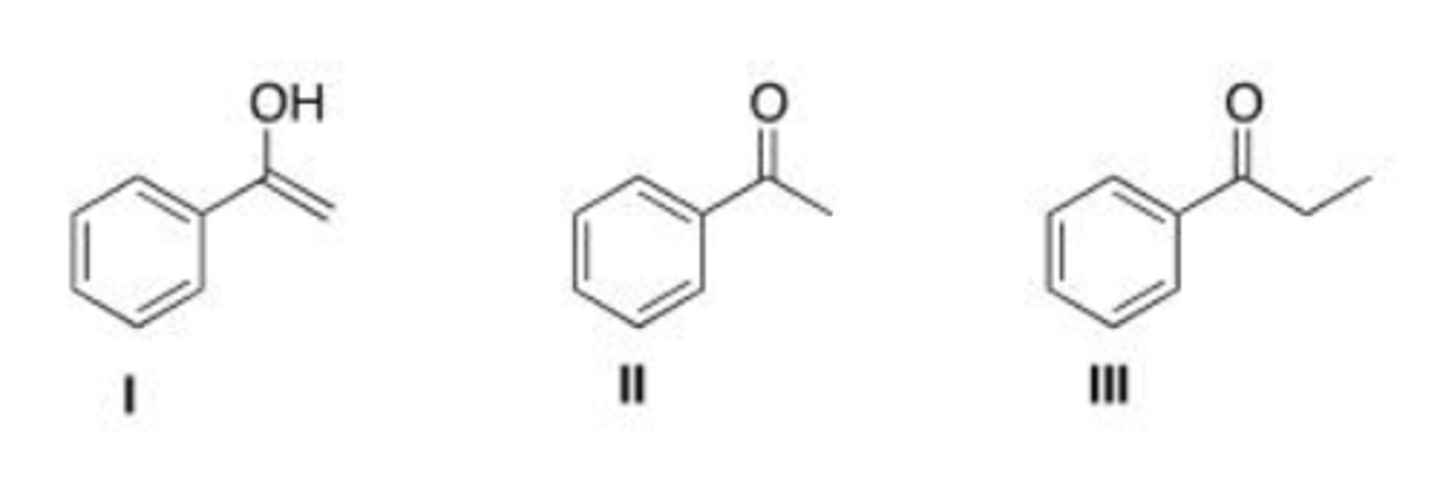
Which is the more stable form of acetophenone?
A. Only I
B. Only II
C. Only III
D. I and II are equally stable
A
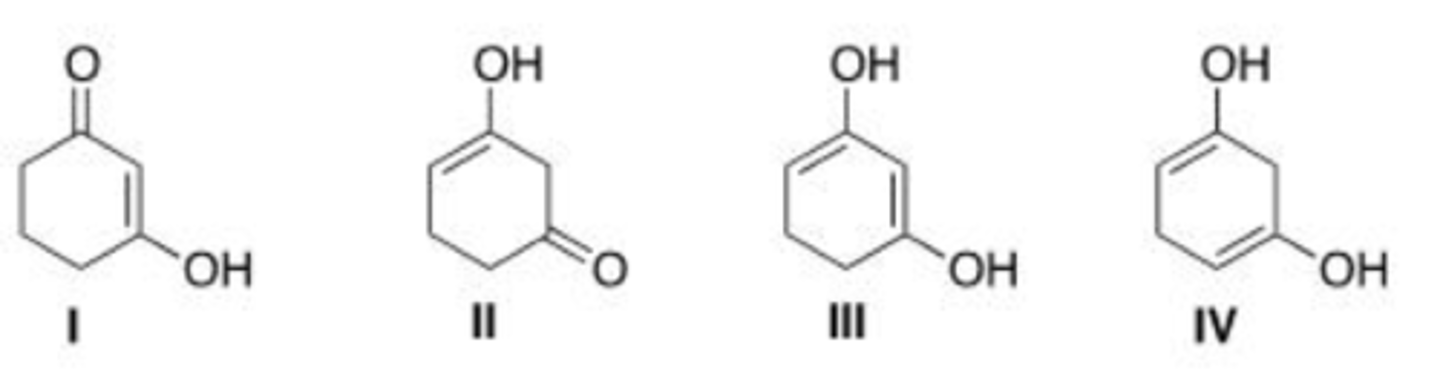
Which is the most stable form of 1,3-cyclohexanedione?
A. I
B. II
C. III
D. IV
D
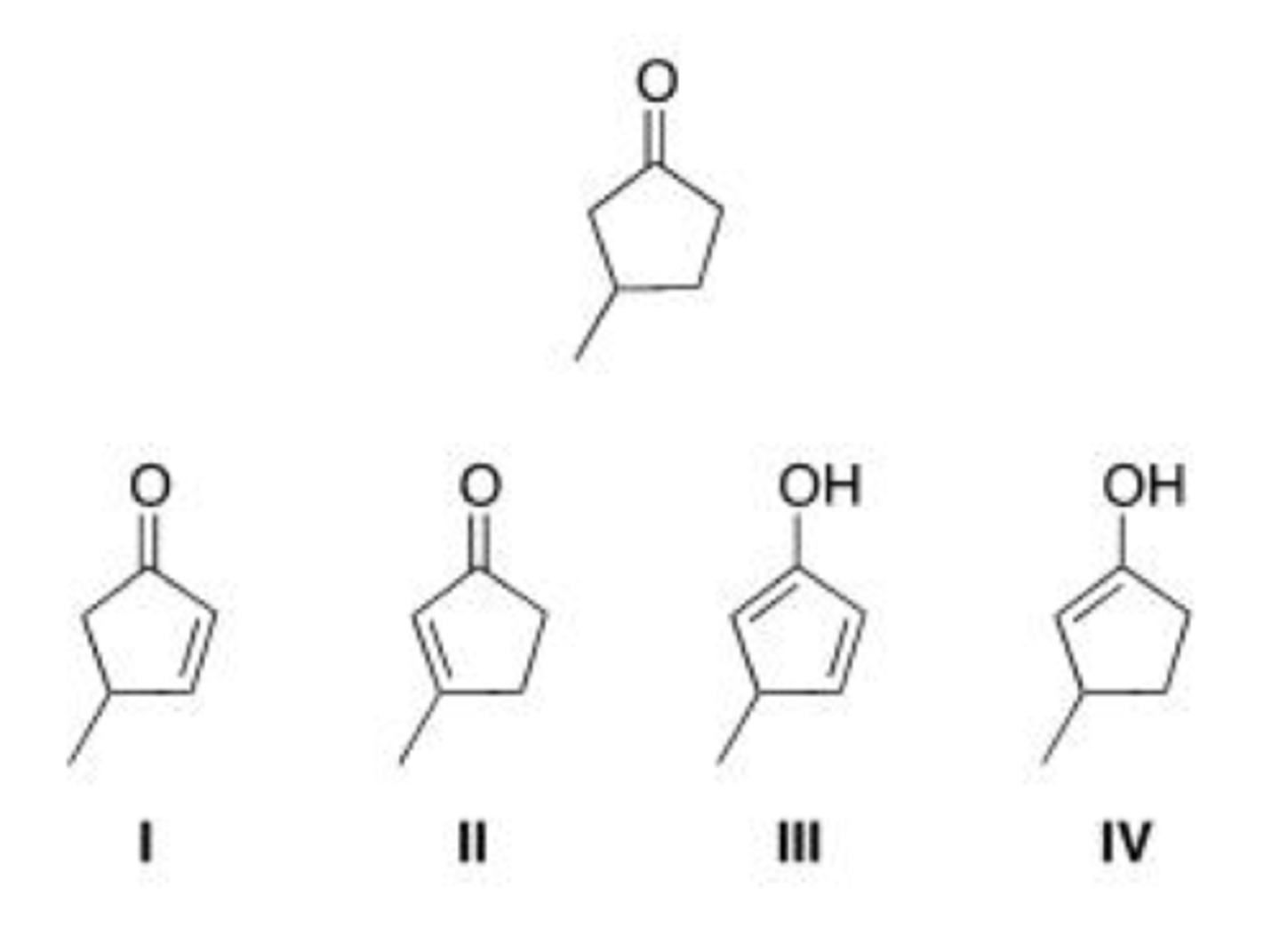
Which of the following is an enol form of the following compound?
A. I
B. II
C. III
D. IV
D
Why is the enolate of acetone less basic than the allyl anion derived from propene?
A. Because there are more atoms in acetone
B. Because there are more resonance structures for the enolate of acetone
C. It isn't; the allyl anion is less basic.
D. One of the resonance structures for the enolate places the negative charge on the more electronegative oxygen.
C
Which of the following four compounds is the most acidic?
A. I
B. II
C. III
D. IV

B
Will acetone be completely deprotonated by potassium tert-butoxide?
A. Yes
B. No
A
Will acetophenone be completely deprotonated by lithium diisopropylamide (LDA)?
A. Yes
B. No
C
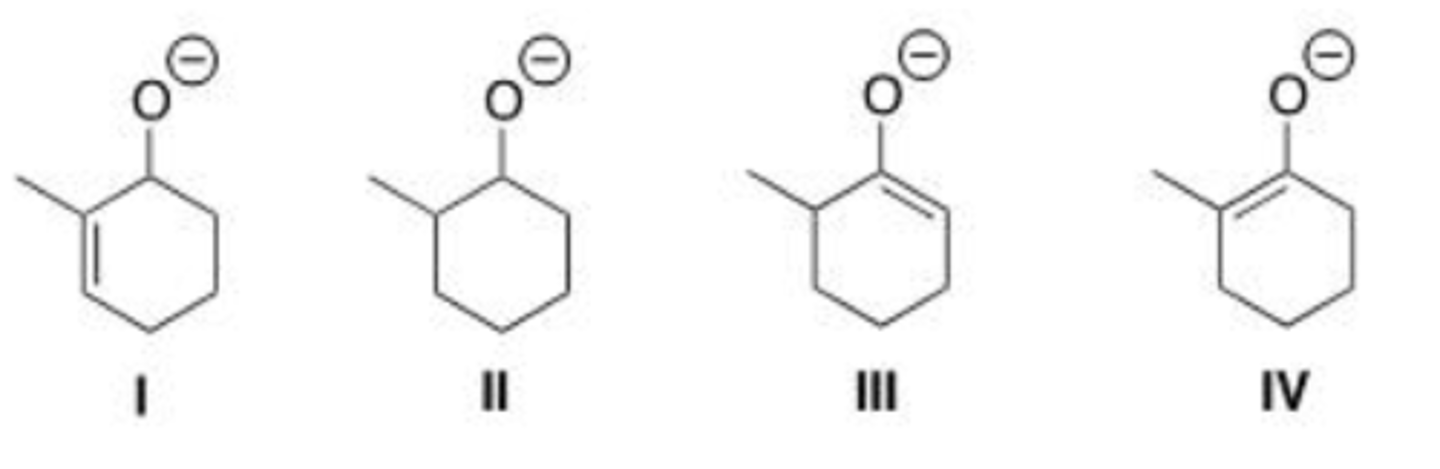
Which is the kinetic enolate of 2-methylcyclohexanone?
A. I
B. II
C. III
D. IV
C
If you want to form a thermodynamic enolate, you want to:
A. Keep the reaction as cold as possible.
B. Use an aprotic solvent such as THF.
C. Use a protic solvent such as ethanol.
D. Use a carboxylic acid.
D
If you want to form a kinetic enolate, you want to:
A. Use a strong, non-nucleophilic base such as LDA.
B. Use a protic solvent.
C. Use a low temperature.
D. Both use a strong, non-nucleophilic base such as LDA and use a low temperature.
B
Which of the following is the intermediate for halogenation of ketones under acidic conditions?
A. An enolate
B. An enol
C. A tautomer
D. An epimer
D
Why is it difficult to stop the halogenation of ketones under basic conditions at the mono-halogenated stage?
A. The ketone undergoes a Bayer-Villigar oxidation.
B. The ketone is reduced.
C. The ketone undergoes an Aldol reaction.
D. The bromine helps to stabilize the second enolate, making the product more acidic than the starting material.
B
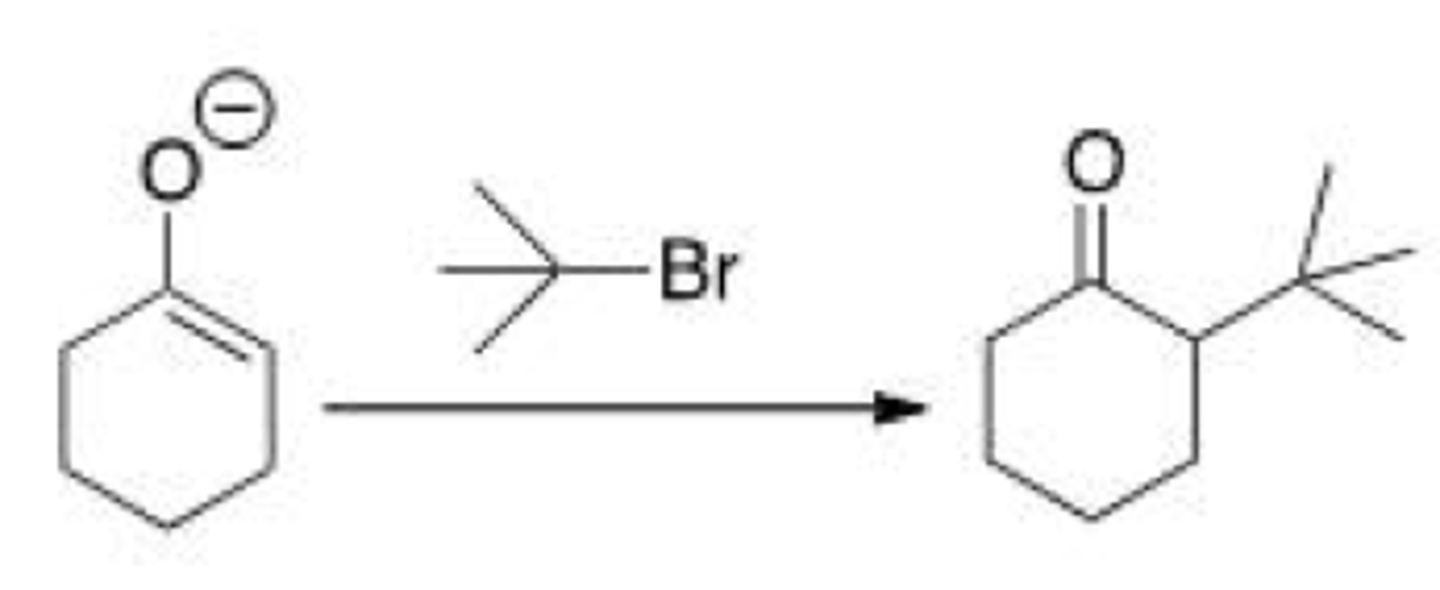
Why can't you prepare 2-tert-butylcyclohexanone by the following reaction?
A. Because tert-butyl bromide is too basic.
B. Because tert-butyl bromide cannot undergo an SN2 reaction.
C. Because tert-butyl bromide is a nucleophile.
D. Because tert-butyl bromide is not a stable compound.
A
What are the three steps in the malonic ester synthesis?
A. Deprotonation, alkylation, hydrolysis/decarboxylation
B. Hydrogenation, alkylation, deprotonation
C. Alkylation, hydrolysis/decarboxylation. hydrogenation
D. Hydrolysis/decarboxylation, deprotonation, alkylation
A
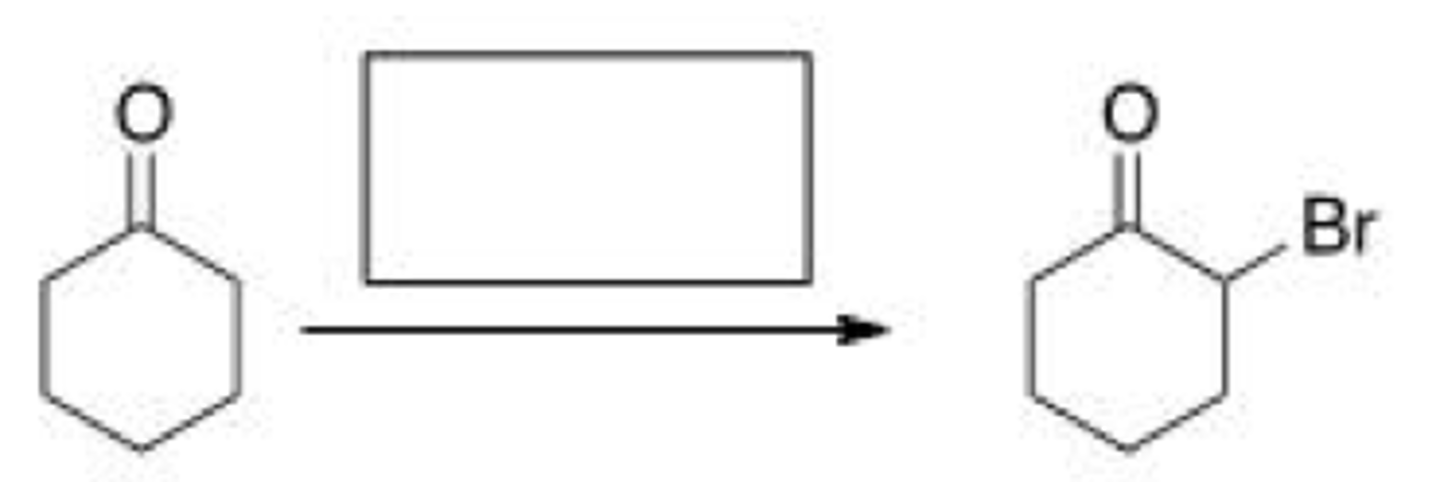
What is the missing reagent for the following reaction?
A. Br2/HOAc
B. Br2/KOH
C. Cl2/FeCl3
D. Br2/FeBr3
C
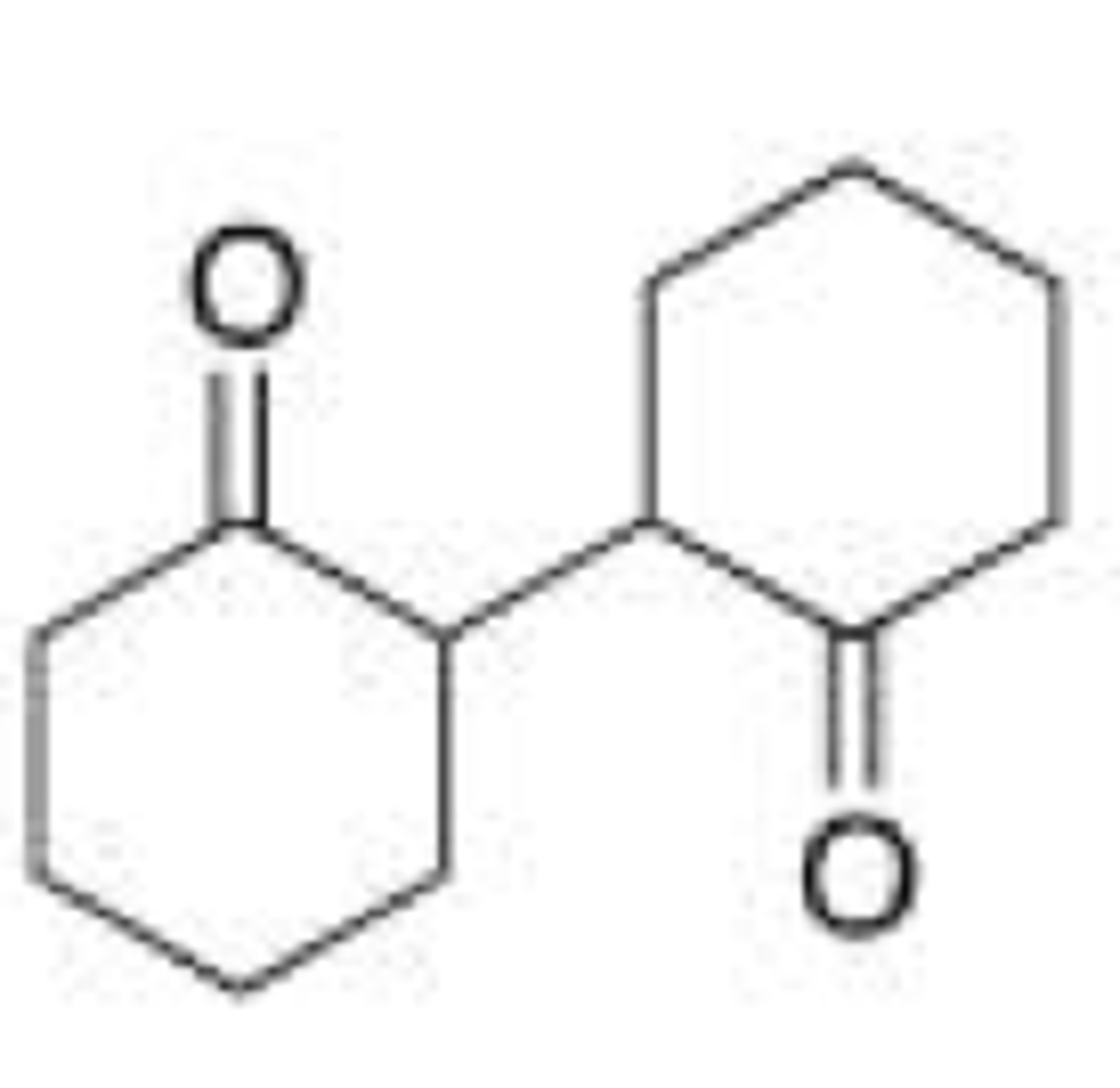
Starting with cyclohexanone, how could you prepare the diketone below?
A. Treat cyclohexanone with a base under thermodynamic conditions.
B. Hydrogenate cyclohexanone with Raney nickel.
C. Convert cyclohexanone into the a-bromoketone and then react this with the enolate of cyclohexanone.
D. Convert cyclohexanone into an enamine with diethylamine and then react this with more cyclohexanone.
C
What is the product of the following reaction?
A. I
B. II
C. III
D. IV
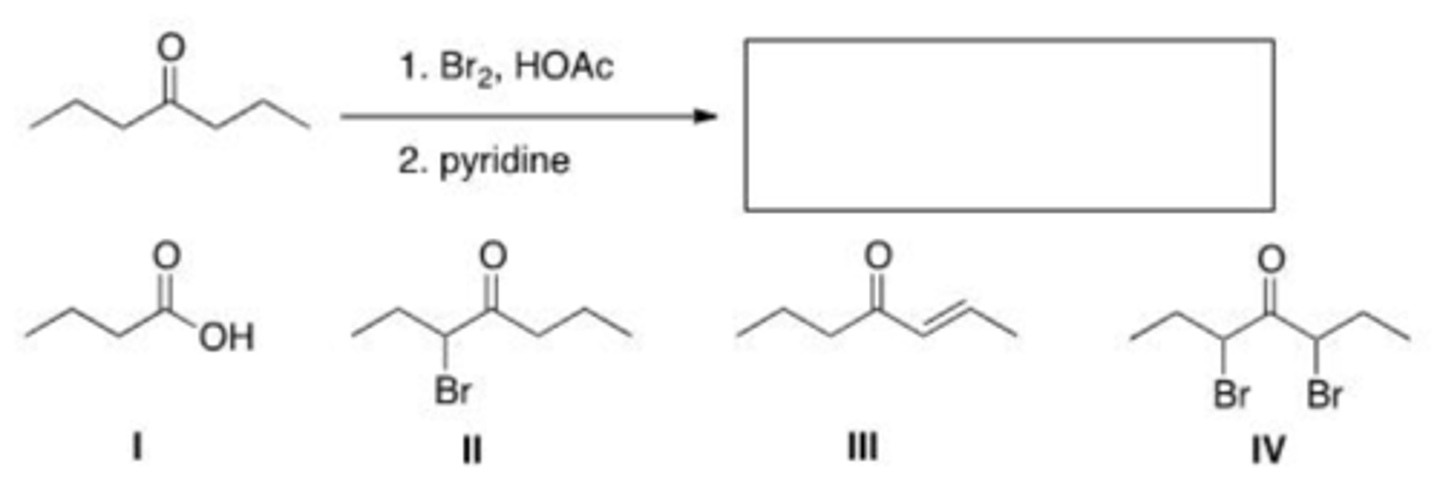
D
What is the product of the following reaction?
A. I
B. II
C. III
D. IV
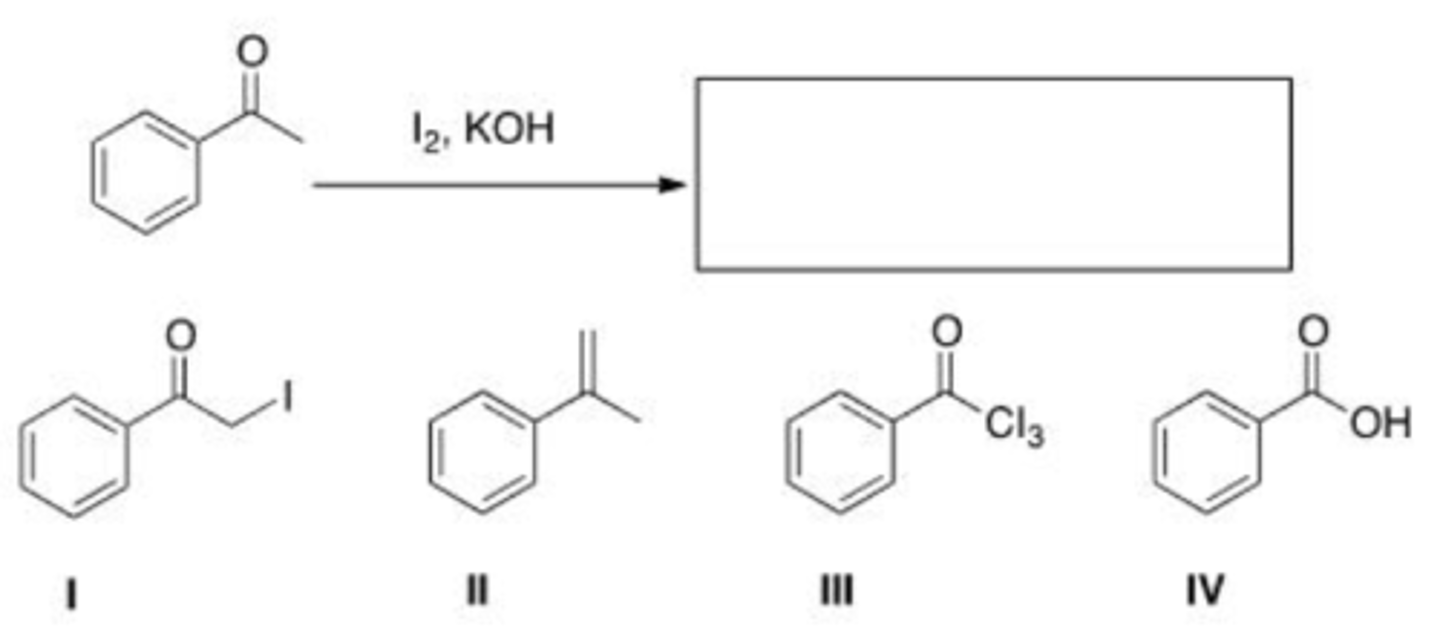
D
What is (are) the product(s) of the following reaction?
A. Only I
B. Only II
C. Only III
D. Only I and III
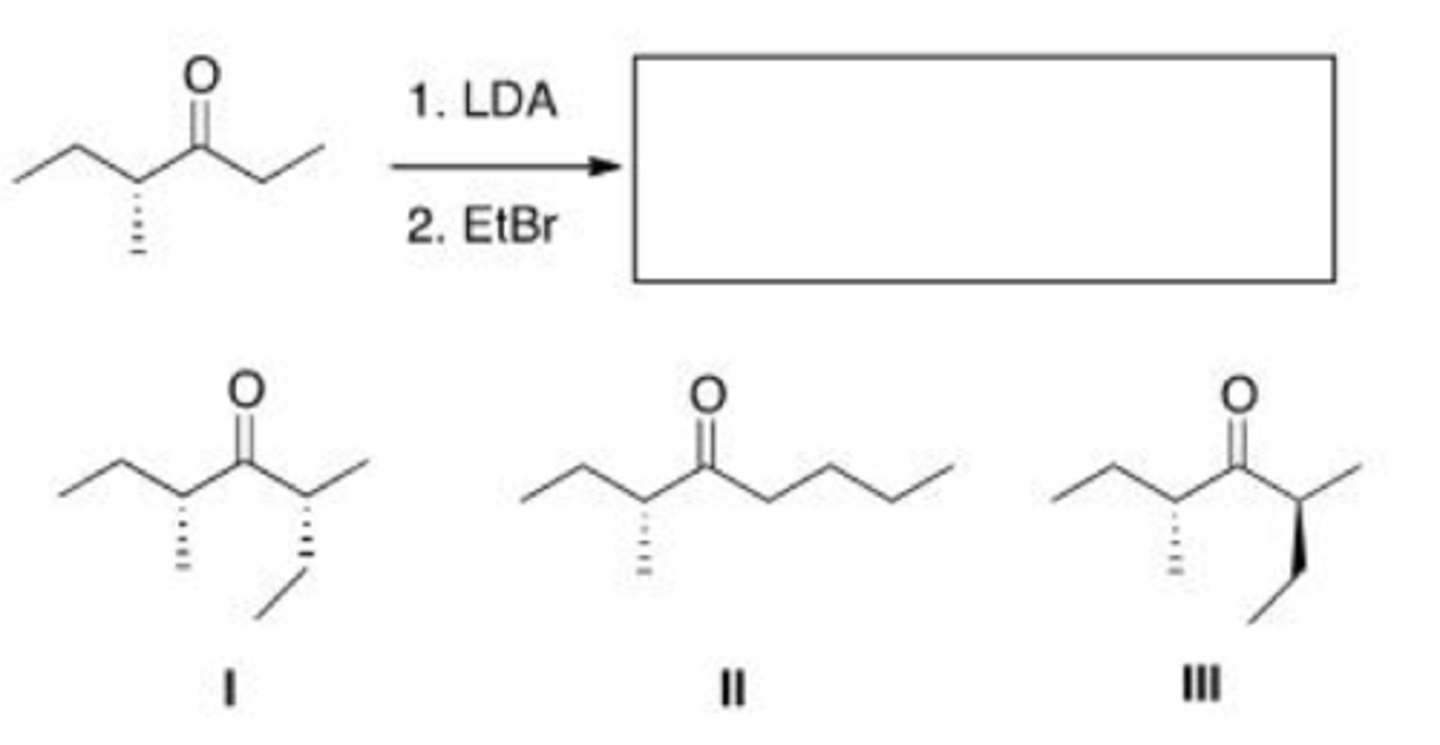
B
What is the missing reagent in the reaction below?
A. Br2/AcOH
B. I2/KOH
C. I2
D. KOH
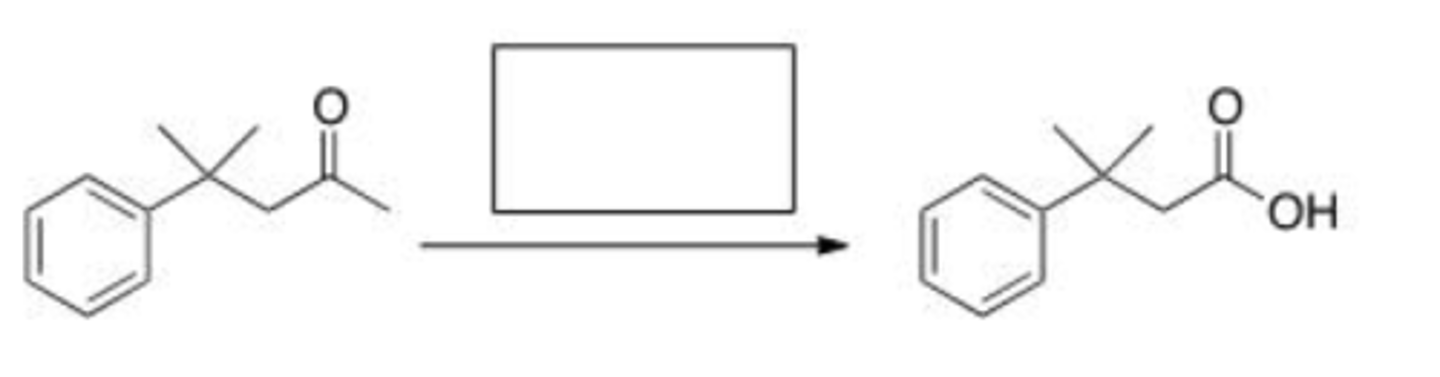
D
What is the starting material in the following reaction?
A. I
B. II
C. III
D. IV
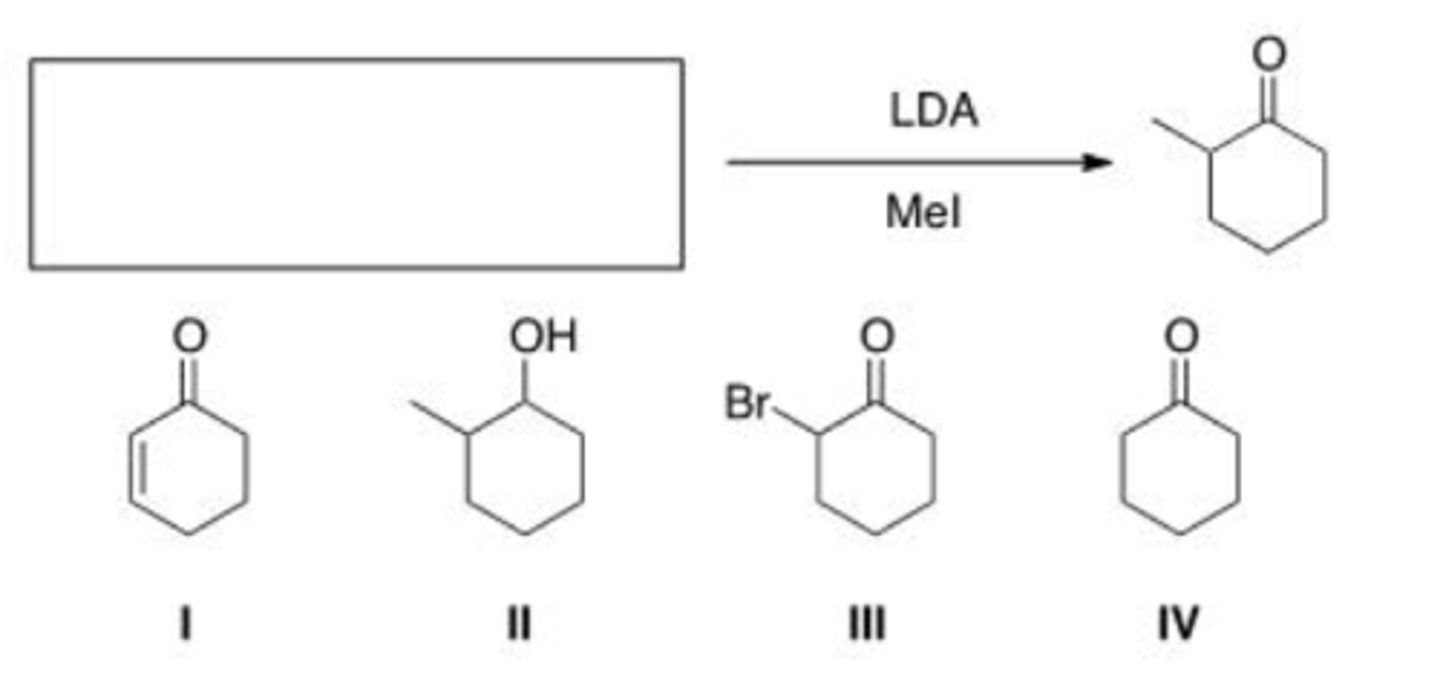
C
What is the starting material in the following reaction?
A. I
B. II
C. III
D. IV
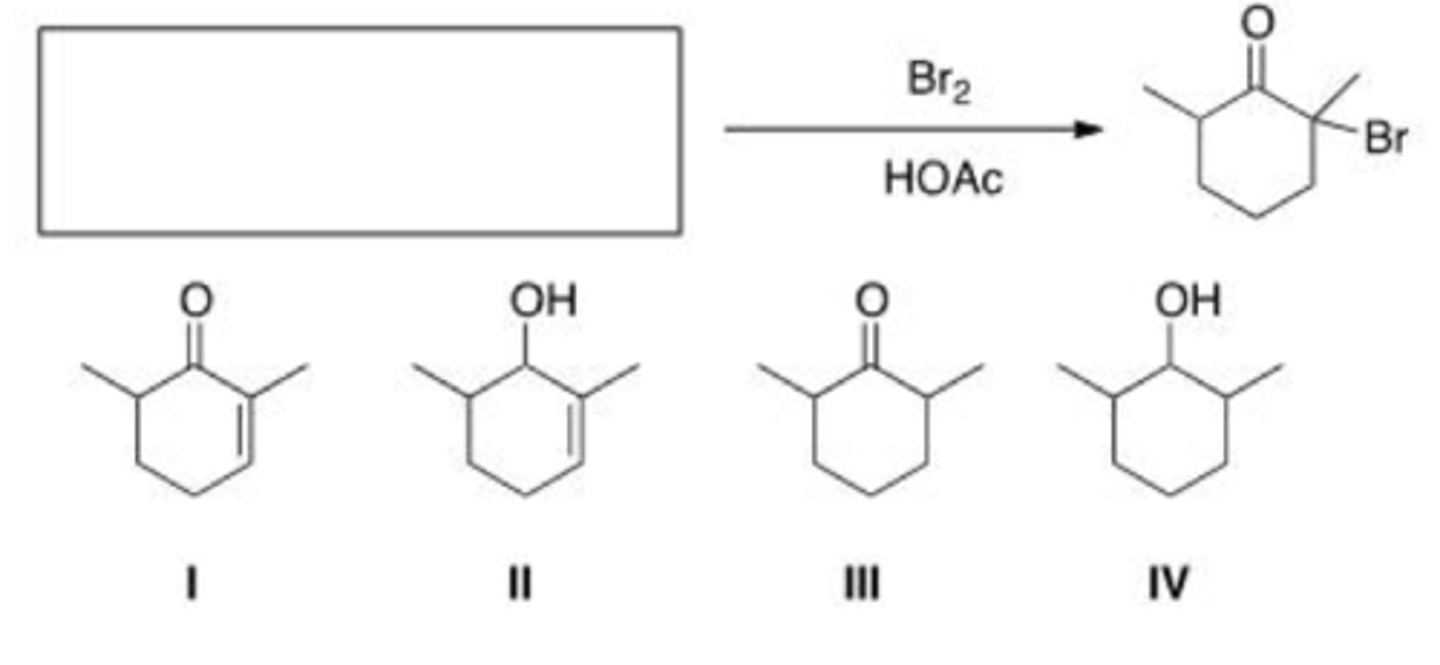
D
Which of the following compounds is an enol of compound X drawn below?
A. Only I
B. Only II
C. Only III
D. Only I and II
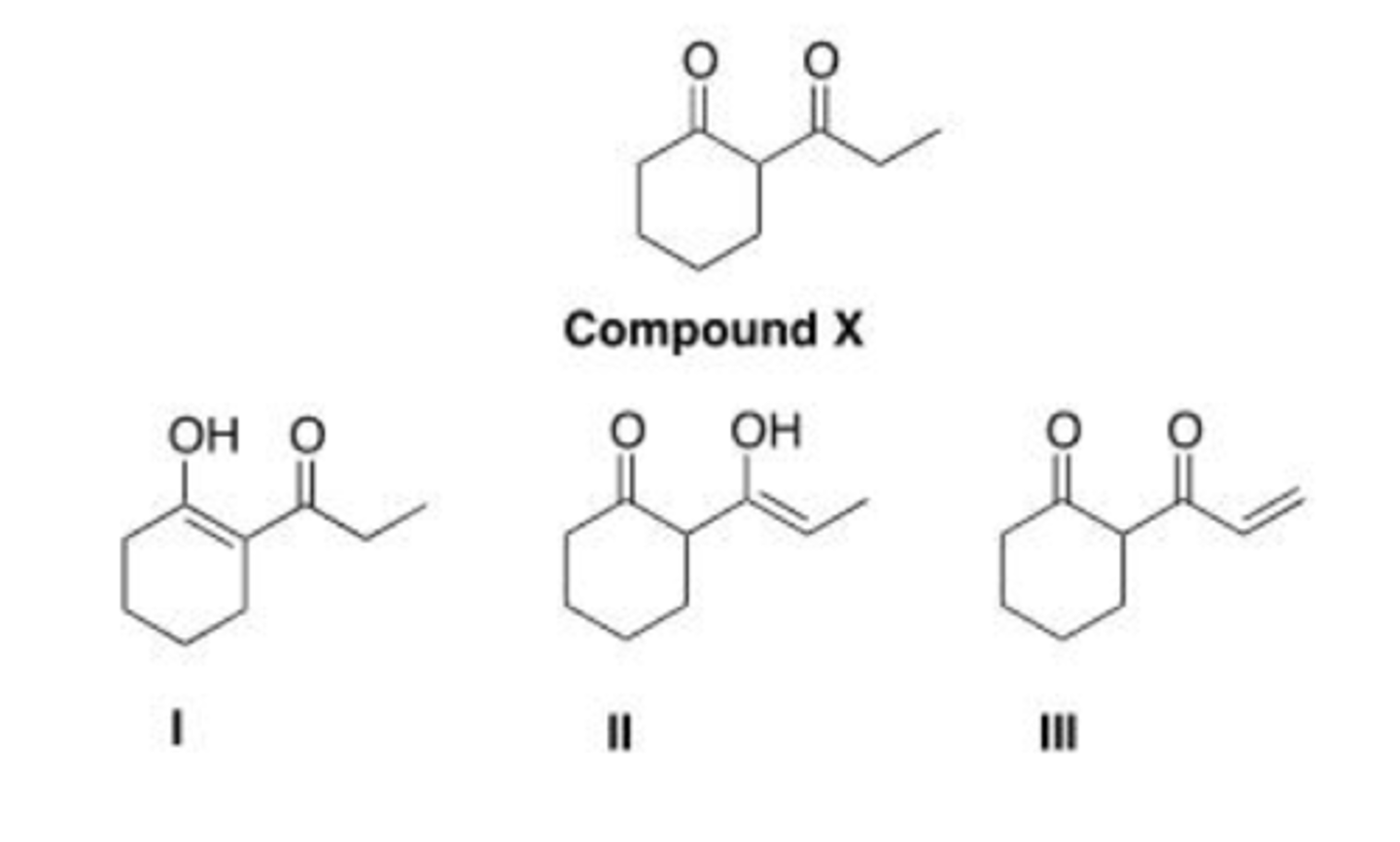
D
Which of the following are enol forms of ethyl acetoacetate drawn below?
A. Only I
B. Only II
C. Only III
D. I, II, and III
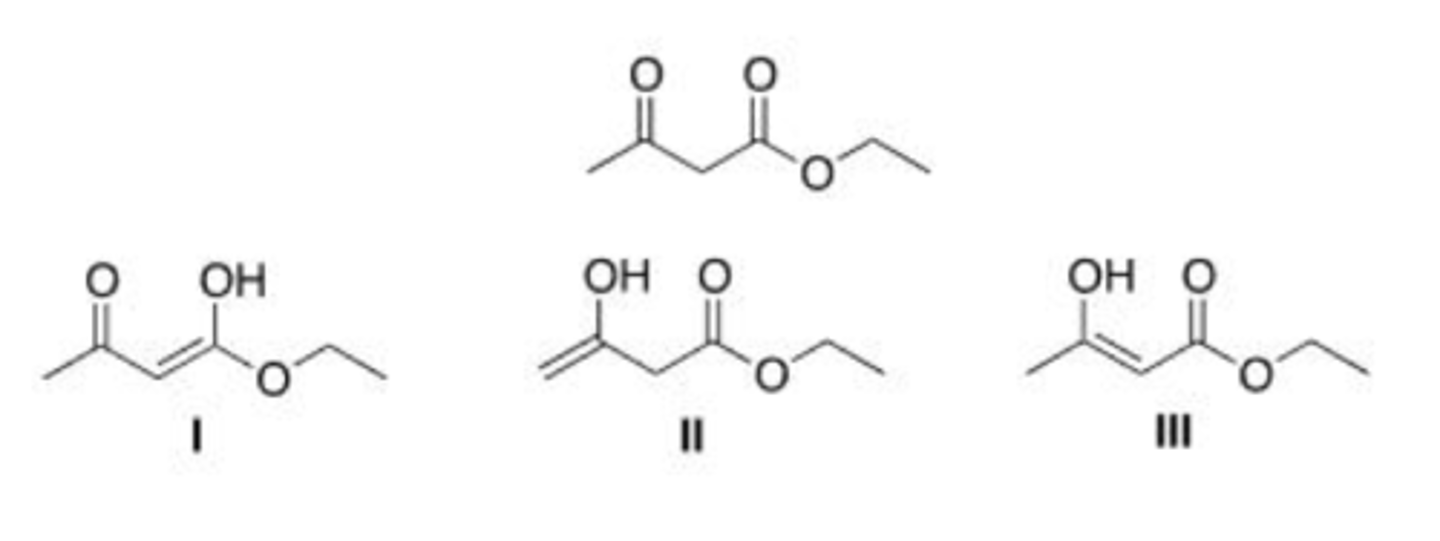
A
For most compounds with a single keto group in the molecule, equilibrium favors the keto form over the enol form of the compound. This is due largely to what?
A. The C=O bond is much stronger than the C=C bond.
B. The C=C bond is much stronger than the C=O bond.
C. The keto form can undergo intramolecular hydrogen bonding.
D. The enol form can undergo intramolecular hydrogen bonding.
C
It has been found that b-dicarbonyl compounds have a greater concentration of the enol form over the keto form. This can be explained by:
A. The C=C of the enol is conjugated with the carbonyl group.
B. The -OH of the enol can hydrogen bond to the oxygen of the nearby carbonyl group.
C. Both A and B above are true.
D. None of the choices are true.
C
The reaction below is a direct enolate alkylation. It has been found that this reaction only works well with unhindered methyl and 1° alkyl halides. Pick the statement that best explains this observation.
A. The nucleophilic enolate requires a reaction center that has a positive charge.
B. Hindered alkyl halides do not undergo SN1 reactions.
C. Hindered alkyl halides do not undergo SN2 reactions.
D. Methyl and 1° alkyl halides can form carbocations that can readily react with the nucleophilic enolate

D
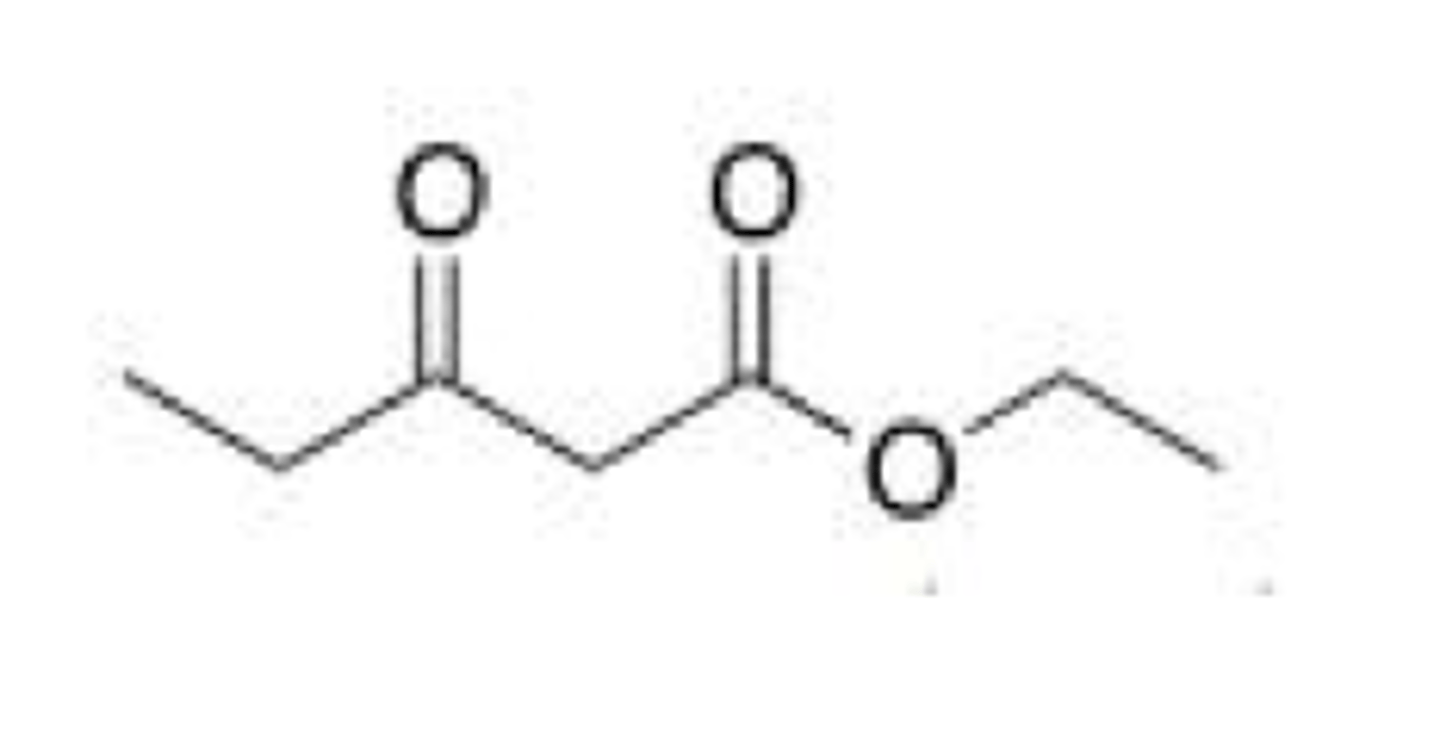
The following molecule is called:
A. a 1,3-diketopentanoate.
B. a diethyl malonate.
C. an ethyl acetoacetate.
D. a b-keto ester.
B
A simple chemical test to distinguish between acetone and 3-pentanone would be the reaction of the compounds with
A. bromine with acetic acid.
B. bromine and aqueous hydroxide ion.
C. THF, LDA at -78 °C followed by reaction with bromine.
D. base and methyl bromide.
D
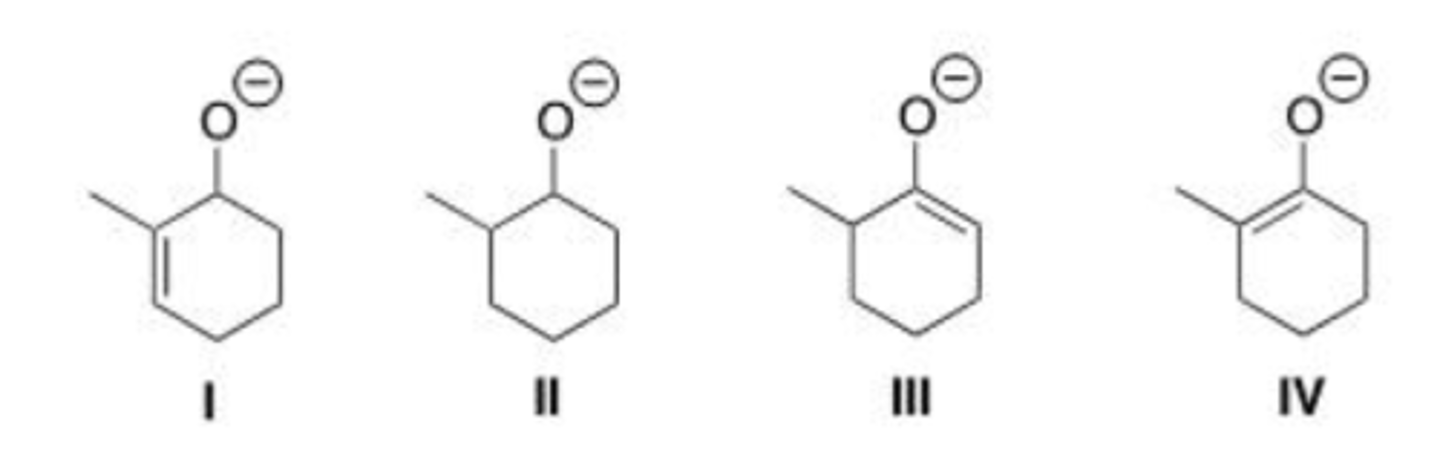
Which is the thermodynamic enolate of 2-methylcyclohexanone?
A. I
B. II
C. III
D. IV
A
Which of the following compounds is the most acidic?
A. Ethyl acetoacetate
B. 2-Butanone
C. 1-Butanol
D. 3-Pentanone
A
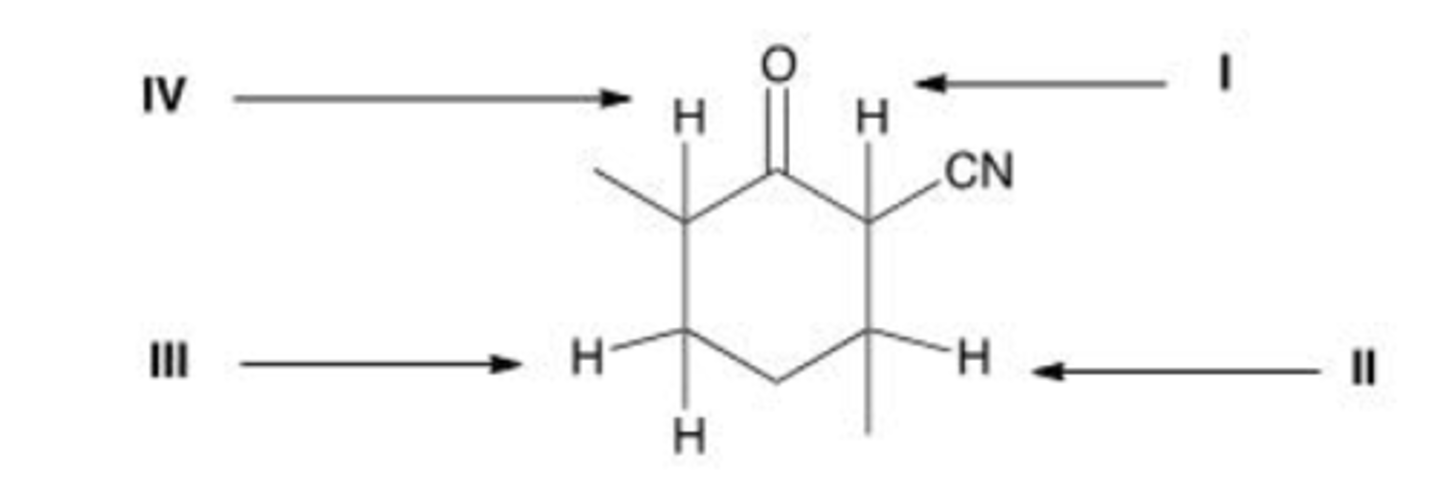
Which is the most acidic proton in the following compound?
A. I
B. II
C. III
D. IV
C
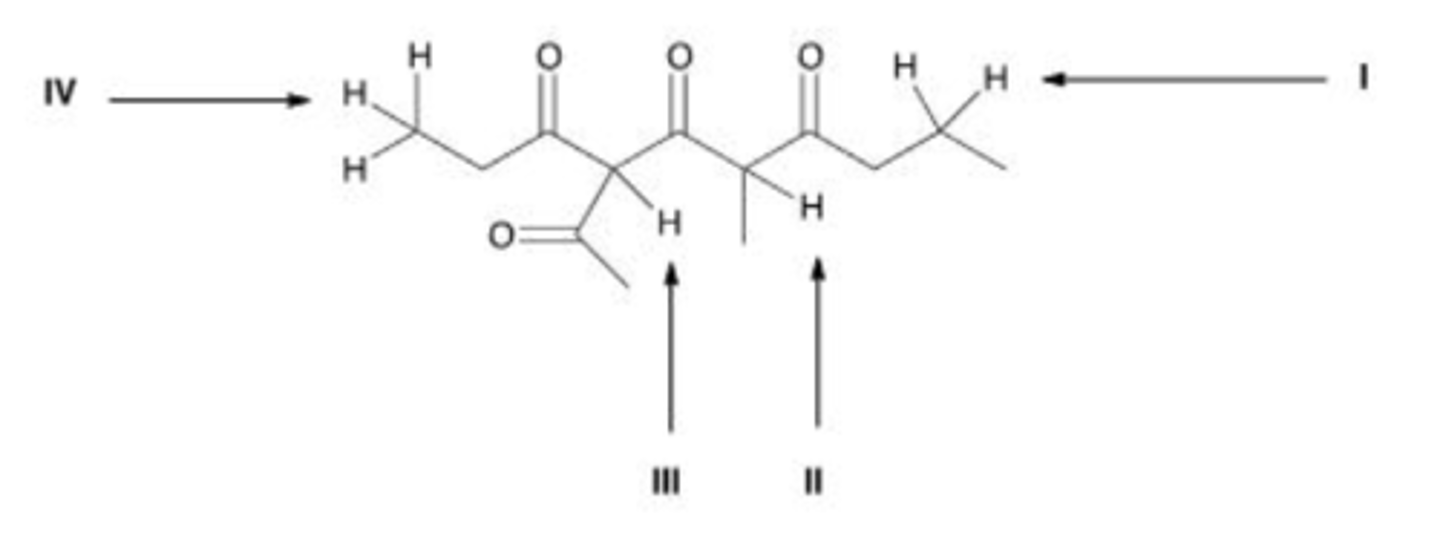
Which is the most acidic proton in the following compound?
A. I
B. II
C. III
D. IV
D
Which of the following bases will completely convert 1,4-cyclohexandione into an enolate?
A. Sodium hydroxide
B. Sodium methoxide
C. Sodium tert-butoxide
D. Sodium hydride
B
Which of the following compounds would undergo racemization in the presence of a base?
A. I
B. II
C. III
D. IV
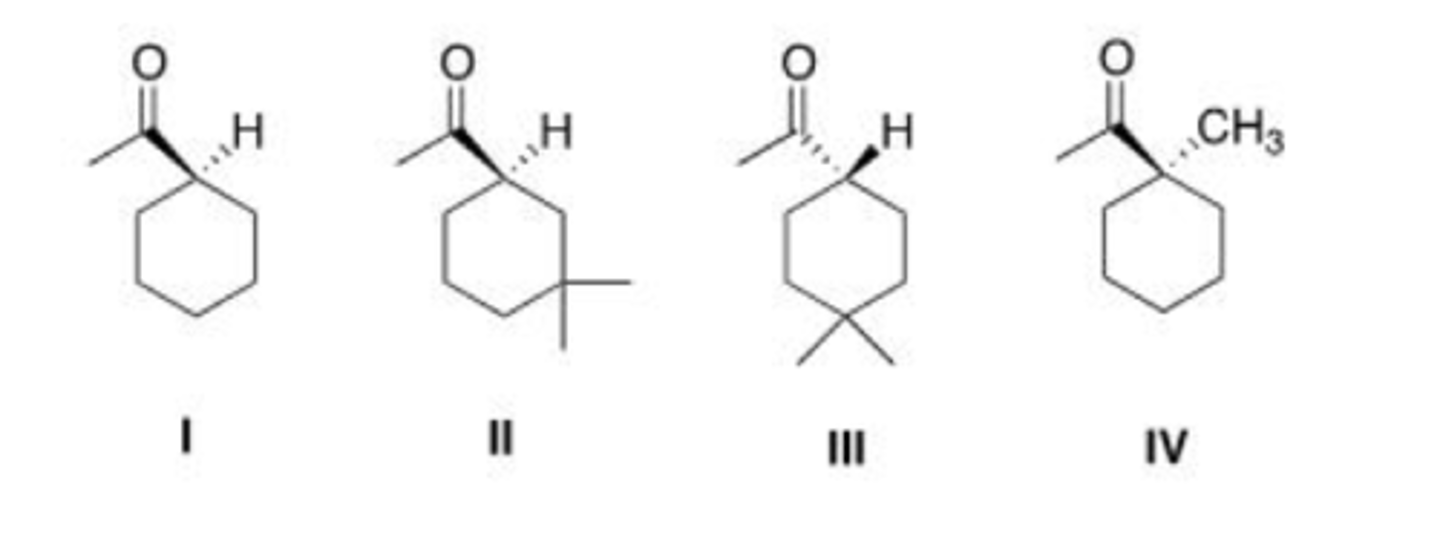
B
Which of the following ketones will give a positive iodoform test?
A. 3-Heptanone
B. 2-Pentanone
C. 3-Hexanone
D. Cyclohexanone
A
What is the major product of the following reaction?
A. I
B. II
C. III
D. IV
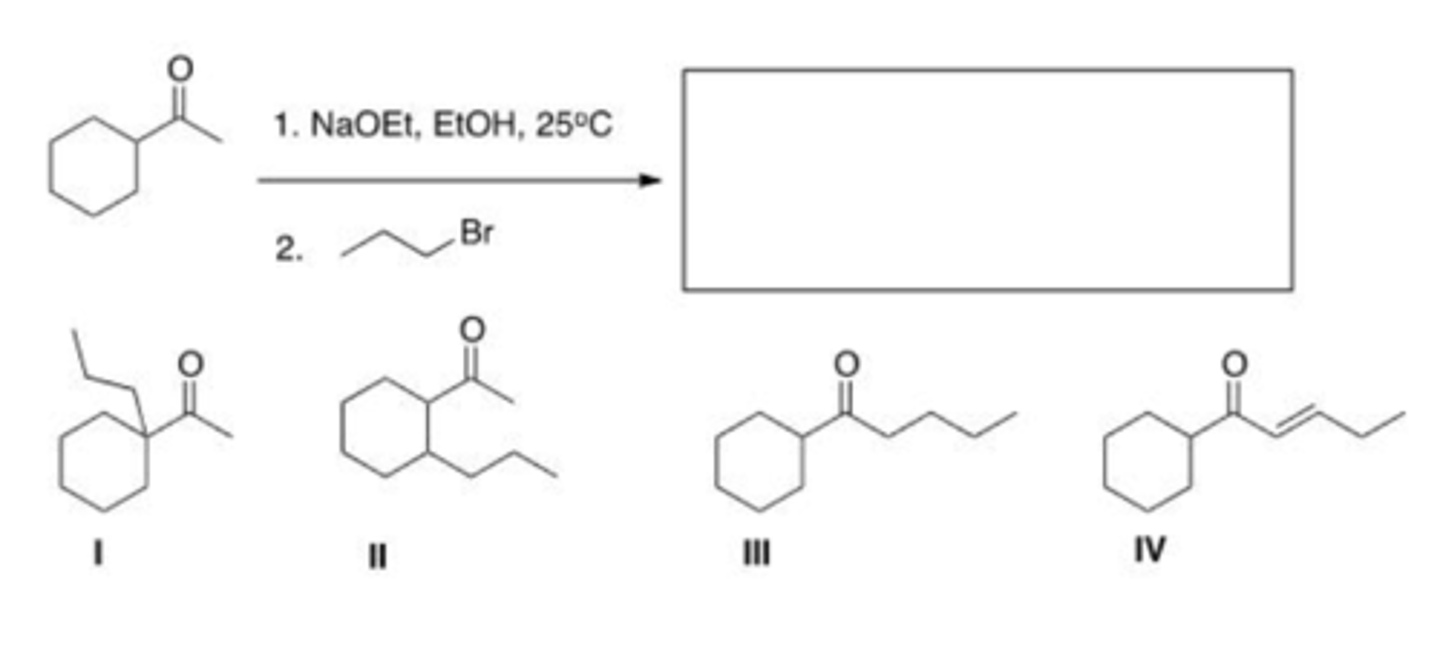
D
Treatment of 2-hexanone with NaOCH2CH3 followed by CH3Br affords compound X (C7H14O) as the major product. X shows a strong absorption in the IR spectrum at 1713 cm-1, and its 1H NMR data is given below. What is the structure of X?
A. I
B. II
C. III
D. IV
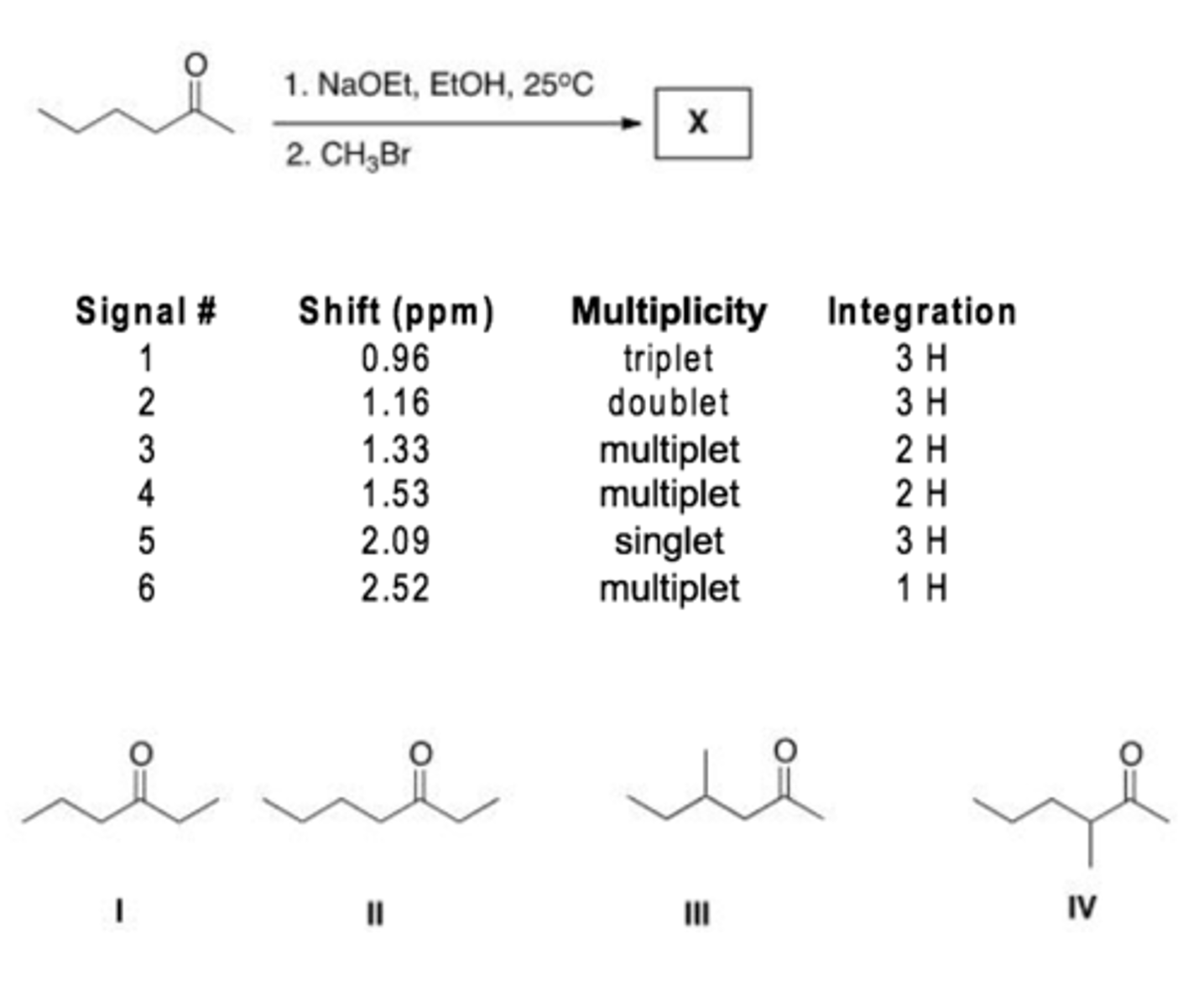
A
The malonic ester synthesis can be adapted to synthesize a-amino acids by using diethyl acetamidomalonate as the starting material. Select the structure of the amino acid produced by the following synthesis.
A. I
B. II
C. III
D. IV
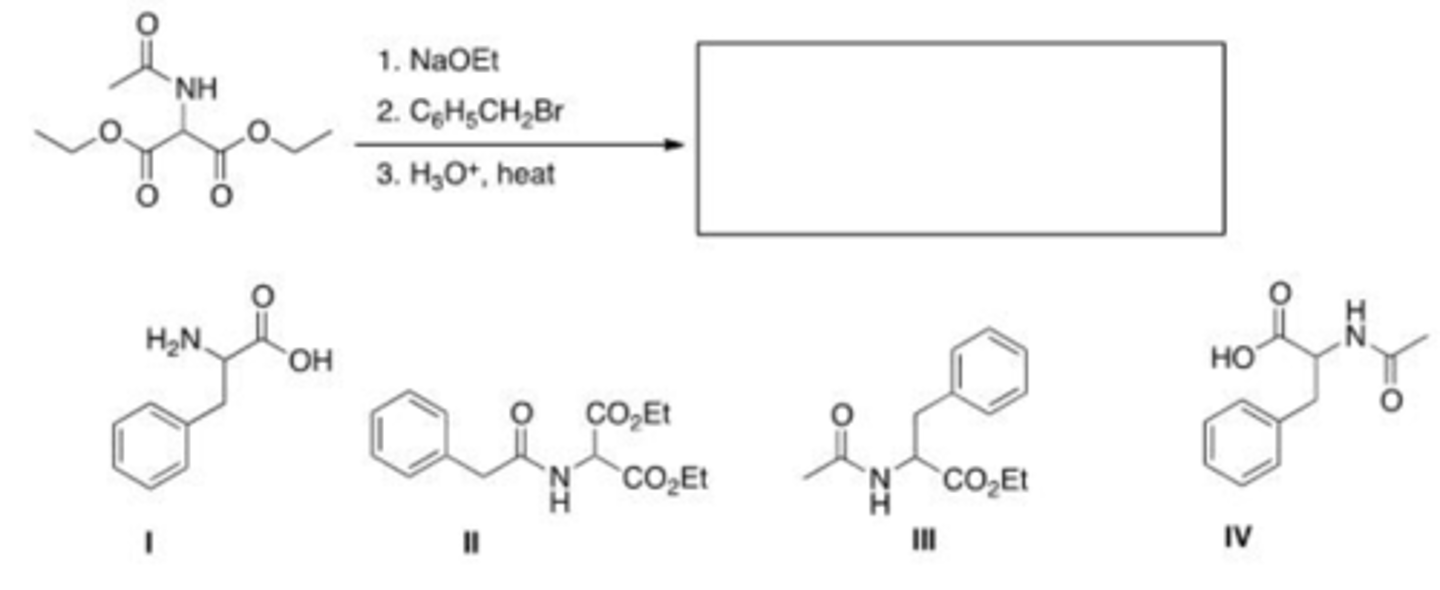
C
Select the appropriate sequence of reactions to accomplish the following synthesis.
A. [1] Br2, CH3CO2H; [2] Li2CO3, LiBr, DMF; [3] CH3CH2CH2CH2Br
B. [1] Br2, CH3CO2H; [2] Mg, Et2O; [3] CH3CH2CH2CH2Br
C. [1] LDA; [2] BrCH2CH2CH2CH2Br; [3] NaOEt
D. [1] NaOEt; [2] BrCH2CH2CH2CH2Br; [3] LDA
![<p>Select the appropriate sequence of reactions to accomplish the following synthesis.</p><p>A. [1] Br2, CH3CO2H; [2] Li2CO3, LiBr, DMF; [3] CH3CH2CH2CH2Br</p><p>B. [1] Br2, CH3CO2H; [2] Mg, Et2O; [3] CH3CH2CH2CH2Br</p><p>C. [1] LDA; [2] BrCH2CH2CH2CH2Br; [3] NaOEt</p><p>D. [1] NaOEt; [2] BrCH2CH2CH2CH2Br; [3] LDA</p>](https://knowt-user-attachments.s3.amazonaws.com/d96e793d-1515-49c2-b7db-b7a74a511205.png)
B
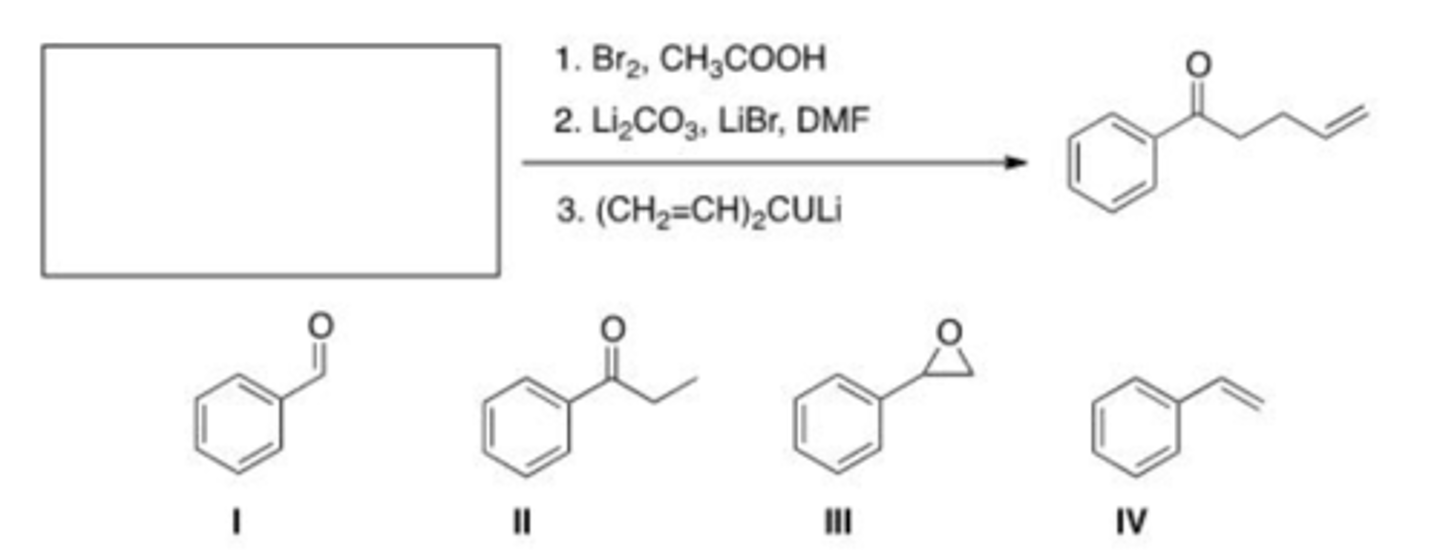
What is the starting material required to accomplish the following transformation?
A. I
B. II
C. III
D. IV
C
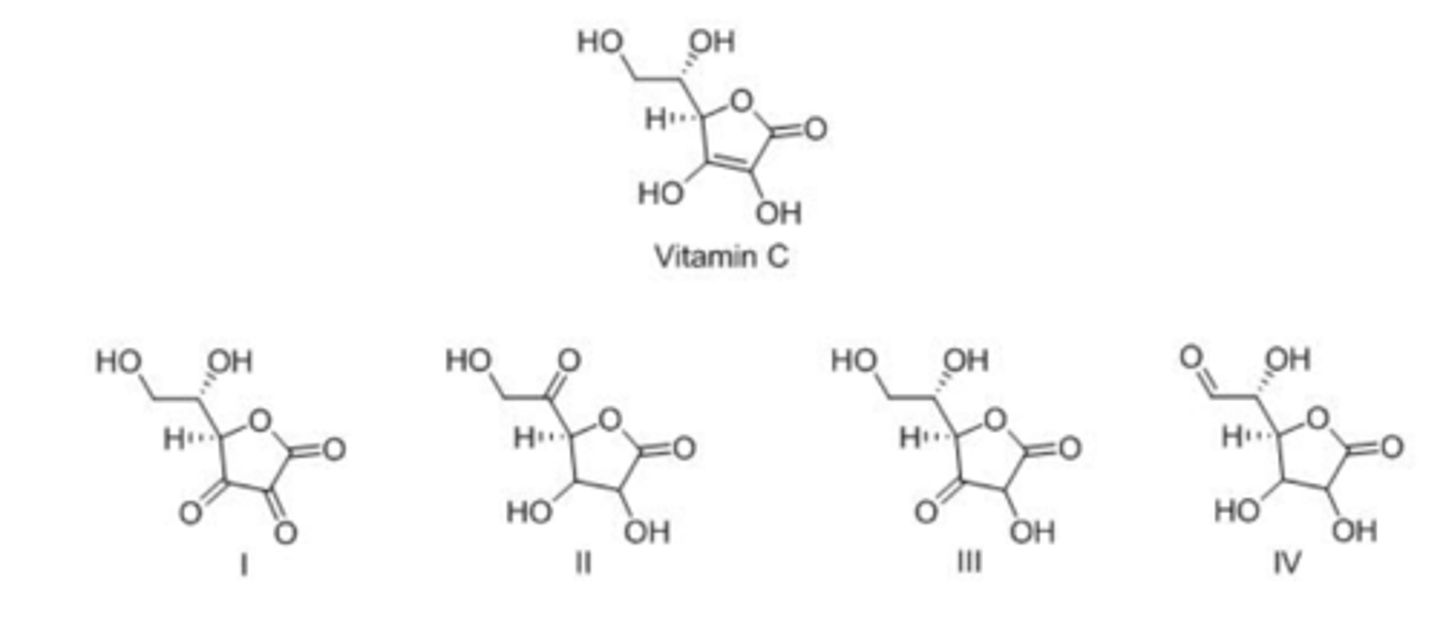
Vitamin C is a stable enediol. Which is the structure of a possible keto form in equilibrium with the enediol form?
A. I
B. II
C. III
D. IV
A
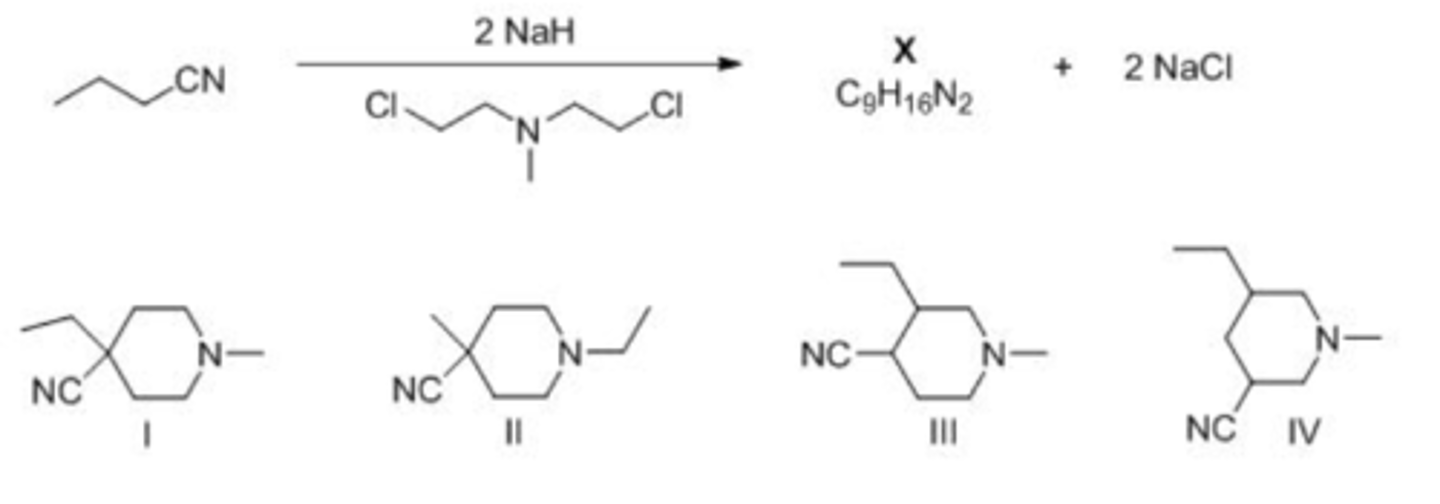
What is the structure of X, product of the following reaction?
A. I
B. II
C. III
D. IV