Biomedical Core Components of the Cell
 Call Kai
 Learn
Learn Practice Test
 Spaced Repetition
 Match
Match Flashcards
 Knowt Play
1/95

There's no tags or description
Looks like no tags are added yet.
Name | Mastery | Learn | Test | Matching | Spaced | Call with Kai | Chat |
|---|
No analytics yet
Send a link to your students to track their progress
96 Terms
What are the two types of eukaryotic cells in the human body?
Somatic and germline cells
Where are all cells derived from?
Embryonic stem cells
How many different types of cells are there?
200 different cell types
How many pairs of chromosomes are in the human body?
23 pairs. 22 autosomes, and 1 pair of sex chromosomes.
What are eukaryotic cells?
A mass of protoplasm containing a nucleus, and partitioned from the environment by a selectively permeable plasma membrane
What are the organelles of the cell?
-Plasma membrane
-Mitochondria
-Endoplasmic Reticulum
-Ribosomes
-Golgi Apparatus
-Endosomes
-Lysosomes
-Proteasomes
-Peroxisomes
-Endocytosis, exocytosis, pinocytosis, phagocytosis
-Centriole/Centrosome
-Nucleus, nucleolus
-Cytoskeleton (filaments/microtubules)
What is the composition of the plasma membrane?
50% lipid, 50% protein, and 5% carbohydrate.
What lipids are found in the PM?
Phospholipid, cholesterol, glycolipids
What proteins are found in the PM?
-Receptors
-CD proteins
-Transporters/channels, enzymes
-Adherens, tight, gap, desmosomes
-Glycoproteins
What carbohydrates are found in the PM?
Glycoproteins and Glycolipids
What is the plasma membrane?
A selective barrier that maintains the intracellular environment distinct from the extracellular one
What are the 3 functions of the plasma membrane?
Recognition, regulation, cell-cell contact. Controls interaction with the extracellular environment.
What are the 2 selective protein delivery mechanisms to the plasma membrane?
-Random delivery, followed by retention
-Selective entry into coated vesicles at the trans Golgo en route to a specific plasma membrane domain
Examples of cells being polarized
-Apical / basal and left / right in epithelial cells
-Front / back in fibroblasts and mesenchymal cells
-Head / axon / dendrites in neurons
What are the 4 activities of the PM?
Endocytosis, Exocytosis, Pinocytosis, Phagocytosis
Endocytosis
Mass uptake of material through the PM
Exocytosis
Bulk release of material through the PM
Pinocytosis
Invaginations of the PM which entrap extracellular fluid and soluble material. These vesicles pinch off and eventually fuse with lysosomes.
Phagocytosis
"Cell eating". Removes foreign bacteria, fungi, damaged cells, etc. Cytoplasmic processes surround the object, edges fuses enclosing object in an intracellular phagosome.
Structural characteristics of Mitochondria
-An elipsoid organelle
-Inner mitochondrial membbrane projects folds or cristae into the interior. Cristae are double membrane to increase surface area of the IMM.
-Shape, length, and number will vary among cell types (e.g.: muscle cells have ~200-400 mitochondria)
What is the role of the mitochondria?
Produce the energy of the cell, ATP, through ox phos to regular cellular metabolism
What are the central set of rxns involved in ATP production?
The Citric acid cycle, or the Krebs cycle
What 5 structures do mitochondria contain?
Circular DNA, tRNA, rRNA, mRNA, and ribosomes
Endoplasmic Reticulum
A system of intercommunicating channels that form a continuous membrane and enclose a cisterna
What is the role of the Rough ER?
Protein folding, packaging, and transportation
What are the characteristics of the Rough ER?
-Saclike and parallel stacks of cisternae
-ER membrane dotted with polyribosomes
-Accumulate proteins destined for the PM and organelles.
In what type of cells will the Rough ER be most prominent
Prominent in cells specialized for protein secretion. Like Exocrine cells.
What is the role of the Smooth ER?
Producing phospholipid and steroids
What are the characteristics of the Smooth ER?
-Membranous network lacking polyribosomes so it appears smooth
-SER is continuous with RER
-SER has specialized functions including the synthesis of steroid hormones (testosterone, estrogen, cortisol) & phospholipids.
What cells are enriched with Smooth ER?
-Testosterone secreting Leydig cells of the testis. SER contain membrane-bound enzymes required for these processes.
-Muscle cells
What is the role of Smooth ER in muscle cells?
-Specialized and participates in contraction
-Sarcoplasmic Reticulum
-Involved in the sequestration and release of Ca2+ during contraction and relaxation, respectively.
What are ribosomes?
Electron-dense particles in cytoplasm, detected by TEM
What is the composition of ribosomes?
-4 types of rRNA species and >80 ribosomal proteins
What are the 2 major subunits in eukaryotic ribosomes?
60S and 40S
What are polyribosomes?
Individual ribosomes held together by mRNA
What is the role of ribosomes?
mRNA encodes for amino acids, and ribosomes and tRNA decode this and translate it into protein
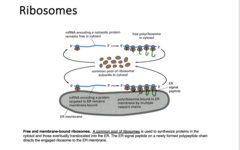
What is the difference between free and membrane-bound ribosomes?
A common pool of ribosomes is used to synthesize proteins in the cytosol (free).
If an ER signal peptide is encoded, the newly formed polypeptide chain is translocated in the ER (bound).
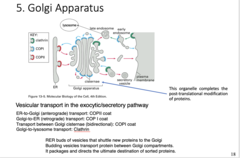
Golgi Apparatus
-Post translational modification and packaging of proteins.
- RER buds of vesicles that shuttle new proteins to the Golgi
-Budding vesicles transport protein between Golgi compartments.
-It packages and directs the ultimate destination of sorted proteins.
What are the Vesicular transport directions and coats in the exocytic secretory pathway?
-ER to Golgi (anterograde) transport: COPII coat
-Golgi to ER (retrograde) transport: COP I coat
-Transport between Golgi cisternae (bidirectional): COP I coat
-Golgi to lysosome transport: Clathrin
Cis vs. trans golgi
-Cis faces towards ER and is convex. Proteins enter from the cis face.
-Trans faces towards PM and is concave. Proteins exit from trans face.
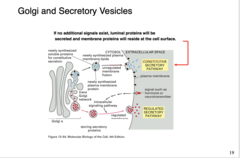
What happens to proteins after the Golgi if no additional signals exists?
Luminal proteins will be secreted and membrane proteins will reside at the cell surface.
What are exosomes?
Membrane-bound extracellular vesicles (EVs) that are produced in the endosomal compartment of most eukaryotic cells.
What are endosomes?
System of vesicles located within the cytosol near the cell surface (early endosomes) and deeper within the cytoplasm (late endosomes).
What are in endosomal membranes?
ATP-driven proton pumps which acidify the interior compartment.
What is the result of the acidic environment of the endosomes.
The ligand/receptor complexes are separated. Receptors may recycle back to the PM while the ligands are then contained within late endosome and fuses with lysosomes.
What are lysosomes?
Sites of intracellular digestion and turnover
What are the characteristics of lysosomes?
-Membrane-liited, internally acidic, and containing hydrolytic enzymes.
-Spherical, 0.05-0.5 micrometers in diameter
Where are lysosomes abundant?
Phagocytic cells, like macrophages
Where are lysosomal membranes and proteins packaged?
In the trans-Golgi network
How are lysosomes delivered?
Separately in clathrin-coateed vesicles to late endosomes forming endo-lysosomes, which then mature to form lysosomes.
What are the hydrolytic enzymes in lysosomes?
-Proteases
-Lipases
-Phosphatases
-Nucleases
-Glycosidases
-Phospholipases
-Sulfases
Heterophagosomes
Fusion of a lysosome with phagosomes containing foreign material
Autophagosome
Fusion of a lysosome with intracellular organelles
Indigestible material remaining within vacuoles after soluble products diffuse into the cytosol.
Residual Body
The residual product of auto and hetero-phagic vacuoles is a yellow pigment which accumulates with age due to oxidation of fatty acids know as...
lipfuscin, aging pigment
Lysosomes fuse with a phagosome, heterogeneous in size and appearance.
Secondary Lysosome
Proteasomes
-19S lid and 20S barrel for protein targeted degradation
-Multiple protease complexes that digest ubiquitinated proteins
-Remove excess and improperly folded proteins by proteasome-dependent degradatinon
What are peroxisomes?
Spherical organelles that oxidize organic substance by transfering hydrogen atoms to molecular oxygen
What toxic product do peroxisomes produce?
Hydrogen peroxide
How is hydrogen peroxide removed in peroxisomes?
Catalase
What do peroxisomes oxidize?
Long chain and branched chain fatty acids
Where are peroxisomes mostly found?
Highly enriched in hepatocytes due to ability to detoxify alcohols
What is the role of centrosomes?
Serves as the microtubule organizing center and a regulator of cell cycle progression
What is the composition of centrosomes?
-2 perpendicular centrioles in a centrosome
-Each centriole is surrounded by granular material (brown haze)
What is the composition of centrioles?
9 bundles of 3 microtubules
Where are centrosomes located?
Close to the nucleus
When does the centrosome duplicate?
During the S phase
What happens to centrosomes during mitosis?
Centrosomes divide in two and move to opposite poles of the cell where they become organizing centers for microtubules of the mitotic spindle.
2 parallel unit membranes separated by a narrow space called...
Perinuclear cistera
What is the internal nuclear membrane closely associated with?
Fibrous lamina (FL)
What 3 proteins compose the Fibrous Lamina?
Lamins A-, B-, and C- type
What is associated with the Fibrous lamina in non-dividing cells?
Chromosomes
What are the properties of the external nuclear membrane?
Continuous with ER and polyribosomes are attached to outer surface
Inner and outer membrane fuse and leave a gap at...
Nuclear pore
The nuclear pore is composed of ______ proteins
>100 proteins
What can and can't pass through nuclear pores?
Ions and small molecules can pass freely through, but larger molecules and protein complexes require an active, ATP-dependent, process
How are target signals on nuclear cargo recognized?
Karyopherins
What are importins and exportins?
-Importins: soluble import (cyto -> N) Karyopherins are designated importins.
-Exportins: Soluble Export (N -> cyto) karyopherins are designated exportins.
What are the two types of chromatin?
Heterochromatin and Euchromatin
How can the 2 types of chromatin be distinguished?
Can be distinguished by light microscopy and EM, dependent on the degree of uncoiling.
What is heterochromatin?
Electron dense and basophilic, appears as coarse clumps associated with the nuclear lamina. Unexpressed DNA.
What is euchromatin?
Less coiled chromosomes appears as finely dispersed granular material. Site of active transcription. Cells actively synthesizing proteins have more euchromatin than heterochromatin.
What is the Nucleolus?
Largest structure in the nucleus
What is the function of the nucleolus?
Site for ribosome biogenesis and production of RNA.
What 3 regions is the Nucleolus composed of?
Nucleolar organizer, pars fibrosa, and pars granulosa
What is the cytoskeleton?
Complex, dynamic network of interlinking protein filaments and tubules that extends from the cell nucleus and centrosome to the cell membrane.
Mechanical properties of actin and tubulin
Shape, strength, mobility, and cell division
What are the three types of cytoskeleton?
1) "Cable" - microfilaments (actin)
2) "Pipe" - microtubules (tubulin)
3) "Rope" - Intermediate filaments (vimentin, lamins, keratins)
What can actin be present as?
Either as a free monomer called G-actin, or as part of a linear polymer called F-actin
What are Microtubules composed of?
Heterodimers composed of alpha and beta tubulin
What do microtubules form the basis of?
Centrioles and basal bodies cilia and flagella
What are the two types of cilia?
Motile cilia and primary cilia.
How many cilia and flagella are in a cell?
Large numbers of motile cilia per cell, one primary cilia per eukaryotic cell, only one flagellum per spermatozoa (sperm cells).
What are the lengths of cilia and flagella?
Cilia is 2-3 micrometers long; Flagella is 100 micrometers long.
What is a basal body?
At the base of each cilia and flagella. Consists of microtubules arranged as a centriole.
What is the microtubule arrangement of a cilia/flagella?
Axoneme organization is central microtubules surrounded by 9 pairs of microtubules and a two single microtubules.
9 + 2 pattern.