Jakes Module 1
 Call Kai
 Learn
Learn Practice Test
 Spaced Repetition
 Match
Match Flashcards
 Knowt Play
1/52

There's no tags or description
Looks like no tags are added yet.
Name | Mastery | Learn | Test | Matching | Spaced | Call with Kai | Chat |
|---|
No analytics yet
Send a link to your students to track their progress
53 Terms
What is the definition of Food Security according to the World Bank?
Food Security has four dimensions: availability, access, utilization, and stability/sustained.

What are the two general levels of Food Security defined by the USDA?
Food Secure and Food Insecure.
What does 'Food Secure' imply according to the USDA?
Household diets are healthy and productive.
What does 'Food Insecure' imply according to the USDA?
There is problematic access to food.
USDA considers 2 levels of food access/quality as "Food Secure
High Food Security and Marginal Food Security
High Food Security
No issues with access to quality food- percieved or real
moderate food security
Anxiety over sufficient access or shortages — diets sufficient for health/productivity.
What are the two levels of Food Insecurity recognized by the USDA?
Low Food Security and Very Low Food Security.
Low Food Security
Available food- reduced quality, variety,m and/or preferred for diet
- belly is full
Very Low Food Security.
available food- disrupted and/or poor
reduced food intake leading to multiple deficiencies
starvation
Starvation
general lack of energy
What is the difference between Food Security and Hunger?
Food Security refers to reliable access to sufficient food, while Hunger is the physical sensation of not having enough food.
Central to all "Food Insecurity" Definitions
A lack of: "consistent available (physically/economically) food of sufficient quantity and quality to provide nutrition at a level that fully supports a healthy and productive person/population".
Drivers of food insecurity
- climate change
- economics
- policy/goverment
- disease
- conflict.
What global organization reported that around 780 million people went hungry in 2023?
Food and Agriculture Organization (FAO).
What are the prominent drivers of Food Insecurity?
Economics, Conflict, and Climate/Weather.
How many people are facing high levels of food insecurity in 2023?
345 million people.

What major events worsened poverty and lack of opportunity over the last three years?
Covid-19 and the Russia/Ukraine War.
What percentage of people in hunger are in areas affected by war?
70%.
What are the main climate-related drivers of Food Insecurity?
Flooding, sustained droughts, tropical storms, and other extreme weather events.
What is the Grand Challenge for agriculture by 2050?
To provide potable water and a safe, nutritious, sufficient food supply for over 9 billion people.
What is required to increase food output by 50%?
It must be logistically possible, economical, and environmentally sound.
What are some barriers to mitigating food security challenges?
Increased scrutiny of agricultural practices, trade imbalances, and limited funding for research.
What are the impacts of consumer preferences on food production?
They create both challenges and opportunities based on culture, religion, and technology.
What environmental impacts are associated with agricultural practices?
Loss of biodiversity, urban encroachment, deforestation, erosion, loss of carbon sinks, water impacts, and altered weather patterns.
What is the proposed solution to carbon emissions in agriculture?
Carbon taxes have been proposed to mitigate environmental impacts.
What role does political corruption play in food insecurity?
It contributes to poverty and lack of opportunity, worsening food security.
What effect did the Covid-19 pandemic have on food security?
It disrupted supply chains and increased unemployment, worsening food insecurity.
How has the Russia/Ukraine War affected global food security?
It disrupted grain exports, impacting low-income countries reliant on these supplies.
What is the Zero Hunger goal set by the UN?
To eliminate hunger globally by 2030.
What is a significant statistic about food insecurity in the U.S.?
Even in the U.S.A., food insecurity remains a critical issue.
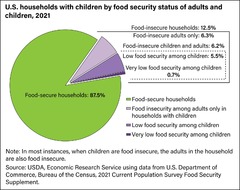
What is the impact of climate change on food production?
It leads to extreme weather events that disrupt agricultural output.

What is the significance of the Food and Agriculture Organization (FAO)?
It provides global statistics and insights on food security and nutrition.
What is the impact of mass migrations on food security?
It leads to exploitations and increased violence, exacerbating food insecurity.

What is the role of agricultural practices in environmental sustainability?
They must balance food production with environmental conservation.
What are the 4 dimensions of Food Security according to the World Bank?
Availability, access, utilization, and stability.
What organizations provide definitions of food security/insecurity?
UN, WHO, FAO, USDA/state agriculture departments, Peace Corps, and private organizations/foundations.
How many people were unsure where their next meal was coming from?
About 800 million people worldwide.
How did high levels of food insecurity change from 2020 to 2023?
They doubled, reaching about 345 million people in 2023.
How many people faced crisis-level food insecurity due to economic factors?
83.9 million people.
What is a primary economic component of food insecurity?
Poverty and lack of opportunity.
How did COVID-19 restrictions affect food security?
Businesses closed, supply chains were disrupted, and unemployment increased.
Why is conflict considered the biggest driver of hunger?
70% of people experiencing hunger live in areas affected by war.
How many people faced crisis-level food insecurity due to conflict?
117 million people.
How can mass migration increase food insecurity?
It can lead to exploitation, increased violence, and additional food insecurity.
How many people faced crisis-level food insecurity due to climate/weather events?
56.8 million people.
What specific climate/weather events contribute to food insecurity?
Flooding, sustained droughts, tropical storms, cyclones, and hurricanes.
What is the projected world population by 2100?
12 billion people.
How much must food output increase by 2050?
About 50%, with limited additional land resources.
How can increased scrutiny of agriculture create food-security challenges?
It can shift production practices and increase production costs.
What production problem can occur between wealthy and lower-income countries?
Trade imbalances can suppress food production in low- and lower-middle-income countries.
What human-resource barriers make solving food insecurity harder?
Limited research/training funding and shortages of food production and processing expertise.
What environmental problems can result from expanding agriculture?
Deforestation, biodiversity loss, erosion, loss of carbon sinks, water impacts, and altered microclimates.