Lecture Review: Immunology, Eugenics, and Ecology
 Call Kai
 Learn
Learn Practice Test
 Spaced Repetition
 Match
Match Flashcards
 Knowt Play
1/29

Earn XP
Description and Tags
Flashcards covering the immune system mechanism, the history of eugenics and biomedical ethics, and fundamental concepts of population, community, and ecosystem ecology.
Name | Mastery | Learn | Test | Matching | Spaced | Call with Kai |
|---|
No analytics yet
Send a link to your students to track their progress
30 Terms
Why do animals need immune systems?
Animals need immune systems to identify and combat pathogens, including bacteria, viruses, and parasites, protecting their health and maintaining homeostasis.
What are pathogens?
Bacteria, fungi, viruses that are harmless when in the external environment, but cause disease when they are transferred to the internal environment of host animals
What cells in the body dedicated to destroying pathogens?
Immune cells in body fluids (Blood and lymph) and tissues are dedicated to identifying and destroying pathogens in the body.
Innate immunity
A type of defense system found in all animals that provides immediate protection against pathogens.
It involves physical barriers like skin and mucous membranes and immune cells that respond quickly to infections.
It also includes internal mechanisms such as inflammation, release of antimicrobial proteins, natural killer cells, and phagocytic cells to prevent pathogen entry and spread.
Adaptive immunity
A specific, slower defense system in jawed vertebrates that uses B and T cells to target pathogens and create memory.
Includes:
Humoral: antibodies in body fluids
Cell-mediated: cytotoxic T cells attack infected cells
Lymphocytes
White blood cells (B cells and T cells) that are key to adaptive immunity. They originate in bone marrow; B cells stay in blood, while T cells(thyroid) mature in the thymus and then enter the bloodstream.
Antigen
A substance, typically a polysaccharide or protein from a specific pathogen, that elicits a response from a B or T cell.
Antigen receptors
Surface proteins on B and T cells that bind to a specific part of a pathogen; each cell has many copies of one unique receptor. Each cell displays about 100,000 of these.
Structure of the B and T cell Antigen Receptors
the structure of b and t cells is based on their amino acid sequence chain that binds to one specific pathogen true or false
Immunoglobulins
Another name for B-cell antigen receptors; note that T-cell antigen receptors are not categorized as these.
Monocyte-derived cell
A cell that engulfs a pathogen, breaks it into fragments, and displays them on its surface using MHC II.
Helper T cell (Antigen-presenting cells)
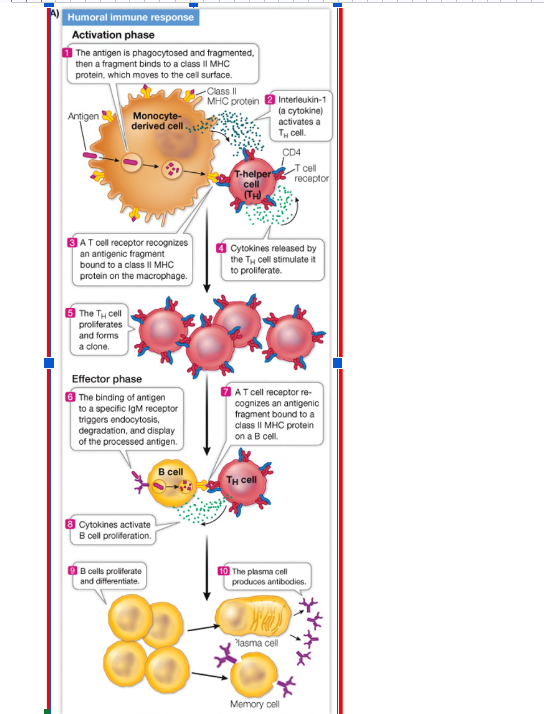
Helper T cells bind to B cells (via MHC) and release cytokines, activating B cells to multiply and become plasma cells and memory B cells.
Antibodies
Proteins made by B cells (immunoglobulins) that specifically bind to antigens and help neutralize pathogens or mark them for destruction.
Explain This
Activation phase:
An antigen-presenting cell engulfs a pathogen and displays its antigen (MHC II).
It activates a helper T cell using chemical signals.
The helper T cell recognizes the antigen and becomes activated.
It releases cytokines to stimulate itself and other immune cells.
Helper T cells clone themselves to build an immune response.
Effector phase:
6. B cells bind the same antigen and internalize it.
7. Helper T cells activate B cells using cytokines.
8. B cells multiply and differentiate.
9. Plasma cells produce large amounts of antibodies.
10. Memory B cells remain for long-term immunity.
Do antibodies kill pathogens?
No, antibodies do not kill pathogens, but through binding to pathogens either interfere with pathogen activity or make them targets for destruction. For example, promoting pathogen phagocytosis by neutrophils and/or macrophages.
Antibodies attach to the virus which blocks the ability of the virus to bind to a host cell.
What happens to an infected cell?
An infected cell breaks up pathogen fragments and moves them to the Class I MHC.
How do cytotoxic T cells kill infected cells?
Infected cells display antigens on MHC I, which are recognized by cytotoxic T cells. Once activated, cytotoxic T cells multiply and kill infected cells by releasing perforin (induces apoptosis) or by activating FAS receptors, leading to programmed cell death and stopping pathogen replication.
Cytotoxic T Cell (Tc) Response
1. Activation Phase
Antigen Presentation: An infected cell displays antigen fragments on its surface using Class I MHC proteins.
Recognition: The T cell receptor on the Cytotoxic T cell (Tc) binds specifically to the MHC-antigen complex.
Clonal Expansion: The Tc cell self-stimulates to undergo proliferation, creating a clone of identical hunter cells.
2. Effector Phase
Target Binding: The activated Tc cell finds other infected cells displaying the same antigen on Class I MHC.
Lethal Strike: The Tc cell releases perforin, which punches holes in the target cell's membrane.
Apoptosis: This chemical attack—or binding to FAS receptors—induces apoptosis (programmed cell death).
Outcome: The infected cell dies, which precludes the survival and replication of the pathogen.
What is Immunological Memory?
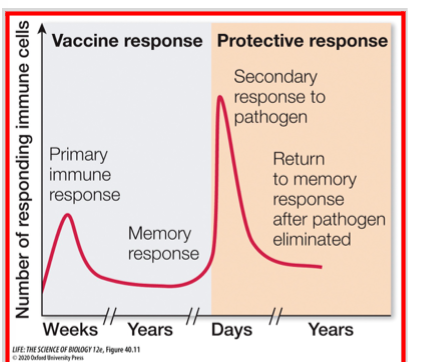
The process where a first exposure to an antigen creates memory B and T cells, leading to a faster and stronger response if the same pathogen is encountered again.
Compare the timing of the Primary vs. Secondary Immune Response.
Primary Response: Occurs during the initial exposure; antibody responses peak at 10–17 days.
Secondary Response: Occurs during subsequent exposures; it is much faster, with antibody concentrations peaking at 2–7 days.
What are the three main characteristics of a Secondary Immune Response compared to a primary one?
Faster: Peaks in 2–7 days.
Greater Magnitude: Produces a much higher concentration of antibodies.
Longer Lasting: The protection remains in the system for a more extended period.
How does the population of immune cells change after the first exposure to a pathogen?
Before first exposure: The body only has naive B cells, T-helper cells, and cytotoxic T cells.
After exposure: The body develops a preexisting population of memory B and T cells, which allows for the rapid secondary response.
Memory B cells
Long-lived B cells formed after activation that remain in the body and allow a faster, stronger antibody response if the same pathogen returns.
COVID-19 Vaccination & Trust Disparities
Vaccine Timeline: The first COVID-19 vaccine was administered in the US on 14 December 2020.
Initial Hesitancy: Vaccine hesitancy was initially higher among certain ethnic/racial groups due to historical distrust in the healthcare system.
Historical Context: This distrust is rooted in historical events, including the rise of eugenics and past racial disparities in medical treatment.
Shift in Trends: By December 2020, racial disparities in vaccine intent began to disappear.
Impact of Education: Through targeted education campaigns, non-white populations actually became more likely to receive the vaccine than other groups.
Eugenics
Definition: The practice or advocacy of improving the human species by selectively mating individuals with specific desirable hereditary traits.
Origin: First proposed by Sir Francis Galton (Charles Darwin’s cousin) in his 1883 book, Inquiries into Human Faculty and its Development.
Timing: The concept was introduced before the "rediscovery" of Mendel's work in 1900.
Initial Goal: Galton aimed to "better" humankind specifically through the propagation of the British elite.
Regional Reception: Despite its origins there, the movement never truly caught on in the United Kingdom.
What was the Eugenics Record Office (ERO) and how did "science" support racism?
Epicenter: The ERO, based at Cold Spring Harbor, NY (1910–1939), was the center of the American movement.
Scientific Racism: During this era, racism was treated as a science.
Negative Eugenics: A strategy focused on controlling and limiting the reproduction of those deemed “unfit”.
Better Babies Contests: Used at state fairs to measure "whiteness" as a metric for awards.
Discuss the history and scale of compulsory sterilization in the US.
Laws that allowed the sterilization of people considered “unfit,” often targeting marginalized groups. Over 65,000 procedures were performed in the U.S. (1907–1981), with significant racial and ethnic bias against Black, Latina, and Native American women.
How were Native American and Puerto Rican women impacted by sterilization policies?
Native American Women: An estimated 40% (60,000–70,000) were sterilized in the 1970s. IHS physicians often threatened that refusal would lead to loss of children or federal benefits.
Puerto Rico (Law 116): Passed in 1937, it legalized eugenic sterilization. By 1965, 34% of women of childbearing age were sterilized.
Post-partum Procedures: By 1949, sterilizations occurred in 18% of all hospital births immediately after delivery.
The Negro Project
A program (1939−1942) proposed by Margaret Sanger and the Birth Control Federation of America that initially aimed to provide Southern Black families access to birth control but faced criticism for racist implementation.
Tuskegee Study of Untreated Syphilis in the Negro Male
A study started in 1932 by the US Public Health Service that followed 399 men with syphilis and observed the natural history of the disease while actively preventing them from receiving treatment. Ended in 1972 only after whistleblower Peter Buxtun leaked the story to the press.128 men died of syphilis or complications; 40 wives were infected, and 19 children were born with congenital syphilis.