CNS Exam 3 - Midbrain, Forebrain
 Call Kai
 Learn
Learn Practice Test
 Spaced Repetition
 Match
Match Flashcards
 Knowt Play
1/93

There's no tags or description
Looks like no tags are added yet.
Name | Mastery | Learn | Test | Matching | Spaced | Call with Kai | Chat |
|---|
No analytics yet
Send a link to your students to track their progress
94 Terms
Which primary brain vesicle forms the midbrain?
Mesencephalon
What are the parts of the mesencephalon?
Tectum, cerebral aqueduct, and cerebral peduncles
What are the features of the tectum of the mesencephalon?
Posterior to the cerebral aqueduct
Superior colliculi → vision reflexes (involuntary)
Inferior colliculi → hearing
Which spinal cord tract is connected to the superior colliculi? What is the path of the information in this tract?
Tectospinal tract (extrapyramidal) - moves head away from objects moving rapidly toward the visual field
Optic tract
Superior colliculus
Tectospinal tract (CROSSES)
CN XI
SCM & Traps contract
What happens if there’s a lesion in the superior colliculi?
Reflex to move away from incoming objects is lost (patient is NOT blind)
What is the pathway for normal hearing?
Lateral lemniscus
Medial geniculate body
Brodmann area 41 (temporal lobe)
What is the pathway for normal vision?
Optic tract
Lateral geniculate body
Brodmann area 17 (occipital lobe)
What surrounds the cerebral aqueduct? What does it produce? What comes from it?
Periaqueductal gray, produces endorphins and enkephalins
Origin of CN III-IV
What are the traits of CN III (oculomotor)?
Apparent origin: interpeduncular fossa
Oculomotor nuclei (somatic motor, voluntary) for 5 mucles:
Inferior oblique
Medial rectus
Inferior rectus
Superior rectus
Levator palpebrae superioris (opens eyelids)
Edinger-Westphal nuclei (preganglionic parasympathetic) for 2 muscles:
Ciliary muscle (for near vision, contracts lens of eye)
Sphincter pupillae (contract pupils)
What are the traits of CN IV (trochlear)?
Apparent origin: inferior to the inferior colliculus
Trochlear nuclei (somatic motor, voluntary) for the superior oblique muscle
4 special characteristics:
CN with fewest fibers
Travels farthest in cranial vault
Only CN with apparent origin on post. brainstem
Only CN with fibers crossing at the apparent origin
What are the 3 parts of the cerebral peduncles?
Tegmentum, substantia nigra, crus cerebri
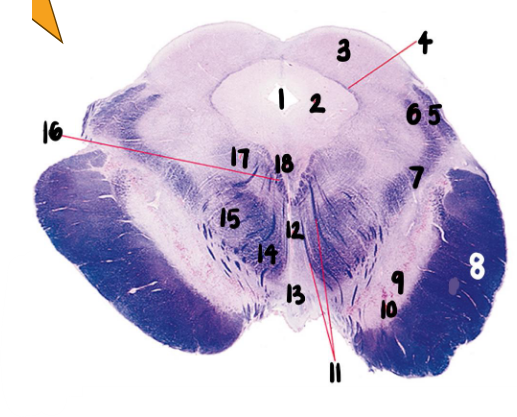
What are structures 1-3, 8-9, and 15?
1 = Cerebral aqueduct
2 = Periaqueductal gray
3 = Superior colliculus
8 = Crus cerebri
9 = Substantia nigra
15 = Red nucleus (Ruber)
What are the characteristics of the tegmentum of the midbrain?
Contains periaqueductal gray, red nucleus (of Ruber), medial lemniscus (to VPL), and reticular formation (connected to reticulospinal tracts of M.O./pons)
Input from dentate and interposed nuclei of cerebellum (not fastigial)
What are the 2 parts of the red nucleus?
Parvocellular portion: highly vascular, superior, extends into subthalamus
Magnocellular: inferior, larger, smaller in humans than many mammals, beginning of rubrospinal tract
What are the traits of the substantia nigra?
Afferent/efferent exchange between caudate and putamen (the neostriatum)
Grey matter between tegmentum and crus cerebri
Makes dopamine from tyrosine (and melanin → black color)
Damage leads to Parkinson’s, treatment is L-dopa (can cross BBB)
What is characteristic of Parkinson’s disease?
Caused by lack of dopamine, treated with L-dopa
Symptoms: resting tremor, shuffling gait, odd posture, pain, loss of speech (late stages)
What are the traits of the crus cerebri?
White matter structure, contains pyramidal UMN axons, 4 pathways:
Corticomesencephalic: cortex → midbrain → CN III-IV to control voluntary eye movements
Corticopontine: cortex → pons
Corticobulbar: cortex → M.O.
Corticospinal: cortex → spinal cord
What are the parts of the diencephalon?
Thalamus, hypothalamus, epithalamus, subthalamus, 3rd ventricle
What are the functions of the diencephalon?
Thalamus: gateway to the cerebrum (all information EXCEPT olfaction) - relays gracilis, cuneatus, spinothalamic (VPL); trigeminothalamic (VPM)
Hypothalamus: control center for endocrine/ANS function
What are the traits of the epithalamus?
Superior to tectum of midbrain
Includes pineal gland, habenular nuclei, and posterior commissure
What are the traits of the pineal gland?
Highly modified neurons (pineal/epiphyseal cells) with fenestrated capillaries
Not directly sensitive to light (relayed by suprachiasmatic nucleus)
Not a true endocrine gland
Calcifies with age, may show up on imaging as “brain sand”
Secretes melatonin (made from serotonin)
What is relevant about melatonin?
Made from serotonin, levels vary daily/seasonally, has an antigonadal function
Secreted in darkness (more in winter), so serotonin is depleted then, causing seasonal affective disorder (S.A.D.)
What are the traits of the habenular nuclei?
Bilateral, at base of pineal gland
Involved in assigning reward value (sends information to cells that make serotonin/dopamine, increases levels when something is enjoyed)
What are the traits of the posterior commissure?
Superior to midbrain tectum, very small, involved in the pupillary light reflex (eye constriction, both direct and indirect; tests CN II-III as well)
What is the largest commissure of the brain?
The corpus callosum, with 300 million fibers crossing the midline
What are the traits of the thalamus?
Gateway to the cerebrum
Has medial (hearing, to BA 41) and lateral (vision, to BA 17) geniculate bodies
2 halves joined by massa intermedia (interthalamic adhesion), forms lateral walls of 3rd ventricle
Internal capsule is lateral to each mass, contains myelinated axons to/from cerebrum
What are the functions of the thalamus?
Relays and integrates all information except olfaction
Hels focus attention of cerebral cortex (temporarily makes certain cortical sensory areas receptive, e.g. “too much pain to think”)
Sorts inputs, e.g. to localize pain
What are the subdivisions of the thalamus?
Divided into subdivisions (subnuclei) by the internal medullary lamina (white matter)
VPM (face) & VPL (body)
Medial & lateral geniculate bodies
Pulvinar nucleus
Anterior & ventral anterior nuclei
What do the VPM and VPL do?
Get info from somatosensory tracts (medial lemniscus, spinothalamic tract)
VPL relays body info, VPM relays face info
Send info to somesthetic cortex (Brodmann areas 1-3)
What does the medial geniculate nucleus do?
Gets info from the lateral lemniscus
Sends hearing info to the temporal lobe (Brodmann area 41)
What does the lateral geniculate nucleus do?
Gets info from optic tract
Sends vision info to occipital lobe (primary vision cortex, Brodmann area 17)
What is characteristic of the pulvenar nucleus?
Largest subnucleus of thalamus, only in the highest primates
What is characteristic of the anterior & ventral anterior nuclei?
Get info from the cerebellum (dentate nucleus)
What structures are included in the hypothalamus?
Infundibulum (but not the pituitary gland), optic chiasm
What are the regions of the hypothalamus?
Anterior: above the optic chiasm
Intermediate/tuberal: above tubercinerum (between infundibular stalk & mammilary bodies)
Posterior: above mamillary bodies
What are the functions of the hypothalamus?
Vague control over hunger/thirst
Control over physical aspects of emotions (e.g. crying, blushing, sweating)
ANS control (sympathetic and parasympathetic)
Endocrine control (direct and indirect)
How does the hypothalamus have direct endocrine control?
Through the superopticohypophyseal (hypothalamohypophyseal) tract
Neuronal control to the posterior pituitary (neurohypophysis)
How does the hypothalamus have indirect endocrine control?
Through a blood connection and the use of releasing factors (tuberoinfundibular tract)
Controls the anterior pituitary (adenohypophysis)
What is characteristic of the paraventricular (PV) and supraoptic (SO) nuclei?
Anterior region of hypothalamus
Direct connection to posterior pituitary (hypothalamohypophyseal tract)
Trigger release of ADH/oxytocin
What is characteristic of the anterior (An) nucleus?
Anterior region of hypothalamus
Parasympathetic functions
What is characteristic of the preoptic (Pr) nucleus?
Anterior region of hypothalamus
Thermoregulation as the body gets too warm (sweating)
What is characteristic of the suprachiasmatic (SC) nucleus?
Anterior region of hypothalamus
Directly light-sensitive via CN II (optic)
Controls circadian rhythm
Sends information to the epithalamus (pineal gland)
What is characteristic of the arcuate (Ar) nucleus?
Tuberal region of hypothalamus
Indirect control of anterior pituitary (tuberoinfundibular tract)
Axons from tract release hypothalamic releasing hormones/factors into perivascular space at base of infundibular stalk
Releasing factors carried to anterior pituitary via hypophyseal portal veins
What is characteristic of the ventral medial (VM) nucleus?
Tuberal region of hypothalamus
Thirst and hunger gratification center (satiety)
What is characteristic of the dorsal medial (DM) nucleus?
Tuberal region of hypothalamus
GI parasympathetic functions
What is characteristic of the posterior (Po) nucleus?
Posterior region of the hypothalamus
Thermoregulation as the body gets too cold (shivering)
Sympathetic activation (piloerection)
What is characteristic of the mamillary bodies?
Posterior region of the hypothalamus
Short-term memory
Damaged by B vitamin deficiencies, Korsakoff’s syndrome (vitamin B1 deficiency, in alcoholics)
Damage causes anterograde amnesia (can’t store new memories) and confabulated (imagined) memories
What is the hypothalamohypophyseal (superopticohypophyseal) tract?
Paraventricular (PV) and superoptic (SO) nuclei of hypothalamus → neurohypophysis (posterior pituitary)
Direct connection via neurons, will release ADH/oxytocin
What is the tuberoinfundibular tract?
Arcuate (Ar) nucleus (of tuberal area of hypothalamus) → base of infundibular stalk → releasing factors (hypophysiotropic hormones) → hypophyseal portal veins → anterior pituitary glands
What is characteristic of the subthalamus?
Under the lateral ventral aspect of the thalamus
Parvocellular portion of red nucleus
Superior part of substantia nigra
Subthalamic nuclei (corpus loysi) → globus pallidus
Afferent/efferent exchange
Extrapyramidal (below consciousness)
Damage → (hemi)ballism
What is (hemi)ballism?
Forceful rotary movements of shoulders and/or hips, arising from damage to subthalamic nuclei
What are the parts of the telencephalon?
Outer grey matter (pallium)
Gyri = raised
Sulci = depressed
Inner white matter (centrum semiovale)
Basal ganglia: clusters of gray, deep within the white matter
What are the 4 lobes of the cerebral cortex? What about the pseudolobes?
True lobes:
Frontal (largest)
Temporal
Parietal
Occipital
Pseudolobes: within the lateral sulcus, behind temporal lobe
Insula (isle of Reil)
Limbic regions
What are the major fissures and sulci of the telencephalon?
Longitudinal fissure (deep, separates hemispheres)
Horizontal fissure (separates from cerebellum)
Central sulcus (in coronal plane)
Lateral sulcus (separates frontal, parietal and temporal lobes)
Parieto-occipital sulcus (separates parietal and occipital lobes)
Calcarine sulcus (within occipital lobe)
What are the general functions of the cerebral cortex?
Final integration of neural mechanisms (gracilis, cuneatus, spinothalamic, trigeminothalamic tracts)
Initiation of voluntary actions (corticospinal tracts)
Memory, associative memory
Abstract thinking
What are the stats for the cerebral cortex?
Total surface area (rolled out): 2 square feet
2/3 of area is in sulci
Cortex is 1.5 - 4.5 mm thick
Thickest: precentral gyrus, for voluntary movements of hands/feet (Brodmann area 4)
Thinnest: calcarine sulcus, divides occipital lobes (Brodmann area 17)
What is characteristic of the neocortex?
AKA homogenic, isocortex
Phylogenically “new”
90% of cortex, homogenous throughout
What is characteristic of the allocortex?
AKA heterogenic
Includes paleocortex and archicortex
Heterogenous thoughout
What is the 1st lamina of the brain?
Molecular (plexiform), well-defined
Outermost, nearest the pia mater
What is the 2nd lamina of the brain?
External granular (intracortical association layer)
Vertical axons extend into deeper lamina below
Does NOT make it to the white matter
What is the 3rd lamina of the brain?
External pyramidal (intercortical association layer)
Vertical axons extend into deeper lamina below
DO make it to the white matter
What is the 4th lamina of the brain?
Internal granular
Gets information from the thalamus (afferent)
What is the 5th lamina of the brain?
Internal pyramidal
Only layer with (giant) Betz cells
Cortico-something fibers originate here
What is the 6th lamina of the brain?
Multiform (polymorphic), well-defined
Deepest, closest to white matter
What is characteristic of Brodmann areas 1-3 (somesthetic cortex S1)?
In the postcentral gyrus (parietal lobe)
Input from VPL, VPM, medial lemniscus, spinothalamic tract
Sensory: pain, thermal, deep & light touch, vibratory, kinesthetic
Primary laminae: IV (from thalamus), V and VI (some motor function)
What is characteristic of Brodmann area 4 (motor cortex M1)?
In the precentral gyrus (frontal lobe)
Output: initiate highly skilled, precise, voluntary movements of distal extremities, face, oral musculature
Contributes to pyramidal tracts more than any other area
Only area with Betz cells
Primary laminae: V and VI (projection)
What is characteristic of Brodmann areas 6 and 8 (motor cortex)?
In the premotor region (frontal lobe, anterior to area 4)
Output: initiate movement, contribute to pyramidal system
Area 6 - large muscle groups of proximal extremities (glutes, lats, pecs)
Area 8 - eye movements (UMNs to CN III, IV, VI)
What is characteristic of Brodmann areas 9-12 (prefrontal cortex)?
Anterior and rostral part of frontal lobe
“Newest” neopallital structure
Input from all cortical regions, thalamus and hypothalamus
Functions: planning, insight, foresight, personality, “greatest elaboration of thought”
Primary laminae: II-III (associative)
What is characteristic of Brodmann areas 44-45 (Motor speech cortex, Broca’s area)?
In the frontal operculum (lateral inferior frontal lobe)
Input from parietal and temporal lobes (directs area 4 neurons)
Output: innate tongue, laryngeal, and pharyngeal muscles for speaking, writing, and signing
Typically lateralized to the left
What are the 2 pathologies arising from lesions of Broca’s area?
Broca’s aphasia: complete loss of power to communicate through writing, speaking, or signs
Broca’s dysphagia: words come out slowly (1-2 at a time)
What is characteristic of Brodmann area 22 (auditory association cortex, Wernicke’s area)?
In the superior temporal gyrus of the temporal lobe (around areas 41-42)
Input from parietal and occipital lobes
Involved in hearing memory
Typically lateralized to the left
What pathology arises from lesions of Wernicke’s area?
Wernicke’s dysphagia: speak fluently, but words are incoherent (wrong syntax, grammar, etc.)
What is characteristic of Brodmann areas 41-42 (primary auditory cortex A1)?
In transverse temporal (Herschel’s) gyrus of temporal lobe
Area 41 - input from medial geniculate nucleus
Area 42 - input from area 41, medial geniculate nucleus
Detects frequency (hearing pitches)
What is characteristic of Brodmann areas 5, 7, 39-40 (parietal association cortex)?
Fills most of parietal lobe
Synthesize memory and sensation into creative functions (reading, writing, language)
Area 39 in the angular gyrus
What pathologies arise from lesions of Brodmann area 39 (angular gyrus)?
Alexia: Complete loss of ability to read
Dyslexia: Partial loss/difficulty in reading
Agraphia: Complete loss of ability to write
Dysgraphia: Partial loss/difficulty in writing
What is characteristic of Brodmann area 43 (gustatory area)?
One of many, located in parietal operculum
Functions for taste
What is characteristic of Brodmann areas 17-19 (vision cortex V1)?
Located in occipital lobe
17 is the primary vision cortex (striate cortex)
Along calcarine sulcus, input from lateral geniculate nucleus
Functions for vision, lesion leads to blindness
18-19 support 17
Fill most of occipital lobe
Input from 17, associate images with the past
Integrate and store memories of visual sensations (movements, colors)
Lesion leads to prospagnosia (face blindness)
What is characteristic of Brodmann areas 34 and 28 (olfactory)?
Located in temporal lobe
Involved in olfaction (smell, only info that does not go through the thalamus)
Maybe involved in first memories (allocortex)
Area 34 - uncus
Area 28 - parahippocampal gyrus
What is the physiology of vision?
Light enters from visual field (hits med. retina of same-side eye, lat. retina of opposite-side eye)
Info travels posterior in optic nerve
Some info crosses in optic chiasm (med. retina → goes to other side, lat. retina → same side)
Info travels posterior in the contralateral optic tract
Info hits the contralateral lateral geniculate body
Info travels to Brodmann area 17
What are the key things to remember about vision?
The optic chiasm segregates information by visual field, not by eye
Light hitting the medial (nasal) retina crosses in the optic chiasm
What functions are lateralized to the left?
Speech (motor and concrete parts), linear reasoning (A → B), grammar
What functions are lateralized to the right?
Prosodic language (singing, context, tone), spatial manipulation (e.g. packing a car)
What are the basal nuclei of the telencephalon?
Caudate, putamen, globus pallidus, amygdaloid complex
What is the neostriatum?
Caudate + putamen nuclei
What is the corpus striatum?
Neostriatum + globus pallidus
(Caudate + putamen + globus pallidus)
What is the lentiform (lenticular) nucleus?
Putamen + globus pallidus
What are the basal ganglia?
Caudate + putamen + globus pallidus
What are all the basal ganglia?
Lateral ventricles
Septum pellucidum
Caudate
Putamen
Globus pallidus
Internal capsule
Thalamus
Massa intermedia (interthalamic adhesion)
3rd ventricle
What is characteristic of the caudate nucleus?
Has a head, body, and tail
Afferent (info in) from all lobes of cortex, thalamus, substantia nigra, putamen
Efferent (info out) to globus pallidus, thalamus, substantia nigra, putamen
What is characteristic of the putamen?
Connected to caudate embryologically
Afferents (info in) from all lobes of cortex, thalamus, substantia nigra, caudate
Efferents (info out) to globus pallidus, thalamus, substantia nigra, caudate
What is characteristic of the globus pallidus?
In the lenticular formation (with putamen)
Medial medullary lamina separates into GP medial/lateral segments
Lateral medullary lamina separates GP from putamen
Afferents (info in) from caudate, putamen, subthalamic nuclei
Efferents (info out) to anterior thalamus, away from corpus striatum to rest of CNS
What is characteristic of the amgydala?
Located in the temporal lobe
Afferents (info in) from olfactory tract, hypothalamus, neocortex
Part of limbic system, associated with inhibitions of fear and anger
What are projection, commissural, and association axons?
Projection: leave to lower CNS, may cross (e.g. internal capsule)
Commissural: connect equivalent structures on opposite sides (e.g. corpus callosum)
Association: don’t cross midline, from one part of telencephalon to another (e.g. putamen)
What is Huntington’s chorea?
Graceful involuntary movements of extremities, tongue, and facial muscles
Due to the deterioration of the corpus striatum (GABA deficiency)